
What if the best home hydrogen generator isn’t the one with the boldest wellness claims, but the one that fits your intended use and makes its evidence easy to evaluate? If you’re wondering how to choose a home hydrogen generator, start by comparing the routine you want with the information the device provides. Inhalation, hydrogen-infused water, and topical use involve different routines, and a device’s specifications don’t prove it will deliver a particular health outcome.
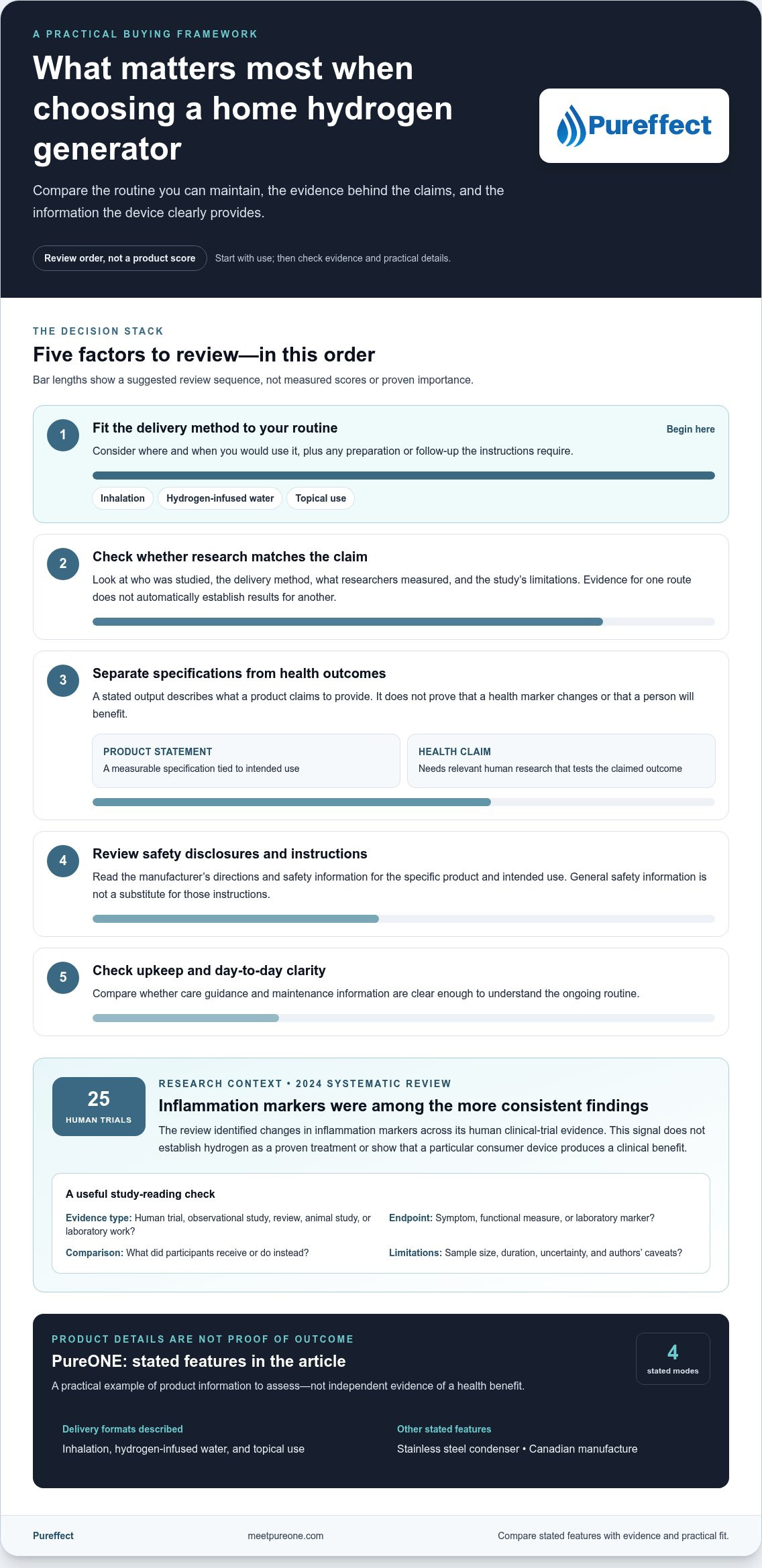
The research deserves the same careful look. A 2024 systematic review of 25 human clinical trials identified changes in inflammation markers among the more consistent findings. That signal doesn’t establish hydrogen as a proven treatment or confirm that a particular consumer device will produce a clinical benefit. Promising findings are a reason to ask better questions, not to skip them.
This guide will help you compare delivery methods, assess research quality, review safety information, and consider the upkeep and everyday routine involved. We’ll also use PureONE as a practical example: its four modes span inhalation, hydrogen-infused water, and topical use. The goal is a choice grounded in what a device states, what research actually shows, and what feels workable for you.
Key Takeaways
- To decide how to choose a home hydrogen generator, start with your intended delivery method and the routine you can realistically maintain.
- Assess human research by looking at who was studied, what they used, what researchers measured, and the study’s limitations.
- Compare products using clear safety disclosures, manufacturer instructions, and practical maintenance guidance, not wellness claims alone.
- Use device specifications to understand what a product states it delivers, not as proof of a specific health outcome.
- PureONE’s stated features include a stainless steel condenser, Canadian manufacture, and four modes for different home-use routines.
What Should You Look for in a Home Hydrogen Generator?
Product pages can mix practical specifications with broad wellness promises. Start with a more useful question: how do you plan to use the device, and does the product information explain that routine clearly? That’s the heart of how to choose a home hydrogen generator without treating confident marketing as evidence.
A home molecular hydrogen generator is a consumer wellness device designed to provide hydrogen for inhalation, hydrogen-infused water, or topical application. It isn’t a diagnostic tool and shouldn’t be mistaken for a proven medical treatment. The format and the claims made for it are separate questions.
Which home-use delivery method fits your routine?
Inhalation means using a device to breathe hydrogen gas; hydrogen-infused water is made for drinking; topical use applies hydrogen to the skin. Each involves different steps. Consider where you would use it, when it would fit into your day, and what preparation or follow-up the instructions require. Don’t assume one method is more effective than another without comparative research that directly evaluates those methods.
A device offering several formats may provide flexibility, but more options aren’t automatically better. Start with the use you can explain clearly and imagine maintaining. If you’re comparing a multi-mode device with one designed for a single format, weigh the flexibility against which mode you’re most likely to use.
How to separate a device specification from a health claim
Look for measurable details tied to the intended use, such as a stated gas composition or the amount of hydrogen delivered in water. Those describe a product’s claimed output. They don’t show that hydrogen reaches a particular tissue, changes a health marker, or produces a personal benefit. A proposed mechanism is an explanation for how an effect might occur; a research finding is an outcome observed in a study; a proven treatment requires a much stronger body of relevant evidence.
Put product statements into two columns: what can be measured, and what health outcome is being suggested. A measurable specification can be checked against a defined test or measurement. A health claim needs human research that matches the delivery method, population, and outcome being claimed. Be cautious when promotional wording leaps from a plausible idea to a promise of results.
Safety information belongs in the same practical review. Hydrogen’s flammability and handling considerations are summarized in this Hydrogen safety overview, but general information isn’t a substitute for the device’s instructions. Read the manufacturer’s directions and safety disclosures for the specific product and intended use.
How to Judge Hydrogen Research Before You Buy
A paper can be peer-reviewed and still have limits that matter to your decision. Look past its title and headline result. Ask whether the study was designed to test the claim you care about, how outcomes were measured, and whether the findings are precise enough to be meaningful. These details help distinguish a promising research question from evidence that supports a particular product or routine.
A practical checklist for evaluating medical studies
Read the abstract, then check the methods and limitations. A review gathers findings from earlier papers; it doesn’t test a device directly. A human study may be more relevant to consumer use than laboratory or animal research, but its design and scope still matter. For example, the 2024 systematic review mentioned above covered 25 human clinical trials and identified changes in inflammation markers among the more consistent findings. It does not, by itself, show that a specific home generator produces a clinical benefit.
- Identify the evidence type. Is it a human trial, observational research, a review, an animal study, or laboratory work?
- Check the endpoint. Was the measured outcome a symptom, a functional measure, or a laboratory marker? Does it answer the question you’re asking?
- Look at the comparison. What did participants receive or do instead, and were the groups comparable?
- Read beyond the headline. Note the sample size, duration, reported uncertainty, and limitations. See whether the authors distinguish their findings from conclusions that need further testing.
What early findings can, and can’t, tell you
Early research can help identify questions worth testing, but a result from a particular population or intervention may not apply to a different group, dose, or delivery route. For instance, research involving hydrogen-infused water doesn’t directly establish what inhalation or topical use may do. Even a favorable measured outcome needs interpretation in light of the study design and whether other research reaches a similar result.
Evidence summary: A study reports what researchers observed under specific conditions. On its own, it cannot establish that the same outcome will occur for every person or with a different consumer device.
For foundational context on molecular hydrogen, the companion article What is Molecular Hydrogen? The Science of Cellular Health in 2026 explores the broader science. When assessing a product, keep research evidence separate from manufacturer specifications. You can review the PureONE Molecular Hydrogen Generator details as one example of product information, not as independent proof of a health outcome.
How to Compare Home Hydrogen Generators for Safety and Everyday Use
A useful comparison looks beyond headline claims. Check whether the intended use, instructions, care guidance, and safety disclosures are clear enough to help you understand how the device fits into your home. Then keep two questions separate: does the routine work for you, and does relevant research support the outcome you’re interested in? Convenience and customer testimonials can describe user experience, but they don’t establish a health benefit.
Questions to ask about intended use and instructions
Read the manufacturer’s instructions as carefully as the product description. They should explain the intended use and operating routine in plain language. Compare that use with the intervention in relevant studies. If the research involved drinking hydrogen-infused water, for example, it doesn’t automatically establish results for inhalation. Clear disclosures help you understand the product; they don’t replace evidence about outcomes.
| Delivery method | Routine to consider | Relevant evidence | Information to review |
|---|---|---|---|
| Inhalation | Where and when would you use it? | Research using the same route and a relevant population | Intended use, operating instructions, and safety disclosures |
| Hydrogen-infused water | Would preparation and drinking fit your day? | Studies testing water, with outcomes relevant to your question | Use directions, care guidance, and any stated output details |
| Topical application | Would this fit an existing skin-care routine? | Research that specifically examines topical use | Application instructions and product-care information |
How to assess routine, maintenance, and transparency
Think through the routine, not just the feature list. Consider how often you’d use each stated mode, the time involved, and whether the instructions make the steps easy to follow. Review the care guidance and any replacement-part information provided, but don’t assume a maintenance schedule that the manufacturer hasn’t specified. For a focused look at inhalation and water formats, see Hydrogen Inhalation Machine vs. Water Bottle: Which Is Right for You?
Practical fit isn’t proof of clinical value. If you’re pregnant, managing a health condition, taking medication, or considering a wellness device alongside medical care, discuss its use with a qualified healthcare professional. Don’t use a device as a substitute for prescribed treatment. These checks make the decision more grounded. To review one example’s stated features and uses, explore the PureONE generator.
Is PureONE a Fit for Your Home Hydrogen Routine?
After weighing product information against your intended use, ask a practical question: does the device fit the way you expect to use it at home? PureONE offers four modes spanning inhalation, hydrogen-infused water, and topical use. If you prefer setting aside a dedicated time for inhalation, consider whether that feels workable in your day. If you’re drawn to water or topical use, think about how those would fit alongside habits you already have.
Which stated PureONE features may suit different routines?
PureONE’s product information describes a proprietary stainless steel condenser and a consistent gas mixture of 66% molecular hydrogen and 33% oxygen. The unit is manufactured in Canada. These details help explain what the product states about its construction and output, but they don’t establish a health outcome.
Keep that distinction in mind when weighing public-figure endorsements or testimonials, too. They may share personal experiences, but they aren’t independent evidence of clinical efficacy. Research is most useful when its participants, delivery method, and measured outcome relate to the question you’re asking. For example, findings about athletic recovery shouldn’t be taken as proof of an effect on an unrelated condition.
What to consider before making a decision
Before deciding, check whether the product’s intended use and instructions align with your priorities. Consider these questions:
- Evidence relevance: Does research address the use format and outcome you care about?
- Transparency: Are the product’s stated details and instructions clear?
- Everyday fit: Can you see yourself using the device as directed and following its care guidance?
Pureffect offers a 365-day risk-free trial. Review the current terms so you understand the details before relying on that offer.
If PureONE’s stated features fit your priorities, explore PureONE’s product details at your own pace. A thoughtful choice is one that feels practical and is based on clear expectations, not a promise of a medical outcome.
Make Your Next Step a Thoughtful One
Before choosing, write down what you want a home device to add to your routine and what would make it practical to keep using. That gives you a personal benchmark beyond polished claims. If your expectations depend on a specific health outcome, pause and consider whether the available evidence actually supports it. A device can be convenient and clearly described without being a proven treatment.
That’s a grounded way to approach how to choose a home hydrogen generator: match your priorities with transparent product information, keep expectations realistic, and make the decision at your own pace. You don’t need to resolve every scientific question before comparing options. You do need to know what you’re choosing and why it fits your life.
Ready to compare the product’s stated modes and features with your routine? Explore the PureONE Molecular Hydrogen Generator and review its details before deciding.
Frequently Asked Questions
How do I choose the right hydrogen generator for home use?
Start with the format you’re most likely to use, then compare its instructions and stated output with your needs. To decide how to choose a home hydrogen generator, picture an ordinary week: would you make time to inhale hydrogen, drink hydrogen-infused water, or use a topical mode? Consider how the device fits your space and habits, too. A long list of modes matters less than a routine you can follow comfortably.
Are home hydrogen generators supported by scientific research?
Research on molecular hydrogen is ongoing, so judge support claim by claim. Check whether a paper studied the same delivery method, a comparable population, and an outcome that matters to you. Also look at the comparison group and the authors’ stated limitations. A positive result in one narrowly defined study can help shape future research, but it doesn’t by itself show that a home device will produce the same effect.
Is hydrogen inhalation the same as drinking hydrogen-infused water?
No. They deliver hydrogen through different routes, so findings from one format can’t automatically be applied to the other. For example, a study measuring outcomes after participants drank hydrogen-infused water doesn’t establish what happens with inhalation. Compare the actual intervention in a study with the use method you’re considering. This distinction also matters when product materials describe several modes: each is a separate use format, not interchangeable evidence.
What does a 66% hydrogen and 33% oxygen mixture mean?
It describes the stated proportions of molecular hydrogen and oxygen in the gas mixture produced by the device. It isn’t a measure of hydrogen dissolved in water, a daily dose, or a prediction of how the body will respond. To understand what the figure means for use, consider it alongside instructions describing the intended mode. The mixture specification alone doesn’t establish a health effect or show that a condition will improve.
Can a home hydrogen generator treat inflammation or a medical condition?
No home hydrogen generator should be relied on to diagnose, treat, or cure a medical condition. Research findings about inflammation markers are not the same as proof that a device treats inflammation or improves a disease. If you’re considering a wellness device while taking medication, receiving treatment, or managing a health condition, discuss it with a qualified healthcare professional. Don’t stop or change prescribed care based on product claims or testimonials.
What should I check before buying a hydrogen generator?
Read the intended-use instructions and safety disclosures, and look for clear guidance on operating and caring for the device. Check whether the product explains its stated output and whether any research cited matches the use format you plan to follow. Consider practical details, too: where you’ll use it, the steps involved, and any care or replacement-part information provided. These checks help you compare products without treating convenience or endorsements as clinical proof.
Disclaimer
The information provided by Pureffect and any of its products are for educational and informational purposes only and is not intended as medical advice. Individual results may vary, and no specific health outcomes are guaranteed. Always consult a qualified healthcare professional before starting any wellness practice or product.