
A longer, healthier life is shaped by everyday habits, not one secret fix. Practical longevity strategies for a healthier life include regular movement: according to the U.S. Department of Health and Human Services, adults should get at least 150 minutes of moderate activity a week and do muscle-strengthening activities on two or more days per week. These habits support healthy aging, while reducing fall risks helps protect independence as the years pass.
It’s natural to wonder whether small daily choices can make a difference. They can add up, especially when they’re realistic enough to maintain. This guide covers what research and public-health recommendations say about exercise, plant-forward eating, sleep routines that support your body clock, and practical ways to prevent falls. These habits work together as a flexible approach, not a rigid formula, to support your health over time.
Key Takeaways
- Build activity into your routine with aerobic movement and strength work, choosing options you can keep up over time.
- Use Blue Zones food traditions as inspiration: make plants the foundation of meals and favor minimally processed choices.
- Support your body clock with a steady sleep schedule and habits that make winding down easier.
- Reduce fall risks by noticing hazards at home and making balance, strength, and safe movement part of healthy aging.
- Think of longevity as a collection of practical habits, not a single food, routine, or wellness tool.
1. Does exercise increase life expectancy?
Regular exercise is linked with better health and may help people live longer. It supports cardiovascular fitness, strength, balance, and mental well-being, while inactivity can make everyday tasks harder. People born in the United States in 2022 could expect to live 77.5 years, according to the National Center for Health Statistics. That figure describes a population average, not a personal forecast or a guarantee that exercise adds a specific number of years.
For a practical weekly target, the U.S. Department of Health and Human Services recommends that adults get at least 150 minutes of moderate activity weekly. Brisk walking, cycling on level ground, and dancing are examples that can raise your breathing while still allowing conversation. The same guidelines recommend muscle-strengthening activities on two or more days per week. Try body-weight squats, resistance bands, or lifting groceries safely, adjusting the effort to your ability.
A study of 6,200 men and women found that adopting four healthy behaviors was associated with an 80 percent lower chance of death from all causes over eight years. This finding concerns a combination of habits, not exercise alone, so it shouldn’t be read as proof that one workout guarantees longer life. Still, it shows why physical activity works best alongside other health-supporting choices.
Smoking damages the lungs and coronary arteries and is associated with cancer and stroke. Quitting ends ongoing exposure to tobacco smoke. Alcohol can also affect health, and vaping exposes the body to substances that may harm the lungs. Avoiding smoking and vaping is a practical way to reduce these risks.
Blood pressure, cholesterol, and blood sugar matter because persistently high levels can strain blood vessels and organs. Monitor them through routine medical care, then focus on relevant factors such as physical activity, food choices, medication use, and existing conditions.
Supplements marketed for longevity may help address a documented nutrient shortfall, but they aren’t proven substitutes for exercise or medical treatment. They can cause side effects or interact with prescription medicines, so review their ingredients alongside your current medications with a pharmacist.
2. What foods do people in Blue Zones eat?
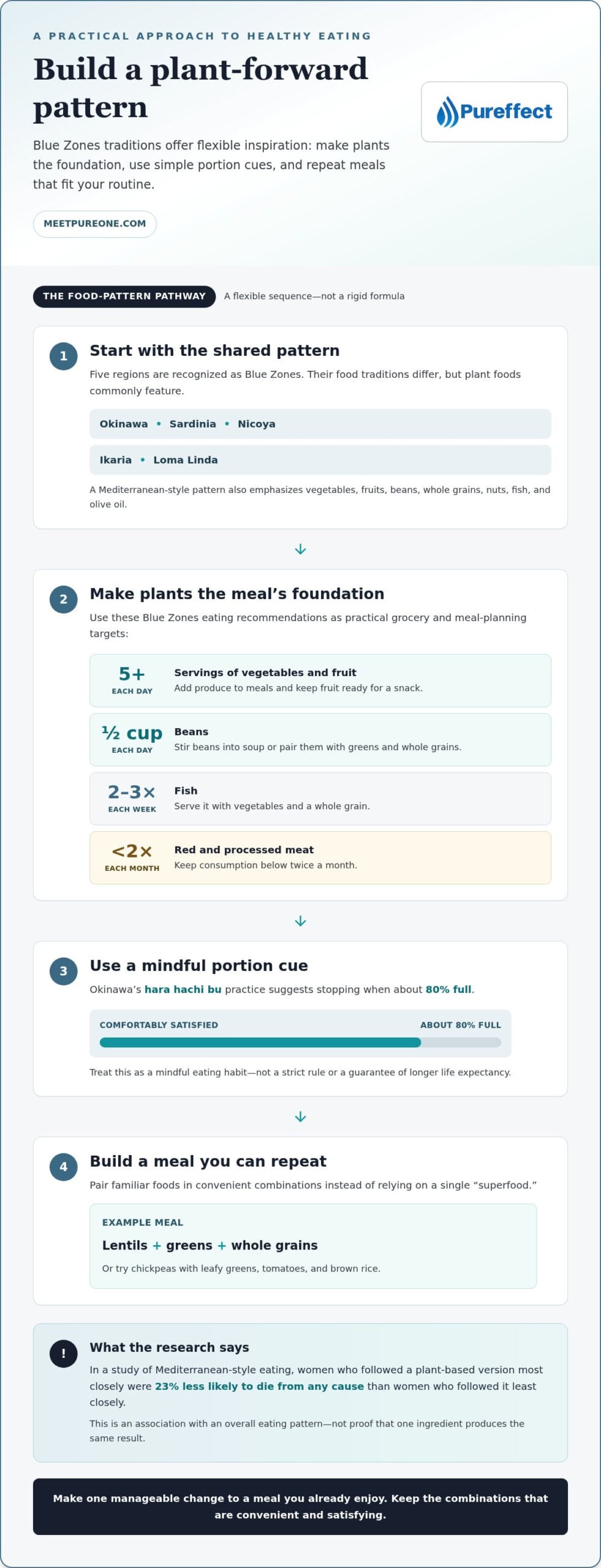
Plant-forward eating patterns are associated with longer life and a lower risk of chronic disease. A Mediterranean-style pattern emphasizes vegetables, fruits, beans, whole grains, nuts, fish, and olive oil. You don’t need to become vegetarian or give up every dessert. Making minimally processed plant foods the foundation of meals is one of several longevity strategies for a healthier life.
Five regions are recognized as Blue Zones: Okinawa, Sardinia, Nicoya, Ikaria, and Loma Linda. Their food traditions differ, but beans, vegetables, fruits, and other plant foods commonly feature. Okinawa’s hara hachi bu practice offers a portion cue: stop eating when about 80% full. Treat it as a mindful eating habit, not a strict rule or a guarantee of longer life expectancy.
A study of Mediterranean-style eating found that women who followed a plant-based version most closely were 23% less likely to die from any cause than women who followed it least closely. This association concerns an overall pattern, not a single ingredient. At home, borrow the pattern by pairing lentils with greens and whole grains, or adding olive oil to a vegetable-based meal.
Blue Zones eating recommendations suggest practical targets: five or more daily servings of vegetables and fruit, plus one-half cup of beans each day. Include fish two to three times a week, and limit red and processed meat to less than twice a month. Use these targets to guide grocery choices: add beans to soup, keep fruit ready for a snack, or choose a vegetable side with a familiar meal.
Nutrient-dense combinations can make meals more satisfying and help support muscle maintenance as people age. Try chickpeas with leafy greens, tomatoes, and brown rice, or serve fish with vegetables and a whole grain. Varying ingredients adds different flavors and nutrients to meals, and is more useful than expecting a single “superfood” to do all the work.
Food choices support health alongside other factors, including activity and medical care. For a simple weekly experiment, adjust a meal you already enjoy: add beans, vegetables, fruit, or a whole grain without overhauling your menu. Notice which combinations are convenient and satisfying, then repeat them. A sustainable pattern is easier to maintain than a rigid plan that doesn’t fit your routine.
3. Sleep quality and circadian rhythm
Sleep supports daytime alertness, recovery, and regular body rhythms. Your circadian rhythm is the body’s day-night timing system, shaped by cues such as light and daily routines. Set a consistent wake time, then choose a bedtime that leaves enough time for rest. This rhythm is one of several longevity strategies for a healthier life, not a complicated protocol that requires perfect nights.
Most adults should aim for 7 to 9 hours of sleep each night. Adults aged 65 and older need 7 to 8 hours nightly. Quality matters alongside duration. Repeated waking, trouble falling asleep, or waking unrefreshed can make time in bed less restorative. For one week, record bedtime, wake time, and nighttime interruptions. The log can help reveal patterns, such as a late activity before restless nights.
Very short sleep deserves attention. Sleeping for less than 5 hours a night may increase a person’s chance of dying early. A study assessing healthy sleep patterns and mortality risk included 172,321 adults. Another study found that people who napped regularly were 37% less likely to die from heart disease than those who rarely napped. These findings show associations, not proof that naps cause longer life.
Light helps anchor sleep timing. Get at least 30 minutes of bright daylight exposure every day, ideally early enough to reinforce a daytime signal. In the evening, dim lights and avoid screens for 60 minutes before bed. Choose a simple wind-down activity, such as reading a paper book or preparing clothes for tomorrow. Repeating those steps can make the transition from activity to rest feel more familiar.
Notice what disrupts your sleep. Late caffeine, heavy meals close to bedtime, and alcohol near bedtime can make it harder to fall asleep or stay asleep. Smoking affects health and can become part of a disruptive evening routine, so avoid using nicotine to unwind. If you nap, try doing so earlier in the day and notice whether it delays bedtime.
Sleep gives the body time to recover from daily movement and muscle-strengthening activity. If you wake tired despite allowing enough time for rest, consider possible factors such as pain, medication effects, or a sleep disorder. Record when the problem occurs and how it affects your day. Reviewing the pattern with a medical professional can help identify a useful next step within your longevity strategies for a healthier life.
4. Fall prevention and healthy aging
Falls can change how safely someone moves through daily life. Falls can be a concern for older adults and may affect safety and independence. A fall may lead to injury, reduced confidence, or less activity, so prevention is about protecting independence, not avoiding movement. Notice when you feel unsteady, and tell a healthcare professional about falls or near-falls.
Start at home by removing common trip hazards. Clear walkways, secure loose rugs, keep frequently used items within easy reach, and add lighting along stairs and nighttime routes. Use stair handrails and grab bars where you need support. Wear securely fitting shoes indoors instead of walking in socks on smooth floors.
Balance, leg strength, and safe movement work together. Try standing from a sturdy chair, walking heel to toe beside a counter, or practicing gentle weight shifts with support nearby. A 30-minute walk can build routine and confidence, while balance exercises help you practice control. Choose a pace that feels moderate, and use stable support if standing exercises feel difficult.
Review health factors that can affect steadiness. Changes in vision, foot pain, dizziness, or a condition that affects movement may make familiar tasks harder. Some medicines can also cause drowsiness or lightheadedness. If a parent takes four or more prescriptions, ask a pharmacist about medication timing. Keep a record of symptoms and when they occur to support a focused medical review.
Social connection and stress management also shape healthy aging. Frequent social activity was linked with significantly longer survival in a study of 28,000 people. Loneliness has been compared with smoking 15 cigarettes a day in terms of health risk. Make plans with friends, join a walking group, or set a regular call with family. A calmer mind can make it easier to stay engaged with daily routines and seek help after a fall.
Food supports strength, too. Build meals around vegetables, fruits, beans, and other nutrient-dense choices, and keep water accessible during the day. These steps can’t prevent every fall, but they support the energy and physical capacity needed for everyday movement. Notice whether fear or unsteadiness has led you to avoid stairs, errands, or social visits, and share that change at a medical appointment.
Vehicle safety matters alongside fall prevention. The National Highway Traffic Safety Administration reports a 45% fatal injury risk reduction for front-seat passenger car occupants (Kahane, 2015). Seat belts and safer travel choices address a different hazard than household falls, but both help protect mobility and independence as people age.
Pureffect: PureONE Molecular Hydrogen Generator
PureONE Molecular Hydrogen Generator offers a home wellness option alongside everyday habits such as movement, nourishing meals, and consistent sleep. It lets users inhale a hydrogen-oxygen mixed gas, drink hydrogen-infused water, or apply hydrogen gas directly to the body or infused water to the skin. These uses don’t replace established healthy-aging practices or medical care, and the generator isn’t a proven way to extend lifespan.
If you’re exploring molecular hydrogen as a wellness addition, learn how PureONE’s uses could fit your routine. Keep the basics in view: sustainable health habits remain central to healthy aging. Visit meetpureone.com to learn more about PureONE.
Choose one habit to carry forward
Healthy aging isn’t a finish line or a perfect routine. It’s a series of choices you can return to, even when your schedule changes. Pick one practical step for this week, such as setting a consistent bedtime, adding a plant-based lunch, or clearing a walkway you use every day. Keep it simple enough to repeat, then build from there.
These longevity strategies for a healthier life provide a foundation, not a promise of a particular outcome. If you’re also exploring molecular hydrogen for your wellness routine, Pureffect offers the PureONE Molecular Hydrogen Generator. It can complement your interest in wellness, but it isn’t a substitute for established healthy habits or medical care.
Explore the PureONE Molecular Hydrogen Generator and decide whether it fits your approach. Small, thoughtful steps can help you keep moving toward a healthier life.
Frequently Asked Questions
What is longevity?
Longevity describes how long a person lives, while healthy longevity also considers how well they function as they age. Life expectancy is a population estimate, not a personal prediction. Consider both lifespan and healthspan: the years a person lives and the years they can maintain independence, mobility, and meaningful activities. Daily choices and medical care can influence health, though no routine controls every factor.
What foods do people in Blue Zones eat?
People in Blue Zones are commonly associated with meals centered on plants, including beans, vegetables, fruit, and whole grains. Food traditions differ across Okinawa, Sardinia, Nicoya, Ikaria, and Loma Linda, so there isn’t one shared menu. For a simple meal inspired by these patterns, combine lentils or beans with vegetables and a whole grain. Treat regional food traditions as inspiration, not a strict prescription or a promise of a particular lifespan.
What habits do people who live the longest have in common?
Long-lived populations are often associated with repeatable routines: regular movement, plant-forward meals, adequate rest, and social connection. Put those ideas into practice by walking with a neighbor, preparing beans for several meals, or setting a regular time to call someone you care about. These habits work as a pattern, not as isolated tricks. Choose routines that fit your abilities, preferences, and responsibilities, then make them easier to repeat.
Can healthy habits help protect my joints and mobility as I age?
Healthy habits can support the strength, balance, and general fitness needed for everyday tasks. For example, practice standing from a sturdy chair, take a comfortable walk, and wear supportive footwear for errands. Build activity gradually and adapt movements that cause pain. If joint symptoms limit walking, stair climbing, or dressing, discuss those specific tasks with a healthcare professional so the next steps address your needs.
Does exercise increase life expectancy?
Regular exercise is linked with health benefits and can contribute to a longer life, particularly as part of a broader pattern of healthy habits. Choose activities you can sustain, such as walking for errands, dancing, or gardening. Include strength-building movement as well as aerobic activity, and adjust the intensity to your current fitness. Exercise supports health, but it can’t guarantee a particular lifespan or replace care for medical conditions.
How does purpose actually extend life?
A sense of purpose can help people stay engaged with routines, relationships, and goals that make daily life meaningful. In a 13-year study, Japanese men with a strong sense of purpose were less likely to die from stroke, heart disease, or other causes than men who felt less sure of themselves. That finding shows an association, not proof that purpose alone causes longer life. Start with a valued role, such as mentoring or caring for a garden.
Disclaimer
The information provided by Pureffect and any of its products are for educational and informational purposes only and is not intended as medical advice. Individual results may vary, and no specific health outcomes are guaranteed. Always consult a qualified healthcare professional before starting any wellness practice or product.