
A high price alone doesn’t make a wellness purchase valuable. Justifying a high-ticket wellness purchase means weighing how well it fits your needs, whether you’ll use it, and what supports its value. The decision should make sense emotionally and practically, without pressure.
It’s reasonable to feel drawn to the person you hope to become while still wanting a clear reason to spend. Emotion can point to what matters to you, but it shouldn’t have to do all the work. A thoughtful choice connects that aspiration to everyday usefulness and value you can explain to yourself.
This article explores how identity, emotion, and perceived quality shape a major wellness decision. You’ll learn how to separate genuine value from persuasive presentation, assess the role a purchase could play in your routine, and decide whether your reasoning holds up without artificial urgency.
Key Takeaways
- Separate the wellness outcome you hope for from the product itself, then assess whether it fits your real routine and priorities.
- Look beyond premium presentation: consider whether the quality and value you perceive are supported by clear, relevant details.
- Notice the emotions behind your interest, and use them to clarify what matters rather than to rush your decision.
- Think of “high-ticket” as context-dependent; the meaningful question is whether the purchase’s cost and role make sense for you.
- Explore the PureONE Molecular Hydrogen Generator as a home wellness option if its available uses align with what you’re looking for.
Aspirational purchasing and identity investment
Justifying a high-ticket wellness purchase starts with understanding what it represents to you. It may symbolize a future identity: feeling more energetic, moving regularly, or making room for recovery. That vision can clarify your priorities, but it can also blur the line between wanting a change and believing a purchase will create it. Someone picturing themselves as a regular runner, for example, might feel drawn to equipment before building a running habit.
Separate the aspiration from the item. Write down the change you want, then describe the role the purchase would play in your actual routine. Someone hoping to feel calmer might plan quiet time after work. If the value depends on becoming a different person first, pause. The decision should fit the life you have, not only an ideal version of it.
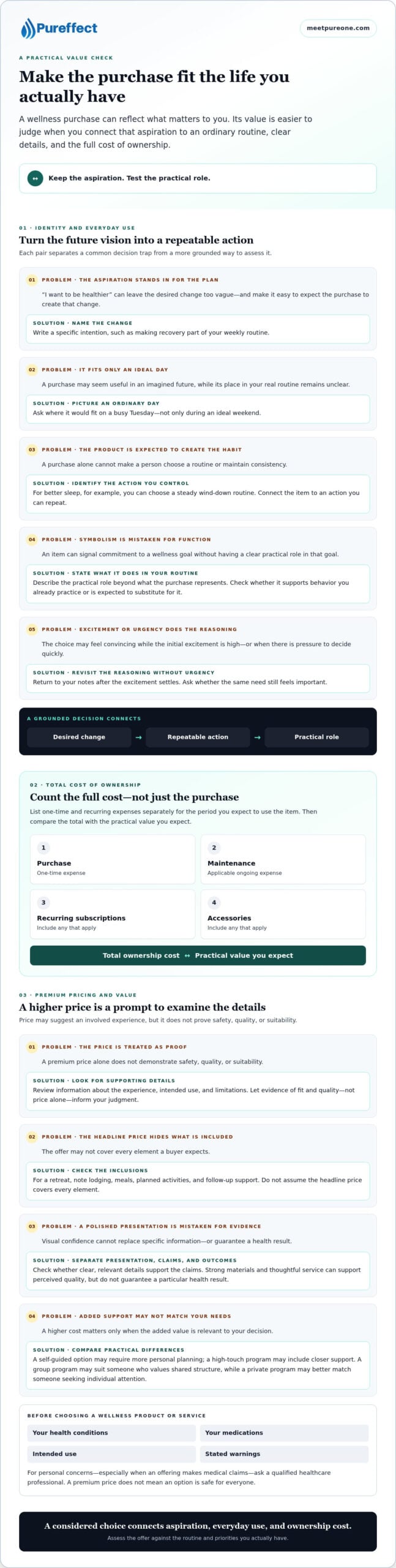
Total cost of ownership includes the purchase, applicable maintenance, recurring subscriptions, and accessories for the period you expect to use the item. List one-time and recurring expenses separately, then compare the total with the practical value you expect.
Use these checks to see whether identity is clarifying your decision or steering it:
- Name the desired change. Replace “I want to be healthier” with a specific intention, such as making recovery part of your weekly routine.
- Picture an ordinary day. Consider where the purchase would fit on a busy Tuesday, not only during an ideal weekend.
- Identify the action you control. Someone seeking better sleep can choose a steady wind-down routine; a product can’t make that choice for them.
- Separate symbolism from function. Ask what practical role the item serves beyond signaling commitment to a wellness goal.
- Test the reasoning without urgency. Revisit your notes after the initial excitement settles. Does the same need still feel important?
A practical way to justify a high-ticket wellness purchase is to connect it to an action you can repeat. Write that action in one sentence, then list the ownership costs beside it. This keeps your aspiration in view while grounding the choice in realistic use, ongoing expenses, and a routine you can maintain.
In high-ticket wellness sales, buyers may be drawn to a vision of a better future and use logic to justify a purchase. Keeping the aspiration and practical role distinct makes that reasoning easier to examine. Ask not only what the item symbolizes, but what value it offers in the routine you described.
A wellness seller may address money concerns by helping prospective buyers consider value beyond the price. The discussion can focus on expected practical value and how the purchase fits a repeatable action, rather than treating cost as the only measure. Buyers can still judge whether that broader value fits the life and routine they actually have.
Premium pricing as a signal of safety and quality
A premium price may suggest careful design or a more involved experience, but it proves neither. Price alone doesn’t demonstrate safety, quality, or suitability. Look for details that explain the experience and support the claims.
Those figures describe examples, not a universal benchmark. The right comparison depends on what the offer includes, how long it lasts, the level of support, and whether it addresses your priorities.
Lower-cost alternatives can make sense if they address the same need and fit your habits. Compare practical differences, not just price tags: a self-guided option may require more personal planning, while a high-touch program may include closer support. A higher cost matters only if the added value is relevant to your decision.
Use these checks to assess the value behind a premium price:
- Compare what’s included. For a retreat, note lodging, meals, planned activities, and follow-up support. Don’t assume the headline price covers every element.
- Look for clear claims. A polished presentation can build confidence, but it cannot replace specific information about the experience, intended use, or limitations.
- Assess fit. A group program may suit someone who values shared structure; a private program may better match someone seeking individual attention.
- Separate quality from outcome promises. Strong materials and thoughtful service can support perceived quality, but they don’t guarantee a particular health result.
Safety deserves its own review. Before choosing a wellness product or service, consider your health conditions, medications, intended use, and any stated warnings. Ask a qualified healthcare professional about personal concerns, especially if the offering makes medical claims. A premium price doesn’t mean an option is safe for everyone.
Finally, compare the seller’s presentation with the actual details. If a premium retreat promises personal attention, for example, its description should explain what that attention involves. For a home wellness device, reviewing the home wellness device information can help clarify its intended uses. Let evidence of fit and quality, not price alone, carry the decision.
One useful test is whether a brand’s visual identity and presentation support its premium price. That contrast doesn’t establish whether the service is good or poor; it’s a reason to examine how the offer is presented and whether that supports the price. Visual identity should reinforce premium positioning rather than leave you questioning the gap. Consider whether the overall presentation lends credibility to the asking price, while keeping that impression separate from proof of safety, quality, or results. A convincing appearance can reduce skepticism, but it shouldn’t replace concrete checks.
Emotional drivers behind wellness purchases
A wellness decision can start with a feeling before it becomes a practical comparison. Concern about sleep, frustration with a routine, or hope for more energy can make an offer feel especially meaningful. Imagine buying a meditation program after a stressful month. The desire for calm may be genuine, but that feeling alone can’t show whether the program suits your needs.
Emotions can help reveal what matters, but vivid promises may feel more convincing than evidence. Name the feeling, then identify the outcome you want. For example: “I feel worn down, and I want a steadier evening routine.” This separates the need from the product being promoted.
One relevant medical finding comes from a Cochrane review by Hróbjartsson and Gøtzsche. It found no major clinical effects from placebo interventions overall, though small effects appeared for patient-reported outcomes such as pain and nausea. The authors cautioned that reporting bias may influence these effects. This illustrates why expectations and felt experience matter, but doesn’t establish that a particular wellness product improves health.
What evidence supports a wellness purchase’s health benefits? Look for human studies testing the same intervention, intended use, and outcome behind its claims. A finding about one intervention doesn’t automatically support another product or health outcome. Testimonials describe individual experiences, not proof of consistent results.
In the United States, HSA or FSA reimbursement isn’t automatic for items marketed as wellness products. Eligibility depends on applicable expense rules and plan requirements, so confirm the item’s classification with your plan administrator before including reimbursement in your budget.
Marketing may heighten emotion through polished images, personal stories, or promises about becoming your “best self.” These elements can make an imagined future feel close, but they aren’t clinical evidence. A customer story about a sleep product reflects one person’s account; research must examine whether similar outcomes occur systematically.
To assess whether a wellness claim is evidence-based or exaggerated, consider:
- The exact claim. “Supports relaxation” is different from claiming to treat a diagnosed condition.
- The participants. Findings from one group may not apply to people with different health needs.
- The measured outcome. A change in a laboratory marker doesn’t necessarily mean daily life improves.
- The type of evidence. Testimonials can prompt questions, while controlled human studies test specific outcomes.
- The limitations. Study duration, comparison groups, and reporting bias affect how confidently findings can be interpreted.
Write down three things: the feeling prompting your interest, the outcome you want, and the evidence that addresses it. For example, afternoon fatigue may lead you to consider sleep habits, daily demands, or health concerns rather than assume a promoted product addresses the cause. Emotion can help frame the question. Relevant evidence helps assess the answer.
A thoughtful decision can acknowledge hope or a desire for control without treating either as proof. Match the specific health claim to appropriate research, then decide whether the available evidence and intended use make sense for you.
What counts as a high-ticket wellness purchase?
There’s no single price that makes every wellness purchase “high-ticket.” The label depends on the category, the buyer’s circumstances, and the commitment involved. Treat it as a useful reference point, not a universal rule for every device, program, or service.
Consider the difference between a recurring subscription and a substantial one-time commitment. A $20 monthly subscription is an example of a low-ticket sale, while a long-term wellness program asks for more consideration. The amount alone doesn’t tell you whether either option offers meaningful value. Scope, intended use, support, and fit all matter.
Use these questions to describe the purchase clearly:
- What are you buying? Identify whether it’s a physical product, private program, group experience, or ongoing service.
- What does the commitment cover? For a coaching program, note its format, duration, and included support.
- What is the payment structure? Separate a one-time charge from recurring payments, then consider the full commitment.
- What need does it address? A purchase aimed at supporting a daily routine differs from one built around a specific event.
- What alternatives meet the same need? Compare self-guided resources, group formats, and individual support by function, not label.
“High-ticket” can also describe a sales category rather than a precise consumer budget. These examples show why context matters, but they aren’t wellness price benchmarks.
For an individual, the better question is whether the financial commitment fits the expected use and the value you can reasonably explain. A private wellness program and a home-use product may both feel substantial, yet they solve different problems and involve different kinds of engagement. Compare like with like. Don’t let a category label make the decision for you.
Before deciding, summarize the offer in one sentence: what it is, what it includes, and how it fits your needs. Then compare that description with the alternatives you’ve considered. If a home wellness option is part of your evaluation, explore this home wellness device as one point of comparison.
Pureffect: PureONE Molecular Hydrogen Generator
The PureONE Molecular Hydrogen Generator is a home-use option to consider if molecular hydrogen fits your wellness interests and routine. It offers four therapeutic modes: drinking hydrogen-infused water, applying it to the skin, applying hydrogen gas directly to the body, and inhaling the mixed gas. This gives you different ways to use one tabletop device at home.
Think about which uses you would realistically incorporate, how they relate to your wellness priorities, and whether the available product details support your decision. A purchase makes more sense when its intended uses fit your routine, rather than relying on assumptions about results. It is designed to support overall wellness, not replace medical advice or care.
Explore the PureONE Molecular Hydrogen Generator details, then visit meetpureone.com if you’d like to learn more.
Make Your Next Wellness Choice With Confidence
The clearest way to justify a high-ticket wellness purchase is to make the decision reflect your priorities, not someone else’s ideal of better living. Give yourself room to choose deliberately. Write down what would make the purchase worthwhile in your own life, then return to that standard when marketing or excitement pulls your attention elsewhere.
That standard can guide future wellness decisions, too. It helps you stay open to options without treating every new promise as a reason to buy. If the PureONE Molecular Hydrogen Generator fits what you’re exploring, review its uses and details to decide whether it belongs in your routine.
Explore the PureONE Molecular Hydrogen Generator and keep shaping a wellness approach that feels thoughtful and genuinely yours.
Frequently Asked Questions
What is the total cost of ownership, including maintenance, subscriptions, and accessories?
Include the purchase price, applicable maintenance, recurring subscriptions, and accessories for the period you expect to use it. List one-time and recurring expenses separately; no specific total can be calculated here.
What evidence supports the health benefits of this wellness purchase?
Look for human studies testing the same intervention, intended use, and outcome behind the health claims. Testimonials describe individual experiences, not proof of consistent results.
Disclaimer
The information provided by Pureffect and any of its products are for educational and informational purposes only and is not intended as medical advice. Individual results may vary, and no specific health outcomes are guaranteed. Always consult a qualified healthcare professional before starting any wellness practice or product.