
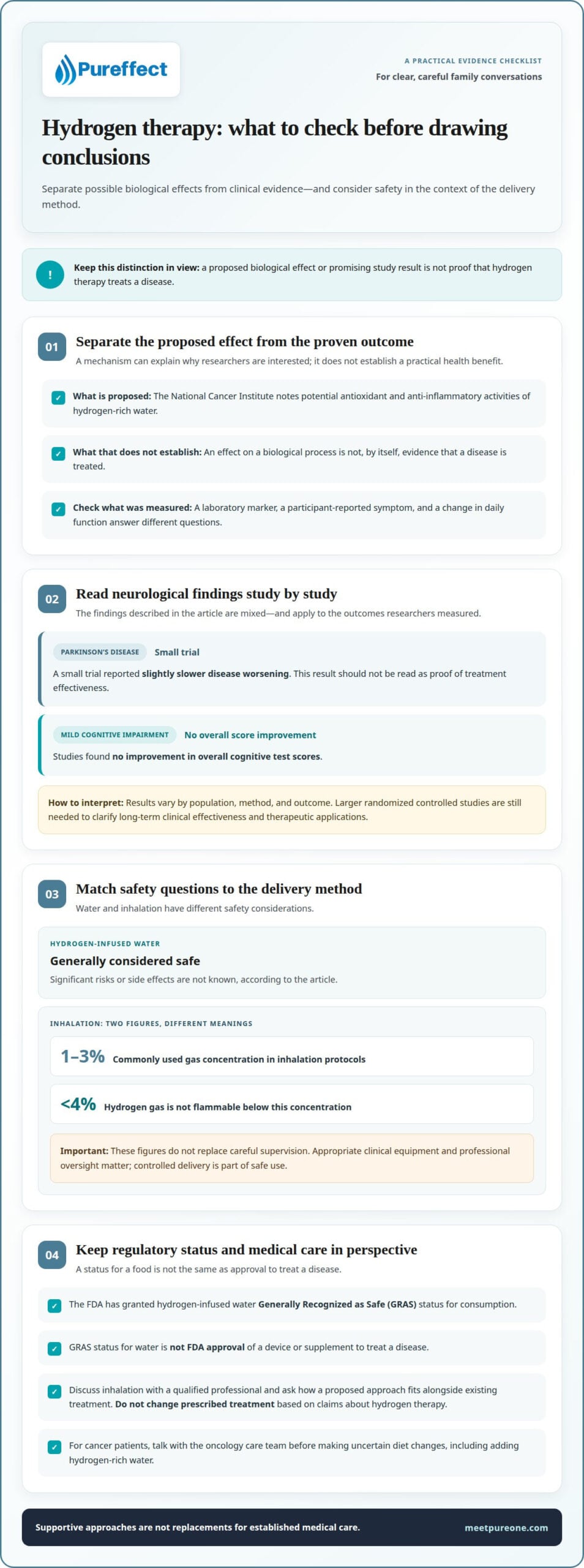
Molecular hydrogen therapy delivers H₂ through inhalation, hydrogen-infused water, or baths, and researchers are studying its possible effects on the body. According to the National Cancer Institute, hydrogen-rich water has potential antioxidant and anti-inflammatory activities. Explaining the benefits of hydrogen therapy to family members starts with a useful distinction: possible biological effects aren’t proof that it treats a disease.
It’s understandable to be curious. The idea sounds simple, but questions about what hydrogen does, which findings matter, and whether it’s safe deserve clear answers, not big promises.
This guide explains what molecular hydrogen is and how it may work, then reviews clinical findings on inflammation and brain health, including mixed results. You’ll also learn what’s known about potential side effects, why inhalation calls for professional supervision, and how to view hydrogen therapy as a supportive approach rather than a substitute for medical care. The goal is to help you discuss the topic with your family in plain language and understand what the evidence can, and can’t, say.
Key Takeaways
- Learn how molecular hydrogen can be delivered and why the method matters when considering potential effects.
- Separate proposed antioxidant and anti-inflammatory mechanisms from evidence of proven health benefits.
- Compare neurological study findings carefully: results vary by population, method, and outcome measured.
- Understand why hydrogen inhalation calls for appropriate clinical equipment and professional supervision.
- See how the PureONE Molecular Hydrogen Generator offers home use across inhalation, hydrogen-infused water, and topical applications.
Safety and clinical supervision
Safety depends on how molecular hydrogen is used. Hydrogen-infused water is generally considered safe, and significant risks or side effects are not known. Inhalation calls for more caution because hydrogen gas can become flammable at higher concentrations. The delivery method matters.
Hydrogen inhalation protocols commonly use gas concentrations of 1-3%. Hydrogen gas is not flammable at concentrations lower than 4%. Those figures don’t replace careful supervision. Appropriate clinical equipment and professional oversight matter because safe use depends on controlled delivery, not concentration alone. Avoid treating a home device as equivalent to clinical care.
For a supervised discussion, describe the method being considered, the reason for using it, and any relevant health conditions. Ask the care team how it might fit alongside existing treatment. This is especially important for inhalation, where the equipment and gas mixture affect safety. Don’t change prescribed treatment based on claims about hydrogen therapy.
Are hydrogen therapy devices or supplements FDA-approved in the United States? The FDA has granted hydrogen-infused water Generally Recognized as Safe (GRAS) status for consumption. GRAS status for water is not the same as FDA approval of a device or supplement to treat a disease.
That distinction helps keep claims in perspective. A food-safety status for hydrogen-infused water doesn’t establish that a device treats a medical condition, or that a supplement is an approved treatment. Look at what the specific status applies to, and separate it from claims about therapy or disease outcomes.
What conditions has hydrogen therapy been studied for? Research has examined neurological conditions, including Parkinson’s disease, stroke, and mild cognitive impairment. Findings vary by study and outcome. For example, a small Parkinson’s trial reported slightly slower disease worsening, while studies in people with mild cognitive impairment found no improvement in overall cognitive test scores.
For cancer patients, the practical safety step is clear: talk with the oncology care team before making uncertain changes to diet. This matters even when a change seems simple, such as adding hydrogen-rich water. The care team can consider the person’s treatment and nutrition needs together. Hydrogen therapy should not disrupt cancer care.
Hydrogen therapy is a supportive approach, not a replacement for conventional neurological treatment. That distinction is useful when explaining hydrogen therapy benefits to family: promising research and established care are not interchangeable. Larger randomized controlled studies are still needed to clarify long-term clinical effectiveness and therapeutic applications.
Frequency also varies by delivery method, treatment goals, and individual needs. A schedule used in one study doesn’t automatically apply to another person or method. Keep the intended outcome specific, and discuss it with a qualified professional before adding inhalation or changing a care plan.
Potential antioxidant and anti-inflammatory effects
Oxidation and inflammation are related biological processes, but they aren’t interchangeable. Oxidation describes chemical reactions involving electrons. Inflammation involves immune activity and changes in nearby tissue. A claim about one process doesn’t automatically establish an effect on the other. This distinction keeps discussions of molecular hydrogen focused on specific biological questions rather than broad wellness promises.
Oxidative stress describes an imbalance between reactive molecules and the systems that help manage them. Reactive molecules also have normal roles in the body, so the goal isn’t simply to eliminate them. A study might examine whether an intervention changes a marker associated with oxidative activity. That’s different from showing that a person feels better, functions differently, or experiences a change in disease course.
Inflammation also needs context. A temporary response after an injury differs from ongoing inflammation associated with a health condition. Location, cause, and duration all matter. For example, a change in a laboratory marker wouldn’t by itself tell a family whether someone’s joint discomfort had improved. Symptoms, physical function, and biological measurements answer separate questions.
When evaluating a hydrogen-related claim, look at the exact outcome researchers measured. Was it a laboratory marker, a symptom reported by participants, or an observable change in daily function? Was the finding compared with a control group? These details help distinguish a proposed mechanism from a demonstrated effect and prevent an early biological signal from being presented as proof of a practical health benefit.
Study design matters, too. Results from a small or short study may help researchers shape future questions, but they can’t establish lasting effects across different populations. The delivery method and participant group also shape what a result applies to. A finding involving one form of hydrogen exposure shouldn’t be assumed to apply to another without supporting evidence.
For a family conversation, separate three ideas: what researchers propose, what a study directly measured, and what the result could mean in everyday life. If a claim jumps from a biological process to preventing or treating a disease, ask what evidence supports that specific step. Clear distinctions make it easier to discuss potential effects without treating a mechanism as a promise.
The practical takeaway is to assess each claim according to its evidence. A proposed antioxidant or anti-inflammatory mechanism may help explain why researchers study molecular hydrogen. On its own, it doesn’t establish a useful outcome for a particular person. Keeping mechanism, measurement, and lived experience separate makes the science easier to discuss accurately.
Potential neurological and brain-health benefits
Molecular hydrogen can cross the blood-brain barrier and reach brain tissue. That access helps explain researchers’ interest, but it doesn’t show a change in brain health. A molecule reaching tissue and a person experiencing a meaningful improvement are separate questions that require different kinds of evidence.
“Brain health” can mean several things. A cognitive test may assess memory or attention, while a daily-life assessment might consider whether someone can manage familiar tasks. A change in one measure doesn’t automatically mean a change in another. For example, a result on a memory task wouldn’t by itself establish improved independence at home.
Neurological outcomes also depend on what researchers choose to measure. A study might track a specific symptom, performance on a task, or broader functioning. These measures describe different aspects of health. When sharing a claim with family, name the outcome instead of saying only that hydrogen “supports the brain.” That makes the claim clearer and easier to evaluate.
The comparison group matters, too. If participants receive an intervention, researchers need a meaningful way to interpret what changed during the study. Changes over time don’t automatically show that the intervention caused them. Study duration, participant characteristics, and the chosen measure all affect how readers should understand the result.
For families, this offers a practical way to discuss brain-health claims. Ask what was measured, who was studied, and whether the reported change reflects a test result or everyday function. For example, “attention test performance” is more precise than “sharper thinking.” A careful description keeps the conversation tied to the actual outcome instead of stretching it into a broad promise.
It also helps to separate research interest from treatment decisions. A biological explanation can make a hypothesis plausible, but it doesn’t establish that a therapy treats a neurological condition. Keep established care and supportive wellness approaches distinct, especially when discussing changes to an existing care plan.
The clearest takeaway is to judge each brain-related claim by its measured outcome and the people studied. Molecular hydrogen’s ability to reach brain tissue provides a reason for investigation, not a result by itself. Precise language lets families stay curious while avoiding conclusions that go beyond the evidence.
What molecular hydrogen therapy is
Molecular hydrogen therapy involves exposure to H₂, a small molecule made of two hydrogen atoms. Hydrogen occurs naturally in small amounts through activity by gut bacteria, and the body also gets hydrogen from food and water. Therapy refers to deliberate use of molecular hydrogen for wellness or as a supportive approach. That label doesn’t describe one standardized treatment or establish that every method has the same effect.
Hydrogen is also present in the surrounding air, but only in trace amounts: molecular hydrogen makes up 0.00005% of the air. A saturated hydrogen solution contains about 1.6 parts per million (ppm) of H₂. These figures describe different settings and units. They help explain why the amount delivered matters when interpreting a study, but concentration alone doesn’t show whether a health outcome will change.
After intake, molecular hydrogen is rapidly eliminated from the body through normal breathing. Consumed hydrogen lasts in the body about one hour. This brief presence is one reason researchers consider the timing and amount of exposure when designing studies. It also means a single exposure shouldn’t be assumed to produce a lasting effect. The biological question is what happens during exposure and what outcomes researchers measure afterward.
How strong is the evidence for hydrogen therapy compared with standard treatments? Current findings don’t establish that molecular hydrogen is as effective as standard treatments. It should be understood as a supportive approach, not a substitute for conventional neurological care.
Evidence also depends on whether a study tests a biological marker, a symptom, or a change in daily function. Those outcomes aren’t interchangeable, and results from one population don’t automatically apply to another. For example, a measured change in a laboratory result wouldn’t by itself show that a person feels better. Claims should match the outcome actually studied.
How much does hydrogen therapy cost, and is it covered by insurance? Cost depends on the format, such as equipment or hydrogen-infused water, while insurance coverage depends on the plan and intended use. These factors make it useful to distinguish a home device from a recurring consumable when considering ongoing expenses.
If you’re considering home use, a molecular hydrogen generator for home use is one equipment format. The key is to separate what a device delivers from what research has demonstrated. That distinction helps families talk about molecular hydrogen clearly, without treating a concentration, a proposed mechanism, or a product description as proof of a medical outcome.
Pureffect: PureONE Molecular Hydrogen Generator
PureONE Molecular Hydrogen Generator offers a home option for exploring molecular hydrogen. Its four therapeutic modes let users inhale hydrogen gas, drink hydrogen-infused water, or apply it directly to the skin. The device is designed to support overall wellness and reduce inflammation, but it isn’t a replacement for medical care or prescribed treatment.
Made in Canada, PureONE produces a consistent mixture of 66% molecular hydrogen and 33% oxygen. These details help families understand what the device is designed to deliver and how it fits into a personal wellness routine. For anyone considering hydrogen therapy at home, it’s a practical next step after learning about the different delivery methods and the limits of current clinical evidence.
Explore PureONE at meetpureone.com, or contact Pureffect to learn more.
Make Your Next Step a Thoughtful One
If you’re explaining hydrogen therapy benefits to family, focus the conversation on what you hope to learn, not on selling a guaranteed outcome. A useful next step is to write down questions about intended use, how it fits with existing care, and what evidence would matter to your family. This makes the discussion more personal and less driven by broad wellness claims.
Shared decisions work best when everyone can speak openly about priorities and concerns. Keep the conversation grounded in individual goals, and bring medical questions to the person’s care team. If home use is part of your exploration, Pureffect offers the PureONE Molecular Hydrogen Generator as an option to consider.
Explore the PureONE Molecular Hydrogen Generator and decide whether it fits your family’s next step. Curiosity and careful questions are a strong place to begin.
Frequently Asked Questions
How Does Molecular Hydrogen Work?
Molecular hydrogen is studied for possible antioxidant and anti-inflammatory activity. The National Cancer Institute describes these as potential activities, not established treatment effects. Hydrogen can be delivered through inhalation, infused water, or baths, and the route affects how it reaches the body. So “how it works” has two parts: its proposed biological activity and the way it’s delivered. Neither alone proves a clinical benefit.
What Are the Main Hydrogen Therapy Benefits?
Potential benefits under study include antioxidant and anti-inflammatory effects, alongside possible neurological applications. Research has examined hydrogen therapy in settings such as stroke and Parkinson’s disease, but the findings don’t establish a general benefit for everyone. The useful question isn’t simply whether hydrogen “helps,” but which effect was measured, in which group, and with which delivery method. Those details help keep family discussions specific.
Why would a gas as small and simple as hydrogen matter in medicine at all?
Molecular hydrogen can cross the blood-brain barrier and reach brain tissue, making it relevant to neurological research. Its simple structure doesn’t establish that it improves health, but helps explain why researchers are studying its biological activity. For example, a study focused on brain-related outcomes asks a different question from one examining inflammation. The molecule’s size is a research rationale, not proof of treatment effectiveness.
What is hydrogen therapy and how is it supposed to work?
Hydrogen therapy refers to using molecular hydrogen through inhalation, hydrogen-infused water, or hydrogen baths. Researchers investigate whether it may influence processes such as oxidation and inflammation. These routes aren’t interchangeable: drinking water and inhaling gas create different forms of exposure. If discussing a study with family, identify its delivery method first. That makes it easier to avoid applying a finding from one method to another.
What health benefits of hydrogen therapy are supported by clinical research?
Clinical research has explored possible effects involving inflammation and neurological outcomes, but findings vary by condition and measure. The National Cancer Institute describes potential antioxidant and anti-inflammatory activities of hydrogen-rich water. That description doesn’t establish disease prevention or treatment. To assess a claim, distinguish a measured biological effect from an improvement in symptoms or daily function. These are not the same outcome.
What are the risks and side effects of hydrogen therapy?
Hydrogen-infused water is generally considered safe, with no significant risks or side effects known. Inhalation requires greater care because hydrogen gas can become flammable at higher concentrations, making appropriate clinical equipment and professional supervision important. Cancer patients should discuss uncertain dietary changes with their care team. Anyone considering hydrogen therapy should keep it separate from prescribed treatment plans and avoid treating it as a substitute for neurological care.
Disclaimer
The information provided by Pureffect and any of its products are for educational and informational purposes only and is not intended as medical advice. Individual results may vary, and no specific health outcomes are guaranteed. Always consult a qualified healthcare professional before starting any wellness practice or product.