
Hydrogen water may support cardiovascular health, but current evidence doesn’t show that it prevents or treats heart disease. Early research suggests molecular hydrogen may have anti-inflammatory effects, while much of the available evidence comes from small studies or laboratory experiments. Larger, longer-term studies are needed to understand what these findings mean for people.
It’s reasonable to ask whether adding hydrogen to water offers a real health benefit, especially when heart health is at stake. The short answer: the science is intriguing but still developing. A promising mechanism or early result is not the same as proven protection.
Here, we’ll examine what research suggests about cardiovascular and metabolic health, where the evidence has limits, and how hydrogen-water doses used in clinical studies compare. We’ll also consider the broader question: what might molecular hydrogen contribute to heart health, and what remains unproven?
Key Takeaways
- Separate early signs of antioxidant or anti-inflammatory activity from proof that hydrogen water prevents or treats heart disease.
- Look at whether cardiovascular and metabolic findings come from human studies, animal research, or lab experiments; the evidence type shapes what conclusions are reasonable.
- Clinical studies have used different hydrogen concentrations and daily amounts, so there isn’t one established dose for heart health.
- Consider hydrogen-rich water as a wellness option, not a replacement for established cardiovascular care.
- Explore how the PureONE Molecular Hydrogen Generator fits if you’re interested in making hydrogen-infused water at home.
Hydrogen water: Does it have health benefits?
Early findings suggest possible antioxidant and anti-inflammatory effects, but they don’t establish hydrogen water as a heart-disease treatment. Ohsawa’s 2007 report helped launch research into how molecular hydrogen may affect reactive oxygen species.
Potential Antioxidant and Anti-Inflammatory Effects
An antioxidant effect means limiting some forms of cellular oxidation, while an anti-inflammatory effect involves influencing inflammatory activity. Both matter because oxidative and inflammatory processes can affect tissues, including the heart and blood vessels. The key question is whether laboratory findings translate into meaningful benefits for people.
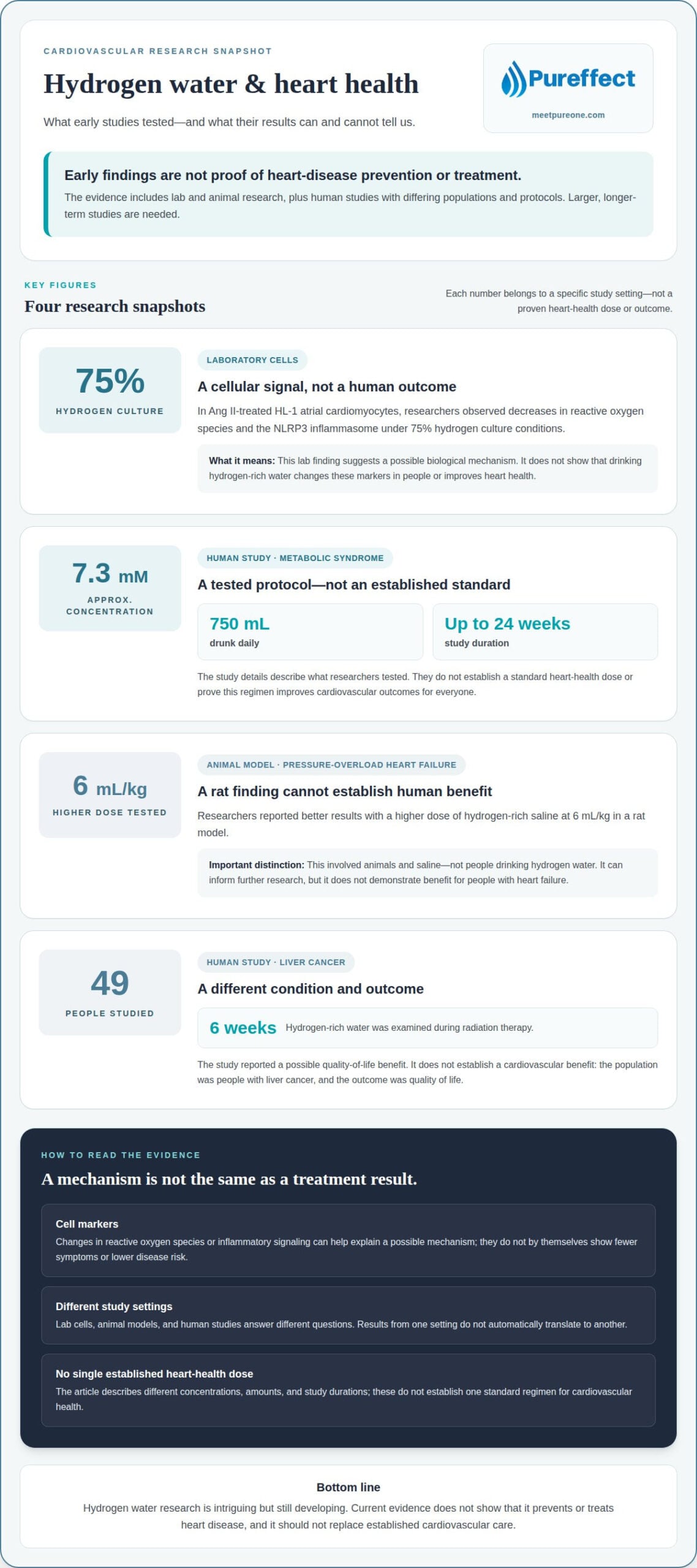
One example comes from Ang II-treated HL-1 atrial cardiomyocytes, a laboratory cell model. Researchers cultivated the cells under 75% hydrogen and observed decreases in reactive oxygen species and the NLRP3 inflammasome. NLRP3 is involved in inflammatory signaling. These results offer a possible biological explanation, but they describe cells in a lab, not a demonstrated effect in people drinking hydrogen water.
That distinction matters when weighing claims about hydrogen therapy. A change in an inflammatory marker can help researchers understand a mechanism, but it doesn’t show that symptoms, heart function, or disease risk improve. The HL-1 example points to questions for human studies, including whether drinking hydrogen-rich water produces similar changes in the body.
Oxidative Stress and Antioxidant Effects
Oxidative stress occurs when reactive molecules build up faster than the body can manage them. Reactive oxygen species also play normal roles in cell signaling, so the goal isn’t simply to eliminate them. Ohsawa’s 2007 report described molecular hydrogen as selectively reducing reactive oxygen species and oxygen free radicals.
This proposed selectivity is central to the antioxidant discussion. A broad antioxidant effect could disrupt useful signaling as well as harmful oxidation; a selective effect might behave differently. Still, the reported mechanism alone doesn’t establish that hydrogen water changes oxidative stress in humans or improves cardiovascular outcomes.
For readers, the practical takeaway is to distinguish a biological explanation from a treatment result. For example, fewer reactive oxygen species in cultured HL-1 cells aren’t equivalent to lower heart-disease risk. Human studies need to assess relevant outcomes directly, rather than relying only on cellular markers.
Nrf2 Antioxidant Signaling
Nrf2 is a cellular regulator involved in activating genes that support antioxidant defenses. When Nrf2 signaling changes, cells may adjust how they respond to oxidative stress. This pathway matters because it offers another way to study how cells maintain balance, beyond measuring reactive oxygen species alone.
In hydrogen research, Nrf2 is discussed as a possible signaling link between molecular hydrogen and cellular defenses. That mechanism is distinct from directly neutralizing reactive molecules. However, the findings provided here do not establish that hydrogen water activates Nrf2 in people or changes cardiovascular health through this pathway.
Researchers can test the idea by examining Nrf2-related activity alongside measures such as reactive oxygen species and inflammatory signaling. The Ang II-treated HL-1 cell findings offer a laboratory example of the latter measures, not proof of an Nrf2 effect. For now, Nrf2 helps frame a research question; it shouldn’t be treated as evidence that hydrogen water works as cardiovascular therapy.
Potential cardiovascular and metabolic benefits
Early findings include signals involving cholesterol, angina, artery function, and metabolic syndrome. Evidence for molecular hydrogen for cardiovascular health remains preliminary, not equivalent to evidence for established treatments or lifestyle changes. Those approaches have a different role: they address diagnosed risks and disease, while hydrogen research is still exploring possible effects.
Metabolic Syndrome and Heart Disease
Metabolic syndrome is a cluster of risk factors associated with a higher likelihood of cardiovascular disease. It matters because risks involving blood sugar, blood lipids, and other processes can combine rather than occur alone. Studying hydrogen-rich water in this context may help researchers examine specific metabolic measures, but these investigations don’t establish it as a replacement for managing cardiovascular risks.
A rat model of pressure-overload heart failure offers a separate example. Researchers reported better results with a higher hydrogen-rich saline dose of 6 mL/kg. This involved animals and saline, not people drinking hydrogen water. It can inform further research, but it doesn’t demonstrate that the same approach benefits people with heart failure.
Hydrogen-Rich Water in Metabolic Syndrome
One study used hydrogen-rich water at approximately 7.3 mM, with participants drinking 750 mL daily for up to 24 weeks. These protocol details show how researchers have tested hydrogen water in metabolic syndrome. They don’t establish a standard dose or prove that this regimen improves cardiovascular outcomes for everyone. Study duration and measured outcomes matter when interpreting the findings.
Metabolism describes how the body processes nutrients and manages energy. Lipid deposition means fat accumulation in tissues, while glycolipid metabolism concerns compounds involving fats and sugars. These processes help frame questions about metabolic health, but the findings summarized here don’t demonstrate that hydrogen-rich water changes either process in people.
A study involving 49 people with liver cancer examined hydrogen-rich water during radiation therapy for 6 weeks and reported a possible quality-of-life benefit. That cancer-treatment example doesn’t establish a cardiovascular benefit. It illustrates why researchers and readers need to connect each result to the condition, population, and outcome actually studied.
Comparing Hydrogen With Established Approaches
Research has explored possible effects on cholesterol, angina symptoms, and artery function. A small study examined high cholesterol, a major heart-disease risk factor, while other findings suggest possible changes in angina symptoms. These early signals don’t show that hydrogen water can replace established cardiovascular treatment. Interest in molecular hydrogen for cardiovascular health should be weighed against the limits of the evidence.
Prescribed treatment and lifestyle changes address known risks; hydrogen-rich water remains an area of investigation. It belongs in a different evidence category. If you’re exploring hydrogen-infused water as a wellness addition, a home molecular hydrogen generator is one way to incorporate it, without treating it as a replacement for cardiovascular care.
Hydrogen-rich water dosage in clinical studies
Human studies have examined hydrogen-rich water in metabolic syndrome and exploratory cardiovascular areas, including cholesterol, angina, and artery function. The findings summarized here don’t establish inhaled hydrogen as a cardiovascular treatment or show that it improves heart-disease outcomes.
Studies have examined hydrogen-rich water at varying concentrations. Daily amounts have ranged from 250 mL to 2 L (2,000 mL). These ranges describe study protocols, not a standard dose for patients or a proven dose for cardiovascular symptoms.
Those figures measure different things. Concentration describes the amount of dissolved molecular hydrogen in water; daily volume describes how much participants drank. A study’s dose therefore depends on both values, as well as its duration and the outcome researchers assessed. Comparing volume alone can hide meaningful differences between protocols.
Reports may use different concentration units. For hydrogen-rich water, 1 ppm is equivalent to 1 mg/L and 0.5 mM. These conversions help interpret study descriptions, but they don’t show that two products deliver the same measured concentration in a glass.
Regular water and hydrogen water also differ in what is dissolved. Each water molecule contains three atoms: one oxygen atom and two hydrogen atoms. Hydrogen-rich water contains additional molecular hydrogen, or H₂, dissolved in the water. That added gas is the feature studied, not a change to water’s basic H₂O structure.
How can consumers assess a product’s hydrogen content? Compare its stated concentration and unit with those used in clinical studies, and consider when that concentration was measured. A label’s claim alone doesn’t establish how much hydrogen is present in the water when you drink it.
Timing matters because dissolved hydrogen diffuses out fairly quickly. Hydrogen-rich water should generally be prepared immediately before consumption. A freshly prepared glass and one left standing may not have the same hydrogen content, even if they were prepared in the same way.
What have human clinical trials studied about hydrogen water or hydrogen inhalation for cardiovascular conditions? Human research has examined hydrogen-rich water in metabolic syndrome, while exploratory findings address cholesterol, angina, and artery function. These results don’t establish a reliable effect on heart-disease risk, symptoms, or cardiovascular function; the facts here provide no basis for claiming inhalation improves those outcomes.
When reading studies, consider the population, route, concentration, volume, and outcome together. For example, a result from drinking hydrogen-rich water cannot automatically be applied to inhalation. Nor does a change in one measured marker prove better heart function or establish hydrogen water as therapy.
Molecular hydrogen and general cardiovascular health
Cardiovascular health involves connected systems: the heart, blood vessels, and circulation throughout the body. In 2015, cardiovascular disease caused more than 17.7 million deaths globally, representing 31% of deaths worldwide that year.
Clinical Research on Molecular Hydrogen and Heart Health
Clinical research on molecular hydrogen and heart health remains exploratory, so it doesn’t establish a proven cardiovascular treatment. Research summaries report that molecular hydrogen can enter cells, including those in the heart and blood vessels, within minutes. That describes distribution, not a demonstrated protective effect. The distinction matters: reaching relevant tissue doesn’t by itself show that health improves.
Cardiovascular health is broader than one measurement or one organ. The heart pumps blood, while blood vessels help carry oxygen throughout the body. A proposed effect on cells therefore needs evaluation in relation to the wider circulatory system. Researchers need to connect biological observations with outcomes that matter to people, rather than treating a cellular change as proof of overall benefit.
The global figures also show why cardiovascular claims deserve careful interpretation. The 2015 death toll reflects the burden of cardiovascular disease, not the effect of molecular hydrogen. A finding from one setting cannot establish protection across different cardiovascular conditions. Study population, delivery route, and measured outcome all shape what a result can reasonably mean.
What does clinical research show about molecular hydrogen for heart health? It offers an area of investigation, but the findings described here don’t establish prevention or treatment of cardiovascular disease. Evidence must be judged by whether it demonstrates relevant health outcomes, not simply by whether a proposed biological pathway seems plausible.
Medical Organizations’ Views on Molecular Hydrogen
The findings discussed here are research observations, not clinical guidance from the American Heart Association or another medical organization. A study result and an organization’s treatment recommendation are different kinds of evidence. Discussion of molecular hydrogen in scientific research should not be interpreted as an endorsement by a medical organization.
That distinction is useful when assessing health claims. A proposed cellular effect, for example, cannot alone establish that an intervention belongs in routine cardiovascular care. Medical recommendations require evidence suited to clinical decisions, including how an intervention affects people and whether its benefits outweigh potential harms.
The practical takeaway is to keep research interest separate from established care. Molecular hydrogen may be investigated for effects relevant to cardiovascular biology, but the findings presented here don’t show that it should guide treatment decisions. Use clinical evidence, rather than a proposed mechanism or broad protective claim, to frame conversations about heart health.
Pureffect: PureONE Molecular Hydrogen Generator
PureONE Molecular Hydrogen Generator is a home-use option for people interested in exploring molecular hydrogen beyond reading about early research. It offers four modes: drinking hydrogen-infused water, inhaling hydrogen gas, and applying it to the skin. These options support different ways to incorporate hydrogen into a wellness routine, but they don’t make the device a proven treatment for cardiovascular disease.
The generator is manufactured in Canada and produces a consistent mixture of 66% molecular hydrogen and 33% oxygen. Consider it as a wellness product, not a substitute for prescribed heart care or clinical advice. If you’d like to learn more about the PureONE Molecular Hydrogen Generator, contact Pureffect for information.
Keep Your Next Step Grounded in Evidence
Curiosity about molecular hydrogen for cardiovascular health can be a starting point, not a substitute for sound decisions. As you consider any wellness practice, keep your priorities clear: understand what the evidence can and can’t tell you, and keep established heart care at the center of decisions about cardiovascular risk.
A useful next step is to focus on what matters to you, whether that’s learning about hydrogen-infused water at home or considering how a wellness device fits your routine. Pureffect offers the PureONE Molecular Hydrogen Generator for people exploring molecular hydrogen use beyond the research. It isn’t a treatment for heart disease, so keep its role distinct from medical care.
Contact Pureffect to discuss your questions about the PureONE Molecular Hydrogen Generator. Stay curious, take an evidence-minded approach, and choose the next step that feels right for you.
Frequently Asked Questions
What is Molecular Hydrogen Therapy?
Molecular hydrogen therapy refers to using hydrogen gas or hydrogen-enriched water as a wellness intervention. Delivery methods discussed in research include drinking hydrogen-rich water and inhaling hydrogen gas; some devices also apply hydrogen to the skin or body. These approaches aren’t interchangeable, since the route and dose differ. The term “therapy” describes the use, not proof that it treats a diagnosed condition or replaces medical care.
Are there any risks to drinking hydrogen water?
Hydrogen water is generally considered safe, and a review reported no significant adverse reactions to molecular hydrogen at the time it was written. That doesn’t establish that every product or situation carries no risk. The water’s source and any added ingredients matter too. If you notice an unexpected reaction after drinking it, stop using it and seek appropriate medical advice.
What is molecular hydrogen and how might it affect cardiovascular health?
Molecular hydrogen is hydrogen gas made of two bonded hydrogen atoms, written as H₂. Researchers are exploring whether it affects cellular processes relevant to blood vessels and the heart. The proposed relationship is still under study, so molecular hydrogen for cardiovascular health shouldn’t be treated as proven prevention or treatment. Distinguish a possible biological effect from evidence that people experience better heart-health outcomes.
What cardiovascular benefits and outcomes have been measured in molecular hydrogen studies?
Studies have explored outcomes such as cholesterol levels, angina symptoms, and artery function. These measures address different aspects of cardiovascular health, so one result can’t establish an overall heart benefit. A study measuring a change in cholesterol, for example, doesn’t by itself show fewer heart attacks or strokes. When reading a result, note the population studied, the hydrogen delivery method, and the specific outcome researchers measured.
What are the risks, side effects, and contraindications of molecular hydrogen therapy?
Available information describes molecular hydrogen as generally well tolerated, but it doesn’t establish safety for every person or every delivery method. Evidence about drinking hydrogen water may not answer questions about inhalation or topical use. People with complex health conditions, pregnancy, or planned procedures should consider their circumstances and product instructions before use. Don’t interpret early safety findings as proof that there are no contraindications.
Can molecular hydrogen interact with heart medications or affect blood pressure?
The findings discussed here don’t establish whether molecular hydrogen interacts with specific heart medications or reliably changes blood pressure. Interaction risk depends on the medication, dose, health condition, and hydrogen delivery method. Don’t reduce, stop, or replace prescribed treatment based on hydrogen use. If you’re considering it alongside heart medication, discuss the exact product and intended use with your healthcare professional.
Disclaimer
The information provided by Pureffect and any of its products are for educational and informational purposes only and is not intended as medical advice. Individual results may vary, and no specific health outcomes are guaranteed. Always consult a qualified healthcare professional before starting any wellness practice or product.