
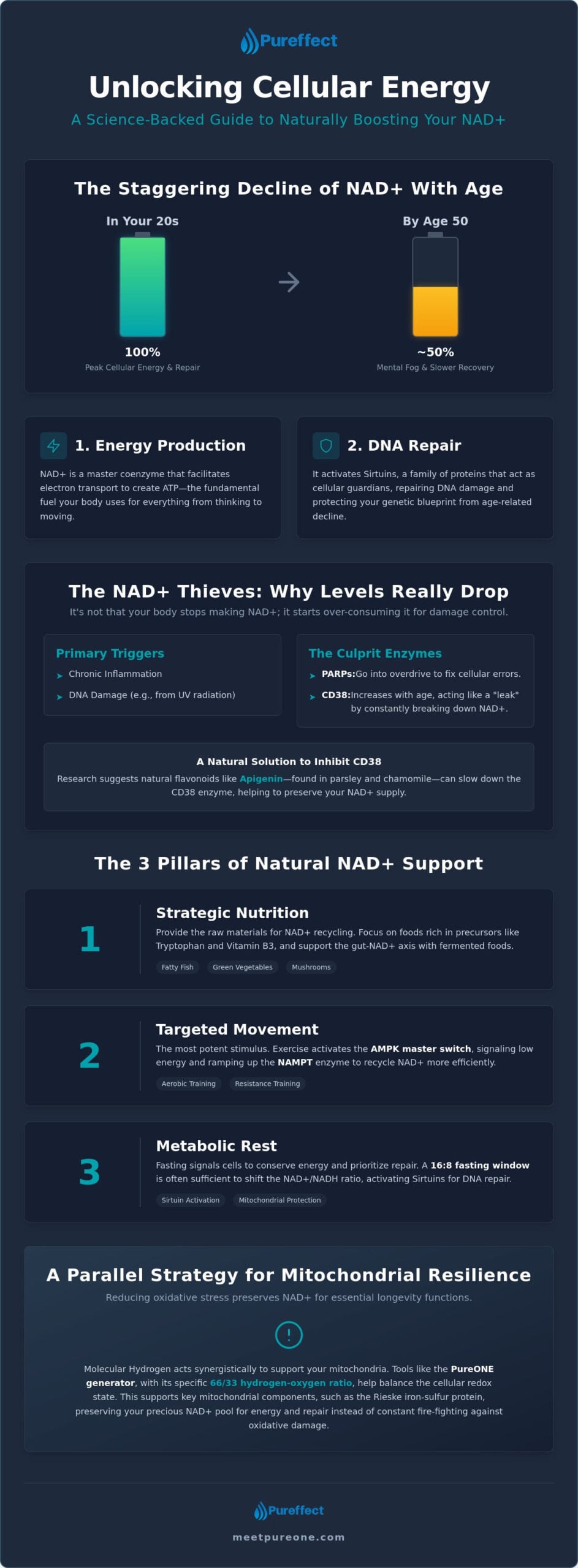
Did you know that by the time you reach 50, your body has roughly half the NAD+ levels it had in your 20s? That is a staggering drop. Ever wonder if that is why the morning fog feels thicker and your gym recovery takes longer? If you have felt frustrated by a dip in mental clarity or the high cost of unverified supplements, you aren’t alone. Many people are searching for natural ways to boost NAD+ levels because they want to feel like themselves again without the guesswork.
You deserve a strategy rooted in evidence. This guide reveals the latest 2026 scientific protocols to naturally optimize your NAD+ for enhanced energy and DNA repair. We will explore why exercise remains a top-tier stimulator for cellular metabolism. You will also learn about the December 2025 research regarding the Rieske iron-sulfur protein and how tools like the PureONE generator support cellular balance through a specific 66/33 hydrogen-oxygen ratio. This approach acts as a parallel strategy to support your mitochondria. Ready to build a science-backed protocol that actually delivers?
Key Takeaways
- Understand the dual role of NAD+ in energy production and DNA repair to see why maintaining these levels is vital for long-term cognitive health.
- Implement natural ways to boost NAD+ levels by using controlled lifestyle stressors like fasting and exercise to trigger your body’s internal recycling loops.
- Identify how chronic inflammation and overactive PARP enzymes act as a hidden drain on your cellular fuel, and learn how to plug these “leaks.”
- Discover the synergy between molecular hydrogen and mitochondrial resilience, specifically how reducing oxidative stress preserves NAD+ for essential longevity functions.
What is NAD+ and Why Does Your Body Stop Making It?
What exactly is What is Nicotinamide Adenine Dinucleotide (NAD+)? Think of it as the master molecule in your cells. It is a critical coenzyme found in every living cell. Without it, your biological engines simply stop turning. It handles two huge jobs. First, it facilitates electron transport to create ATP, which is the fuel your body uses for everything from blinking to running marathons. Second, it activates sirtuins, a family of proteins that act as cellular guardians for DNA repair. This is why finding natural ways to boost NAD+ levels is so central to modern longevity research.
But here is the catch. Your body doesn’t just stop making it; it starts over-consuming it. Research shows that humans have approximately half the NAD+ levels they had in their 20s by the time they hit age 50. Why does this happen? Meet the NAD+ thieves. These are enzymes like PARPs and CD38. When your body faces chronic inflammation or DNA damage from UV radiation, these enzymes go into overdrive. They burn through your NAD+ reserves to fix cellular errors, leaving very little left for energy production. This creates a deficit that manifests as that familiar mid-afternoon slump or brain fog.
The NAD+/NADH Ratio: Why Balance Matters
It isn’t just about the total amount of NAD+ you have. It is about the ratio. Your cells constantly flip-flop between the oxidized form (NAD+) and the reduced form (NADH). A high ratio of NAD+ to NADH is a hallmark of mitochondrial efficiency and metabolic health. It means your cells are ready to process energy effectively rather than being bogged down by metabolic waste. The redox state is the cellular currency exchange for energy. When this balance shifts toward NADH, your metabolism slows down, making natural ways to boost NAD+ levels even more important for maintaining vitality.
The CD38 Connection: Stopping the NAD+ Leak
One of the biggest culprits in age-related decline is CD38. This enzyme naturally increases as we get older, and its main job is to break down NAD+. It is essentially a leak in your cellular bucket. How do we fix it? Research suggests that certain natural flavonoids, like apigenin found in parsley and chamomile, can inhibit CD38 activity. By slowing down this thief, you can protect your existing supply from being drained. This is a foundational step in learning how to increase cellular energy and optimizing your internal environment for long-term health.
The 3 Pillars of Natural NAD+ Support: Diet, Exercise, and Fasting
How do we convince our cells to produce more fuel without relying solely on external supplements? The answer lies in hormesis. This is a biological phenomenon where brief, controlled stress triggers a protective response. In the case of NAD+, this stress activates the NAMPT enzyme. This enzyme is the rate-limiting step in the “Salvage Pathway,” which essentially recycles used NAD+ back into its active form. By leveraging natural ways to boost NAD+ levels, we aren’t just adding more fuel; we are fixing the engine’s recycling system. Synchronizing these habits with your circadian rhythm ensures that the NAMPT enzyme peaks during your most active hours, maximizing cellular efficiency.
Nutritional Precursors Beyond Supplements
Your diet provides the raw materials for this recycling. Foods rich in tryptophan and vitamin B3 (niacin) serve as foundational building blocks. A 2024 research study highlighted the gut-NAD+ axis, showing that fermented foods can influence how the microbiome supports systemic levels. To keep your levels steady, consider a grocery list focused on fatty fish like salmon, green vegetables such as broccoli, and various mushrooms. These choices help maintain a steady supply of precursors for the therapeutic potential of NAD-boosting molecules to be fully realized through your daily meals.
Physical Activity and the AMPK Pathway
Movement is perhaps the most potent stimulus we have for cellular health. When you engage in aerobic or resistance training, you activate a metabolic master switch called AMPK. This switch signals the body that energy is low, which in turn ramps up NAMPT activity. Studies have shown that consistent exercise can restore NAD+ levels in older adults to levels typical of much younger individuals. To support this process and manage the oxidative stress that comes with heavy training, many athletes integrate a hydrogen therapy daily routine into their post-exercise recovery plan.
Intermittent Fasting and Sirtuin Activation
Fasting works by signaling the cell to conserve energy and prioritize repair. When you enter a fasted state, your NAD+/NADH ratio shifts, activating sirtuins that repair DNA and protect your mitochondria. Recent metabolic studies suggest that a 16:8 fasting window is often sufficient to trigger these pathways. Research on hydrogen therapy and intermittent fasting demonstrates how these two practices can work together to shield your cells from age-related decline. For those looking to optimize this balance, a molecular hydrogen generator can be a helpful addition to a longevity-focused lifestyle.
The Hidden Drain: How Chronic Stress and Inflammation Deplete NAD+
Think of your cellular health as a bucket. Most people focus on pouring more water in, but what if your bucket is full of holes? Chronic stress and systemic inflammation are the primary culprits behind these leaks. When your body encounters environmental toxins or UV radiation, it activates PARP enzymes to repair the resulting DNA damage. These enzymes are essential, but they are also greedy. They consume massive amounts of NAD+ to do their job. If you are constantly exposed to stressors, your PARPs stay permanently active. This creates a massive deficit in your available energy pool. Understanding how to plug these leaks is one of the most effective natural ways to boost NAD+ levels without spending a fortune on precursors.
Lifestyle choices often act as silent energy leaks. For instance, metabolizing alcohol requires a significant amount of NAD+, literally pulling it away from your brain and muscles. Poor sleep hygiene does the same by disrupting your body’s natural production rhythm. According to a scientific review of NAD+ boosting strategies, reducing this background “noise” of inflammation is just as important as stimulation. By lowering systemic inflammation, you preserve your existing NAD+ pool for the things that matter, like mental clarity and physical recovery.
Oxidative Stress: The Silent NAD+ Killer
Reactive oxygen species (ROS) are unstable molecules that damage cellular structures. Every time a cell is damaged by ROS, it forces your body to use its precious NAD+ for repair instead of energy production. It is a zero-sum game. Research shows that by reducing this oxidative burden, you free up more coenzymes for your mitochondria to use. NAD+ is the fuel for repair; inflammation is the fire that consumes it. Lowering this fire allows your natural recycling pathways to catch up and function as they should.
Sleep Hygiene and the Circadian Clock
Your cells follow a strict 24-hour schedule. NAD+ production isn’t constant; it peaks and valleys based on your internal clock. The PER2 protein helps regulate the NAMPT enzyme, which we discussed in the previous section as the key to the Salvage Pathway. Blue light exposure at night tricks your brain into thinking it is daytime, throwing this delicate protein balance out of sync. To align your patterns with your cellular energy cycles, try these three steps:
- View natural sunlight within 30 minutes of waking to set your circadian clock.
- Stop using blue-light-emitting devices at least two hours before bed.
- Maintain a consistent cool temperature in your bedroom to support deep, restorative sleep phases.
Managing this oxidative drain is a full-time job for your body. To support your cells in this battle and reduce the workload on your repair enzymes, you can use a PureONE Molecular Hydrogen Generator to help neutralize harmful free radicals and protect your NAD+ reserves.
Molecular Hydrogen: The 2026 Frontier for NAD+ Optimization
Why is molecular hydrogen (H2) suddenly a staple in longevity protocols? It isn’t a direct building block like the precursors you might find in a supplement aisle. Instead, it acts as a selective antioxidant. It specifically targets the most destructive free radicals while leaving beneficial signaling molecules untouched. This is vital for natural ways to boost NAD+ levels. By neutralizing these harmful radicals, H2 significantly reduces the workload on the PARP enzymes we explored in the previous section. When your PARPs aren’t constantly burning through fuel to fix DNA damage, your body can keep its NAD+ reserves for energy and cognitive clarity.
The team at Pureffect designed the PureONE Hydrogen Generator around a specific 66/33 hydrogen-oxygen ratio. This balance is intended to support mitochondrial function where NAD+ is most active. Inhalation offers a passive way to support your body’s natural recycling loop. It doesn’t require a lifestyle overhaul. It simply provides the cellular environment your mitochondria need to stay efficient and resilient.
How H2 Influences the NAD+/NADH Ratio
Current research has pinpointed exactly how H2 interacts with our biology. A December 2025 study found that H2 targets the Rieske iron-sulfur protein (RISP) within mitochondrial Complex III. This interaction prompts a temporary suppression that activates the mitochondrial unfolded protein response (UPRmt). This pathway is a major win for cellular defense. By modulating the electron transport chain, H2 inhalation helps keep your NAD+ status in a healthy range. Beyond inhalation, drinking hydrogen-infused water is a practical tool for metabolic health. It’s especially effective when you follow a research-driven guide on how to use hydrogen water for athletic recovery to minimize post-workout oxidative stress.
Integrating PureONE into a Longevity Routine
How do you make this part of your day? It’s best used as a stack with the natural ways to boost NAD+ levels we’ve already covered. Try a hydrogen session during your intermittent fasting window to further protect your mitochondria while sirtuins are active. Or, use it after a HIIT session to dampen the inflammatory “fire” that consumes your NAD+. Because Pureffect values transparency, the 365-day risk-free trial allows you to test these scientific findings in your own life. You can explore the PureONE shop for accessories that make daily use even easier. It’s a simple, common-sense step toward a more energized version of yourself.
Take Control of Your Cellular Future
This is exactly why Pureffect developed the PureONE Hydrogen Generator. It’s a Canadian-made tool designed to support that delicate redox balance. Endorsed by longevity experts and backed by a 365-day risk-free trial, it allows you to verify the science for yourself in your own home. Why wait for the fog to lift on its own when you can support your cells today? You’ve seen the research on how molecular hydrogen acts as a parallel strategy for mitochondrial resilience.
Optimize your cellular health with the PureONE Hydrogen Generator. Your journey toward better living is a marathon, not a sprint. You have the research. You have the tools. Now, it’s time to let your cells do what they do best.
Frequently Asked Questions
Can I really boost NAD+ levels without supplements?
Yes, you can effectively use natural ways to boost NAD+ levels by leveraging your body’s internal recycling systems. High-intensity interval training and caloric restriction are proven to activate the NAMPT enzyme. This enzyme is the primary driver of the Salvage Pathway. Research suggests these biological triggers are often more efficient at maintaining cellular pools than external precursors alone because they improve the body’s overall capacity to recycle what it already has.
How long does it take to see results from natural NAD+ boosting methods?
Does coffee or caffeine affect my NAD+ levels?
Caffeine doesn’t directly consume NAD+, but its impact on your circadian clock can influence production. Research indicates that caffeine can boost NAMPT expression in certain tissues, potentially aiding the recycling process. However, if you drink it too late in the day, you risk disrupting the PER2 protein. This protein is essential for aligning your cellular energy cycles with your sleep-wake schedule to ensure peak production during the day.
Is there a specific diet that is best for NAD+ production?
A diet rich in whole foods like fatty fish, mushrooms, and green vegetables provides the necessary precursors for synthesis. Fermented foods are also a major 2024 research focus for their role in the gut-NAD+ axis. Avoiding excessive alcohol and processed sugars is equally important. These substances trigger chronic inflammation, which activates the PARP enzymes that drain your cellular fuel reserves before they can be used for energy.
What is the relationship between NAD+ and vitamin B3?
Vitamin B3 is the primary building block for NAD+ production in the human body. Whether it comes from niacin, nicotinamide, or more complex precursors, your body converts these B3 forms into the active coenzyme. This is why natural ways to boost NAD+ levels often focus on B3-rich foods like poultry and legumes. It’s the raw material your cells need to keep the energy production line moving efficiently.
How does molecular hydrogen specifically help with NAD+ recycling?
Molecular hydrogen helps by acting as a selective antioxidant that reduces the workload on your repair enzymes. When H2 neutralizes harmful free radicals, it prevents the overactivation of PARP enzymes. This “frees up” the existing NAD+ pool so it can be used for energy rather than constant DNA repair. It essentially acts as a shield for your cellular currency, ensuring more of it stays in the recycling loop for daily vitality.
Disclaimer
The information provided by Pureffect and any of its products are for educational and informational purposes only and is not intended as medical advice. Individual results may vary, and no specific health outcomes are guaranteed. Always consult a qualified healthcare professional before starting any wellness practice or product.