
What if your post-workout routine was smart enough to distinguish between the “good” stress that builds muscle and the “bad” oxidative damage that causes pain? Most of us have accepted lingering muscle soreness and the mid-workout “burn” as inevitable parts of training. It is frustrating when your progress stalls because your body simply cannot keep up with your ambition. If you have noticed that recovery takes longer than it used to, you are certainly not alone.
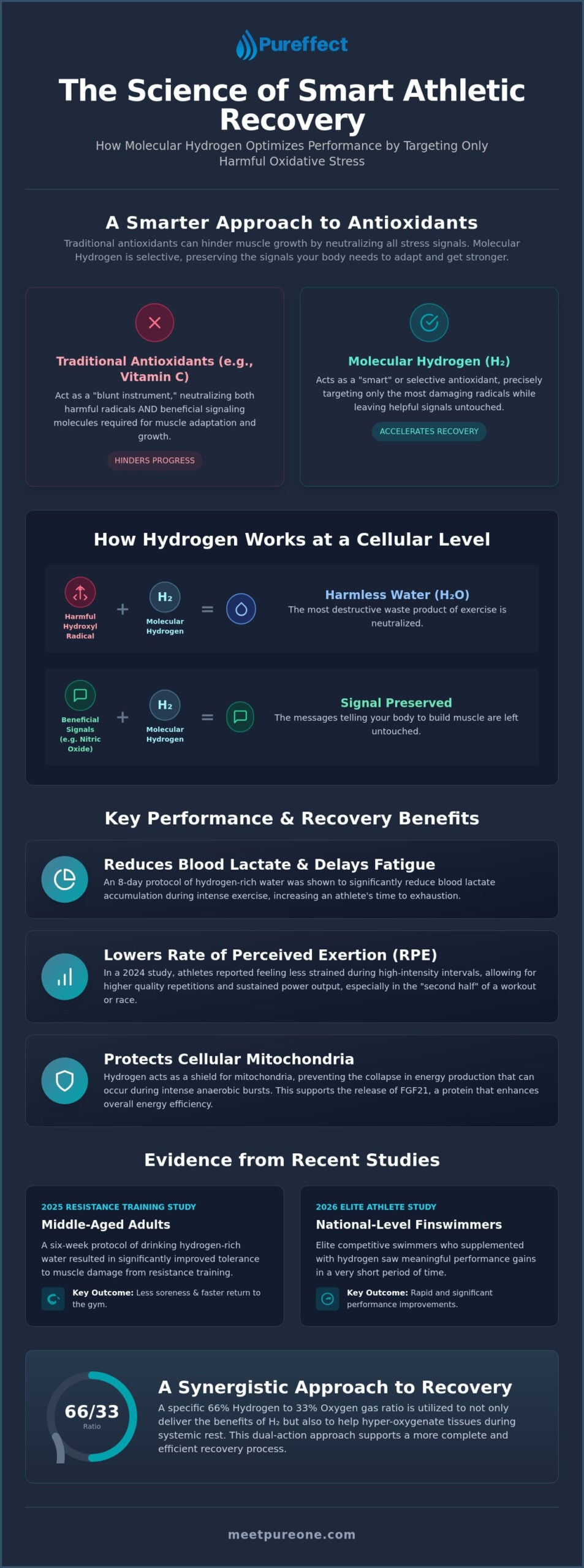
Using hydrogen water for athletic recovery is changing how we look at downtime. Unlike traditional antioxidants that can sometimes blunt your training adaptations, molecular hydrogen is selective. It targets only the most cytotoxic radicals. A 2025 study on middle-aged adults found that drinking hydrogen-rich water for six weeks significantly improved their ability to tolerate muscle damage from resistance training. This means less soreness and a faster return to the gym without the usual “day-after” struggle.
In this guide, we will dive into the latest research, including a 2026 study on national-level finswimmers who saw meaningful performance gains in a very short time. You will learn how to use this tool to reduce your perceived exertion and lower your downtime. Ready to see what the science says about accelerating your peak performance? Let’s look at the data.
Key Takeaways
- Discover why molecular hydrogen is a “smart” antioxidant that preserves the natural signals your body needs to build muscle and adapt.
- See the data on how an 8-day protocol can lower blood lactate levels and help you train longer before hitting fatigue.
- Learn the optimal timing and “loading phase” for hydrogen water for athletic recovery to ensure the gas is present when your cells need it most.
- Explore how a specific 66/33 hydrogen-oxygen ratio helps oxygenate your tissues during systemic rest for a more complete recovery.
The Science of Selective Antioxidants: Why Hydrogen is Different for Athletes
Most athletes reach for high-dose Vitamin C or E to fight soreness. It seems logical. But did you know that sweeping away all oxidative stress can actually hinder your progress? Your body needs specific stress signals to trigger muscle growth and strength adaptations. This is where hydrogen water for athletic recovery stands apart from traditional supplements. It acts as a selective antioxidant, meaning it only targets the most aggressive, damaging free radicals while leaving your body’s beneficial signaling molecules untouched.
Preserving Muscle Adaptation Signals
Why is some oxidative stress actually a good thing? Think of it as a messenger. When you train hard, your body produces reactive oxygen species (ROS) that tell your cells to get stronger. If you neutralize these with blunt-force antioxidants, you might accidentally “mute” the message for growth. Molecular hydrogen is unique because it ignores helpful molecules like nitric oxide, which is essential for blood flow and muscle repair. This makes hydrogen superior to Vitamin C for post-workout recovery because it reduces oxidative stress without blocking the biological pathways that lead to increased strength and endurance.
Neutralizing the Hydroxyl Radical
While some radicals are helpful, the hydroxyl radical is purely destructive. It’s the primary culprit behind cellular damage and lingering fatigue during peak exertion. When you use the science of molecular hydrogen, you are introducing a tiny molecule that can penetrate deep into your cells and mitochondria. Once there, it seeks out hydroxyl radicals and converts them into simple water (H2O). This process effectively “washes away” the most toxic waste products of exercise.
It helps maintain homeostatic balance during high-intensity training, allowing you to push harder without the typical cellular fallout. By focusing only on the “bad” radicals, you ensure that your recovery is both fast and productive. This “smart” approach to recovery is why so many people are moving away from traditional supplements and toward molecular hydrogen. It’s about working with your body’s natural biology, not against it.
Research Findings: Managing Muscle Fatigue and Blood Lactate
Have you ever felt that heavy, leaden sensation in your legs during the final stretch of a run? That is the accumulation of blood lactate. While lactate itself is a fuel source, its buildup often correlates with the “burn” that eventually forces us to slow down. Recent research indicates that a consistent 8-day intake of hydrogen-rich water can significantly reduce blood lactate levels during intense exercise. This reduction is directly linked to an increased time to exhaustion. It essentially moves the goalposts of your physical limits by delaying the onset of fatigue.
The ‘Burn’ Factor: Lactate and Perceived Exertion
How we feel during a workout is often just as important as our actual heart rate. In 2024, research focused on the Rate of Perceived Exertion (RPE) found that athletes using hydrogen reported feeling less strained during high-intensity intervals. When that perceived “burn” is lower, you can maintain higher quality repetitions in resistance training rather than cutting a set short. We are seeing this play out in elite rowing and cycling circles. These athletes use hydrogen to maintain “second-half” performance, ensuring their power output doesn’t crater when the race is actually won or lost. It’s about staying sharp and powerful when your competitors are beginning to fade.
Mitochondrial Protection for Long-Term Performance
The mitochondria are the powerhouses of your cells, but they are incredibly vulnerable during anaerobic bursts. Intense training can cause a collapse in mitochondrial membrane potential, which effectively stalls your energy production. Molecular hydrogen acts as a shield for these vital structures. By leveraging its selective antioxidant properties, hydrogen prevents this collapse and supports the release of Fibroblast Growth Factor 21 (FGF21). This protein helps your body utilize energy more efficiently across the board. Supporting your mitochondria also connects directly to cellular coenzyme levels; learning about natural ways to boost NAD+ levels can further enhance the energy production your muscles depend on during and after training. If you want to dive deeper into these cellular mechanisms, check out our guide on increasing cellular energy for long-term mitochondrial health.
Consistent use of hydrogen water for athletic recovery doesn’t just help with today’s soreness. It protects the cellular machinery you need for years of consistent training. If you’re looking for a professional-grade way to support this process at home, you might want to explore the PureONE generator as a foundational part of your daily routine.
A Research-Driven Protocol for Athletic Recovery
Timing is everything when you are working with a molecule as small and fleeting as hydrogen. Because it has a short half-life, it leaves your system relatively quickly once consumed. To maximize the benefits of hydrogen water for athletic recovery, you need to time your intake to match your body’s peak stress events. It isn’t just about drinking a glass whenever you remember; it’s about strategic saturation.
While a single dose can offer some protection, the best results come from a consistent “loading phase.” Aim for 7 to 10 days of steady use to fully prime your cellular environment. This consistency builds on the 8-day research findings we previously mentioned regarding lactate management. It ensures your body is prepared for the oxidative storm that comes with high-intensity training. You can see how this fits into a broader daily cellular wellness routine to keep your recovery capacity high even on rest days.
The Pre-Workout Primer (30 Minutes Prior)
Drink approximately 16oz of high-concentration hydrogen water about 30 minutes before your workout starts. This allows the gas to circulate through your bloodstream and reach your muscle tissues before you even pick up a weight. Research on muscle fatigue indicates that having hydrogen present at the start of exercise helps mitigate the initial surge of oxidative damage. Pre-loading with molecular hydrogen acts as a biological buffer, delaying the onset of muscle acidosis during high-intensity intervals. It’s a simple shift that helps you maintain power output for longer durations.
The Post-Workout Recovery Window
The 60-minute window immediately following your session is critical for neutralizing exercise-induced ROS. During this time, your body is in a state of high inflammation and repair. While drinking water is essential, many athletes find that inhalation is the superior post-workout choice. Inhalation provides a higher volume of hydrogen and supports systemic oxygenation, which is vital for tissue repair. This systemic approach is also a game-changer for those combating travel fatigue when heading to away games or competitions. It calms the central nervous system and speeds up the return to a rest-and-digest state.
Ready to build your own high-performance recovery protocol? You can order the PureONE generator to bring these research-driven strategies into your own home gym.
Optimizing Your Recovery Station with PureONE
How do you turn these scientific findings into a sustainable habit? Building a dedicated recovery station at home is the most effective way to ensure you actually stick to the protocols we have discussed. At Pureffect, we designed the PureONE generator to be a professional-grade hub for hydrogen water for athletic recovery. It bridges the gap between lab-tested research and your daily training environment. By having both infusion and inhalation modes in one device, you can easily switch between your pre-workout primer and your post-workout systemic rest.
Why the 66/33 Ratio is the Gold Standard for Athletes
Most recovery tools focus on a single variable. But when you are inhaling hydrogen, you don’t want to sacrifice oxygen levels in the process. The PureONE produces a specific 66% hydrogen and 33% oxygen mixture. Why does this matter? During deep rest, supplemental oxygen helps prevent what some researchers call “hypoxic fatigue,” where a lack of fresh oxygen can actually slow down tissue repair. This balanced ratio ensures that while the molecular hydrogen is neutralizing those hydroxyl radicals, your tissues are simultaneously receiving the oxygen they need for cellular respiration. You can view the full technical specs on the PureONE product page to see how this balance supports your performance goals.
Setting Up Your Home Recovery Hub
Practical maintenance is simple even during your busiest training weeks. Just keep the unit clean and follow the straightforward usage guides. To help you verify the logic and see the impact on your own DOMS and inflammatory markers, Pureffect offers a 365-day risk-free trial. This gives you an entire year to put the science to the test during your most intense training cycles. It is a common-sense way to see if this technology fits your lifestyle without any pressure. If you are ready to move past lingering soreness and hit your next session with full power, upgrade your recovery with the PureONE generator today.
Redefining Your Recovery Potential
You now have a research-driven roadmap to move beyond the limitations of standard recovery protocols. By shifting from blunt-force antioxidants to a selective approach, you ensure your body keeps the growth signals it needs while clearing the toxic waste that holds you back. It is a fundamental change in how we manage the physiological stress of training. At Pureffect, we believe that professional-grade tools should be accessible to anyone serious about their physical longevity.
Using hydrogen water for athletic recovery is about more than just surviving your next leg day; it is about protecting your cellular machinery for years of consistent effort. If you are ready to see these research findings in action, you can accelerate your recovery with the PureONE Hydrogen Generator. Our proprietary 66/33 hydrogen-oxygen ratio and professional-grade Canadian manufacturing provide a balanced environment for systemic repair. With our 365-day risk-free trial, you can verify these results throughout an entire year of training. We are here to help you return to peak performance, one session at a time.
Frequently Asked Questions
How soon after a workout should I drink hydrogen water for recovery?
Drink it as soon as possible after your session ends. The most effective window is within the first 60 minutes post-exercise when oxidative stress is at its peak. Consuming 16 to 24 ounces during this time helps neutralize reactive oxygen species (ROS) before they can cause extensive cellular damage. While pre-loading is great for performance, this immediate post-workout dose is what really jumpstarts the repair process for your muscles.
Does hydrogen water help with Delayed Onset Muscle Soreness (DOMS)?
It certainly helps by managing the inflammatory response that follows intense training. While we can’t eliminate soreness entirely, hydrogen helps by lowering the markers of muscle damage in the blood. This means you won’t feel that debilitating stiffness as intensely 24 to 48 hours later. It allows you to maintain a consistent training schedule without being sidelined by the “day-after” pain that often follows a heavy leg day or long run.
Can I use hydrogen inhalation and drink hydrogen water at the same time?
You can absolutely use both, and many high-performance athletes prefer this “stacking” method. Drinking hydrogen water provides a quick delivery to your bloodstream via the gut, while inhalation allows for a higher volume of the gas to reach your tissues systemically. Using both methods together during your downtime ensures maximum saturation. This multi-modal approach is the best way to use hydrogen water for athletic recovery when your training volume is particularly high.
Will hydrogen water interfere with my muscle growth or hypertrophy?
It will not interfere with your muscle growth because it is a selective antioxidant. Traditional supplements like high-dose Vitamin C can sometimes “blunt” the signals your body needs to build muscle. Hydrogen is different. It only targets the most destructive radicals, leaving the beneficial signaling molecules alone. This means you get the recovery benefits without sacrificing the hormetic stress required for hypertrophy and strength gains. It’s a smarter way to protect your progress.
Is there a limit to how much hydrogen water an athlete should drink daily?
There is no known toxic limit for molecular hydrogen, as any excess gas is simply breathed out. The FDA has granted hydrogen “Generally Recognized As Safe” (GRAS) status for use in beverages up to 2.14% by volume. Most athletes find success drinking between two and three liters of hydrogen-rich water daily. It’s best to spread this intake throughout the day to keep your cellular levels consistent, especially surrounding your most demanding training sessions.
How does hydrogen water compare to traditional sports drinks for recovery?
It is a completely different category of recovery tool. Traditional sports drinks focus on replacing electrolytes and glycogen through sugars and salts. Hydrogen water for athletic recovery focuses on the cellular environment by protecting your mitochondria and reducing blood lactate levels. It doesn’t replace the need for electrolytes, but it provides a level of oxidative protection that standard drinks simply cannot offer. Think of it as a specialized tool for cellular repair. Pairing this approach with strategies for natural ways to boost NAD+ levels gives you a comprehensive cellular foundation that no sports drink can match.
Disclaimer
The information provided by Pureffect and any of its products are for educational and informational purposes only and is not intended as medical advice. Individual results may vary, and no specific health outcomes are guaranteed. Always consult a qualified healthcare professional before starting any wellness practice or product.