
Is your $30 bottle of fizzing tablets actually outperforming a high-end device, or are you just buying into a convenient subscription that misses the mark on systemic health? It’s a fair question. With a massive 67% of the market now focused on budget-friendly options under $50, the debate over hydrogen tablets vs hydrogen machine has never been more confusing. You want the antioxidant boost without the “ppm” jargon or the constant worry about recurring costs.
We hear you. It’s frustrating to guess whether drinking hydrogen water is enough to support your long-term wellness. This guide cuts through the marketing noise using verified clinical findings to show you exactly how dosage and delivery methods impact your cellular resilience. We’ll explore why recent research into the 66% hydrogen and 33% oxygen mixture is changing the game for systemic recovery. You’ll get a clear look at the research-backed differences between sipping and breathing your H2. Ready to find your definitive winner?
Key Takeaways
- Understand how “therapeutic thresholds” in clinical research dictate whether you should drink or inhale hydrogen to meet specific health goals.
- Learn why the magnesium-based reaction in tablets offers great portability but introduces specific chemical variables into your daily routine.
- Discover why inhalation is now considered the frontier of H2 research for systemic issues that drinking water alone might not reach.
- Evaluate the long-term ROI of hydrogen tablets vs hydrogen machine by comparing recurring monthly costs against a single, multi-modal device.
- Explore the benefits of skin application and inhalation, two research-backed delivery modes that tablets simply cannot replicate.
The Molecular Hydrogen Dilemma: Why Delivery Method Matters
Think of molecular hydrogen as the smallest, most agile antioxidant in existence. Because it’s so tiny, it slips past cellular barriers that stop larger molecules cold. But here’s the catch: it only works if it reaches your cells in a high enough concentration. This “therapeutic threshold” is the invisible line between a refreshing drink and a legitimate health intervention. In 2026, researchers have moved past asking if hydrogen works. They’re now obsessed with how we take it. The choice between hydrogen tablets vs hydrogen machine isn’t just about your budget. It’s about matching the delivery method to your specific biological needs.
Are you looking for quick post-workout recovery or long-term support for systemic inflammation? Portability often comes at the cost of potency. While a tablet is easy to toss in a gym bag, it provides a one-time “pulse” of hydrogen. A machine offers a continuous stream. Recent studies suggest that for issues like neuroprotection or lung health, a steady concentration is often superior to a single spike. This shift toward targeted delivery is why understanding the delivery vehicle is now just as important as the molecule itself. If you’re also weighing other recovery modalities, our comparison of hydrogen therapy vs infrared sauna offers a research-driven look at how these two approaches stack up for systemic health.
The Science of Bioavailability: Ingestion vs. Inhalation
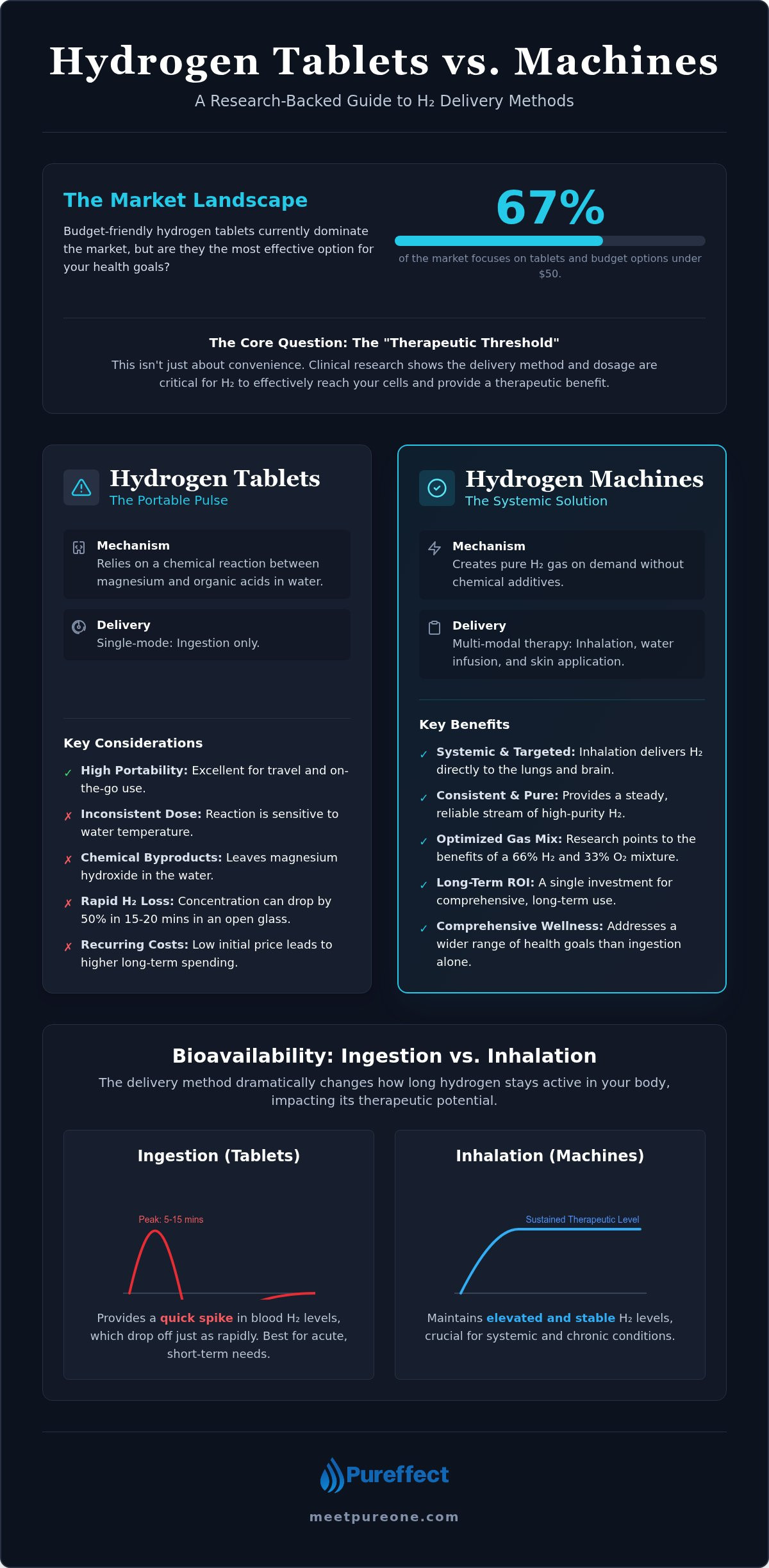
When you drink hydrogen water, the gas travels through your digestive tract. Research published in Frontiers in Pharmacology indicates that blood levels of H2 peak within 5 to 15 minutes of ingestion. However, these levels drop off just as quickly. Inhalation provides a different kinetic profile, maintaining elevated levels for as long as you use the device. Bioavailability in this context refers to the efficiency with which H2 molecules diffuse from the point of entry into the systemic circulation. This makes Hydrogen therapy a highly flexible tool, but only if you understand these timing differences.
Tablets and Machines: A 2026 Comparison Framework
The two formats couldn’t be more different. Tablets rely on a chemical reaction between magnesium and organic acids to produce gas in a glass of water. It’s convenient, but you’re limited by how much water you can drink. Mechanical generators, like the PureONE, create gas on demand without chemical additives. These machines often produce a 66% H2 and 33% O2 mixture, a ratio gaining traction in research for its dual-support of cellular energy and oxygenation. If you’re managing a chronic condition, “convenience” might lead to under-dosing if you only rely on a few glasses of water a day. We need to look at the research-driven data to see which method actually moves the needle for your health.
Hydrogen Tablets: The Science of Magnesium-Based Hydration
How does a tiny pill turn a glass of plain water into a therapeutic beverage? It’s a bit of kitchen chemistry. Most hydrogen tablets rely on a reaction between elemental magnesium and water. To speed things up, manufacturers add organic acids like malic or tartaric acid. When the tablet hits the water, it creates a cloud of hydrogen gas bubbles. It’s simple. You drop a pill. It bubbles. You drink. This ease of use is why tablets dominate about 67% of the market. They don’t require electricity or a heavy base unit, making them the ultimate travel companion for H2 on the go.
However, the hydrogen tablets vs hydrogen machine debate gets complicated when we look at consistency. Every time you use a tablet, you’re starting a new chemical reaction. If your water is too cold, the tablet might not dissolve fully. If the water is too warm, the gas escapes before you can take a sip. There’s also the matter of recurring costs. While a $30 bottle seems cheap today, daily users often find themselves spending hundreds of dollars a year on a single delivery method. Is the convenience worth the long-term price tag and the limited scope of use?
Magnesium Byproducts and Water Quality
When that tablet disappears, the magnesium doesn’t just vanish. It stays in your glass as magnesium hydroxide. For many, this is a “bonus” mineral supplement. For others, it’s a variable they didn’t account for. Research into Hydrogen Delivery Methods shows that gas stability is a major hurdle for tablets. In an open container, H2 concentration can drop by half in as little as 15 to 20 minutes. You have to drink it fast, or you’re just drinking expensive, slightly metallic water.
Targeting Metabolic Health with H2 Water
Tablets have one major advantage: they are the “gold standard” for clinical trials involving metabolic health. Why? Because they’re easy for study participants to use at home. Research has shown that consistent consumption of hydrogen-rich water can improve markers for metabolic syndrome. This includes better glucose tolerance and a reduction in LDL cholesterol levels. But there is a limit. While drinking H2 water is great for your gut and metabolism, it struggles to reach the same systemic concentrations as inhalation. If you’re looking for a more comprehensive home wellness hub that offers more than just a drink, you might find the single-mode nature of tablets a bit restrictive.
The Hydrogen Machine: Unlocking Multi-Modal Therapy
While tablets are a great entry point, they limit you to one delivery method: ingestion. What if you want to target your brain or your lungs directly? A hydrogen machine changes the equation by providing a consistent, high-output stream of gas. Unlike the chemical reaction in a glass of water, a dedicated generator produces H2 without any additives or magnesium byproducts. This is where the hydrogen tablets vs hydrogen machine comparison really shifts. You aren’t just drinking a supplement; you’re accessing a therapeutic medical gas that can be used in multiple ways.
The PureONE takes this a step further by offering four distinct modes. It doesn’t just make hydrogen water. It allows for inhalation, skin application, and even localized therapy. One of the most exciting research findings involves a specific 66% hydrogen and 33% oxygen mixture. Studies suggest this ratio is particularly effective for respiratory recovery because it provides the antioxidant benefits of H2 alongside vital oxygen support. It’s a level of precision that a tablet simply cannot match.
Inhalation Research: Targeting the Brain and Lungs
Why is breathing the gas so important? Research indicates that inhaled hydrogen crosses the blood-brain barrier more efficiently than dissolved hydrogen in water. This makes it a primary focus for studies on neuroprotection and cognitive health. In the lungs, H2 gas acts directly on oxidative stress markers, helping to soothe the respiratory system from the inside out. By using the PureONE, you’re utilizing a delivery method that mirrors the high-concentration protocols found in clinical settings.
Dermal Application: Hydrogen’s Role in Skin Resilience
Your skin is your largest organ, and it’s constantly under attack from UV rays. A 2021 study highlighted that hydrogen-infused water can significantly reduce UV-induced skin damage when applied topically. A machine allows you to create “hydrogen baths” or use a localized applicator for targeted relief. Topical H2 application is a rapidly growing field in anti-aging research because it neutralizes free radicals directly at the surface level. If you’re ready to move beyond the glass and experience the full spectrum of H2 benefits, it’s time to explore the multi-modal power of the PureONE.
Choosing Your Path: Efficacy, Sustainability, and ROI
Deciding between hydrogen tablets vs hydrogen machine often comes down to how you view your health: is it a series of quick fixes or a long-term project? Tablets are fantastic for travel. They don’t require a power outlet. But for the daily user, the logistics become a bit heavy. Every bottle you finish is more plastic in the recycling bin and more carbon from shipping. A machine is a durable investment in your “Home Health Hub.” It removes the chemical variables of magnesium-based reactions and replaces them with a clean, consistent output that’s ready whenever you are.
We see the PureONE as more than just a water maker. It’s a professional-grade tool designed for those who want to apply the latest clinical findings to their daily routine. Whether you’re using the 66% hydrogen and 33% oxygen mixture for respiratory support or soaking your skin to combat UV damage, a machine offers a level of versatility that a pill simply can’t match. It’s about having the right tool for every biological “job” your body needs to tackle. For those who are also considering thermal therapies as part of their wellness stack, our in-depth guide on hydrogen therapy vs infrared sauna for cellular recovery breaks down the science behind both approaches.
The ROI of Wellness: A 2026 Cost Analysis
Let’s talk numbers. A high-quality bottle of tablets typically costs between $30 and $50. If you’re serious about your protocol and take them daily, you’ll spend at least $1,080 over three years. That’s a significant “wellness tax.” When you look at the PureONE investment, the math starts to shift in favor of the machine. You can dive deeper into these figures with our guide on Calculating the ROI of a Wellness Machine. Plus, the 365-day risk-free trial removes the uncertainty. You get a full year to see if the results match the research before fully committing.
Conclusion: Building Your Cellular Resilience
The research is clear. If your goal is metabolic support or gut health, hydrogen water from tablets is an effective, portable solution. However, if you want to target systemic inflammation, neurological health, or respiratory recovery, inhalation is the necessary frontier. The PureONE bridges this gap. It gives you the best of both worlds by offering high-concentration drinking water and clinical-grade inhalation in one device. Don’t settle for a single-mode solution when your health is multi-faceted. It’s time to prioritize research-backed delivery and build the cellular resilience you deserve.
Empower Your Health with Research-Backed Delivery
Choosing the right delivery method is the first step toward real results. While tablets offer a portable way to boost metabolic markers, a high-output machine remains the only way to access the full spectrum of H2 benefits. By combining inhalation, drinking water, and skin application, you ensure that every cell in your body receives the support it needs. The debate of hydrogen tablets vs hydrogen machine isn’t just about cost; it’s about the quality of your long-term wellness journey.
The PureONE is proudly manufactured in Canada and utilizes a unique 66% hydrogen and 33% oxygen mixture to support your recovery and resilience. It is even endorsed by Howie Mandel for its ease of use and consistent performance. Are you ready to stop guessing and start experiencing the difference? You can experience clinical-grade hydrogen therapy with the PureONE risk-free for 365 days. We’re confident that once you feel the impact of multi-modal therapy, you’ll never look back. Your journey toward better living starts today.
Frequently Asked Questions
Are hydrogen tablets as effective as a machine for long-term health?
Tablets are highly effective for targeted metabolic support, but they lack the multi-modal versatility required for comprehensive, systemic health. While they provide a convenient “pulse” of hydrogen water, a machine offers a consistent, long-term supply for inhalation and skin application. Over several years, the cumulative benefits of daily inhalation often outweigh the intermittent use of tablets. It’s also a matter of sustainability, as a machine eliminates the recurring costs and packaging waste associated with monthly tablet subscriptions.
Can I inhale hydrogen gas from tablets?
No, you cannot safely or effectively inhale gas directly from a tablet reaction. Tablets are specifically formulated to dissolve in water for ingestion. The chemical reaction between magnesium and organic acids produces off-gas that may contain irritating byproducts not suitable for the lungs. If your goal is respiratory or neurological support, a dedicated generator is the only research-backed way to deliver pure, breathable hydrogen gas to your system.
What does the latest research say about hydrogen for chronic inflammation?
Current medical research highlights molecular hydrogen as a selective antioxidant that specifically neutralizes the harmful hydroxyl radical. A 2024 review suggests that sustained H2 levels are particularly effective at modulating inflammatory cytokines. This systemic reach is a major factor in the hydrogen tablets vs hydrogen machine debate. While tablets help with gut-related inflammation, inhalation provides the steady concentration needed to address chronic, body-wide issues more effectively.
Is there a difference in the quality of hydrogen produced by a machine vs. tablets?
The primary difference is the presence of chemical byproducts. Tablets rely on a magnesium-based reaction that leaves magnesium hydroxide and organic acids in your glass. While generally safe, these additives can change the taste and mineral profile of your water. A high-quality machine generates gas without these extras, providing a cleaner experience. This purity is especially important for those who use hydrogen frequently and want to avoid unnecessary mineral buildup.
How many tablets would I need to equal one 30-minute inhalation session?
It is nearly impossible to match the dosage of a 30-minute inhalation session by drinking water alone. Inhalation delivers a continuous stream of gas that saturates the bloodstream quickly. To reach a similar cumulative dose, you would need to drink roughly 10 to 15 liters of high-concentration hydrogen water in a single sitting. This isn’t practical or comfortable. For high-dose therapeutic needs, the machine is the clear winner in the hydrogen tablets vs hydrogen machine comparison.
Is it safe to drink hydrogen water and inhale hydrogen gas on the same day?
Yes, it’s perfectly safe and often encouraged to use both delivery methods together. Drinking hydrogen water targets the digestive tract and metabolic markers, while inhalation provides direct access to the brain and respiratory system. Using both pathways ensures that the H2 molecule reaches every corner of your body. A multi-modal device like the PureONE makes this easy by allowing you to switch between modes whenever you need a boost.
Disclaimer
The information provided by Pureffect and any of its products are for educational and informational purposes only and is not intended as medical advice. Individual results may vary, and no specific health outcomes are guaranteed. Always consult a qualified healthcare professional before starting any wellness practice or product.