
How much did you spend last year on “feeling better” only to have nothing but empty supplement bottles and a pile of clinic receipts to show for it? It’s a common frustration. You know that proactive health is the right move, but the costs feel scattered and the results often feel invisible. If you’re tired of the “subscription model” of health, you’re likely considering a more permanent solution. But is it actually a smart financial move? Calculating the ROI of a wellness machine doesn’t have to be a guessing game. It’s about finding the mathematical delta between reactive medical spending and proactive cellular maintenance.
You want to be sure you aren’t just buying another high-tech “gizmo” that collects dust. We agree. That’s why we’ve built a framework that aligns with the latest medical research. For instance, independent testing by H2HUBB in February 2026 has finally provided concrete data to verify performance standards for home devices. In this guide, you’ll learn how to quantify health-span benefits and translate them into a clear formula you can show a spouse or a financial planner. We’ll explore specific research findings that justify the investment and give you a spreadsheet-ready way to see the long-term value. Ready to see the numbers?
Key Takeaways
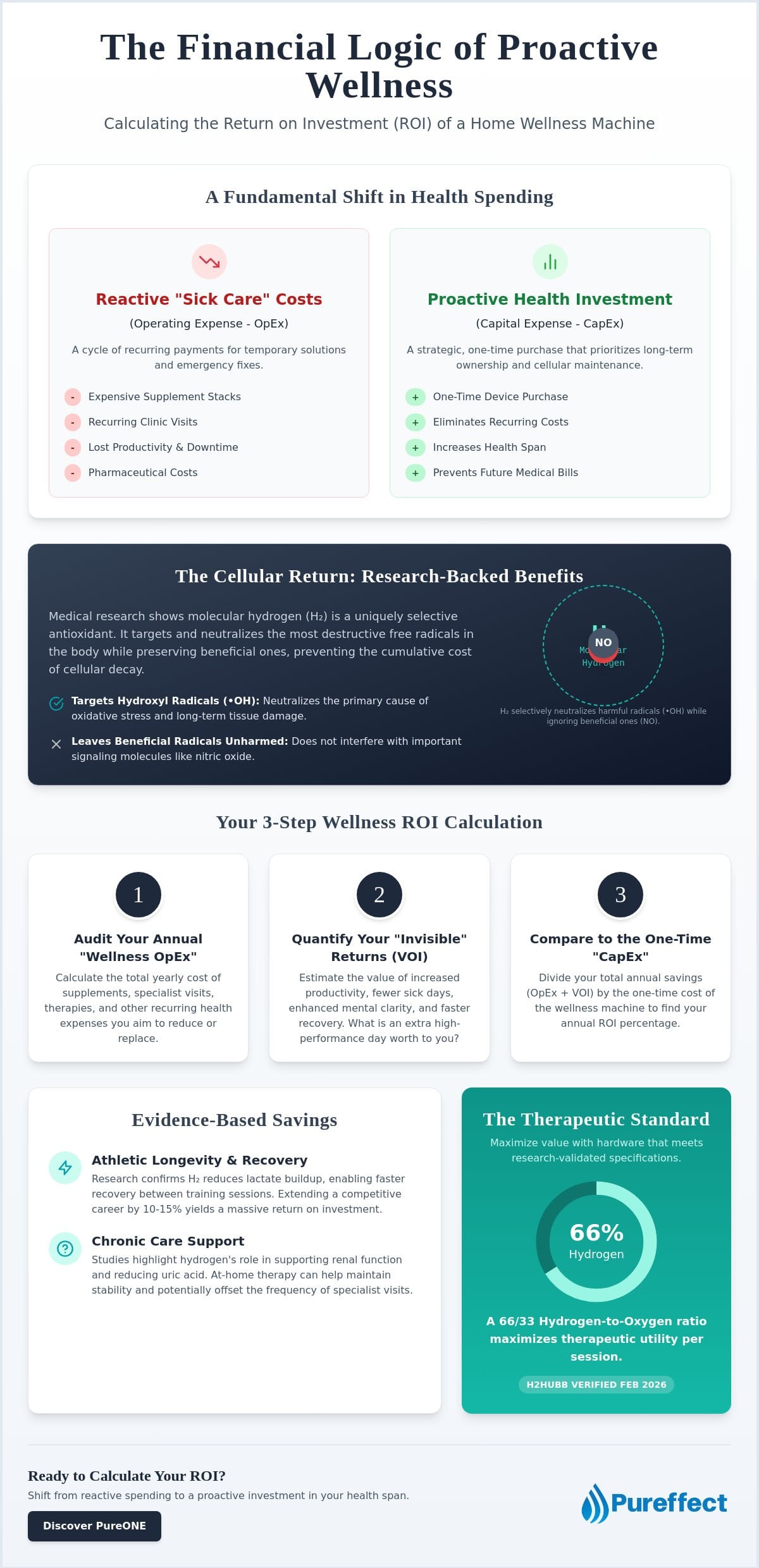
- Learn to shift your financial perspective from reactive “sick care” costs to proactive investments in cellular maintenance and long-term health span.
- Explore specific medical research detailing how molecular hydrogen selectively neutralizes hydroxyl radicals to help prevent cumulative tissue damage.
- Get a practical framework for calculating the ROI of a wellness machine by auditing your annual “Wellness OpEx” and current clinic visits.
- Discover why a 66/33 hydrogen-to-oxygen ratio maximizes therapeutic utility, ensuring your home hardware delivers the highest possible value per session.
- Access a clear, spreadsheet-ready formula designed to help you communicate the financial logic of wellness investments to a spouse or financial planner.
Beyond the Price Tag: Redefining Wellness ROI for 2026
Traditional finance experts usually talk about Return on Investment (ROI) in the context of portfolios and dividends. But what if we applied that same logic to your cellular health? In 2026, the conversation has shifted. We aren’t just looking at the sticker price of a device anymore. Instead, we’re calculating the ROI of a wellness machine based on how much it saves you in long-term medical costs and lost productivity. It’s a move from reactive “sick care” to proactive “health span” investment.
Most people are stuck in a cycle of paying for emergencies. They wait for a problem to arise, then pay a premium to fix it. Proactive investment is different. It’s about health span, the period of life spent in good health. By decentralizing professional therapy and bringing it into your home, you’re building a personal bio-clinic. This allows you to address issues at the foundational level before they require expensive intervention. Can you really put a price on an extra decade of high-level cognitive function? Most would say no, but the math says it’s possible to measure.
Capital Expenditure vs. Operating Expense
The ‘Invisible’ Return: Preventing the Cost of Decline
How do you measure a headache you didn’t get? Or the afternoon slump that never happened? This is where the Value of Investment (VOI) model comes in. It looks at the “invisible” benefits like mood, energy, and mental clarity. Research shows that reducing systemic inflammation isn’t just about comfort; it’s about protecting your professional earning potential. This is part of the larger Investing in Preventative Health at Home trend. When your body functions at a higher level, your output follows. That’s a return that shows up in your bank account, not just your bloodwork.
The Math of Recovery: Research-Backed Metrics for Your Calculation
Numbers don’t lie. They often hide in the bloodwork. When calculating the ROI of a wellness machine, you have to look at the cellular level. Medical research indicates that molecular hydrogen has a unique ability to selectively neutralize hydroxyl radicals. These are the most destructive reactive oxygen species in the human body. By targeting these specifically, H2 helps reduce long-term tissue damage without interfering with beneficial signaling radicals. This is a biological return that prevents the cumulative cost of cellular decay.
Think about the financial weight of metabolic syndrome. It’s a gateway to a lifetime of pharmaceutical costs. Preventing these conditions saves thousands in future prescriptions and doctor visits. This is where we move into the Value on Investment (VOI). It’s not just about the money you save. It’s about the time you gain. If a recovery session gets you back to work or training 24 hours faster, what is that day worth to you? This data-driven approach is essential when calculating the ROI of a wellness machine for a high-performance lifestyle.
Evidence-Based Savings in Chronic Care
Studies show hydrogen’s role in supporting renal function and reducing uric acid levels. This is critical for long-term health. You can read more about molecular hydrogen for kidney health in our research guide. For those managing conditions like Parkinson’s, at-home support may help offset the frequency of specialized physical therapy sessions. It’s about maintaining stability between professional appointments.
The ROI of Athletic Longevity
High-performance athletes face constant muscle fatigue. Research confirms that H2 reduces lactate buildup, allowing for faster turnaround between sessions. If you’re an athlete, you should calculate your “cost per season.” Extending your competitive years by even 10% or 15% offers a massive return. Check out the science of hydrogen therapy for athletic recovery to see the data. Investing in a high-output generator could be the key to that longevity.
Step-by-Step Template: Calculating Your Household Wellness ROI
Ready to move from theory to reality? To build a solid case for your investment, you need a structured approach. Calculating the ROI of a wellness machine requires looking at both your current bank statements and your future health trajectory. It’s about moving past the “sticker shock” and seeing the machine as a financial tool. Follow these four steps to find your number.
- Step 1: Audit your Wellness OpEx. Total your annual spending on supplements, clinic visits, and specialized recovery therapies. This is your baseline operating expense.
- Step 2: Determine the Machine Lifespan. Take the total cost of the device and divide it by the expected sessions over its lifetime. Most high-end units are built to last years.
- Step 3: Factor in Time Savings. Calculate the value of your time. If a clinic visit takes 20 minutes to drive each way plus the session time, you’re losing hours every week. Home therapy has zero commute.
- Step 4: Apply the Prevention Multiplier. Estimate the savings on future medical interventions. Research indicates that maintaining cellular health today reduces the statistical likelihood of expensive chronic care later.
The Cost-Per-Session Comparison
Quantifying Qualitative Gains
Some returns don’t show up on a receipt. Take the “Sleep ROI” for example. Research suggests that molecular hydrogen may support the autonomic nervous system, leading to deeper restorative cycles. Better sleep translates directly to higher cognitive output and better decision-making at work. Then there’s the “Inflammation Tax.” This is the cost of lost productivity during a flare-up. For someone managing chronic migraines or fibromyalgia, reducing “down days” by even 15% per year represents a massive gain in both quality of life and earning potential. Ready to start your own calculation? You can see the specs for a high-performance generator to help finalize your math.
Maximizing Your Return with the PureONE Molecular Hydrogen Generator
When calculating the ROI of a wellness machine, the hardware’s versatility is your biggest multiplier. The PureONE Molecular Hydrogen Generator isn’t a single-use tool. It offers four therapeutic modes in one device. This maximizes utility across your entire household. Why buy three different gadgets when one covers inhalation, infusion, and targeted applications? It’s about efficiency. By centralizing these functions, you’re effectively lowering your cost-per-benefit ratio from day one.
The 66/33 hydrogen-oxygen ratio is often cited as the gold standard for therapeutic return. Research indicates that this specific balance supports cellular resilience more effectively than hydrogen alone. It is a synergistic approach. By providing both gases in this precise ratio, you’re hitting multiple metabolic pathways simultaneously. This isn’t just a technical spec; it’s a way to ensure every minute spent in a session delivers the highest possible biological yield. We believe in grounded authority, which is why we value that organizations like H2HUBB verified our output specs in February 2026.
Durability is the final piece of the ROI puzzle. A machine that breaks in two years is a liability, not an investment. The PureONE features a proprietary stainless steel condenser designed for long-term heavy use. This engineering choice protects your initial capital expenditure. To make the math even easier, the 365-day trial eliminates the “Investment Risk” variable. While there is a $200 restocking fee for returns, having a full year to verify the health benefits in your own home ensures you aren’t stuck with a “gizmo” that doesn’t deliver.
One Machine, Multiple Savings Streams
Think about your current supplement graveyard. Are you still buying expensive hydrogen tablets every month? Replacing these recurring costs with a generator offers a clear, direct saving. Tablets are a never-ending “OpEx” expense. A generator is a one-time “CapEx” move that pays for itself over time. Understanding the full research-backed differences between hydrogen tablets vs hydrogen machine delivery methods can help you make the most informed financial decision. Having both inhalation and infusion modes also prevents “feature creep” spending later on. You won’t need to buy a separate device just to get hydrogen-rich water. For a closer look at these options, read our comparison on the hydrogen inhalation machine vs. water bottle.
Securing Your Health Capital
Investing in your health requires confidence in the manufacturer. Canadian manufacturing and professional endorsements provide a level of security that mass-produced imports often lack. This quality ensures your machine remains an asset for years, not months. Your next step is simple. Audit your health goals for the next five years and decide which protocol fits your lifestyle. Ready to see the numbers for yourself? You can calculate your own return with the PureONE generator today and start moving toward a more proactive health model.
Securing Your Future Health Span
You’ve seen the math. Shifting your wellness strategy from monthly subscriptions to permanent hardware isn’t just about saving money. It’s about taking ownership of your biological trajectory. By using a Value on Investment model, you can finally account for the “invisible” gains like deeper sleep and sustained mental clarity. Calculating the ROI of a wellness machine becomes simple when you factor in the years of avoided clinic fees and the professional edge that comes with faster recovery. It’s a logical move for anyone serious about longevity.
The PureONE Molecular Hydrogen Generator is designed to be a cornerstone of this strategy. It’s manufactured in Canada with proprietary technology and comes with the confidence of a 365-day risk-free trial. Even figures like Howie Mandel have turned to this technology to support their own well-being. You have the framework and the research. Now, you just need to decide if your health span is worth the investment.
Ready to invest in your cellular future? Explore the PureONE
Take the first step toward a more resilient version of yourself. Your future self will thank you for the foresight you showed today.
Frequently Asked Questions
How long does it typically take for a wellness machine to pay for itself?
The payback period depends on your current “Wellness OpEx” or monthly spending. For individuals spending heavily on clinic visits or premium antioxidant supplements, the break-even point often arrives within 18 to 24 months. When calculating the ROI of a wellness machine, you should compare the one-time purchase price against the cumulative cost of recurring monthly subscriptions and travel expenses.
Can I really replace my supplement stack with a hydrogen machine?
You can often reduce your reliance on general antioxidant supplements, but it isn’t a total replacement for targeted nutrition. Medical research highlights that molecular hydrogen selectively targets the most toxic free radicals without disrupting beneficial ones. This precision often makes it a more efficient cellular tool than broad-spectrum antioxidant pills, which can sometimes interfere with natural signaling processes.
Is a hydrogen machine a better investment than red light therapy for recovery?
Both are valuable, but hydrogen offers a systemic metabolic return that red light therapy cannot match. While red light is excellent for localized tissue and mitochondrial stimulation, hydrogen gas diffuses through every cell and barrier in the body. This systemic reach provides a broader “biological dividend” for those looking to address inflammation at the foundational level.
What is the expected lifespan of a high-quality molecular hydrogen generator?
A high-quality generator is engineered to last between five and ten years with basic annual maintenance. This longevity is a critical variable when calculating the ROI of a wellness machine. Using durable materials ensures the hardware survives thousands of sessions, bringing the cost-per-use down to a negligible amount when spread over a decade of daily health optimization.
How do I calculate the ‘value of time’ saved by using a home machine?
You calculate the value of time by multiplying your effective hourly rate by the total hours saved on clinic commutes and waiting rooms. If a round trip to a wellness center takes 45 minutes, using a home machine three times a week saves you over 115 hours per year. For a professional, that recovered time is often worth more than the cost of the hardware itself.
Does insurance ever cover the cost of a home wellness machine like the PureONE?
Standard health insurance rarely covers wellness hardware, as these devices are typically classified as personal health equipment. However, some users successfully utilize Health Savings Accounts (HSA) or Flexible Spending Accounts (FSA) if they have a documented Letter of Medical Necessity from a physician. It’s always best to consult with your provider or a tax professional regarding specific eligibility requirements.
Disclaimer
The information provided by Pureffect and any of its products are for educational and informational purposes only and is not intended as medical advice. Individual results may vary, and no specific health outcomes are guaranteed. Always consult a qualified healthcare professional before starting any wellness practice or product.