
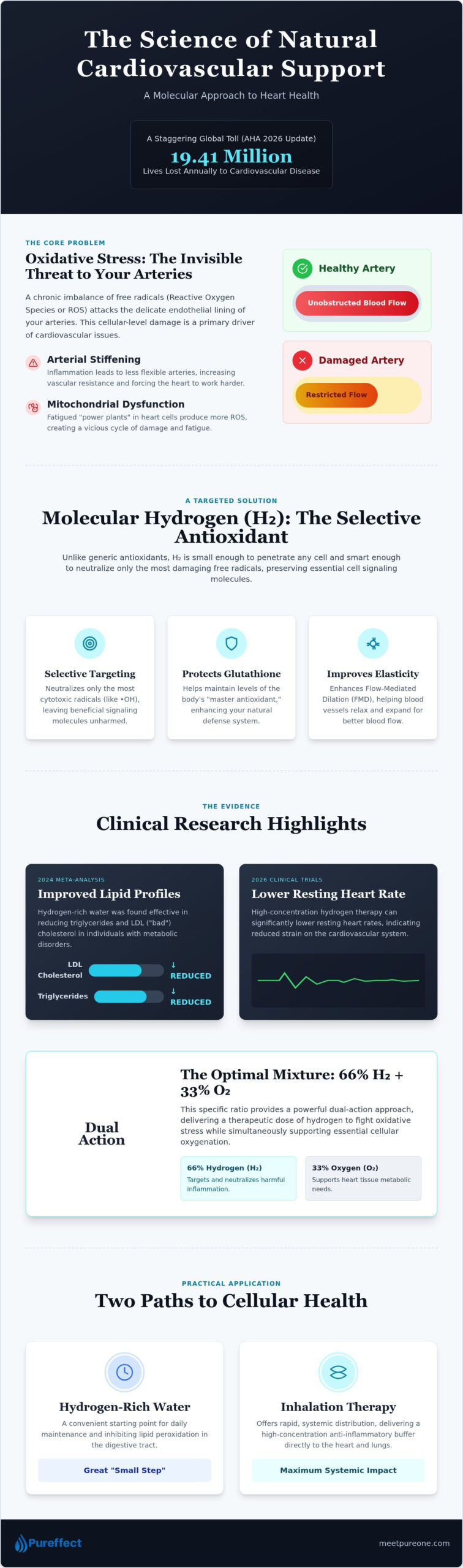
Did you know that cardiovascular disease claimed approximately 19.41 million lives globally according to the American Heart Association’s 2026 update? It’s a staggering number that makes improving cardiovascular health naturally feel more urgent than ever. You’ve likely felt the frustration of conflicting supplement advice or the nagging worry that silent inflammation is working against you. It’s exhausting to feel like you’re doing everything right while the underlying science remains a mystery.
We’re here to bridge that gap. We’ll show you how heart support starts at the cellular level, moving beyond basic habits into the world of molecular hydrogen therapy. Recent 2024 meta-analysis findings show that hydrogen-rich water effectively reduces triglycerides and LDL cholesterol in those with metabolic disorders. Even more recent 2026 clinical trials indicate that high-concentration hydrogen can significantly lower resting heart rates. You deserve a routine backed by data, not just guesswork. Why settle for general advice when you can look at the molecular evidence?
This guide explores the latest research on how a 66% hydrogen and 33% oxygen mixture supports your circulation and lowers systemic inflammation. We’ll walk through a science-backed daily routine that addresses oxidative stress directly. Are you ready to see what the latest research says about protecting your heart for the long term?
Key Takeaways
- Identify why oxidative stress is the primary driver of arterial damage and how to neutralize it at the source.
- Discover why improving cardiovascular health naturally requires a cellular approach rather than just macro-level lifestyle changes.
- Learn the clinical significance of the 66% hydrogen and 33% oxygen ratio for optimizing your body’s vascular response.
- Master “Zoned” breathing and HRV tracking to lower sympathetic stress and protect your heart from the effects of silent inflammation.
- Explore how the PureONE generator provides a practical, research-driven way to maintain cardiovascular resilience from the comfort of home.
The Invisible Barrier: Why Oxidative Stress Matters for Your Heart
Standard cardiovascular advice usually focuses on what you can see or measure on a scale. But what about the invisible barrier? Oxidative stress occurs when there’s a chronic imbalance between free radicals and your body’s natural antioxidant capacity. When these reactive oxygen species (ROS) accumulate, they specifically attack the endothelial lining of your arteries. This delicate layer is responsible for vascular tone and blood flow. If it’s compromised, your risk for various conditions increases, as noted in this comprehensive overview of cardiovascular diseases.
Why is standard advice often insufficient? Diet and exercise are vital, but they don’t always reach deep cellular inflammation. True improving cardiovascular health naturally requires building cellular resilience. This means strengthening your cells’ ability to neutralize damage before it triggers a systemic inflammatory response. Think of it as upgrading your internal security system rather than just reacting to alarms.
The Role of Inflammation in Vascular Resistance
Chronic inflammation isn’t just a buzzword; it’s a physical architect of disease. Research findings from late 2025 highlight how low grade inflammation leads to arterial stiffening. This makes your heart work harder with every single beat. This process often stems from mitochondrial dysfunction, where the power plants of your heart cells become fatigued and leaky. When these organelles fail, they produce even more ROS, creating a vicious cycle of muscle fatigue. In this context, vascular resistance is the physical friction and stiffness within the circulatory system caused by oxidative structural damage.
Why Selective Antioxidants are the Future of Heart Care
Have you ever wondered why taking handfuls of vitamins doesn’t always yield results? The antioxidant paradox suggests that flooding the body with generic antioxidants can actually interfere with healthy cellular signaling. You need a targeted approach. This requires a selective molecule small enough to cross the cell membrane effortlessly and neutralize only the most toxic radicals. The shift toward investing in preventative health at home represents a move away from broad spectrum supplementation toward precise, cellular resilience. Improving cardiovascular health naturally in 2026 is about using these targeted tools to protect the heart muscle from the inside out.
Molecular Hydrogen: A Research-Backed Natural Tool for Vascular Support
Why is molecular hydrogen gaining so much attention in the medical community? It boils down to its status as a selective antioxidant. Unlike traditional supplements that may neutralize all free radicals indiscriminately, hydrogen only targets the most cytotoxic ones. This is a vital distinction. It allows your body to maintain the beneficial signaling molecules it needs for repair. In the study of Oxidative Stress in Cardiovascular Disease, this precision is seen as a major breakthrough for protecting arterial health.
Molecular hydrogen also supports the heart by maintaining levels of glutathione, your body’s “master antioxidant.” By keeping glutathione levels stable, H2 helps the heart muscle resist fatigue and damage. Clinical trials in early 2026 have specifically looked at flow-mediated dilation (FMD). These studies show that hydrogen therapy can significantly improve how blood vessels relax and expand. This direct impact on vascular elasticity is a cornerstone of improving cardiovascular health naturally.
The specific 66% hydrogen and 33% oxygen mixture is particularly effective for this purpose. This ratio provides a therapeutic dose of H2 while simultaneously supporting cellular oxygenation. It’s a dual-action approach that addresses both oxidative stress and the metabolic needs of your heart tissue.
Hydrogen-Rich Water and Cholesterol Profiles
Can drinking water actually change your lipid profile? A 2024 meta-analysis of eight randomized controlled trials suggests it can. The research found that hydrogen-rich water was effective in reducing triglycerides and LDL cholesterol in individuals with metabolic disorders. It works by inhibiting lipid peroxidation, which prevents fats from oxidizing and sticking to your artery walls. If you want to understand the foundational mechanics, our guide on What is Molecular Hydrogen? covers the science in detail.
Inhalation Therapy: Direct Support for the Bloodstream
While drinking hydrogen water is a great “small step,” inhalation therapy offers rapid systemic distribution. Inhaled hydrogen gas reaches the heart and lungs much faster than oral alternatives. This creates a high-concentration “buffer” against inflammation in the pulmonary and circulatory systems. Gas purity is the most critical factor here. Using a device with a proprietary stainless steel condenser ensures that the gas you breathe is pure and therapeutic. For those ready to integrate this into their routine, the PureONE Molecular Hydrogen Generator offers a professional-grade way to support your heart at home.
3 Novel Habits for Strengthening Your Cardiovascular System Naturally
While standard advice says “just get active,” improving cardiovascular health naturally in 2026 is more precise. It’s about data. Are you tracking your Heart Rate Variability (HRV)? HRV measures the variation in time between each heartbeat. It’s a direct window into your autonomic nervous system. A high HRV suggests your heart is resilient and ready for stress. To boost this, try “Zoned” breathing. This involves slow, rhythmic nasal breathing that signals your nervous system to exit “fight or flight” mode. It’s a simple way to lower sympathetic stress on your arteries.
Next, look at your plate. Don’t just eat greens; focus on fermented nitrates. Foods like fermented beet juice or aged arugula significantly boost nitric oxide production. This gas helps your vessels dilate, improving circulation without pharmaceutical intervention. Finally, use molecular hydrogen as a recovery tool. It bridges the gap between exertion and repair, ensuring your heart isn’t overtaxed by the very exercise meant to strengthen it.
Optimizing Recovery with Hydrogen Therapy
Your heart doesn’t just rest while you sleep; it repairs. 2026 clinical data suggests that deep sleep is the primary window for arterial endothelial repair. If you’re constantly under oxidative stress at night, your morning blood pressure will reflect it. Protect your mitochondrial function by implementing a “digital sunset.” Turn off blue-light devices 90 minutes before bed. This simple habit allows your body to produce the melatonin needed for deep, restorative cellular cleanup. Better sleep leads to better circulation, plain and simple.
Ready to bring professional-grade recovery into your living room? The PureONE Molecular Hydrogen Generator makes this daily routine effortless.
PureONE: Integrating Molecular Hydrogen into Your Heart Healthy Routine
We’ve explored the cellular science and the lifestyle shifts. Now, let’s talk about the practical application. Improving cardiovascular health naturally shouldn’t feel like a part-time job or a series of complicated chores. The PureONE Molecular Hydrogen Generator is designed to act as a comprehensive home wellness hub. It brings medical-grade precision into your living room, allowing you to address oxidative stress without leaving the house. Since it’s Canadian-made and features a proprietary stainless steel condenser for gas purity, you don’t have to worry about the quality of what you’re putting into your body.
The device offers four therapeutic modes, giving you the versatility to support your heart in different ways throughout the day. Whether you’re infusing water or using the 66% hydrogen and 33% oxygen gas mixture for inhalation, the goal remains the same: reducing the silent inflammation that drives vascular decline. With a 365-day risk-free trial, you have a full year to verify the results and see how your body responds to a more resilient cellular environment.
A Simple Daily Protocol for Heart Support
You don’t need to reinvent your entire schedule to see benefits. A simple, consistent rhythm is often more effective than sporadic, high-intensity efforts. Consider this daily routine:
- Morning: Drink 16oz of hydrogen-infused water immediately upon waking. This primes your metabolism and addresses lipid peroxidation before your day even starts.
- Evening: Dedicate 30 minutes to gas inhalation. This helps neutralize the oxidative load your cardiovascular system accumulated throughout the day.
This balanced protocol does more than just support your arteries; it’s a direct investment in your mitochondrial health. By providing your cells with the right tools at the right time, you’re helping your heart maintain its energy levels and repair capacity.
Why Consistency Beats Intensity
Vascular resilience isn’t built in a single afternoon. It’s the result of daily micro-doses of H2 that gradually strengthen the endothelial lining. This “low-barrier” approach is why public figures like Howie Mandel have endorsed the system. It fits into a busy life while providing foundational support. When you explore the PureONE for your home setup, you’re choosing a tool that values long-term stability over quick fixes. Are you ready to see how a science-backed routine can change your perspective on heart health?
Take Control of Your Cellular Resilience
Protecting your heart is no longer a matter of guesswork or generic advice. We’ve seen how targeting oxidative stress at the source can preserve your endothelial lining and support long-term vascular tone. By choosing selective antioxidants like molecular hydrogen, you’re improving cardiovascular health naturally from the inside out. It’s about building a foundation of resilience that keeps your system strong as you age. Whether you’re tracking your HRV or adopting a 66/33 inhalation routine, these small steps create a significant impact over time.
You don’t have to navigate this journey alone. The PureONE system provides a medical-grade, Canadian-made solution that fits seamlessly into your daily life. It’s the same technology endorsed by Howie Mandel for its quality and ease of use. If you’re ready to see how cellular support can change your energy and circulation, we invite you to experience it firsthand without any pressure. Start your 365-day risk-free trial of the PureONE Molecular Hydrogen Generator today. With our money-back guarantee, you have a full year to decide if it’s the right partner for your wellness journey. Your heart deserves a proactive approach.
Common Questions About Heart Health and Hydrogen
Can molecular hydrogen help lower high blood pressure naturally?
Research suggests molecular hydrogen supports healthy blood pressure by neutralizing the free radicals that cause arterial stiffness. A 2026 clinical trial focused on flow-mediated dilation showed that consistent use helps blood vessels relax more effectively. By improving the health of the endothelial lining, H2 provides a foundational way of improving cardiovascular health naturally. It doesn’t drop pressure instantly but works over time to support the body’s own regulatory systems.
Is inhaling hydrogen gas safe for someone with existing heart conditions?
Molecular hydrogen is a non-toxic gas that is naturally produced in the human digestive system. While generally considered safe, anyone with a pre-existing heart condition should consult their cardiologist before starting any new therapy. The 66% hydrogen and 33% oxygen mixture is designed to provide therapeutic H2 without compromising your oxygen levels. This balanced approach ensures you’re supporting cellular repair while maintaining the vital oxygenation your heart muscle requires for daily function.
How much hydrogen-infused water should I drink for heart health benefits?
Most clinical studies showing positive results for lipid profiles and heart rate reduction involve drinking between 16 and 32 ounces of hydrogen-rich water daily. Consuming this amount consistently helps maintain a steady level of selective antioxidants in your bloodstream. It’s often best to drink your first 16 ounces in the morning to prime your metabolism. This habit is a simple, effective method for improving cardiovascular health naturally without requiring a major overhaul of your schedule.
Does molecular hydrogen therapy replace heart medications?
No, molecular hydrogen therapy is intended to be a complementary tool for wellness, not a replacement for prescribed heart medications. You should never stop or alter your medication regimen without direct supervision from your healthcare provider. Think of H2 therapy as a way to support your body at the cellular level while your medical team manages your specific clinical needs. It works alongside standard care by addressing the oxidative stress that often complicates chronic heart issues.
What is the 66/33 hydrogen-oxygen ratio and why does it matter for the heart?
The 66/33 ratio refers to a mixture of 66% molecular hydrogen and 33% oxygen gas. This specific balance is crucial because the heart is an extremely oxygen-dependent organ. While the hydrogen works to neutralize harmful reactive oxygen species and reduce inflammation, the supplemental oxygen ensures that your cells have the fuel they need for energy production. This dual-action approach provides a comprehensive environment for vascular repair and mitochondrial support during your daily inhalation sessions.
How long does it take to see cardiovascular improvements with hydrogen therapy?
Timeline for results varies depending on your baseline health, but research provides some clear markers. For example, a 24-week clinical trial on individuals with metabolic syndrome found significant decreases in resting heart rate and improved lipid profiles after consistent use. Some users report feeling better within the first few weeks, but the structural benefits to your arteries and circulation typically build over several months. Consistency is the key to seeing long-term changes in your vascular resilience.
Disclaimer
The information provided by Pureffect and any of its products are for educational and informational purposes only and is not intended as medical advice. Individual results may vary, and no specific health outcomes are guaranteed. Always consult a qualified healthcare professional before starting any wellness practice or product.