
What if the secret to ending your persistent fatigue isn’t more sleep, but a smaller molecule than you ever imagined? It’s frustrating when you do everything “right” yet still feel like your body is running on a low battery. Most of us have accepted that slow recovery and morning brain fog are just part of getting older. But what if that’s not the whole story? You deserve to feel as vibrant as your schedule demands, without the constant fear of your energy levels bottoming out.
We’ve found that the real change happens at the cellular level. Supporting mitochondrial function with hydrogen is a science that has evolved rapidly. By 2026, researchers have moved beyond calling hydrogen a simple antioxidant. They now view it as a “biological signaling modulator.” A landmark discovery in December 2025 identified the Rieske iron-sulfur protein within mitochondrial Complex III as a primary target for H2. This explains how hydrogen helps your cells produce energy more efficiently while reducing oxidative stress. In this article, we’ll explore how this targeted nutrient revitalizes your mitochondria and speeds up your recovery times. We’ll also dive into the latest clinical findings that validate investing in high-quality hydrogen hardware. It’s time to see how a specific 66/33 ratio of hydrogen and oxygen can help you reclaim your daily vitality.
Key Takeaways
- Understand why your mitochondria act as both powerhouses and sensors. You’ll learn how supporting mitochondrial function with hydrogen stops “cellular burnout” before it starts.
- Uncover the science of the Nrf2 pathway and how hydrogen acts as a targeted nutrient to trigger your body’s own master antioxidant defenses.
- Explore the process of mitochondrial biogenesis to see how you can cultivate a younger, more resilient cellular landscape for faster recovery.
- Learn why the specific 66/33 hydrogen and oxygen ratio provides the ideal balance for deep cellular support without the risk of hypoxic stress.
- Get a practical, step-by-step protocol for using the Pureffect generator to achieve consistent mitochondrial remodeling at home.
The Mitochondrial Crisis: Why Cellular Energy Fails
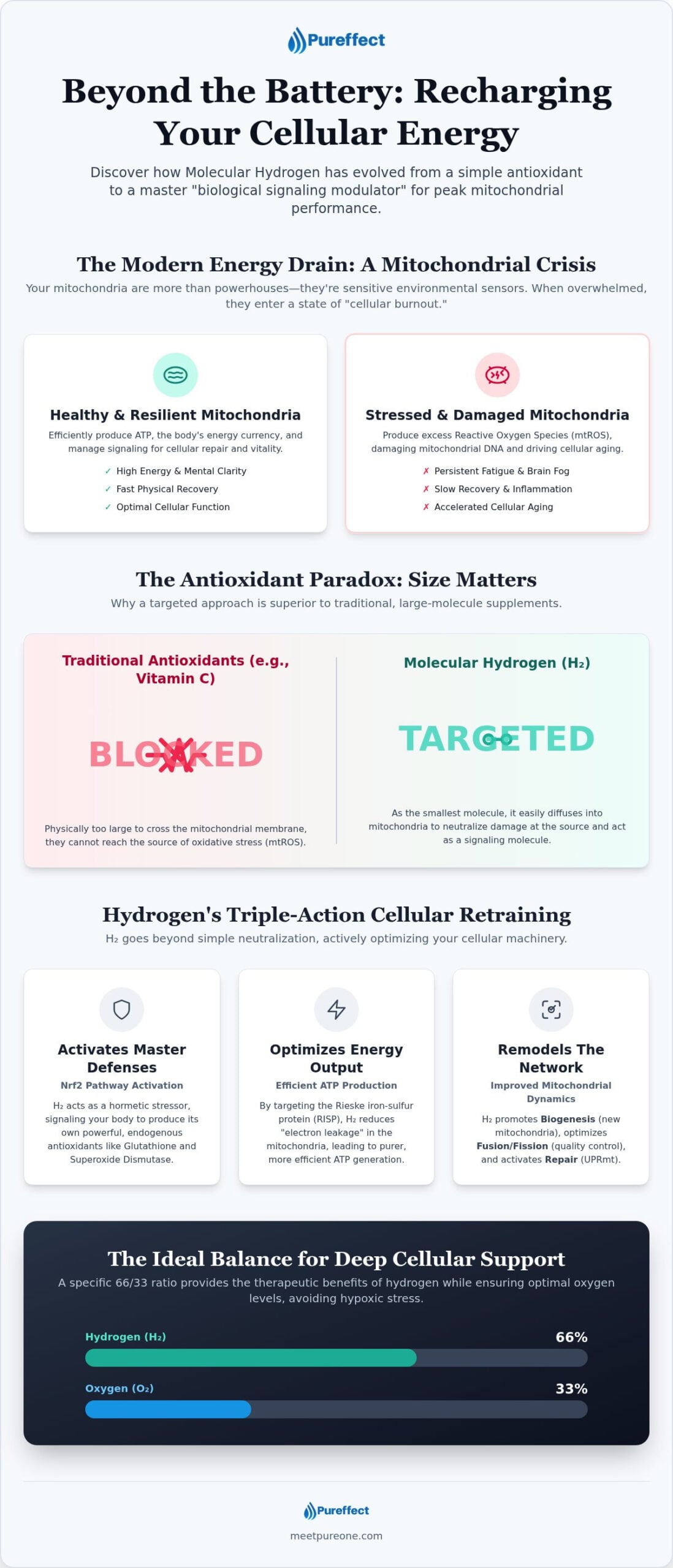
We often call mitochondria the “powerhouse” of the cell. It’s a classic biology textbook definition. But in 2026, we know they’re much more than just batteries. They’re actually sophisticated sensors. They monitor your environment, diet, and stress levels. When they sense trouble, they don’t just keep churning out energy; they pivot. This shift often leads to what we call “cellular burnout.” If you’re struggling with persistent fatigue or brain fog, you’re likely hitting a mitochondrial bottleneck. Your cells simply can’t keep up with the energy demands of modern life. This is where the conversation around supporting mitochondrial function with hydrogen becomes vital.
The Role of mtROS in Cellular Aging
Mitochondria produce energy through a process that naturally creates byproducts called reactive oxygen species (ROS). Think of ROS like exhaust from a car engine. In small amounts, these molecules act as essential “good” signals for cellular repair. However, when the engine runs too hot for too long, you get an accumulation of Mitochondrial Oxidative Stress (mtROS). This excess “exhaust” begins to corrode the engine itself. Specifically, it damages mitochondrial DNA (mtDNA). Damage to your mtDNA is a primary driver of biological aging. Unlike the DNA in your cell’s nucleus, mtDNA is fragile and lacks the same level of protective armor. When it breaks down, your energy production tanks.
Why Traditional Antioxidants Often Fail
You might think popping a Vitamin C or E supplement would fix the problem. Unfortunately, it’s rarely that simple. This is known as the “antioxidant paradox.” Many traditional supplements are physically too large to cross the double membrane of the mitochondria. They circulate in the blood but never reach the engine room where the damage happens. This is why Hydrogen therapy has become such a breakthrough in recent science. Size matters. Hydrogen is the smallest molecule in the universe. It doesn’t need a special transport system to enter your cells. It simply diffuses through membranes, reaching the exact spot where mtROS is doing its worst work. For a deeper look at the basics, you can check out What is Molecular Hydrogen? to see why this tiny element is such a heavy hitter for cellular health. Supporting mitochondrial function with hydrogen isn’t just a trend; it’s a matter of physics.
How Molecular Hydrogen Acts as a Targeted Mitochondrial Nutrient
Molecular hydrogen doesn’t just float around your cells waiting to bump into a toxin. It’s far more proactive. Think of it as a targeted nutrient that actively communicates with your cellular machinery. While we previously discussed how hydrogen’s small size allows it to enter the mitochondria, its real power lies in how it “retrains” these organelles to function at a higher level. Supporting mitochondrial function with hydrogen is about more than just repair. It’s about optimization. By acting as a signaling molecule, hydrogen helps your cells maintain their electrical charge and energy output even under stress.
Hydrogen and the Nrf2 Pathway
How does a gas molecule trigger a physical change in your energy levels? It happens through the Nrf2 pathway. This is your body’s internal “master switch” for antioxidant production. Hydrogen acts as a hormetic stimulus. It’s like a mild workout for your cells that doesn’t cause actual damage but triggers a massive defensive response. Research into Keap1-Nrf2 activation shows that hydrogen prompts the cell to produce its own endogenous antioxidants, such as glutathione and superoxide dismutase. This creates a more resilient environment for your mitochondria to thrive. For a deeper look at these mechanisms, see our research-driven guide to mitochondrial health.
Upregulating ATP Production
ATP is the currency of your life. Every thought you have and every muscle you move costs ATP. Hydrogen is becoming a “rising star” in gas medicine because of its unique relationship with the electron transport chain. A major breakthrough in December 2025 identified the Rieske iron-sulfur protein (RISP) within mitochondrial Complex III as a primary target for H2. By interacting with this protein, hydrogen helps reduce “electron leakage.” This keeps the production of ATP “pure” and efficient. When you reduce this leakage, you’re supporting mitochondrial function with hydrogen by preventing the very oxidative stress that causes fatigue in the first place.
Hydrogen also influences mitochondrial dynamics. This includes:
- Biogenesis: The stimulation of PGC-1α, which signals your body to create brand new, healthy mitochondria.
- Fusion and Fission: Helping the cell merge healthy mitochondria or isolate damaged ones to maintain overall network quality.
If you’re ready to start this cellular retraining process, the PureONE Molecular Hydrogen Generator makes this daily signaling easy to achieve at home.
Optimizing Delivery: Why the 66/33 Hydrogen-Oxygen Ratio Matters
Getting hydrogen into your body is one thing; getting it to the mitochondria is another. While drinking hydrogen-rich water is a fantastic habit for gut health, inhalation provides a direct highway to your cells. The 2026 trend in biohacking has shifted toward multi-modal therapy. This involves inhaling the gas while simultaneously drinking hydrogen-infused water to maximize systemic saturation. By using both methods, you’re supporting mitochondrial function with hydrogen from the inside out and the outside in.
Inhalation: The Direct Route to the Mitochondria
Inhalation is the most efficient way to reach therapeutic concentration levels in the blood. When you breathe the gas, it bypasses the digestive system and enters the bloodstream through the lungs. This allows the molecules to reach the brain, heart, and muscles in seconds. Research suggests that certain mitochondrial signaling pathways require a sustained concentration that is difficult to achieve through water alone. If you’re trying to decide which method is best for your daily routine, you can explore the differences in our guide on the Hydrogen Inhalation Machine vs. Water Bottle.
The 66% H2 / 33% O2 Advantage
Why do we emphasize a 66% hydrogen and 33% oxygen split? It’s about physiological balance. When hydrogen stimulates your mitochondria to produce more ATP, your cells’ metabolic rate naturally increases. This increased activity requires a steady supply of oxygen. Many systems provide pure hydrogen, which can occasionally lead to hypoxic stress during long sessions if you aren’t careful. The 66/33 ratio, often called “Oxy-Hydrogen,” mimics the natural balance required for cellular respiration. It ensures that as you boost your energy production, you’re also providing the necessary fuel for that “cellular fire.” This specific “gold standard” ratio is a key feature of the PureONE generator.
Purity is just as important as the ratio itself. The PureONE features a stainless steel condenser that ensures the gas you inhale is cool, dry, and free from moisture-borne contaminants. This focus on gas quality is essential for long-term safety. By combining high-purity gas with the ideal oxygen balance, you’re supporting mitochondrial function with hydrogen in the most biologically compatible way possible. It’s a sophisticated approach to energy that feels as natural as breathing.
Practical Protocol for Supporting Mitochondria with PureONE
Understanding the science is the first step. Implementing it is where the real transformation happens. Supporting mitochondrial function with hydrogen is not a one-time event; it’s a practice of consistency. Think of it as “mitochondrial remodeling.” Just as you wouldn’t expect a single gym session to change your physique, your cells need regular signaling to shift their metabolic state. The goal is to move from a state of “survival” to one of “thriving.”
The 30-Minute Daily Resilience Protocol
To get the most out of your PureONE, we recommend a three-pillar approach that fits into your existing routine. It doesn’t have to be complicated.
- Step 1: Morning Priming. Start your day with a 30-minute inhalation session. This primes the Nrf2 pathway we discussed earlier, setting your cellular defenses before the day’s stressors hit.
- Step 2: Active Hydration. Use the 10-minute cycle to infuse a 1-liter bottle of water. Sip this during your most demanding mental or physical tasks to provide immediate support when electron leakage is highest.
- Step 3: Evening Repair. End your day with a final inhalation session. This supports the natural “cleanup” and repair processes that happen while you sleep, ensuring you wake up feeling refreshed.
Measuring Your Results
How do you know it’s working? While the internal changes are microscopic, the outward signs are quite clear. Most users report a significant reduction in afternoon slumps and improved mental clarity within the first few weeks. Pay attention to your exercise tolerance. Are you recovering faster? Is that heavy-legged feeling after a workout starting to fade? These are the hallmarks of improved bioenergetics. Supporting mitochondrial function with hydrogen is a cumulative process, and these subjective markers are your best guide.
We believe in this science so much that we offer a 365-day risk-free trial. This gives your body a full year to undergo the remodeling process and respond to the therapy. It’s about building long-term cellular resilience, not just a quick caffeine-like buzz. If you’re ready to take the next step in your health journey, you can start your mitochondrial upgrade with the PureONE Generator today. It’s a simple, foundational investment in your future energy.
Reclaiming Your Cellular Vitality
Are you ready to stop managing your fatigue and start addressing it at the source? We’ve explored how 2026 science has shifted our understanding of the cell. It’s no longer just about fueling a powerhouse; it’s about communicating with your mitochondria through targeted signaling. By supporting mitochondrial function with hydrogen, you’re giving your body the smallest, most efficient tool to reduce oxidative stress and optimize ATP production. The recent identification of specific molecular targets like RISP has finally explained why this tiny molecule has such a massive impact on your daily energy.
The Pureffect generator is designed to make this science accessible for home use. It utilizes medical-grade components and adheres to rigorous quality standards to ensure you’re getting a consistent 66/33 therapeutic gas ratio every time. This isn’t just another health gadget. It’s a foundational shift in how you care for your cellular resilience. It’s why innovators like Howie Mandel have embraced this approach for their own wellness. You don’t have to take our word for it. You can verify the logic and see how your own recovery times respond. Experience the mitochondrial benefits of Pureffect risk-free for 365 days. Your journey toward better living starts with a single, deep breath.
Frequently Asked Questions
How long does it take to feel the effects of hydrogen on mitochondrial function?
Most people notice a shift in mental clarity and daily stamina within two to four weeks of consistent use. While some users report a “buzz” after their first inhalation, the real magic happens over time. This is because your mitochondria need a steady signal to begin the remodeling process. It’s not a quick fix; it’s a foundational upgrade. That’s why we include a 365-day risk-free trial to let your cells fully adapt.
Can I use hydrogen therapy if I already take mitochondrial supplements like CoQ10?
You can absolutely continue your current supplement routine. In fact, molecular hydrogen often makes supplements like CoQ10 or PQQ more effective. These nutrients act as fuel or carriers, while hydrogen cleans up the “exhaust” that slows the engine down. By reducing oxidative stress, you’re creating a cleaner environment for your supplements to do their work. It’s a team effort for your cellular health.
Is inhaling 66% hydrogen and 33% oxygen safe for daily use?
This specific ratio is designed for safety and physiological balance. Many pure hydrogen systems can lead to a slight drop in oxygen saturation during long sessions. By including 33% oxygen, the PureONE ensures your metabolic rate has the fuel it needs to keep up with the hydrogen stimulus. It mimics the balance your cells naturally require for respiration. It’s safe, effective, and built for daily home use.
How does hydrogen therapy compare to other mitochondrial ‘biohacks’ like cold plunges?
Think of hydrogen as a “low-barrier” version of a cold plunge. Both methods use hormesis to trigger cellular repair. However, cold plunges can be a shock to the nervous system and aren’t always practical for daily use. Supporting mitochondrial function with hydrogen provides a similar signaling benefit without the intense physical stress. It’s a more targeted way to reduce inflammation and boost recovery while you simply relax or drink water.
What is the difference between molecular hydrogen and the hydrogen in plain water?
It’s a common point of confusion. In a water molecule (H2O), the hydrogen is chemically bonded to oxygen and isn’t “available” for your body to use as a signaling molecule. Molecular hydrogen (H2) is a free gas that we dissolve into the water or provide for inhalation. Because H2 isn’t bound to anything, it can easily slip through your cell membranes to reach the mitochondria where it’s needed most.
Does hydrogen therapy help with mitochondrial dysfunction related to aging?
Yes, hydrogen is particularly effective for age-related concerns because it targets mtDNA damage. As we age, our mitochondria produce more “exhaust” and less energy. Research shows that supporting mitochondrial function with hydrogen helps trigger the Nrf2 pathway, which is your body’s master switch for antioxidant production. This helps protect your mitochondrial DNA from the corrosion that leads to brain fog and slower physical recovery times as the years pass.
Disclaimer
The information provided by Pureffect and any of its products are for educational and informational purposes only and is not intended as medical advice. Individual results may vary, and no specific health outcomes are guaranteed. Always consult a qualified healthcare professional before starting any wellness practice or product.