
What if the first month of hydrogen therapy is less about spotting a dramatic change and more about learning what’s true for you? It’s natural to wonder what to expect in the first month of hydrogen therapy, especially when personal stories sound more certain than the research. Individual responses vary, and studies don’t establish a guaranteed timeline or outcome.
Use the month as a structured observation period. Track a few everyday measures, such as sleep quality, energy, or how you feel after your usual activity. Look for patterns over time instead of reading too much into one good or difficult day. This guide explains what human research can and can’t tell you, how to keep a practical record, and how to assess a home-use option against your routine and expectations. The goal is to make a more informed decision, with evidence in view and hype kept at arm’s length.
Key Takeaways
- There’s no guaranteed response schedule. Not noticing a change during the first month doesn’t, by itself, show that the approach has failed.
- Assess your experience without treating personal stories as proof of a likely result.
- When reviewing human studies, check who participated, how hydrogen was used, how long the study lasted, and what outcomes researchers measured.
- Use a simple log of your routine, sleep, activity, and selected symptoms to spot patterns, not to diagnose a condition.
- Compare a home-use routine with your preferences. PureONE offers hydrogen inhalation, hydrogen-infused water, and skin application.
What to Expect in Your First Month of Hydrogen Therapy: Realistic Starting Points
There’s no universal schedule for hydrogen therapy, and research doesn’t support a guaranteed benefit within a set number of days. During the first month, you might notice a change, notice nothing clear, or find that your experience varies from day to day. No noticeable change doesn’t, by itself, mean you’ve failed or used the approach incorrectly.
Think of a first-month trial as structured observation, not proof of benefit. It can help you describe your experience and decide what questions to explore next. It can’t establish that hydrogen caused a change, diagnose a condition, or predict what someone else will experience.
Is there a typical hydrogen therapy timeline?
No timeline applies to everyone. The experience may depend on the person, the delivery method, how consistently it’s used, and the outcome being considered. Feeling more rested, for example, is different from measuring a change in a health marker. Those outcomes require different kinds of evidence.
Personal stories can provide context, but they can’t establish a predictable timeline for other users. A neutral Hydrogen therapy overview can introduce the topic and summarize proposed mechanisms and the state of research. It shouldn’t be mistaken for evidence that a particular result will occur.
What counts as a meaningful change?
Everyday impressions, such as feeling more alert or recovering differently after activity, are subjective observations. They may be worth recording, but they aren’t the same as validated clinical measurements, such as a laboratory test, or a diagnosed medical outcome. A change in how you feel can matter to you without proving its cause or showing that a health condition has changed.
Before starting, choose one or two observations that fit your reason for trying hydrogen therapy. Make them specific enough to review later. For example, rate your morning energy the same way each day, or note how you feel after your usual activity. Keep other changes in your routine in mind. This gives you a clearer record, not a diagnosis.
For background on the science behind molecular hydrogen, see What is Molecular Hydrogen? The Science of Cellular Health in 2026. Keep the distinction in view: proposed biological effects and early findings aren’t the same as a dependable personal outcome within one month.
What Human Research Says About Hydrogen Therapy and Early Outcomes
Human studies don’t provide a single month-one forecast. They examine different groups, hydrogen delivery methods, routines, and outcomes. A finding in one setting can’t guarantee the same result for you.
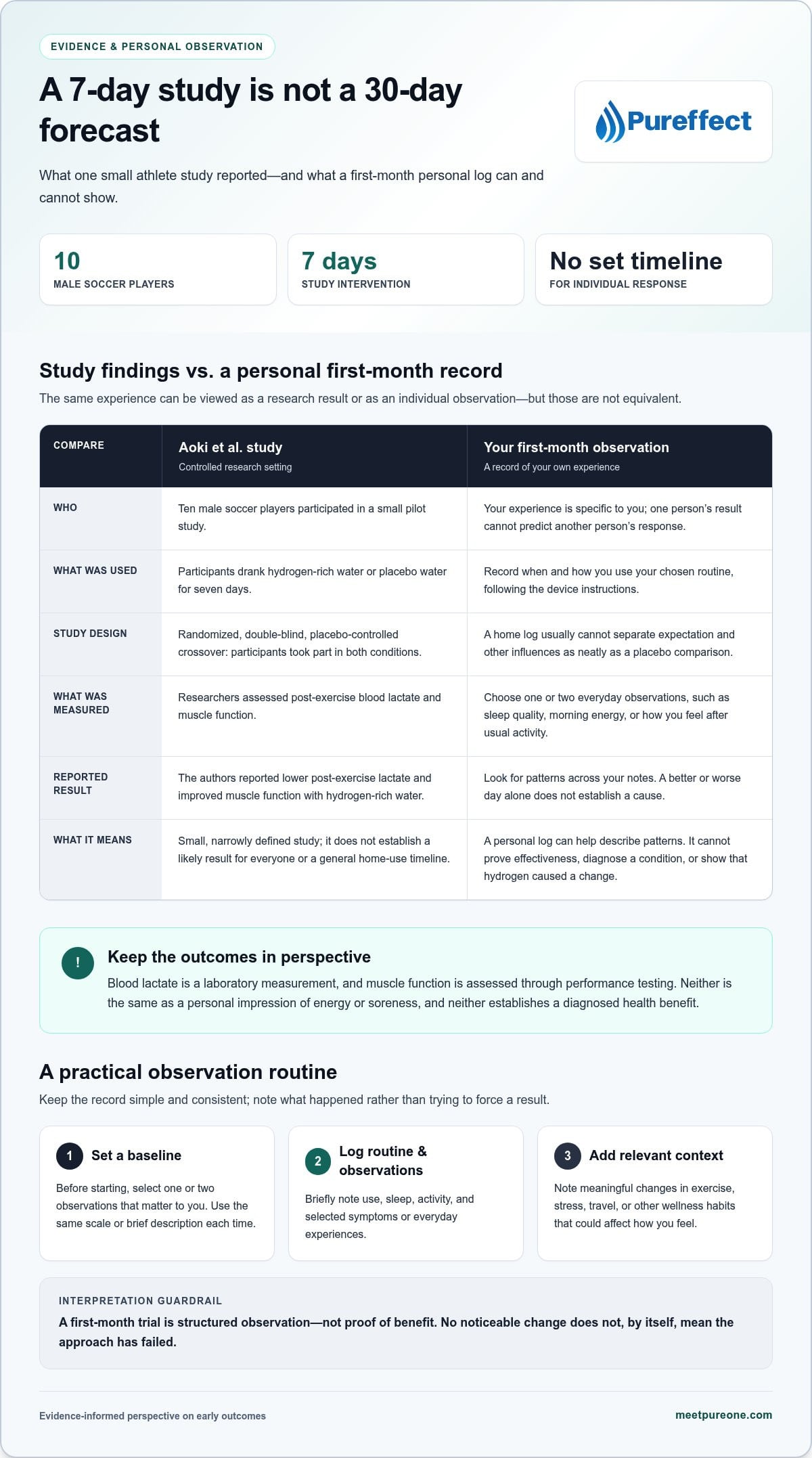
One example is Aoki and colleagues’ 2012 pilot study, “Pilot study: Effects of drinking hydrogen-rich water on muscle fatigue caused by acute exercise in elite athletes.” Ten male soccer players took part in a randomized, double-blind, placebo-controlled crossover study. They drank hydrogen-rich water or placebo water for seven days, and researchers assessed post-exercise blood lactate and muscle function. The authors reported lower post-exercise lactate and improved muscle function with hydrogen-rich water. The crossover design let participants take part in both conditions, but the study was still small and focused on trained male athletes. It examined drinking water over a week, so it doesn’t establish a likely result for everyone or a general home-use timeline.
For relevant exercise-research context, see The Science of Hydrogen Therapy for Athletic Recovery: A Research-Driven Guide. Findings about exercise recovery shouldn’t be generalized to unrelated goals or health conditions.
How to interpret study duration and measured outcomes
A seven-day intervention provides a different window from a first-month routine, and its results don’t tell us what will happen by day 30. Blood lactate is a laboratory measurement; muscle function is assessed through performance testing. Neither is the same as a person’s impression of energy or soreness, and neither establishes a diagnosed health benefit. The study’s small, narrowly defined participant group also limits how widely its findings can be applied.
Why early impressions are not the same as proof
How you feel is still worth noticing. Sleep, activity, stress, expectations, and normal day-to-day variation can all shape symptoms and impressions. In a study, a placebo comparison helps researchers account for some effects of expectation. An individual home trial usually can’t separate these influences as neatly.
So, treat what to expect in the first month of hydrogen therapy as a question to observe, not a result a study can guarantee. Record personal experiences as just that, and don’t treat them as proof of cause or as a substitute for clinical assessment. If you’re comparing a home-use option with your routine, the PureONE Molecular Hydrogen Generator is designed for home use.
How to Track Your First Month of Hydrogen Therapy Without Overreading Results
A simple record can make your experience easier to review. Keep it practical, and remember: a personal log can reveal patterns, but it can’t prove treatment effectiveness. The aim is to note what happened, not to diagnose yourself or force a result.
Set a baseline before the first session
Before starting, choose one or two observations that matter to you. For example, note your sleep quality and how you feel after your usual walk. Use the same scale or brief description each time, and record your typical routine as a point of comparison.
- Record your routine: Note when and how you use hydrogen therapy, following the device instructions.
- Track a few observations: Briefly log sleep, activity, and selected symptoms or everyday experiences.
- Note relevant changes: Record significant shifts in exercise, stress, travel, or other wellness habits that could affect how you feel.
Keep other routines as stable as practical during the observation period. If you want a clearer read on what to expect in the first month of hydrogen therapy, avoid introducing several new wellness practices at once. Otherwise, it’s harder to judge what may be related to your experience.
Review the month without forcing a conclusion
Look for repeated patterns, not one unusually good or difficult day. Did you notice a similar experience on several occasions, or did it vary with sleep, activity, or changes in your routine? Treat “no noticeable change” as a valid observation. It isn’t a reason to increase use beyond the device instructions.
Your notes can help you describe your experience, but they can’t establish cause, measure clinical changes, or replace medical assessment. If you have a health condition or are considering a change to your care or treatment, discuss your concerns with a qualified clinician.
For a closer look at a home-use option, review the PureONE Molecular Hydrogen Generator.
Choosing a Home Hydrogen Therapy Routine: Where PureONE Fits
A home routine is most useful when it fits your day and the outcome you want to observe. Compare options by practical factors: delivery method, how easily you can follow the instructions, how consistently you can use the routine, and whether human research has examined a similar method for a similar outcome. A study of hydrogen-rich water, for example, doesn’t automatically answer questions about inhalation or skin application.
For a broader practical comparison, see Hydrogen Inhalation Machine vs. Water Bottle: Which Is Right for You? Rather than choosing the method that sounds more advanced, consider which option matches your intended use and routine. Keep expectations aligned with the evidence. Knowing what to expect in the first month of hydrogen therapy starts with choosing a routine you can follow, not assuming one delivery method is superior.
How PureONE can fit a considered home routine
The PureONE Molecular Hydrogen Generator is designed for home use and supports hydrogen inhalation, hydrogen-infused water, and direct skin application. It offers four therapeutic modes, giving you several ways to incorporate it into a home routine.
PureONE is manufactured in Canada and produces a consistent mixture of 66% molecular hydrogen and 33% oxygen. These are product details, not evidence that a particular health outcome will follow. Use the device according to its instructions, and assess it by the same practical standards you’d apply to any home-use option: whether the routine is manageable and whether the research relates to your goal.
Pureffect offers a 365-day risk-free trial. Review the PureONE Molecular Hydrogen Generator details and trial terms to decide whether the device and its routine suit your preferences and expectations.
Make Your Next Step an Informed One
The clearest answer to what to expect in the first month of hydrogen therapy is that there’s no guaranteed timeline. Human studies examine specific groups, methods, and outcomes, so they can offer context without predicting your personal response. A steady routine and brief notes on sleep, activity, or selected symptoms can help you reflect on your experience, but they can’t prove what caused a change.
PureONE is designed for home use and offers four therapeutic modes, including hydrogen inhalation, hydrogen-infused water, and skin application. These features can help you assess how the device might fit your routine, but they aren’t promises of a health outcome.
Consider the device details, trial terms, and your own expectations before deciding. Explore the PureONE Molecular Hydrogen Generator.
Stay curious, keep your expectations grounded, and let careful observation guide your next step.
Frequently Asked Questions
What should I expect during the first week of hydrogen therapy?
There’s no established experience everyone should expect during week one. You might notice a subjective difference, or you might notice no change. Research findings depend on the participants, delivery method, study duration, and outcome measured, so they can’t predict your personal response. Follow your device instructions and record a baseline. Brief daily notes can help, but one unusually good or difficult day isn’t proof of benefit.
How long does hydrogen therapy take to work?
There’s no universal, evidence-based timeline that predicts when an individual will notice a change. Studies examine different uses and outcomes over different periods, so their results shouldn’t become a personal deadline. Track your experience consistently and note other routine changes that could affect how you feel. Be cautious of claims that promise results within a fixed number of days; research doesn’t establish a guaranteed response schedule.
Is it normal to feel nothing during the first month of hydrogen therapy?
Yes. Not noticing a change is a valid experience, but it doesn’t establish whether hydrogen therapy is effective or ineffective for you. Personal perception differs from a clinical measurement. Focus on following instructions and recording a few consistent observations. Don’t increase use or change medical care based only on the absence of perceived effects.
Can hydrogen therapy reduce inflammation within a month?
You shouldn’t assume it will. To assess a finding about inflammation, look at the study participants, hydrogen delivery method, duration, and the specific measure used. A result in one study doesn’t guarantee the same outcome for an individual or establish a one-month timeline. If you have concerns about inflammation or are considering a treatment decision, discuss your situation with a qualified clinician rather than relying on personal impressions alone.
How should I track results during my first month of hydrogen therapy?
Choose what you want to observe, record your starting point, and use the same simple method throughout the month. For example, note your routine, sleep quality, activity, and one or two selected symptoms. Record changes in exercise, stress, or other habits that may affect your experience. Review repeated patterns rather than isolated days. A personal log can support reflection, but it can’t diagnose a condition or prove cause.
Is hydrogen therapy a replacement for medical treatment?
No. Don’t stop, delay, or change prescribed treatment because you’re trying hydrogen therapy or think you’ve noticed a change. Research findings and personal experiences vary, and tracking your own observations isn’t a substitute for medical assessment. If you have a health condition, take medication, or are considering changing your treatment, discuss your situation with a qualified healthcare professional. Keep your clinician informed about approaches you’re considering.
Disclaimer
The information provided by Pureffect and any of its products are for educational and informational purposes only and is not intended as medical advice. Individual results may vary, and no specific health outcomes are guaranteed. Always consult a qualified healthcare professional before starting any wellness practice or product.