
What if the most useful biohack isn’t a gadget or a complicated protocol, but a small habit you can stick with? If conflicting wellness advice has left you unsure what’s evidence-based, you’re not alone. This beginner’s guide to biohacking takes a practical approach: start with the basics, test one change at a time, and stay curious without treating every health claim as fact.
Biohacking can mean anything from adjusting your sleep routine to trying an emerging wellness tool. But the label doesn’t guarantee that an idea works, or that research in a lab translates into a real-world benefit. Some practices have stronger evidence than others, and personal experience alone can’t show what caused a change.
Here, you’ll learn what biohacking means, where its limits are, and how to choose simple, evidence-informed habits that fit your life. You’ll also find a straightforward way to track what you try, notice possible downsides, and avoid mistaking coincidence for cause. No expensive setup is required. Start with a clear question and see what genuinely helps.
Key Takeaways
- This beginner’s guide to biohacking separates everyday habit experiments from medical treatment and hype.
- See how evidence for sleep, movement, nutrition, and stress practices compares, and why research findings need context.
- Choose a clear wellbeing goal and a simple measure to judge whether a habit fits your life.
- Learn where molecular hydrogen research stands, and why emerging wellness options belong behind foundational habits.
What Is Biohacking? A Beginner-Friendly Definition Without the Hype
Biohacking means intentionally changing your habits or surroundings and observing how those changes affect your wellbeing. It’s a broad, informal term, not a standardized medical treatment or a guarantee that a practice works. The useful distinction is simple: make a thoughtful change, notice what happens, and keep your conclusion proportionate to the evidence.
The label covers everything from everyday routines to wearable devices, supplements, and experimental interventions. A community-edited overview of Biohacking describes some of that breadth, but the term itself doesn’t tell you whether an approach is safe or well-supported. Assess each practice on its own merits.
What counts as biohacking in everyday life?
You don’t need specialized equipment. Getting outdoor light in the morning, keeping a more consistent bedtime, or taking a short walk after a meal can all count if you’re deliberately trying the habit and paying attention to its effects. These changes are low-cost and easy to fit into daily life. A device or supplement may be part of someone’s experiment, but neither is a prerequisite.
Make your observations more useful by choosing a measure connected to your goal. If you’re adjusting your evening routine, note your bedtime consistency and how rested you feel in the morning. Those records can help you decide whether the change seems worth keeping, but they can’t establish what caused a difference.
A personal experiment can show what you noticed; it doesn’t prove the same intervention will work for everyone. Sleep, schedules, health, and individual responses vary. One person’s positive experience can prompt a question, but it isn’t universal evidence.
Biohacking, wellness trends, and medical care are not interchangeable
Tracking can inform personal choices, but a journal, wearable, or app can’t diagnose a condition. A wellness experiment shouldn’t replace medical advice. Don’t stop prescribed treatment or delay care because a habit, device, or supplement seems promising. Discuss health concerns and treatment changes with a qualified healthcare professional.
That doesn’t make every biohacking idea meaningless. Some habits have stronger research behind them than others, while emerging interventions may have limited or uncertain evidence. Stay curious, consider risks, and separate what you observe personally from what clinical research has established.
What Does the Research Say About Biohacking’s Core Health Habits?
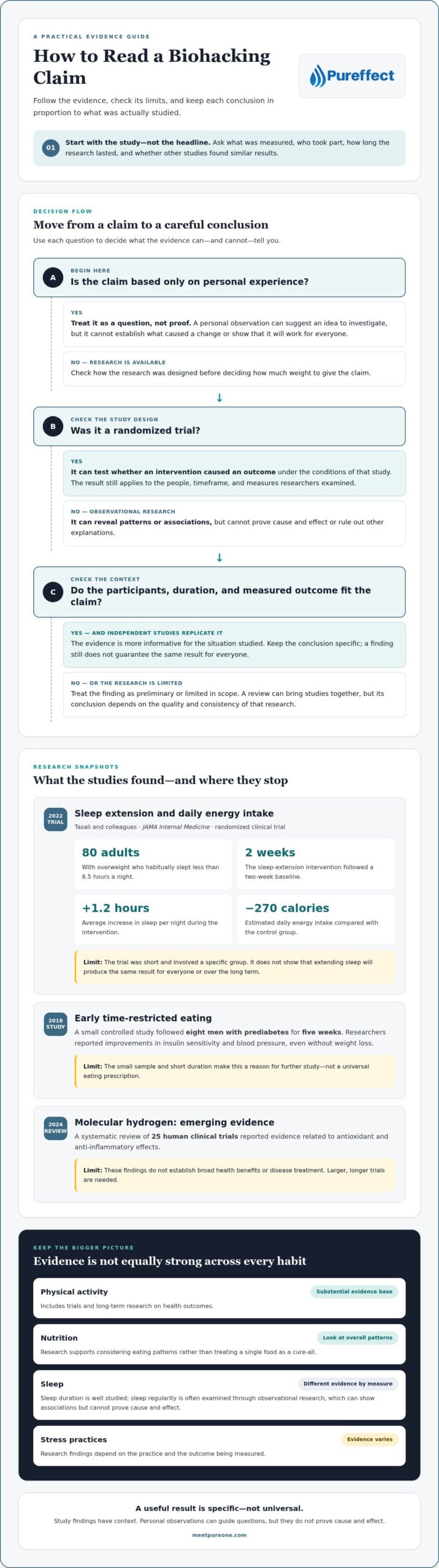
Research doesn’t support every habit or wellness trend equally. Physical activity has a substantial evidence base, including trials and long-term research on health outcomes. Nutrition research also supports looking at overall eating patterns rather than treating a single food as a cure-all. Sleep duration is well studied, while sleep regularity is often examined through observational research. Such studies can show associations, but they can’t prove cause and effect. Evidence for stress practices varies by method and outcome.
A useful example is a 2022 randomized clinical trial by Tasali and colleagues, published in JAMA Internal Medicine. Researchers studied 80 adults with overweight who habitually slept less than 6.5 hours a night. After a two-week baseline, participants assigned to sleep-extension counseling increased their sleep by about 1.2 hours per night during the two-week intervention. Their daily energy intake fell by an estimated 270 calories compared with the control group. The trial was short and involved a specific group, so it doesn’t show that extending sleep will produce the same result for everyone or over the long term.
Early time-restricted eating has also shown promising but limited findings. In a small 2018 controlled study, eight men with prediabetes followed an early eating schedule for five weeks. Researchers reported improvements in insulin sensitivity and blood pressure, even without weight loss. The narrow sample and short duration make this a reason for further study, not a universal eating prescription.
How to tell strong evidence from an exciting headline
Randomized trials can test whether an intervention caused an outcome under specific conditions. Observational studies reveal patterns but can’t rule out other explanations. Reviews bring multiple studies together, though their conclusions depend on the quality and consistency of the research. Personal anecdotes can suggest questions, not settle them. Check who participated, how many people were studied, how long the research lasted, what was measured, and whether independent studies replicated the result. A statistically detectable change isn’t automatically meaningful in everyday health.
One study can offer a useful clue, but it can’t establish that a biohack works for everyone. Keep that principle in mind as you assess evidence and personal results.
What molecular hydrogen research can and can’t show
Molecular hydrogen remains an emerging research area, not a foundational health habit. A 2024 systematic review of 25 human clinical trials reported evidence related to antioxidant and anti-inflammatory effects. Those findings don’t establish broad health benefits or disease treatment; larger, longer trials are needed. If you’re curious about a home device, explore the PureONE Molecular Hydrogen Generator as an optional wellness product, while keeping product information separate from clinical evidence.
How to Start Biohacking Safely: A Simple One-Change-at-a-Time Plan
A useful experiment doesn’t need a dashboard or a full routine overhaul. Keep it small enough to repeat, simple enough to track, and easy to stop if it doesn’t suit you. The practical heart of biohacking is changing one everyday behavior, then assessing what you observe without assuming you’ve proved cause and effect.
Choose a low-risk experiment with a clear question
Turn a broad goal into a question you can answer. For example: “If I keep the same wake time on workdays, do I feel more alert before lunch?” Choose one habit, such as setting a regular wake time or preparing what you need for the morning the night before. Avoid restrictive diets, supplement stacks, or changes to prescribed care as do-it-yourself experiments.
- Choose one goal. Be specific about what you want to notice, such as steadier daytime energy.
- Record a baseline. Before changing anything, note your usual wake time and rate your daytime energy in a simple journal.
- Change one habit. Follow your chosen routine while keeping other habits as consistent as practical.
- Review the pattern. Compare your notes with the baseline. Look at the overall pattern, not one unusually good or rough day.
- Decide what’s next. Keep the habit if it feels worthwhile, adjust it, or return to your usual routine.
Track the result without overreading the data
Use the simplest measure that answers your question. A note of your wake time and a quick energy rating may be more useful than collecting every metric a wearable offers. Add brief context when something could affect the result, such as illness, travel, medication changes, disrupted sleep, or an unusually busy routine. These factors can muddy the picture, so don’t credit or blame a habit for every change.
Gather enough consistent observations to look for a pattern, but don’t treat the experiment as a diagnosis. Stop a change if it causes concerning symptoms and seek appropriate clinical advice. Don’t stop or alter prescribed treatment based on a personal test.
If you’re exploring a wellness tool as a separate, optional area of interest, you can learn about the PureONE Molecular Hydrogen Generator. It isn’t a substitute for a simple habit experiment or for medical care.
Where Molecular Hydrogen Fits, and How to Keep Your Approach Grounded
Sleep, regular movement, and balanced nutrition are a stronger starting point for a wellness routine than optional technologies. Molecular hydrogen is an area of ongoing study, but interest in a wellness tool shouldn’t be confused with proof that it improves everyday health. Proposed biological effects and demonstrated benefits for people are different questions.
How to evaluate an emerging wellness tool
Start with the claim. Does it describe a proposed mechanism, or an outcome researchers measured in people? A mechanism may help explain why an intervention could matter, but it doesn’t establish that it improves a health outcome. Look for human clinical studies measuring outcomes relevant to the claim. Check who participated, how long the study lasted, and whether its limitations are clearly described. Findings in one group or on one measure may not apply broadly.
Product information and clinical evidence serve different purposes. A product description can tell you what a device is designed to offer; it can’t demonstrate a health benefit on its own. Molecular hydrogen shouldn’t replace medical care or prescribed treatment. If you’re considering an emerging wellness option alongside a health condition or treatment, discuss your circumstances with a qualified clinician.
The PureONE Molecular Hydrogen Generator is a home device with four therapeutic modes, including hydrogen inhalation, hydrogen-infused water, and topical use. These are ways to use the device, not proof of a clinical outcome. Keeping that distinction clear is a grounded way to explore the topic.
Build a sustainable routine before adding more tools
If you’re curious about hydrogen delivery formats, read this hydrogen inhalation and water comparison. Then choose one low-risk experiment, track a relevant outcome, and review what you notice honestly. Explore the PureONE Molecular Hydrogen Generator to learn about the device’s four modes for inhalation, hydrogen-infused water, and topical use.
Make Your Next Health Experiment Simple and Sustainable
A beginner’s guide to biohacking starts with curiosity, not complexity. Focus first on everyday habits, consider the quality and limits of the evidence, and test one low-risk change at a time. A simple record can help you notice patterns, but it can’t prove that a change will work for everyone or replace medical guidance.
Emerging wellness options, including molecular hydrogen, may be interesting to explore, but they belong alongside foundational habits, not in place of them. PureONE is a home molecular hydrogen generator manufactured in Canada. Pureffect offers a 365-day risk-free trial.
If you’d like to learn more about this optional wellness tool, explore the PureONE Molecular Hydrogen Generator. Whatever you choose, keep your approach manageable: pick one change, observe honestly, and continue only if it fits your life. Small, thoughtful steps are a more sustainable starting point than chasing every new trend.
Frequently Asked Questions
What is biohacking in simple terms?
Biohacking is intentionally changing a habit or your surroundings and observing how it affects your wellbeing. That could mean trying a steadier sleep routine or adjusting your daily schedule. The term is broad and informal, not a specific medical treatment. Think of it as a way to explore personal habits, while remembering that what you notice about yourself doesn’t prove the same change will help everyone.
Is biohacking scientifically proven?
Biohacking as a whole isn’t scientifically proven because it covers many different practices. Evidence depends on the specific habit, device, or supplement. Core health behaviors have research behind them, while some newer interventions have limited or early findings. Check what researchers measured, who took part, and whether results have been replicated. A personal improvement may be worth noting, but it isn’t proof that an intervention caused the change.
How can a beginner start biohacking safely?
Start with one low-risk habit and a clear question, such as whether a regular wake time helps you feel more alert. Record your usual pattern first, then track a simple measure and relevant context, like travel, illness, or disrupted sleep. Avoid changing several things at once, and don’t experiment by stopping prescribed care. This keeps the test manageable and makes observations easier to interpret.
Can biohacking replace medical treatment?
No. Personal experiments, wellness devices, and tracking apps aren’t substitutes for diagnosis or treatment from a qualified healthcare professional. Don’t stop medication, change a treatment plan, or delay care because a wellness practice seems helpful. If you have a health condition, concerning symptoms, or questions about combining an intervention with treatment, discuss your situation with a clinician. Personal tracking can support a conversation, but it can’t diagnose a condition.
Do you need expensive devices to start biohacking?
No. A device isn’t required. You can test a simple behavior using a notebook or a basic note on your phone. For instance, record a chosen routine and one relevant outcome, such as perceived daytime energy. Wearables may offer additional measurements, but more data doesn’t automatically mean clearer insight. Begin with an easy, low-cost habit you can repeat, then decide whether a tool would answer a specific question.
What does research say about molecular hydrogen therapy?
Molecular hydrogen is an emerging research area, not an established replacement for medical care. A 2024 systematic review of 25 human clinical trials reported evidence related to antioxidant and anti-inflammatory effects. That finding doesn’t establish that hydrogen treats a disease or produces broad benefits in everyday life. The studies’ limitations and the need for larger, longer trials matter. Consider product information separately from clinical evidence, and discuss personal health questions with a qualified clinician.
Disclaimer
The information provided by Pureffect and any of its products are for educational and informational purposes only and is not intended as medical advice. Individual results may vary, and no specific health outcomes are guaranteed. Always consult a qualified healthcare professional before starting any wellness practice or product.