
What if two hydrogen inhalation studies reach different conclusions because they use different exposure schedules? That’s one reason advanced protocols for hydrogen inhalation can be difficult to compare. Researchers may vary gas concentration, session length, timing, and measured outcomes, so a protocol from one study is not automatically a guide for everyday use.
It’s reasonable to want clear answers about what to inhale, for how long, and how often. But research protocols are designed to investigate specific questions in specific groups, not to prescribe a routine for everyone. Early human findings may be encouraging, yet they don’t establish that hydrogen inhalation treats a particular condition or works the same way in other settings.
This article explains how to read the details more confidently. We’ll look at the protocol variables researchers report, how study design affects what results can tell us, and which practical and safety questions matter when considering a home device. The aim isn’t to turn experimental methods into personal instructions. It’s to provide a framework for weighing evidence and discussing personal health questions with a qualified clinician.
Key Takeaways
- “Advanced” describes how thoroughly a protocol is documented, not proof that it is more effective or established as treatment.
- When comparing advanced protocols for hydrogen inhalation, look at who was studied, how exposure was delivered, the schedule, the measured outcomes, and the study’s limitations.
- Record details a paper leaves unclear as unreported. Don’t fill gaps with assumptions.
- Research equipment and home devices may differ. Don’t assume their protocols are equivalent without supporting evidence.
- PureONE offers four modes, including hydrogen inhalation, and its stated gas mixture is 66% molecular hydrogen and 33% oxygen.
What Makes a Hydrogen Inhalation Protocol “Advanced”?
A hydrogen inhalation protocol documents how exposure was delivered, the schedule, the participants, and the outcomes measured in a study. “Advanced” means those details are reported clearly enough to help readers understand and compare the research. It doesn’t mean the approach is proven superior or established as a medical treatment.
That distinction matters. A paper may describe a carefully controlled experiment, but its protocol is still a research method, not a personal plan. For a general introduction to the topic and its proposed mechanisms, see Hydrogen therapy. An overview can provide context, but study methods and results need to be assessed on their own.
Which details make a protocol interpretable?
Start with the exposure details, then consider who took part and what researchers measured. A clear report may specify:
- Delivery: Gas concentration, flow rate, and how inhalation was administered.
- Schedule: Session duration, frequency, and total study period.
- Study context: Participant characteristics and the research question.
- Outcomes: Measures used to assess effects or safety.
These details answer different questions. Flow rate describes how much gas is delivered over time; concentration describes the proportion of hydrogen in the gas. Neither, on its own, fully describes a participant’s exposure. When a paper omits a setting or schedule, mark it as unreported rather than guessing. Otherwise, two protocols can appear more comparable than the published details support.
Why research schedules are not prescriptions
A study schedule is designed for a defined group and research question. Researchers may choose a particular exposure and timing to investigate a specific outcome under monitored conditions. That doesn’t show the same schedule is safe or effective for people with different health circumstances or a different purpose.
Treat published protocols as evidence to evaluate, not instructions to copy. The phrase advanced protocols for hydrogen inhalation describes detailed research methods; it doesn’t establish an individualized dose or routine. If you’re considering inhalation and have personal health questions, discuss them with a qualified clinician.
What Human Research Says About Hydrogen Inhalation Protocols
Human studies have examined different populations, exposure schedules, and endpoints. Those differences affect what each result can show. A safety finding in one group doesn’t establish a health benefit, and a change in a measured marker doesn’t automatically translate into a meaningful clinical outcome.
| Population | Design and delivery | Schedule and reported outcome | Key limitation |
|---|---|---|---|
| Hospitalized patients with COVID-19 | Phase I trial; inhaled hydrogen concentration reported as 3.6% | Up to 72 hours; the summary reports the exposure was safe | Sample size, comparison group, and clinical efficacy outcomes aren’t specified in the available study summary |
| Healthy adults | Human safety study; continuous inhalation at 2.4% | Up to 72 hours; no clinically significant adverse events were reported | Safety in healthy adults doesn’t establish safety or benefit for other populations |
| Participants in a cycling study | Human study; inhaled hydrogen-rich gas | 60 minutes before cycling; reported lower perceived fatigue and post-exercise serum lactate than placebo | Participant details, sample size, and study design aren’t stated in the available summary; these endpoints don’t establish broader benefits |
| People with asthma and COPD | Human study; inhalation exposure | One 45-minute session; reported reductions in measured inflammatory cytokines IL-4 and IL-6 | Sample size, comparison details, and clinical significance aren’t provided in the available summary |
The table illustrates why outcomes need to be read in context. The COVID-19 trial summary describes safety during exposure of up to 72 hours, not evidence that inhalation treats the infection. The cycling study reports changes in perceived fatigue and serum lactate, while the asthma and COPD study reports changes in two measured cytokines after one session. These are different populations, schedules, and endpoints; none by itself establishes a general health benefit.
How study design changes what a result can show
Sample size affects how precisely a study can estimate an effect. Comparison groups help show whether an outcome differs from what might otherwise occur, while blinding can reduce bias in some measurements. Short follow-up leaves longer-term effects unanswered. An exploratory result is a reason for further study, not evidence that a finding has been replicated.
The summaries above don’t provide enough bibliographic or methods detail to verify peer-review status, sample sizes, or all comparison and blinding procedures. Treat them as preliminary descriptions, not citation-ready evidence. The phrase advanced protocols for hydrogen inhalation doesn’t change that: review each paper’s full methods and limitations before drawing conclusions.
After reviewing how to assess protocol details, you can explore PureONE device information as a separate step from interpreting clinical evidence.
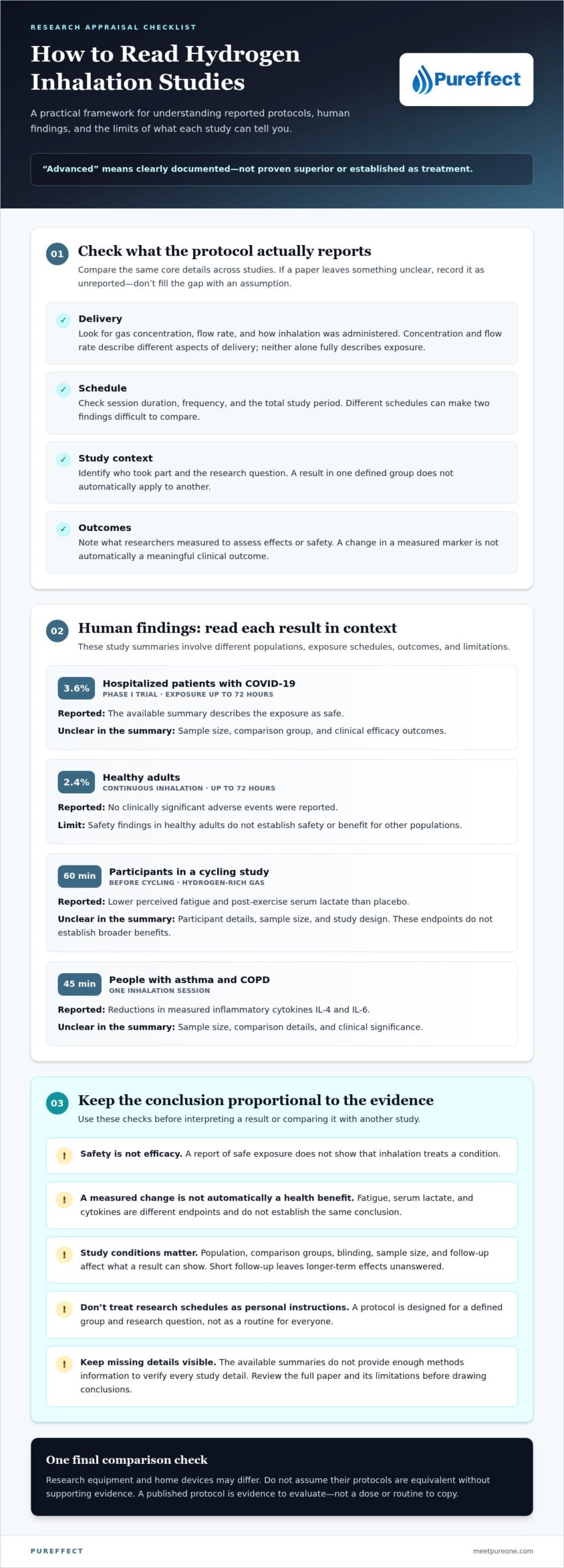
How to Evaluate an Inhalation Protocol Without Self-Prescribing
A paper can look precise at first glance yet leave out details needed to compare its findings with another study. Use this appraisal to separate what researchers reported from what you might be tempted to assume.
- Identify the source. Find the full paper, publication details, and any registration or supplementary methods. Don’t rely on an abstract or promotional summary alone.
- Check the population. Note who participated, their health context, and whether the findings apply only to that group.
- Record delivery details. Look for hydrogen concentration, flow rate, and how inhalation was administered. Mark missing information as “not reported.”
- Write down the schedule. Check session duration, frequency, and total exposure period. Don’t infer details the paper leaves out.
- Identify the endpoint. Was the study measuring symptoms, a clinical event, a lab marker, or safety? These outcomes aren’t interchangeable.
- Read the limitations and disclosures. Consider study size, comparison groups, follow-up, and any reported conflicts of interest alongside the authors’ conclusions.
Compare like with like: similar participant groups, delivery methods, schedules, and measured outcomes. If these don’t match, different results may reflect differences in the studies rather than a clear advantage of one protocol. This is how to assess advanced protocols for hydrogen inhalation without turning a research report into a personal plan.
A study schedule describes research methods, not a universal personal dose. Your health history, medications, symptoms, and current care all matter. Discuss personal questions with a qualified clinician, review the device instructions, and don’t modify equipment or create an exposure schedule.
For foundational background, explore What Is Molecular Hydrogen? The Science of Cellular Health in 2026. To consider how delivery approaches differ, see Hydrogen Inhalation Machine vs. Water Bottle: Which Is Right for You?.
If you’re exploring a home device after reviewing the evidence, view PureONE device information for its inhalation mode and product details.
Applying the Evidence to a Home Hydrogen Inhalation Device
A study’s equipment and a home device may deliver hydrogen differently. Even when both involve inhalation, the reported concentration, flow, delivery setup, and exposure schedule may not match. Similar labels don’t prove equivalent exposure. Don’t assume a home device reproduces a research protocol unless the relevant specifications have been compared.
What to compare between a study and a home device
Compare details reported for both. For example, compare a study’s stated gas composition with the device information only when each describes composition in a comparable way. A mixture specification alone doesn’t tell you the concentration a person inhales under study conditions, or establish a session length or frequency.
- Compare like with like: Check delivery method, composition or concentration, flow, and exposure details only where both sources report them.
- Mark differences clearly: If a study uses a different setup, or a key detail is missing, record that gap rather than treating the methods as interchangeable.
- Keep evidence in context: A device feature describes the product. It doesn’t demonstrate a medical outcome or establish a personal schedule.
PureONE is a home-use molecular hydrogen generator with four therapy modes, including hydrogen inhalation, hydrogen-infused water, and topical application. The company describes its produced gas mixture as 66% molecular hydrogen and 33% oxygen. This information helps explain the device’s stated output, but it isn’t a research protocol and doesn’t establish how long or how often someone should inhale.
A considered next step for home use
Before considering use, read the device instructions and keep expectations grounded in what the research measured. Following the instructions can help you use the device as intended, but consistency itself isn’t evidence of clinical benefit. For personal health questions, discuss your circumstances with a qualified clinician rather than adapting a study schedule on your own.
If you’d like to review the device details alongside the research, take a look at the PureONE hydrogen generator. A careful comparison can help you understand what product information does and doesn’t establish.
To explore the product further, view the PureONE device and its details. Pureffect offers a 365-day risk-free trial.
Make Your Next Step an Informed One
Advanced protocols for hydrogen inhalation are research methods, not ready-made personal routines. Compare what studies actually report: who participated, how inhalation was delivered, the schedule, and the outcomes measured. Missing details and study limitations matter. Don’t fill gaps with assumptions or treat an early finding as proof of benefit.
For home use, product specifications and study conditions aren’t automatically equivalent. PureONE offers four therapy modes, including hydrogen inhalation. Pureffect describes its gas output as a mixture of 66% molecular hydrogen and 33% oxygen. These details describe the device, not a proven health outcome or personal inhalation schedule.
Explore the PureONE Molecular Hydrogen Generator and its 365-day risk-free trial, keeping product specifications distinct from clinical evidence.
Stay curious, keep expectations grounded, and bring personal health questions to a qualified clinician. A thoughtful next step is still progress.
Frequently Asked Questions
What is an advanced hydrogen inhalation protocol?
An advanced hydrogen inhalation protocol is a clearly documented research method describing how exposure was delivered, its schedule, who participated, and what outcomes researchers measured. Reports may include concentration, flow, session duration, and frequency. “Advanced” refers to the level of detail, not proof of superior results. These protocols help readers assess research, but they aren’t automatically established treatments or suitable personal instructions.
How long should you inhale molecular hydrogen?
There’s no single duration that can be recommended from the research summaries discussed here. Published schedules vary according to the study’s question, participants, and delivery method. A session length reported in one paper shouldn’t be treated as a general-use recommendation. For personal-use questions, follow the device instructions and discuss your health circumstances with a qualified clinician rather than choosing a duration by extrapolating from a study.
Is hydrogen inhalation supported by human research?
Human studies have explored safety and possible effects, but the evidence remains limited and varies by design, population, exposure details, and outcome. A finding in one group or on one measured endpoint doesn’t establish a general health benefit, and early results aren’t the same as replicated clinical evidence. The study examples above show why each paper needs to be interpreted within its specific context, not as established treatment guidance.
Can you use a research protocol at home?
A research protocol isn’t automatically a personal-use plan. Study participants, equipment, exposure conditions, and oversight may differ from home circumstances, and a paper may not report every detail needed to compare delivery. Don’t adapt or copy a schedule based on an abstract or isolated result. Review the home device instructions, and discuss personal health questions with a qualified clinician before making decisions about use.
What should you compare when evaluating hydrogen inhalation studies?
Compare the participant population, study design, delivery method, reported concentration and flow, schedule, measured outcomes, and limitations. Check whether the study used a comparison group and how long participants were followed. Missing details matter because they can make it difficult to compare exposure or interpret results. Record what the paper doesn’t report rather than assuming one study used the same conditions as another.
Is hydrogen inhalation a substitute for medical care?
No. The research discussed here doesn’t establish hydrogen inhalation as a replacement for diagnosis, prescribed treatment, or advice from a qualified clinician. Early findings in particular populations or on specific measured outcomes can’t determine what’s appropriate for an individual. Don’t delay or change medical care based on a study protocol or wellness information. Talk with a qualified professional about health decisions, especially if you have symptoms or an existing condition.
Disclaimer
The information provided by Pureffect and any of its products are for educational and informational purposes only and is not intended as medical advice. Individual results may vary, and no specific health outcomes are guaranteed. Always consult a qualified healthcare professional before starting any wellness practice or product.