
What is the best time of day to inhale hydrogen? Current research hasn’t identified a particular hour that works best for general wellness. Studies have tested different schedules, including inhalation around exercise, while a sleep-disorder study reported its sessions without specifying the time of day.
Those protocols show what researchers tested, not that a particular routine is best for everyone. They also don’t establish whether morning, evening, meal timing, or exercise timing changes outcomes. Without direct comparisons, choosing a biologically superior time would go beyond the evidence.
This guide looks at what the reported study schedules and outcomes can tell you, how to assess a timing claim, and how to choose a practical routine. The aim is to make an informed choice, follow your device’s guidance, and keep wellness claims in perspective.
Key Takeaways
- Research hasn’t established a universal best time of day to inhale hydrogen. Study schedules are research protocols, not proven timing advice.
- When assessing a study, look at who took part, when inhalation took place, and which outcome researchers measured.
- Start with the goal you have in mind, then choose a time you can follow consistently and that fits your device’s instructions.
- A convenient routine may be easier to maintain, but convenience doesn’t show that morning, evening, or meal timing has a biological advantage.
- PureONE is a home-use option with four modes, including hydrogen inhalation, and a stated mixture of 66% molecular hydrogen and 33% oxygen.
Best Time of Day to Inhale Hydrogen: What We Know
There’s no established universal best time of day to inhale hydrogen. Human research hasn’t shown that morning or evening sessions lead to better outcomes across the board. Hydrogen inhalation means breathing a gas mixture that contains molecular hydrogen. A study protocol may also specify the concentration used, how long each session lasts, and how often sessions take place. Those details matter when comparing findings, but none establishes an ideal time of day on its own.
Study schedules describe what researchers tested, not necessarily the schedule that works best for other people. For a broader introduction to molecular hydrogen therapy and its research context, see the general overview. A general summary, however, is not proof of a timing recommendation.
Does morning or evening hydrogen inhalation have an established advantage?
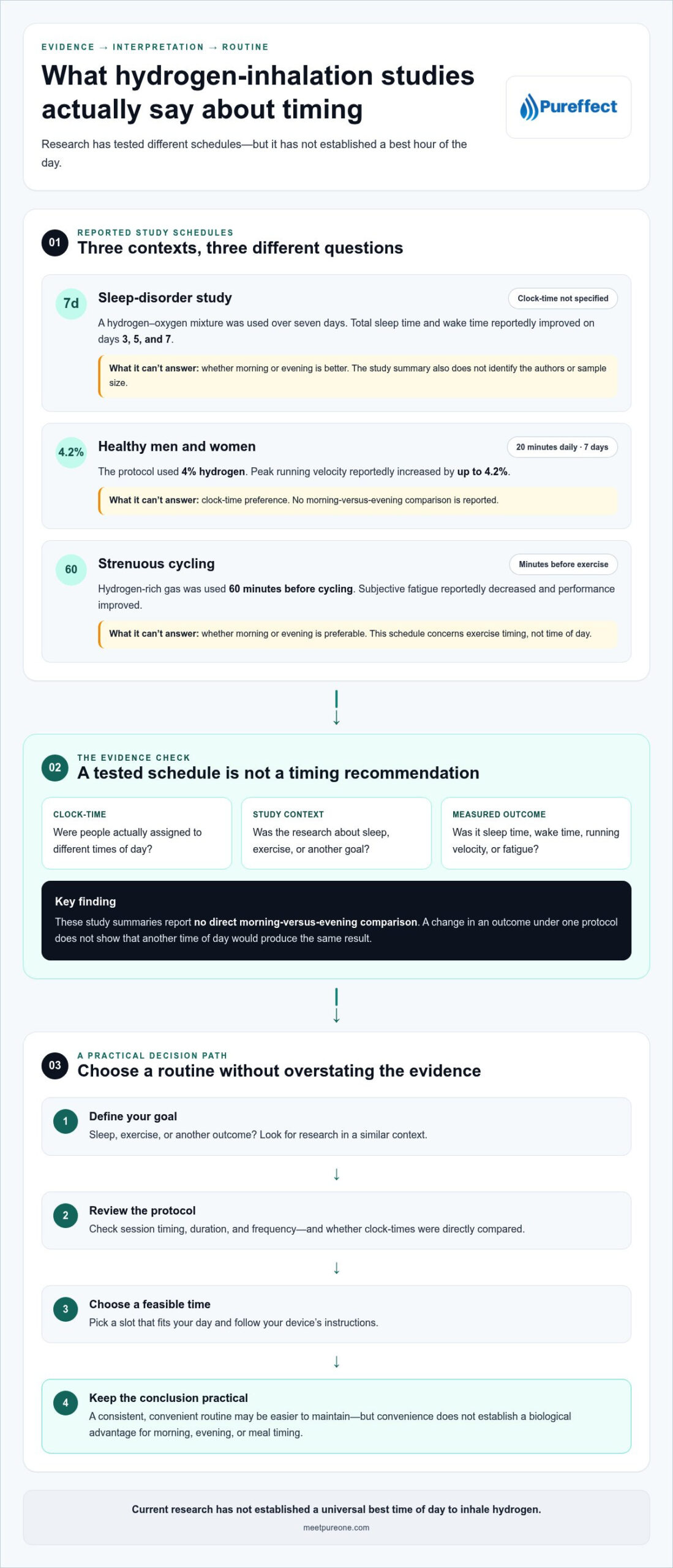
Current evidence doesn’t establish a reliable advantage for either time of day. A study of people with sleep disorders reported improvements during a seven-day inhalation protocol, but didn’t specify whether sessions took place in the morning or evening. The study therefore can’t answer which time is better. Circadian rhythms may be relevant questions for future research, but they aren’t evidence of a timing effect in hydrogen-inhalation studies.
Evidence-based answer: research has not established that inhaling hydrogen in the morning or evening is better for general health. Without a direct comparison of those schedules, calling one biologically superior would go beyond the reported evidence.
What does “best time” mean for an individual routine?
“Best” can mean a time that’s easy to repeat, or a time shown to improve a measured outcome. The first is a practical choice; it doesn’t prove the second. Timing also depends on the question a study is designed to answer. A protocol built around exercise, for example, examines a different context from a sleep study. Its schedule shouldn’t automatically become general advice.
If you’re considering a routine, start with your goal and look for research that studied a similar context. Note the session schedule, duration, and frequency, then choose a feasible time that fits your day and follow your device’s instructions. Consistency may make a routine easier to maintain, but convenience alone doesn’t show a biological advantage. For product details, read about the PureONE Molecular Hydrogen Generator, keeping product information separate from clinical evidence.
What Hydrogen-Inhalation Studies Say About Timing and Outcomes
Human studies have examined hydrogen inhalation in sleep and exercise contexts. Their schedules help describe what was tested, but don’t show that a particular hour is better. The study summaries below don’t identify authors, paper titles, or publication links. Participant counts and comparison-group details therefore can’t be verified from the information provided, so they aren’t included.
| Study population | Inhalation context | Timing reported | Outcome measured | Limitation |
|---|---|---|---|---|
| People with sleep disorders | Hydrogen-oxygen mixture, with a control group reported | Over seven days; clock-time not specified | Total sleep time and wake time reportedly improved on days 3, 5, and 7 | Authors, sample size, and direct morning-versus-evening comparison aren’t identifiable from the available citation details |
| Healthy men and women | 4% hydrogen, 20 minutes daily for seven days | Daily sessions; clock-time not specified | Peak running velocity reportedly increased by up to 4.2% | Authors, participant count, and comparison details need checking against the primary paper; no clock-time comparison is reported |
| Participants completing strenuous cycling | Hydrogen-rich gas before exercise | 60 minutes before cycling | Subjective fatigue reportedly decreased and performance improved | Participant count and comparison details aren’t available here; the protocol addresses exercise timing, not time of day |
Which study details help answer the timing question?
When evaluating a timing claim, look for the paper’s authors, year, participant count, comparison group, session schedule, and measured outcome. Then check whether participants were actually assigned to different clock-times. A protocol that says “before exercise” tests timing in relation to activity. It doesn’t test whether morning or evening is preferable.
Also distinguish the outcome from the timing question. Total sleep time, wake time, peak running velocity, and subjective fatigue are different measures. A change in one of these outcomes under a particular protocol doesn’t establish that a different time of day would produce the same result.
Why study protocols are not universal instructions
Findings from sleep-disorder or exercise studies apply to the populations and protocols studied. They don’t establish a schedule for everyone. For more context on exercise research, see the evidence on hydrogen and athletic recovery.
The summaries describe no direct morning-versus-evening comparison. Because the underlying papers aren’t identified here, the findings and sample details should be checked against the primary studies before being treated as fully verified evidence.
How to Choose a Practical Hydrogen-Inhalation Time
With no proven universal schedule, treat the best time of day to inhale hydrogen as a practical choice, not a promise of better results. Use this sequence to make a considered decision:
- Define your goal. Are you interested in sleep, exercise, or another outcome? Research is most relevant when its participants and context resemble the question you’re asking.
- Review the study protocol. Check what researchers tested, including session timing, duration, and frequency. A study protocol isn’t automatically a general recommendation.
- Choose a feasible time. Pick a slot that fits your day and the device instructions. Choosing morning or evening for convenience doesn’t demonstrate a biological advantage.
- Track consistency. Note when you use the device and whether you followed your routine. Treat personal observations as observations, not proof of a health effect.
Morning, evening, or around exercise: how to think it through
Morning may fit before the day gets busy; evening may be easier to remember as part of a wind-down routine. Neither has been established as superior. Exercise research has examined inhalation in relation to a workout, including before strenuous cycling. That tests the relationship to exercise, not whether a particular hour improves recovery. See the evidence on hydrogen and athletic recovery for more context.
Track a routine without confusing correlation with proof
A brief log can include your session time, whether you completed it, and relevant observations, such as how you felt during a workout or how you slept. Note changes in exercise, stress, or sleep habits too. Otherwise, it’s easy to attribute an experience to hydrogen when several factors may have contributed. A log can help you notice patterns, but it can’t establish cause and effect.
Follow your device’s instructions, and speak with a qualified medical professional about health-specific questions, especially if you have a condition or treatment to consider. Stop using the device and seek medical advice if you experience concerning symptoms. If you’re looking for a home-use option to support a repeatable routine, explore the PureONE Molecular Hydrogen Generator.
Using PureONE at Home: Make Timing Part of a Thoughtful Routine
A home-use device can make it easier to build hydrogen inhalation into an ordinary routine. It doesn’t establish the best time of day to inhale hydrogen or prove that a particular schedule improves health. Keep the research question and product details separate: studies assess outcomes under specific conditions, while product information describes the device.
What to consider when choosing a home-use device
PureONE is a home-use molecular hydrogen generator with four modes, including inhalation. The other described modes include hydrogen-infused water and direct skin application. For inhalation, PureONE produces a mixture of 66% molecular hydrogen and 33% oxygen. These details describe the product’s stated use; they aren’t evidence that it prevents or treats a condition, or that using it at a certain hour delivers a particular result.
Consider how a home routine would fit your day, then follow the device instructions. There’s no need to add fasting, bedtime, or workout rules unless relevant evidence or guidance for your situation supports them.
A low-pressure next step
The practical takeaway is simple: choose a sustainable time rather than assuming there’s a universal ideal hour. Morning may suit one person’s schedule, while evening may suit another. A convenient routine can be easier to maintain, but convenience isn’t proof of a biological timing advantage.
Pureffect offers a 365-day risk-free trial. This is a purchase-policy detail, not clinical evidence or a promise of a health outcome. If you’re weighing a home-use option, explore the PureONE hydrogen generator and its product details.
Build a Routine That Fits Your Day
The evidence doesn’t identify one universal best time of day to inhale hydrogen. Studies explore different goals and schedules, but a research protocol isn’t proof that morning, evening, or another hour works best. Consider your goal, follow device instructions, and choose a time you can realistically stick with.
Consistency can make a routine easier to maintain, but it doesn’t establish a health benefit. Keep product details separate from clinical findings, and seek qualified medical guidance for health-specific questions.
For readers considering a home-use option, PureONE is designed to support hydrogen inhalation. Pureffect also offers a 365-day risk-free trial, a purchase-policy detail rather than evidence of a health outcome. Explore the PureONE hydrogen generator to review its details and decide whether it fits your routine.
You don’t need to chase a perfect hour. Start with a practical, considered choice, and keep an eye on what future research can show.
Frequently Asked Questions
Is morning the best time of day to inhale hydrogen?
No. Current human research hasn’t established that morning inhalation is more effective than evening use or another time. Existing evidence can’t set the best time of day to inhale hydrogen by the clock. If mornings are easiest to remember, they may be a practical choice, but that doesn’t prove a special biological advantage. Follow your device instructions and seek qualified medical guidance for health-specific questions.
Can I inhale hydrogen before bed?
You can consider an evening session if it fits your routine and follows your device instructions, but research hasn’t shown that inhaling hydrogen right before bed improves sleep. A sleep-disorder study reported benefits during its study period, but didn’t specify the time of day sessions took place. It therefore can’t establish a bedtime advantage. If you have sleep concerns or a health condition, discuss them with a qualified medical professional.
Should I inhale hydrogen before or after exercise?
Research has examined hydrogen inhalation in relation to exercise, including sessions before strenuous activity. That doesn’t establish whether before or after exercise is best for everyone. Studies investigate specific protocols and outcomes, not necessarily the ideal routine for general use. Treat research schedules as examples rather than instructions, follow your device guidance, and consult a qualified medical professional if you have health-specific questions.
Do I need to inhale hydrogen on an empty stomach?
There’s no established evidence here that you need to inhale hydrogen on an empty stomach. Suggestions about fasting or using hydrogen at a particular interval around meals shouldn’t be treated as proven requirements unless supported by relevant research. The timing of meals and inhalation hasn’t been shown here to determine an optimal result. Choose a routine that fits your day and the device instructions, and ask a qualified medical professional about questions specific to your health.
How often should I inhale hydrogen?
Research hasn’t established one frequency that’s right for everyone. Studies use different session schedules depending on their participants and research questions, so a schedule tested in one study isn’t automatically a general recommendation. Use your device according to its instructions rather than adopting a research protocol on your own. If you’re considering hydrogen inhalation alongside treatment or have health concerns, speak with a qualified medical professional about what’s appropriate for you.
Disclaimer
The information provided by Pureffect and any of its products are for educational and informational purposes only and is not intended as medical advice. Individual results may vary, and no specific health outcomes are guaranteed. Always consult a qualified healthcare professional before starting any wellness practice or product.