
What if athlete interest in hydrogen therapy reflects a promising research question, not a proven performance edge? That’s the key to understanding why athletes are using hydrogen therapy: researchers are exploring whether molecular hydrogen affects exercise fatigue and recovery, but interest alone doesn’t show that it reliably improves performance.
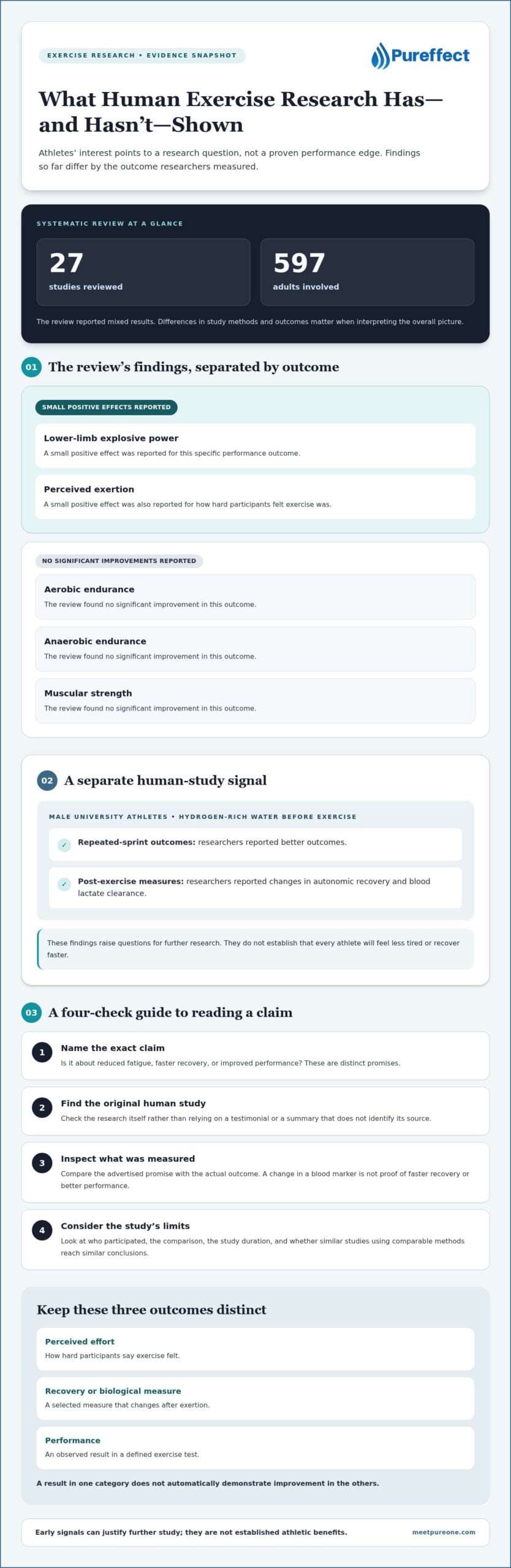
The idea is that hydrogen may act as a selective antioxidant and potentially influence some oxidative stress linked with intense exercise. What have human studies found so far? A 2026 systematic review of 27 studies involving 597 adults reported small positive effects on lower-limb explosive power and perceived exertion, but no significant improvements in aerobic or anaerobic endurance or muscular strength. The mixed results matter: studies differ in their methods and outcomes, and early signals aren’t the same as established benefits.
This article looks at why hydrogen has drawn athletes’ attention, what exercise research has measured, and where its limits remain. It also offers a practical way to assess claims and consider whether exploring molecular hydrogen fits your wellness interests, without sidelining the training and recovery habits that already matter.
Key Takeaways
- Understand why athletes are using hydrogen therapy by looking at the exercise questions researchers are investigating, not assuming it’s a widespread or proven practice.
- Distinguish outcomes such as perceived exertion or recovery markers from direct evidence of improved performance.
- Use a simple four-step check: identify the claim, find the study, inspect what it measured, and consider its limitations.
- Compare promotional promises with the exact outcomes reported in human exercise research before drawing conclusions.
- PureONE’s home-use modes and stated gas mixture are product features, not established evidence of athletic benefits.
Why are athletes exploring hydrogen therapy?
Could molecular hydrogen support recovery or exercise-related wellness? That question has prompted interest in hydrogen therapy, but curiosity about a developing research area doesn’t mean most athletes use it or that benefits are guaranteed. Human studies are examining specific outcomes, and the evidence remains under development.
What do athletes hope hydrogen therapy might support?
Researchers are asking whether molecular hydrogen may affect exercise-related fatigue and recovery. These outcomes are related to performance, but they aren’t interchangeable. A study might measure how hard exercise feels, how a recovery marker changes, or how someone performs in a sprint test. A result in one area doesn’t automatically mean improvement in the others.
For example, a study of male university athletes indexed by the National Institutes of Health in September 2026 examined hydrogen-rich water taken before exercise. Researchers reported better repeated-sprint outcomes alongside changes in post-exercise autonomic recovery and blood lactate clearance. These findings raise questions for further research; they don’t promise that every athlete will feel less tired or recover faster. The Hydrogen therapy overview provides broader context on proposed mechanisms and the evolving evidence.
An early research signal can justify further study, but it isn’t the same as an established athletic benefit.
Why does interest need careful context?
Athlete anecdotes can be sincere, and marketing can sound convincing. Neither can establish that hydrogen caused a change. Training load, sleep, hydration, nutrition, expectations, and natural variation can all influence how someone feels after exercise. Controlled human studies help researchers account for these factors, but the findings still need to be considered in light of who participated, what they used, and what was measured.
So when you see the phrase “hydrogen therapy for athletic recovery,” ask what the evidence actually concerns: perceived exertion, a recovery marker, or performance? A personal experience may prompt a useful question, but it isn’t proof of an answer. Keep established training and recovery practices in view, and compare claims with the human research behind them.
What does exercise research on molecular hydrogen actually examine?
Exercise studies don’t all test the same intervention or ask the same question. Some focus on performance during a defined exercise task; others examine how participants feel or how selected measures change after exertion. To interpret a result, identify the study’s question, then look at its methods and outcome definitions. A broad label such as “recovery” can refer to very different measurements.
Which outcomes do researchers measure?
Researchers may use exercise tests, participant ratings, or biological measurements. Each offers a different kind of information. A rating of perceived effort records how hard a participant says exercise felt. A lab result records a biological change. Neither automatically demonstrates a meaningful improvement in training or competition. Check the outcome named in the paper rather than substituting a more impressive-sounding claim.
Pay attention to when researchers took the measurement, too. An assessment immediately after exercise answers a different question from tracking changes across a training period. The timing and protocol define what a finding can reasonably suggest.
How strong is the evidence so far?
Look at how participants were assigned, what comparison they received, and whether participants and researchers knew which intervention was given. These details affect how confidently a result can be interpreted. Consider the sample and participants’ training status as well: findings from one group may not apply to athletes in another sport or at another training level.
Reviews can help identify patterns across studies, but combining results doesn’t remove differences in study design, exposure method, or outcome. Ask whether independent studies using comparable methods reach similar conclusions. Short-term findings also can’t establish what happens with repeated use over a longer period.
For a grounding in what molecular hydrogen is, start with the basic science, then return to the exercise papers and check exactly what they tested. If you’re considering a home-use option, the PureONE generator details describe product features. Consider those separately from research findings.
How can athletes assess hydrogen therapy claims responsibly?
Start with the claim, not the headline. “Supports recovery” can mean anything from a change in a laboratory measure to a noticeable difference in training or competition. To understand why athletes are using hydrogen therapy, focus on what the evidence tested and whether it matches the promise being made.
What should athletes check in a study?
Look for research in people, a suitable comparison group, and the same form of hydrogen exposure discussed in the claim. A study of hydrogen-rich water, for example, doesn’t automatically establish the effects of inhalation. Then check who took part, how long the study lasted, and whether its outcome relates to your goal. Exercise capacity and a laboratory marker are different kinds of outcomes, and a marker may not translate into better performance.
- Identify the claim. Is it about reduced fatigue, faster recovery, or improved performance? These are distinct promises.
- Find the study. Look for the original human research rather than a testimonial or a summary that doesn’t identify its source.
- Inspect the outcomes. Compare the advertised promise with what researchers measured. A change in a blood marker isn’t proof of faster recovery or stronger performance.
- Check the limitations. Consider the participant group, comparison conditions, study duration, and whether other studies found similar results.
Which claims deserve extra skepticism?
Be cautious with guaranteed results, claims that hydrogen benefits every athlete, or dramatic promises that don’t point to directly relevant human evidence. Testimonials describe individual experiences, not controlled comparisons. Keep three ideas separate: an association is a relationship observed in data; a proposed explanation is a possible mechanism; and a demonstrated effect is an outcome tested in a study. One doesn’t automatically prove the next.
Experimental wellness approaches shouldn’t replace training, sleep, nutrition, or medical care. If you’re managing a health concern or considering a change that could affect your care, discuss it with a qualified healthcare professional. Don’t infer personal-use instructions from a study unless its findings genuinely apply to your situation.
If you’d like to explore a home-use option while keeping product features separate from performance claims, view the PureONE molecular hydrogen generator.
What does exploring hydrogen therapy at home involve?
After reviewing the research, separate two questions: what does a device offer, and what have studies shown about exercise outcomes? A home-use generator can provide ways to engage with molecular hydrogen. Its features, however, don’t establish that athletes will recover faster or perform better. Keeping those questions distinct helps put product information in context.
What are PureONE’s stated features?
PureONE is a home-use molecular hydrogen generator with four therapy modes. These include hydrogen inhalation, hydrogen-infused water, and direct skin application options. The product information states that its gas mixture is 66% molecular hydrogen and 33% oxygen. These are product specifications, not evidence that a particular mode improves athletic recovery.
The device is manufactured in Canada. That’s useful product context, but country of manufacture doesn’t demonstrate therapeutic effectiveness. When comparing a device feature with a research finding, check whether the study tested the same type of hydrogen exposure and an outcome relevant to your question.
How can readers keep expectations grounded?
Consider what interests you about hydrogen, and keep that question distinct from what research has established. A product may offer different ways to explore molecular hydrogen while evidence for exercise-related outcomes remains under study. Exploring a product is a personal choice, not a guarantee of benefit or a substitute for individualized medical advice.
For athletes, the practical takeaway is not to treat a product specification as a performance result. Keep established training, sleep, and nutrition habits central, and don’t use a wellness device in place of medical care. The question of why athletes are using hydrogen therapy is best answered with both parts in view: what researchers are testing and what a home-use option provides.
To learn more about the device’s stated features, explore the PureONE molecular hydrogen generator with those evidence limits in mind.
Choose your next step with clear expectations
Your next step doesn’t have to be a performance gamble. If you’re curious about why athletes are using hydrogen therapy, let that interest guide further learning, not assumptions about what it can do for you. Keep your own goals in focus and allow emerging research to clarify where molecular hydrogen may fit.
If exploring it at home feels right for you, PureONE offers a way to learn more at your own pace. Pureffect states that the product includes a 365-day risk-free trial, giving you time to consider whether it suits your personal wellness interests. The trial doesn’t change what research has established, so keep expectations grounded and your usual health priorities in place.
Explore the PureONE molecular hydrogen generator and decide whether it belongs in your wellness routine. Stay curious, keep asking good questions, and choose what feels right for you.
Frequently Asked Questions
Why are athletes using hydrogen therapy?
Some athletes are curious about emerging wellness approaches and whether they might complement an individual training plan. That explains why hydrogen therapy is a topic of interest, but it doesn’t show how widespread its use is. If you’re weighing your own interest, start with a specific question, such as whether a study tested the sport or training task that matters to you, rather than relying on general athlete-focused messaging.
Does hydrogen therapy improve athletic performance?
There isn’t enough evidence to predict an individual athlete’s competitive result. Match the research task to your own goal when assessing a performance claim. A repeated-sprint test, for example, is not the same challenge as maintaining pace over a long event. The closer a study’s protocol is to the real-world outcome being promised, the more relevant its result may be to that claim.
Can molecular hydrogen help with exercise recovery?
Whether it could be useful for you remains an individual question, not something a general claim can settle. Make the question more concrete by deciding what “recovery” means in your context, such as readiness for the next planned session or a return to usual training. That helps prevent a broad label from standing in for a personal outcome, without assuming that any observed change was caused by hydrogen.
What does research on hydrogen and exercise measure?
Beyond the headline outcome, check how researchers defined and analyzed it. Was the main outcome clearly specified, and do the results include enough detail to judge the size and uncertainty of any observed difference? A statistically detectable change may still be too small to matter in practice. The methods and results sections often answer these questions more precisely than an abstract or product summary.
Is hydrogen therapy proven for athletes?
There isn’t a settled, sport-wide conclusion that applies to every athlete. To judge whether the evidence is becoming more convincing, look for independent research that tests similar questions and reaches compatible results, rather than treating one study as decisive. Check whether the reported finding was a primary study outcome or an additional analysis, too. These details help distinguish a promising research lead from a dependable basis for athletic decisions.
Can athletes use hydrogen therapy alongside their usual recovery routine?
Anyone considering a wellness device should account for their own health circumstances and discuss relevant questions with a qualified healthcare professional, particularly if they have a medical condition or use medication. It may help to bring the device information and the specific research claim that prompted your interest to that conversation. Avoid treating a study protocol as a personal-use instruction, since research conditions aren’t automatically suitable for an individual.
Disclaimer
The information provided by Pureffect and any of its products are for educational and informational purposes only and is not intended as medical advice. Individual results may vary, and no specific health outcomes are guaranteed. Always consult a qualified healthcare professional before starting any wellness practice or product.