
What does “high concentration” mean when you compare one hydrogen generator with another? It may refer to the percentage of hydrogen in a gas mixture, while hydrogen-infused water is commonly described in parts per million. These figures measure different things, so they can’t be compared at a glance.
It’s reasonable to want more than a bold number before choosing a home device. A 2024 systematic review of 25 human clinical trials reported findings related to antioxidant and anti-inflammatory effects of hydrogen water. Those findings don’t prove that a particular product will provide a health benefit. The study methods, participants, and ways of using hydrogen all matter when interpreting research.
This guide explains how to read concentration claims, distinguish gas composition from dissolved hydrogen in water, and assess what medical research can and can’t tell you. It also covers practical ways to compare devices and PureONE’s stated features, including its mixture of 66% molecular hydrogen and 33% oxygen. That percentage is a product specification, not evidence of a health outcome.
Key Takeaways
- Compare hydrogen concentration claims only when they describe the same delivery method and use the same measurement.
- Assess medical research by checking who participated, how hydrogen was used, what outcomes were measured, and what the study can’t establish.
- Compare a high concentration hydrogen generator by its intended modes, stated measurements, relevant evidence, usability, and product guidance.
- PureONE offers inhalation, water, and skin-use modes. Consider which suit your preferences, while separating product specifications from evidence of health benefits.
What Does High Concentration Mean in a Hydrogen Generator?
Concentration describes how much of a substance is present in a mixture or volume. To interpret a number, you need its context: what is being measured, which units are used, and where or when the measurement was taken. A percentage describing hydrogen in a gas mixture and a measure of hydrogen dissolved in water refer to different things.
Hydrogen gas concentration and hydrogen water are different measures
Gas composition tells you the proportion of hydrogen in a gas mixture. Dissolved concentration describes how much hydrogen is present in a given volume of water, often reported in milligrams per litre or parts per million. The figures aren’t interchangeable. A gas percentage doesn’t tell you how much hydrogen is dissolved in a glass of water.
When comparing claims, first identify the units and what was measured. For gas, look at the stated mixture. For water, look for a dissolved concentration and the conditions under which it was measured. If two products report different kinds of measurements, put them in separate categories rather than ranking their numbers side by side.
What a concentration figure can and cannot tell you
PureONE produces a mixture of 66% molecular hydrogen and 33% oxygen. This is a product-specific gas-mixture specification. By itself, it doesn’t state how much hydrogen a person receives during use, how much is absorbed, or whether a particular health outcome will follow. Those questions involve other evidence and details of how the product is used.
The same distinction applies to research. A result from a study of hydrogen-rich water can’t automatically be applied to inhaled gas, because the delivery method differs. For background on proposed uses and the current research landscape, see this overview of hydrogen therapy. A general overview can provide context, but it doesn’t establish a clinical benefit for a specific device or concentration.
Concentration is meaningful only when you know what was measured, how it was measured, and how that measure relates to the intended use. When comparing a high concentration hydrogen generator, start with its output and stated measurement. Then look for evidence about that specific way of using hydrogen instead of treating a larger-looking number as a promise of better results.
What Does Medical Research Say About Molecular Hydrogen?
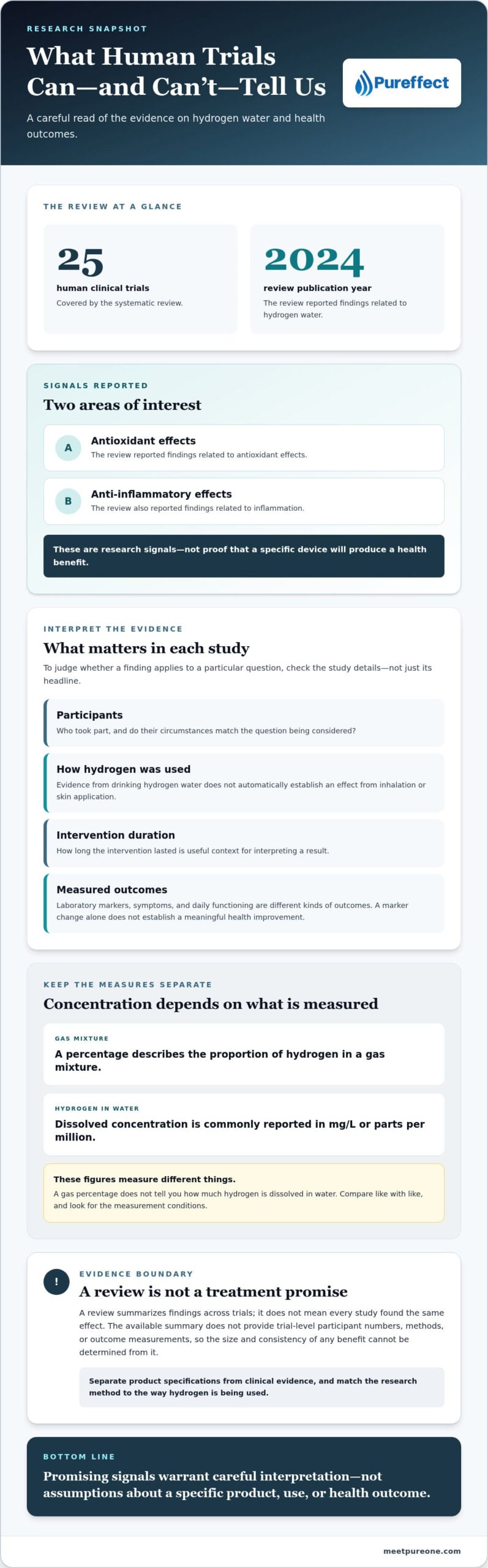
Human research offers promising signals, but the findings need careful interpretation. A 2024 systematic review covering 25 human clinical trials of hydrogen water reported evidence related to antioxidant and anti-inflammatory effects. The information available about this review doesn’t identify its authors or journal, describe the participant groups, or specify each trial’s intervention and measured outcomes. That limits how precisely its findings can be interpreted or applied.
How to read a hydrogen therapy study
Look beyond the review’s headline finding. For each trial, useful details include who participated, how hydrogen was administered, how long the intervention lasted, and whether researchers measured laboratory markers, symptoms, or daily functioning. These outcomes aren’t interchangeable. A change in an antioxidant or inflammation-related marker, for example, doesn’t by itself establish a meaningful improvement in health.
A review summarizes findings across trials; it doesn’t mean every study found the same effect. Without trial-level details such as participant numbers, methods, and outcome measurements, it isn’t responsible to claim a particular size or consistency of benefit. The review points to areas for further study, while leaving questions about which people, uses, and outcomes may matter.
Why a research result is not a treatment promise
A finding in one study population may not apply to someone with a different health condition. Evidence about drinking hydrogen water also can’t automatically establish an effect from inhalation or skin application. To judge relevance, match the study’s participants and delivery method to the question you’re asking. Then consider whether the outcome is clinically meaningful and whether the study’s limitations affect its interpretation.
The 2024 review reports antioxidant and anti-inflammatory signals across human hydrogen-water trials, but the available summary doesn’t establish a specific clinical benefit or who might experience one. If you’re considering hydrogen in relation to a health concern, discuss your circumstances with a clinician. The PureONE Molecular Hydrogen Generator page describes the device’s modes. Consider those product details separately from clinical evidence.
How to Compare a High Concentration Hydrogen Generator
Start with how you plan to use a device, not the biggest number on its product page. A useful comparison considers the output, relevant evidence, and everyday fit together. Use this checklist to assess options on equivalent terms.
- Choose your intended mode. Are you interested in inhalation, hydrogen-infused water, or direct skin application? These are distinct ways of using hydrogen, so a device designed for one mode may not suit your preferences for another. PureONE offers four therapeutic modes across inhalation, water, and direct skin application. For a closer look at how inhalation and water use differ, consult a guide focused on hydrogen inhalation machines versus water bottles.
- Read the measurement, not just the headline. Note the unit and what the figure describes. Compare gas-mixture percentages with other gas-mixture claims, and dissolved-water measurements with other water measurements. Don’t rank one type against the other.
- Look for evidence that matches the use. Check whether cited research studied the same delivery mode and outcomes you care about. Evidence from one method shouldn’t automatically be treated as evidence for another, and a product specification isn’t a clinical result.
- Consider everyday usability. Think about where you’ll use the device, which mode you’d realistically choose, and how its setup and use fit into your routine. A feature adds value when it suits the way you expect to use the product.
- Review product guidance. Look for clear instructions about operation and care. Practical guidance helps you understand what using a home device involves.
Keep the comparison focused on your priorities. If you mainly want water use, a gas-mixture percentage won’t tell you the dissolved concentration. If inhalation is your preference, compare relevant gas-output details rather than water measurements. No concentration figure should be judged in isolation; its meaning depends on the output, measurement context, and intended use.
To see how these criteria relate to a specific home device, explore the PureONE Molecular Hydrogen Generator and its stated use modes.
PureONE: A Home Hydrogen Generator With Multiple Use Modes
Product details are most useful when you relate them to how you plan to use a device. PureONE has a proprietary stainless steel condenser, is manufactured in Canada, and is designed for home use. These are concrete product details, but they don’t determine whether the generator fits your routine. Consider the space you have, the mode or modes you’re most likely to use, and how a home device would fit into your day.
Which PureONE features align with your intended use?
Start with the use preference you identified while comparing devices. Then focus on the product details that relate to that preference. If you’re considering more than one mode, ask yourself whether you’d use that flexibility in your routine. The goal isn’t to collect features for their own sake, but to decide which ones matter to you.
Pureffect describes PureONE as having a proprietary stainless steel condenser and being manufactured in Canada. These details identify a component and the stated place of manufacture. Consider them alongside the product’s modes and your practical needs, rather than treating them as evidence of a health outcome.
| Feature | What it describes | What to consider for your decision |
|---|---|---|
| Stainless steel condenser | A component identified in the product description | Whether the available product information explains its role in the device |
| Canadian manufacturing | The stated country of manufacture | Whether this detail matters to your purchasing preferences |
| Home-use design | The product’s intended setting | How a device at home would fit your space and routine |
A low-pressure next step for evaluating PureONE
Use the comparison criteria from the previous section to review PureONE: consider the measurement context, research relevant to your intended use, and practical fit. Pureffect offers a 365-day risk-free trial. Review the trial terms as part of your purchasing decision so you understand how they apply to you.
Take the time you need to decide what matters most. Explore the PureONE molecular hydrogen generator to review its product details alongside your preferences.
Choose a Device That Fits Your Next Step
Before choosing a high concentration hydrogen generator, decide what would make it a worthwhile addition to your home routine. Is your priority a particular way of using hydrogen, flexibility to explore different modes, or simply learning more about the product? A clear personal reason can keep the decision grounded, especially in a field where research is still developing.
Weigh your interest in the product against what research can establish. Features may suit your preferences, but they don’t guarantee a health result. Rather than treating a headline figure as a verdict, use the product information to decide whether the design makes sense for you. Take the time you need to feel comfortable with your choice.
Ready to see whether PureONE’s stated features fit your preferences? Explore the PureONE molecular hydrogen generator and review its modes and product details.
Frequently Asked Questions
What does 66% hydrogen mean in a hydrogen generator?
For PureONE, 66% describes the stated proportion of molecular hydrogen in its gas mixture, which also includes 33% oxygen. It isn’t a measure of dissolved hydrogen in water or the amount delivered over a period of use. Nor does the percentage establish a health outcome. Read the figure as a product specification, not a clinical result.
Is a higher hydrogen concentration always better?
No. A higher figure is useful only if it relates to the way you plan to use a device and can be compared with the same kind of measurement. For example, if you’re focused on preparing water, prioritize information relevant to water use rather than choosing by a gas-related figure. Treat product specifications and medical evidence as separate parts of your decision. A larger number doesn’t automatically mean greater benefit.
Does a hydrogen generator’s concentration prove that it works?
No. A device specification can describe a product’s stated output, but it can’t establish a health effect. To assess research, look at who participated, what intervention they received, how outcomes were measured, and what limitations the authors reported. Results may not apply to everyone or every use. If you’re weighing a device against a personal health concern, ask a qualified clinician about your situation.
Can one hydrogen generator make both hydrogen gas and hydrogen-infused water?
Some devices are designed for multiple uses. PureONE offers four therapeutic modes across inhalation, hydrogen-infused water, and skin application. Before choosing a multi-use device, consider which options you’d realistically use and whether you value that flexibility in a home product. These applications involve different routines, so information about one mode doesn’t explain another. Use the product materials for mode-specific details.
Is molecular hydrogen therapy a substitute for medical treatment?
No. This article doesn’t establish hydrogen therapy as a replacement for diagnosis, prescribed medication, or clinician-directed care. If you’re managing a condition, speak with your healthcare professional before changing treatment or adding a new approach. Bring the product information and research you’re considering to that conversation. Your clinician can help you weigh it against your health history and existing care, without relying on broad product claims.
Disclaimer
The information provided by Pureffect and any of its products are for educational and informational purposes only and is not intended as medical advice. Individual results may vary, and no specific health outcomes are guaranteed. Always consult a qualified healthcare professional before starting any wellness practice or product.