
The most portable option may not be the best fit for your routine. When comparing portable vs countertop hydrogen generators, start with how you expect to use one: for a drink while away from home, or as part of a regular home routine? The formats have different practical trade-offs, but convenience alone does not show what research supports.
It’s reasonable to want a clear answer before choosing. Studies examine specific hydrogen delivery routes and participant groups, not every device on the market. A March 2026 meta-analysis reported measurable changes in cholesterol and triglyceride levels among overweight participants who drank hydrogen-rich water. That finding offers context about this delivery route, but it does not establish that one generator format is more effective than another.
This guide compares portability, everyday use, and delivery routes, then explains how to interpret the research without stretching its conclusions. Use the practical criteria to decide which format fits your routine and the questions you want the evidence to answer.
Key Takeaways
- Compare portable vs countertop hydrogen generators by where and how you’ll use them, not just by size.
- Check that a device supports the delivery route that matches your intended routine.
- Separate measured research outcomes from proposed explanations, testimonials, and marketing claims.
- Weigh routine, evidence, and practical fit before choosing a format.
- PureONE is designed for home use and offers four therapeutic modes, including hydrogen gas inhalation, hydrogen-infused water, and direct skin application.
Portable vs. countertop hydrogen generators: what actually differs?
Portability is useful when you want to move a device between locations; a countertop format is designed around use at home. A portable hydrogen water device is generally intended to make water for personal use away from home. A home-use generator stays in one place and may support multiple delivery routes. The format label alone does not tell you what a particular device can do, so compare its stated uses with your own routine.
Picture a typical day. Would you carry a water-focused option to work or the gym, or use a device from the same spot at home? Consider where it will sit, how much storage it needs, and whether you want one delivery route or several. For a basic primer on hydrogen and its forms, see What is Hydrogen?
| Format | Best-fit routine | Practical trade-off | Evidence question |
|---|---|---|---|
| Portable, water-focused | Making personal servings away from home | Easy to move, but centered on water use | Does the research study hydrogen-rich water and a comparable route? |
| Countertop or home-use | Using a device in a consistent home setting | Needs a dedicated spot; available modes vary by device | Which delivery route and outcome did the study actually examine? |
When does a portable hydrogen water device make sense?
A portable device may suit someone who wants a water-focused option during a commute, workday, or gym visit. Its main advantage is mobility, while its intended use may be narrower than that of some home-use devices. A compact design does not establish health effectiveness. Check the product’s stated use, then look for research that examines the same delivery route and a relevant outcome.
What does a countertop or home-use generator offer?
A device kept at home can be easier to fit into a consistent routine, but its location does not prove better performance. Countertop products vary: some focus on water, while others offer additional modes. If you’re weighing water against inhalation, Hydrogen Inhalation Machine vs. Water Bottle: Which Is Right for You? explores that distinction. Compare the actual modes of each product with your intended use, then assess the evidence for that route.
What medical research says about molecular hydrogen, and what it cannot prove
A March 2026 meta-analysis of human research on hydrogen-rich water reported measurable changes in cholesterol and triglyceride levels among people with overweight. The studies used drinking water as the delivery route and measured blood lipid levels. The reported finding does not give the size or precision of those changes, so it cannot show how large they were. It is a research signal, not proof of a treatment effect or a noticeable benefit for every participant.
The specific finding reported is a change in cholesterol and triglyceride measures in studies involving people with overweight who drank hydrogen-rich water; the reported details don’t establish the magnitude of the change or prove a clinical benefit. A meta-analysis combines results from multiple studies, but its conclusions depend on the methods and quality of the research included. Without details such as the pooled participant count and effect estimates, avoid treating the headline result as settled evidence.
How should readers assess hydrogen research findings?
Start with studies in people. Check who participated, how the study was designed, which delivery route it examined, what outcome it measured, and what limitations the authors reported. Animal and laboratory findings answer different questions and do not establish effects in people. ClinicalTrials.gov can show registered studies, but a listing alone does not show that a trial found a benefit. Explore Clinical Trials on Molecular Hydrogen to see how research is being registered.
Distinguish measured results from proposed explanations, testimonials, and marketing claims. A change in a blood marker is not automatically a meaningful health outcome. For foundational context, What is Molecular Hydrogen? The Science of Cellular Health in 2026 discusses the subject more broadly.
Do findings for hydrogen water apply to inhalation or skin use?
No. The March 2026 finding described above concerns drinking hydrogen-rich water, not inhalation or direct skin application. Evidence for one route does not establish results for another. This distinction matters when comparing devices with different modes: a product’s capabilities do not mean every mode has the same research support. To review a home-use option with multiple modes, see the PureONE Molecular Hydrogen Generator.
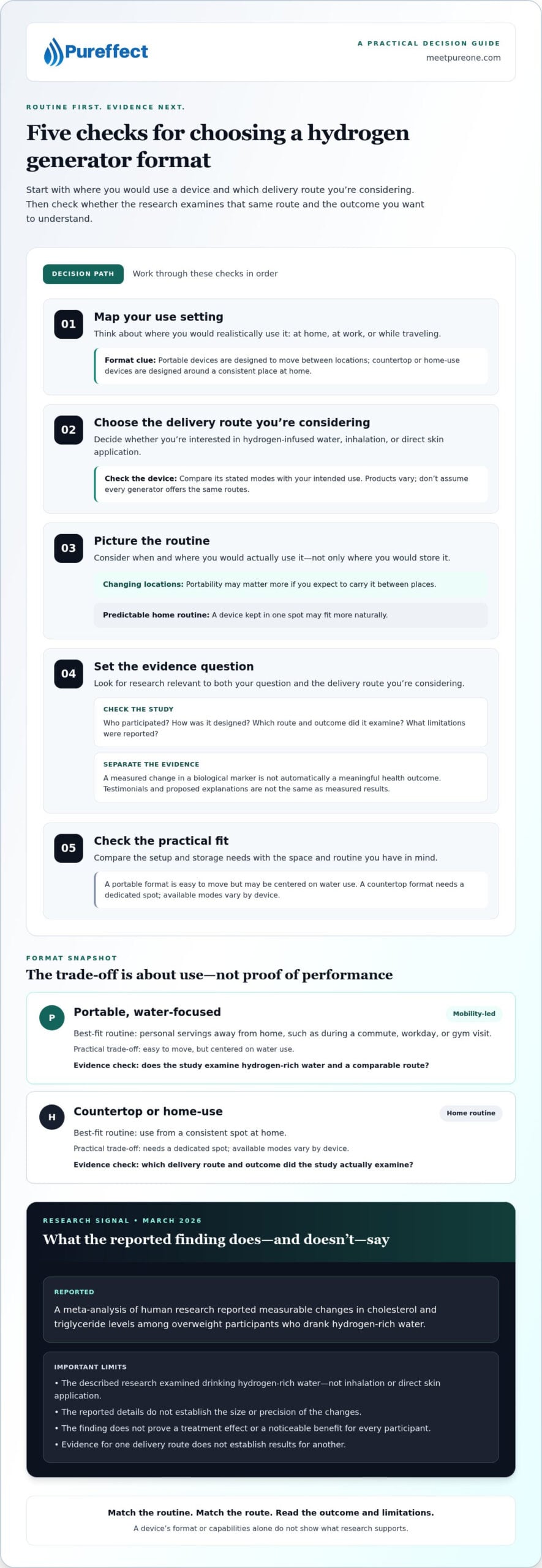
How to choose between portable and home-based hydrogen generators
Start with your ordinary week rather than a product feature list. A format that suits your schedule, space, and intended use is easier to assess. Use these steps to narrow your choice.
- Map your use setting. List where you would realistically use a device, such as at home, at work, or while traveling. If you expect to use it mostly in one place, a fixed home setup may be practical. If you plan to carry it between locations, portability may matter more.
- Choose the route you’re interested in. Decide whether you’re considering hydrogen-infused water, inhalation, or skin application. Compare that preference with each device’s stated modes rather than assuming all generators offer the same uses.
- Picture the routine. A frequent traveler may prefer an option that fits changing plans. Someone with a predictable morning at home may find it easier to use a device kept in one spot. Think through when and where you would use it, not just where you would store it.
- Set your evidence question. Identify the outcome you want to understand, then look for research relevant to that question and delivery route. Check whether the study measured a health outcome or a biological marker, and keep its limitations in view.
- Check practical fit. Compare setup needs, storage, stated modes, and how clearly the product information describes each function. Consider which option you are more likely to use consistently and comfortably.
Which delivery route aligns with your intended routine?
Begin with a use you can picture maintaining. If you’re interested in drinking hydrogen-infused water, focus on products designed for that route. If inhalation or skin application interests you, look specifically for those capabilities. The portable vs countertop hydrogen generators choice becomes clearer once you know what you want a device to do in your day-to-day life.
What should you compare beyond portability?
Compare use modes, intended setting, preparation, storage, and how clearly the product information explains each function. These details help you judge whether a device fits your habits. If a home-based, multi-mode option suits your preferences, explore PureONE’s home-use approach, including its stated options for inhalation, water, and skin application.
Could PureONE suit a home-centered routine?
PureONE may suit a home-centered routine if you prefer a device that stays in one place and offers different ways to use it. Rather than treating a longer feature list as a reason to buy, picture how it would fit into your day. Where would you put it? Which of its modes would you use? A device is more practical when its intended use fits your habits.
PureONE is manufactured in Canada and produces a mixture of 66% molecular hydrogen and 33% oxygen. These are product details, not evidence of a particular health outcome. Consider them alongside your intended use and the research relevant to it, rather than as a shortcut to deciding whether the device is right for you.
How PureONE differs from a water-only portable format
A water-focused portable format is designed around use away from home. PureONE is designed for home use and offers four therapeutic modes, including hydrogen gas inhalation, hydrogen-infused water, and direct skin application. That difference may matter if you want a device that stays in one place and offers more than one way to use it. It does not establish an efficacy advantage. Consider the formats as different routine choices and decide which better suits your preferences and setting.
What to know before considering PureONE
Pureffect offers a 365-day risk-free trial, giving you time to evaluate whether the device fits your routine. Howie Mandel endorses PureONE, but an endorsement is not medical evidence. Read the product information and review the research, paying attention to what was studied and what remains uncertain. A considered decision starts with a clear sense of your intended use.
If a home-centered option suits your preferences, explore the PureONE Molecular Hydrogen Generator.
Choose a format that earns its place in your routine
Before choosing, define what would make a device useful to you. Write down where you expect to use it, which delivery route interests you, and what kind of evidence would help you assess its claims. Those criteria can keep a feature list or familiar endorsement from making the decision for you.
A thoughtful approach to portable vs countertop hydrogen generators starts with your criteria, then checks them against product information and relevant research. Keep the questions specific: does the intended use fit your routine, and does the evidence address that use? You do not need to resolve every scientific question before choosing a format, but you should distinguish convenience from what research has actually examined.
If a home-use option is on your shortlist, review how it aligns with your intended routine. Explore the PureONE Molecular Hydrogen Generator and consider its details alongside your own research.
Frequently Asked Questions
Is a portable hydrogen generator as effective as a countertop model?
Portability or countertop size alone does not show that a device is more effective. In the portable vs countertop hydrogen generators comparison, focus on the outcome you care about and whether evidence supports the device’s intended use. For example, someone interested in drinking hydrogen-infused water should look for research using that route, rather than infer results from a different device or use. Convenience can help determine fit, but it does not establish a clinical benefit.
Can hydrogen water research be applied to hydrogen inhalation?
Not automatically. A study’s findings apply to the participants, delivery method, and outcomes researchers examined. Research on drinking hydrogen-infused water does not establish what happens with inhalation or skin application. If a product offers more than one route, assess each mode against research on that route. Treat conclusions beyond a study’s methods as uncertain unless separate evidence supports them.
How much hydrogen does a portable generator produce?
There is no single output figure for every portable generator. The figure depends on the device and how its maker measures and reports output. When comparing products, note whether a number describes dissolved hydrogen in water or another measure, and look for the testing conditions and any independent verification. A result from one device cannot automatically be assumed for another. Even a clearly reported output does not, by itself, show a health benefit.
What happens if I choose a portable device but mostly use it at home?
You can use a portable device at home, but mobility may matter less if it rarely leaves the kitchen. Picture a routine where you make a drink at the same time each morning: a fixed home setup may feel more natural, while a portable unit may suit you if your plans often change. Consider storage, preparation, and intended use. The most convenient choice depends on your routine, not on evidence that one format works better.
Are the health benefits of molecular hydrogen proven?
Research is ongoing, so broad claims that molecular hydrogen is proven to treat or prevent conditions go beyond what a single promising result can show. When reading a study, check whether it involved people, how it was designed, which delivery route it used, and whether it measured a health outcome or a biological marker. Testimonials and endorsements can describe personal views, but they are not substitutes for controlled clinical research.
Disclaimer
The information provided by Pureffect and any of its products are for educational and informational purposes only and is not intended as medical advice. Individual results may vary, and no specific health outcomes are guaranteed. Always consult a qualified healthcare professional before starting any wellness practice or product.