
What does a “high hydrogen concentration” actually tell you? Not enough on its own. The importance of hydrogen concentration levels depends on what is measured, where it is measured, and how much hydrogen a person is exposed to. It is easy to confuse hydrogen ions, which relate to pH, with molecular hydrogen gas, a different form of hydrogen.
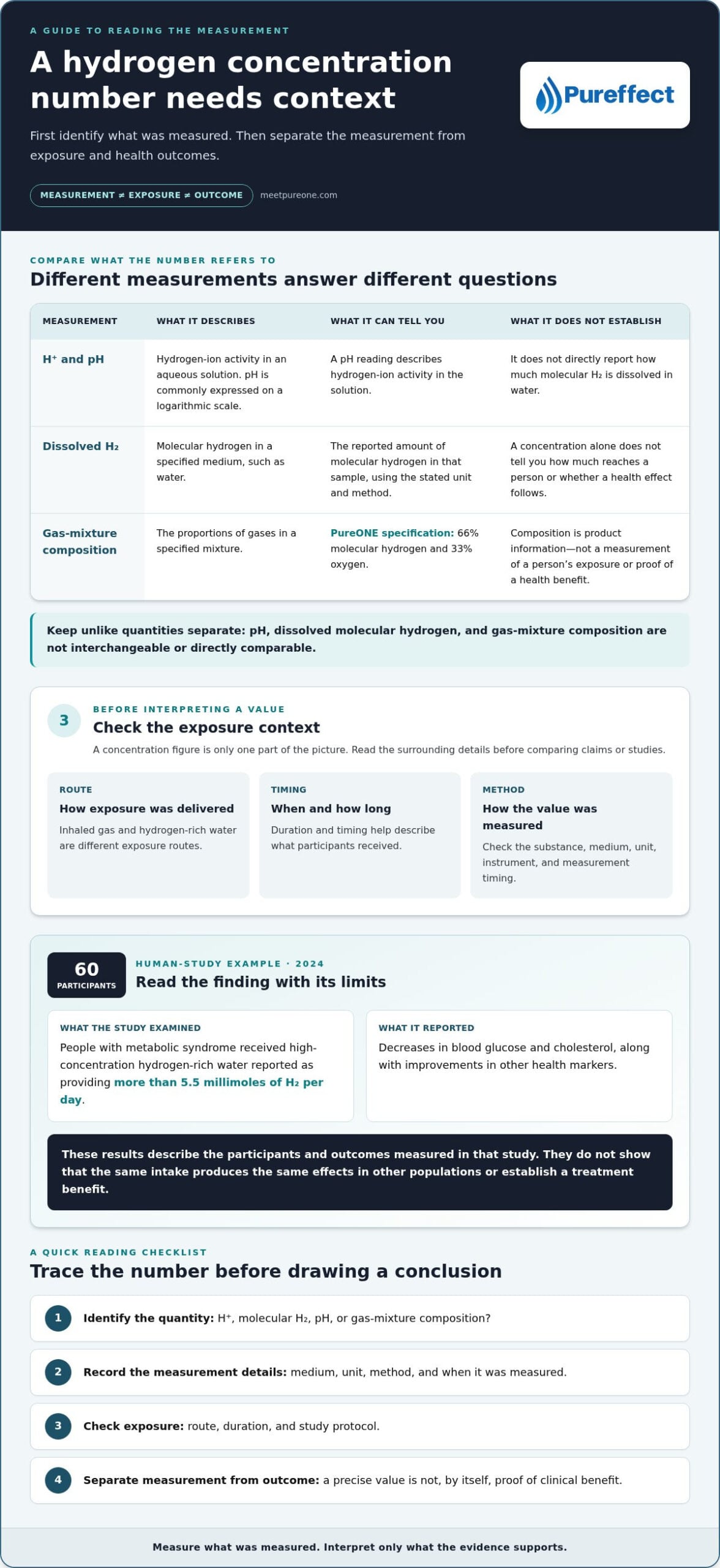
That distinction matters when you read health research or compare device specifications. A concentration figure may describe hydrogen dissolved in water or the composition of a gas mixture, but it does not automatically tell you the dose delivered or prove a health benefit. For example, PureONE specifies a gas mixture of 66% molecular hydrogen and 33% oxygen. That composition is useful product information, but it is not the same as a measurement of a person’s exposure.
In this article, you’ll learn how hydrogen ions differ from molecular hydrogen, what concentration units and measurement methods can tell you, and why exposure context matters. You’ll also see how to assess health findings without mistaking a precise number for proof of an outcome.
Key Takeaways
- The importance of hydrogen concentration levels depends on the substance and medium being measured, not just the size of the number.
- Check whether a figure describes hydrogen ions or molecular hydrogen before drawing conclusions about pH or exposure.
- When reading health research, distinguish laboratory, animal, and human evidence. Look for the study’s route, timing, units, and measurement method.
- Use a checklist to assess concentration claims, and avoid treating a measurement as proof of a health benefit.
- A device’s stated gas composition tells you what the specification describes, but not necessarily a person’s exposure.
Why Hydrogen Concentration Levels Are Easy to Misread
“Hydrogen concentration” can refer to different chemical quantities, so a number needs context before it is meaningful. Concentration is the amount of a specified substance within a specified medium, such as molecular hydrogen dissolved in water or hydrogen gas in a mixture. The importance of hydrogen concentration levels lies in identifying exactly what was measured, not simply comparing which number looks larger.
A concentration figure alone does not establish how much hydrogen reaches a person, how long exposure lasts, or whether a health effect follows. Those are separate questions. A useful rule of thumb: Hydrogen concentration describes a measurement; evidence of clinical benefit requires research showing an outcome.
Hydrogen ions, molecular hydrogen, and pH are not interchangeable
H⁺ is a positively charged hydrogen ion. H₂ is neutral molecular hydrogen, made of two hydrogen atoms bonded together. They are chemically distinct, and research discussing molecular hydrogen is not describing the same quantity as a pH reading. Keeping that difference clear prevents a familiar label, “hydrogen,” from making unlike measurements seem comparable.
In an aqueous solution, pH describes hydrogen ion activity, commonly expressed on a logarithmic scale. It does not directly report how much dissolved H₂ is present. Water’s pH therefore cannot, by itself, tell you its molecular hydrogen concentration. A pH reading and a dissolved-gas measurement answer different questions.
Why the measurement context changes what a number means
Read the measurement details alongside every value: the substance, medium, unit, and method. For example, a value for H₂ dissolved in water and a percentage describing hydrogen in a gas mixture refer to different media and measurement conventions. They cannot be compared as if they were on the same scale. Clear reporting makes it easier to interpret a result and compare it with relevant research.
Gas measurements also have a safety context. Hydrogen can pose fire and explosion hazards at certain concentrations in air, which is one reason precise measurement and handling matter. The Hydrogen Safety and Concentration Limits overview discusses those hazards. Safety limits are not health-benefit thresholds.
Exposure depends on more than concentration. The route of delivery, duration, and study protocol all shape what a participant receives. A concentration stated without those details is incomplete, whether it appears in a paper or a device specification. Keep the questions separate: What was measured? Under what conditions? What outcome, if any, did the study assess?
How Molecular Hydrogen Concentration Is Studied in Health Research
Medical research on molecular hydrogen includes laboratory experiments, animal studies, and human trials. Each can answer different questions, but findings from one stage do not automatically establish an effect in people. Human studies offer more direct evidence about outcomes in participants, yet their findings still apply to the specific group, exposure, and measures tested.
For example, a 2024 study involving 60 people with metabolic syndrome examined high-concentration hydrogen-rich water, reported as providing more than 5.5 millimoles of H₂ per day. The study reported decreases in blood glucose and cholesterol, along with improvements in other health markers. These results describe the participants and outcomes measured in that study. They do not establish that the same intake produces the same effects in other populations or prove a treatment benefit.
What to look for in a medical study
When reading a paper, note its design, participant count, comparison group, measured outcome, and follow-up period. Also record the route, exposure duration, concentration units, and when the concentration was measured. These details help you judge how closely the study matches your question, rather than relying on a headline or an isolated number.
Prioritize original studies and systematic reviews, and verify specific findings against the source. A review can help put multiple studies in context, but it cannot erase differences in their methods. A study’s results apply to its tested route and protocol, not automatically to other forms of exposure or devices.
Why inhalation and hydrogen-rich water evidence cannot be casually combined
Inhaled hydrogen gas and molecular hydrogen dissolved in water are different exposure routes. Their concentration units and delivery conditions may differ, so a finding from one route should not be treated as proof of an equivalent effect from another. For a practical comparison of these approaches, see Hydrogen Inhalation Machine vs. Water Bottle: Which Is Right for You?
To see how a home device presents its own information, review the PureONE molecular hydrogen generator product page. Treat its specification as product information, not as evidence that a health outcome has been clinically demonstrated.
How to Interpret Hydrogen Concentration Levels Without Overclaiming
Use a consistent review process whenever you encounter a product label, study abstract, or health claim. The importance of hydrogen concentration levels becomes clearer when you can trace a reported figure back to the original measurement and compare like with like.
A practical checklist for reading a concentration claim
Work through these checks before drawing a conclusion:
- Identify the reported quantity. Does the source give an H⁺ measurement, molecular H₂, pH, or the composition of a gas mixture? Check the methods or label rather than relying on a broad phrase such as “hydrogen level.”
- Record how and when it was measured. Note the sample medium, unit, instrument, and timing. If a paper reports a value at preparation but not during exposure, keep that distinction visible in your notes.
- Check whether the comparison is fair. Compare studies only when their exposure routes and protocols are relevant to one another. Record differences in timing or delivery instead of treating the figures as directly equivalent.
What research can and cannot show
Read the paper’s methods and results alongside its conclusion. Ask whether the outcome was directly measured, how it was compared, and whether the authors describe limitations that affect interpretation. Keep your wording close to the finding: a measured change in one outcome does not establish effects the study did not assess.
Reviews can help map the research, but check which studies they include and whether those studies address the same question. For broader background, What Is Molecular Hydrogen? The Science of Cellular Health in 2026 provides another point of reference. Approach claims carefully, especially when a source moves from a reported measurement to a wider health conclusion.
If you’re assessing a home-use device, compare its stated information with the questions above. Review the PureONE molecular hydrogen generator details as one example of product information to evaluate alongside research.
What PureONE’s Hydrogen Specification Means for Home Use
Understanding the difference between a product specification and research evidence makes it easier to read a home device’s numbers in context. PureONE is manufactured in Canada and produces a consistent mixture of 66% molecular hydrogen and 33% oxygen. Those percentages describe the stated composition of the gas mixture. They do not, by themselves, tell you a person’s total exposure or establish a health outcome.
Read the product specification in its proper context
A gas-mixture percentage describes the proportions of gases in that mixture. It is not the same measurement as dissolved molecular hydrogen in water, which refers to a different medium, or the exposure used in a particular study. The importance of hydrogen concentration levels comes down to matching the figure to what it actually measures. Avoid translating a composition percentage directly into a dose or assumed benefit.
This distinction is useful beyond one device. A study’s concentration only has meaning alongside its route, duration, measurement method, and research outcomes. A product specification helps you understand what a device states it produces, but clinical evidence is needed to assess health claims. For a wider discussion of what studies can and cannot establish, see How Can Hydrogen Therapy Help Extend Your Life? The Evidence-Based Guide.
Choose a home-use mode with realistic expectations
PureONE offers four modes across inhalation, hydrogen-infused water, and direct skin application. These describe ways to use the device, not guaranteed results or a recommendation that one mode is right for everyone. Interpret research findings according to the route and protocol actually studied. A result from one form of exposure does not automatically apply to another.
Use the same measured approach when reviewing any health-related claim: identify what the specification describes, then look for relevant evidence before drawing conclusions. To examine the device details and its 365-day risk-free trial, visit the PureONE molecular hydrogen generator page. A percentage is one piece of information to understand alongside the intended use and the evidence.
Make Your Next Hydrogen Decision Evidence-Led
The next time you encounter a hydrogen number, pause before comparing it with another. Ask what the figure measures and whether the evidence relates to the same kind of exposure you’re considering. That simple habit can make the importance of hydrogen concentration levels clearer while keeping promising research in perspective.
Science develops through careful measurement, replication, and studies that test specific questions. Staying curious does not mean accepting every claim or dismissing the field outright. It means looking for transparent information and letting the evidence guide your expectations.
If you’re considering a home-use device, review its product details and decide whether its stated uses fit your interests. Explore the PureONE molecular hydrogen generator as your next step. Let clear measurements, not impressive-sounding numbers alone, inform your choices.
Frequently Asked Questions
Is hydrogen concentration the same as pH?
No. pH is not a readout of dissolved molecular hydrogen. If you’re reviewing a water report, treat its pH entry and any H₂ result as separate fields. One cannot substitute for the other. Check what the instrument was intended to measure and whether the report identifies the sample. This cross-check helps prevent an acidity reading from being mistaken for a hydrogen-content result.
What does a hydrogen concentration level measure?
A level reports a quantity selected by the test, so start with the method note or product label rather than relying on a headline. For a water test, note whether the result is a dissolved-gas value or a pH reading. For a gas report, check whether it gives mixture composition or another measure. Save the sample date and instrument details with the value so later comparisons retain their basis.
Is there one ideal molecular hydrogen concentration for health?
There is no single health target that applies across every person, route, or research question. Treat a value in a paper as part of that study’s protocol, not as personal dosing guidance. If you’re weighing hydrogen use alongside a health condition, medications, or another care plan, discuss it with a qualified clinician. Bring the study or product information you want to assess so the conversation can focus on your circumstances.
Can hydrogen concentration in water change after it is prepared?
Yes. A water measurement can vary with the time between preparation and testing and with sample handling. For a useful comparison, follow the device instructions, use consistent preparation and testing conditions, and record when each measurement is taken. Do not treat a reading from one occasion as a guarantee of what is present later, or infer a shelf life unless the device guidance or a validated testing protocol provides one.
Does a higher hydrogen concentration mean greater health benefits?
No. A larger reading does not tell you how a person will respond. To assess a benefit claim, look for human research that measured the outcome being claimed, not merely a change in a laboratory marker or a product’s output. Check whether the participants and use conditions match the claim. If a study did not test the advertised outcome, a higher concentration figure alone cannot fill that evidence gap.
How should I compare hydrogen therapy research with a home device?
Build a simple comparison table instead of lining up headline numbers. Use separate columns for the device specification, research method, exposure route, timing, and measured endpoint. Mark missing details rather than assuming they match. Then check whether the study tested the same form of use the device describes. Peer-reviewed papers can inform your assessment, but their findings still need to address the specific question you’re evaluating.
Disclaimer
The information provided by Pureffect and any of its products are for educational and informational purposes only and is not intended as medical advice. Individual results may vary, and no specific health outcomes are guaranteed. Always consult a qualified healthcare professional before starting any wellness practice or product.