
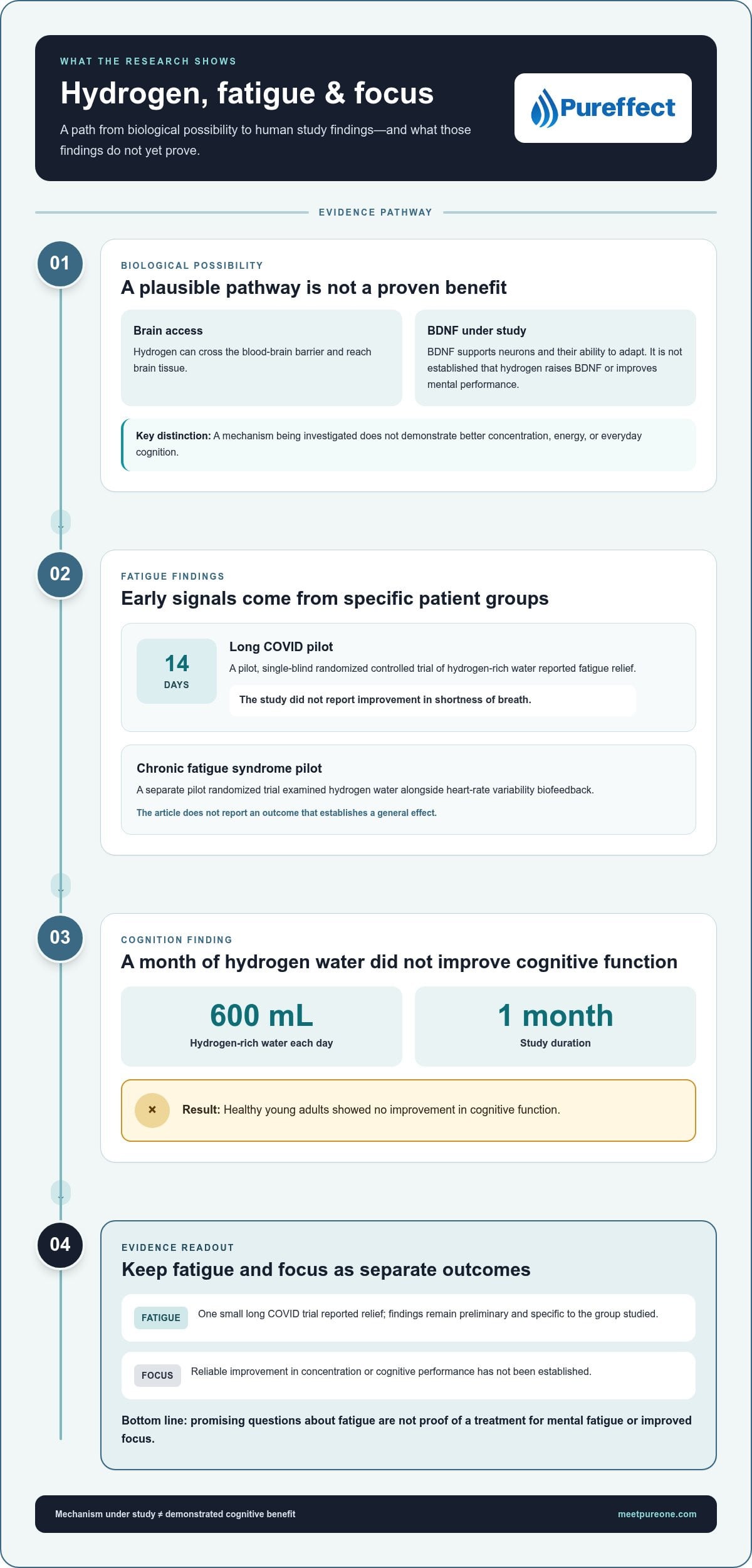
Hydrogen therapy for mental fatigue may affect pathways linked to oxidative stress, but it hasn’t been shown to reliably improve mental focus. In a study, healthy young adults who drank 600 mL of hydrogen-rich water daily for one month showed no improvement in cognitive function. Early findings on fatigue are more encouraging, but they don’t establish hydrogen as a treatment for mental fatigue.
It makes sense to look for ways to feel clearer and more mentally energized, especially when fatigue interferes with everyday tasks. This article explores how molecular hydrogen may relate to brain-derived neurotrophic factor (BDNF) and oxidative stress, what research suggests about fatigue and focus, and where the evidence remains limited. The goal is a grounded view of what hydrogen may do and what it cannot yet promise.
Key Takeaways
- Molecular hydrogen can be taken up through inhalation, hydrogen-rich water, or baths; the delivery method matters when interpreting research.
- Researchers are exploring how hydrogen may reach brain tissue and relate to BDNF, a protein involved in brain health.
- Hydrogen’s proposed antioxidant effects focus on certain harmful free radicals, rather than broadly suppressing oxidation.
- Early fatigue findings are promising but mixed: a small long COVID trial reported fatigue relief, while a study in healthy young adults found no cognitive improvement.
- Separate potential effects on fatigue from proven improvements in focus, and consider the evidence for each outcome on its own.
How Does Molecular Hydrogen Work?
Molecular hydrogen can be delivered by inhalation, in hydrogen-infused water, or through baths. Each route affects how it enters the body, so delivery method matters when interpreting research on mental fatigue and brain function.
Inhalation and Hydrogen Absorption
Inhalation involves breathing a hydrogen-and-oxygen gas mixture so it can pass from the lungs into the bloodstream. The lungs provide a route for hydrogen to circulate through the body, and inhaled hydrogen can reach organs within minutes. Because the body also eliminates it through normal breathing, the timing and duration of exposure matter when assessing possible effects. Clinical inhalation uses appropriate equipment and professional supervision.
Inhaled Hydrogen Compared With Hydrogen Water
Inhaled hydrogen enters through the lungs, while hydrogen-rich water delivers dissolved gas through drinking. These methods aren’t interchangeable: they differ in how hydrogen is administered and how long it remains available in the body. Consumed hydrogen lasts about one hour, and hydrogen gas escapes from opened water. A saturated solution contains 1.6 parts per million, giving a concrete reference for understanding water-based delivery.
Hydrogen baths are another delivery method, alongside inhalation and infused water. Although the routes differ, the central question is whether enough molecular hydrogen reaches relevant tissues to affect a biological process. For someone exploring hydrogen therapy for mental fatigue, the delivery method is useful context, not proof of improved focus or function.
Stroke research offers a clinical example of inhalation. One study treated stroke patients with hydrogen gas at a concentration of 3%. That fact describes the treatment used; it does not establish that inhalation treats mental fatigue or improves cognition. Stroke and everyday mental tiredness are different concerns, so results from one setting shouldn’t be assumed to apply to another disease or symptom.
Is hydrogen therapy approved or recommended by the FDA for mental fatigue? No. The FDA’s GRAS status for hydrogen-infused water concerns its recognized safety status, not approval or recommendation as a treatment for mental fatigue.
Safety depends on the delivery route and setting. Hydrogen is described as non-toxic at the concentrations studied, but gas can become flammable at higher concentrations. Clinical inhalation therefore calls for suitable equipment and professional supervision. The FDA’s GRAS designation for hydrogen-infused water should not be confused with evidence that it improves cognitive function or treats inflammation.
How much do hydrogen water generators, inhalation devices, or treatments cost in the United States? Costs vary depending on whether someone buys a home generator, chooses hydrogen-infused water, or receives clinical inhalation treatment. The format, equipment, and whether treatment is supervised all affect the expense, so there is no single standard cost for these options.
Hydrogen and brain-derived neurotrophic factor
Molecular hydrogen is being studied for possible effects on brain signaling, fatigue, and cognition. One proposed connection involves brain-derived neurotrophic factor, or BDNF, a protein that supports neurons and their ability to adapt.
Hydrogen can cross the blood-brain barrier and reach brain tissue. That makes direct interaction with brain processes biologically plausible, but it doesn’t prove hydrogen raises BDNF or improves mental performance in people. BDNF is associated with neuronal growth and plasticity, while fatigue and brain fog can have many causes. A change in one pathway would not automatically mean better concentration or more energy.
Human findings on fatigue are preliminary. A pilot, single-blind randomized controlled trial examined hydrogen-rich water over 14 days in people with long COVID and reported fatigue relief, but no improvement in shortness of breath. Another pilot randomized trial studied hydrogen water alongside heart-rate variability biofeedback for chronic fatigue syndrome. These examples concern specific patient groups and don’t establish a general effect on brain fog.
Does hydrogen therapy improve fatigue, concentration, or cognitive performance compared with placebo? Evidence doesn’t show consistent improvement across these outcomes. A long COVID pilot reported fatigue relief, while cognitive research has not established reliable gains in concentration or performance.
What doses and treatment schedules have been used in studies of hydrogen therapy for fatigue? A long COVID pilot studied hydrogen-rich water for 14 days, while a chronic fatigue syndrome pilot examined hydrogen water with heart-rate variability biofeedback. Those study designs don’t establish a standard regimen for fatigue.
What medical conditions can cause mental fatigue, and when should someone see a doctor? Sleep problems, mood conditions, infections, medication effects, and other health issues can contribute to mental fatigue. Seek medical care if fatigue persists, worsens, or interferes with everyday functioning so possible causes can be assessed.
For readers considering a home-based format, the hydrogen therapy generator is one option to explore alongside the limits of the current evidence.
Molecular hydrogen as a selective antioxidant
Oxidative stress occurs when reactive molecules outpace the body’s antioxidant defenses. Molecular hydrogen has attracted interest because its proposed antioxidant action is selective, rather than a broad attempt to suppress oxidation.
Proposed Antioxidant Mechanisms
The proposed mechanism is that molecular hydrogen selectively neutralizes certain harmful free radicals involved in oxidative stress. This idea matters because oxidation also supports normal cell signaling, so reducing every oxidative reaction would not be a sensible goal. Molecular hydrogen was reported to selectively neutralize certain harmful free radicals in 2007. That finding sparked interest in how it might affect biological processes.
Free radicals are reactive molecules formed through ordinary processes, including energy production. They can also increase during illness or tissue stress. In excess, they may damage cell components and contribute to inflammation. Antioxidants can help limit that damage, but molecular hydrogen’s proposed selectivity distinguishes it from a general antioxidant effect. It does not mean all oxidative stress disappears or that recovery is assured.
Comparison With Traditional Antioxidants
Traditional antioxidants include nutrients such as vitamins C and E, which help protect cells from oxidative damage. Molecular hydrogen differs in form and proposed action: researchers focus on its ability to target certain reactive molecules. This comparison helps explain the concept, but it doesn’t show hydrogen works better than vitamins or replaces them in medicine.
Antioxidants also differ in where and how they act. A nutrient’s effects depend on its absorption and role in the body, while hydrogen therapy research examines molecular hydrogen delivered through specific methods. Comparing them requires looking at the same outcome, population, and treatment conditions. A result involving oxidative markers, for example, cannot automatically be taken as evidence of better concentration or less fatigue.
For readers assessing hydrogen therapy for mental fatigue, the practical takeaway is to separate mechanism from outcome. Evidence that a substance can influence oxidative stress does not by itself show that people feel less tired, think more clearly, or recover faster. Those claims require human studies that directly measure fatigue and cognitive function. Antioxidant explanations describe a possible pathway; they don’t establish a treatment’s effectiveness for a disease or symptom.
Hydrogen therapy and mental focus
Could molecular hydrogen sharpen attention or help you think clearly through a demanding day? The most relevant human evidence directly measures cognitive performance, rather than assuming that changes in oxidative stress or cellular metabolism lead to better focus.
One year-long study tested daily consumption of 300 mL of hydrogen-rich water containing 1.2 ppm hydrogen in people with mild cognitive impairment. Overall cognitive test scores did not improve. This result matters because it assesses cognition in people experiencing difficulties, rather than relying only on a proposed mechanism involving oxygen, tissue, or free radicals.
That finding doesn’t answer every question about attention. Overall cognitive scores combine different abilities, and a general score may not capture short-term changes in concentration during a specific task. Still, the study offers no basis for claiming hydrogen water improves cognitive performance in people with mild cognitive impairment. A measurable change in oxidative stress would also need to be distinguished from a meaningful change in everyday function.
Focus is not a single outcome. Researchers can examine memory, attention, processing speed, or a broader cognitive score, and these measures aren’t interchangeable. For example, someone might report feeling less mentally tired without showing improved performance on a standardized task. The reverse is also possible: a test result may change without a noticeable difference in daily concentration.
Hydrogen’s proposed effects on cellular metabolism and oxidative stress offer a possible research pathway, not a demonstrated focus benefit. Reactive radicals can be part of normal biological signaling, so altering them doesn’t automatically improve brain function. To support a claim about focus, a study needs to measure cognition directly and distinguish treatment effects from changes in the comparison group.
Other neurological research reinforces the need for careful interpretation. A small study using 1 L of hydrogen-rich water containing 1.6 ppm hydrogen reported slightly slower worsening of Parkinson’s disease. A larger trial did not replicate that finding. Parkinson’s progression is not the same outcome as mental focus, but the differing results show why one study cannot settle a broader claim.
For readers considering hydrogen therapy for mental fatigue, the clearest takeaway is that proposed biological effects and improved focus are separate questions. Existing findings don’t establish consistent gains in cognitive performance. Check what a study actually measures: fatigue, a specific cognitive task, an overall score, or disease progression. Each outcome answers a different question.
If you’re exploring a home option while weighing this evidence, learn about home hydrogen therapy.
Pureffect: PureONE Molecular Hydrogen Generator
Pureffect’s PureONE Molecular Hydrogen Generator is designed for home use, with options to inhale hydrogen gas, drink hydrogen-infused water, or apply it to the skin. That flexibility may suit readers interested in exploring different delivery methods as part of their wellness routine.
The research discussed here doesn’t establish molecular hydrogen as a treatment for mental fatigue or a proven way to improve focus. Consider the device as a way to access these modes, not as a substitute for medical care or evidence of cognitive benefit. Persistent fatigue deserves attention to its possible underlying causes.
If you’d like to learn more about the PureONE Molecular Hydrogen Generator, contact Pureffect.
Choose a Clear Next Step
If you’re considering hydrogen therapy for mental fatigue, start by defining what you want to understand about your focus and energy. A specific goal, such as staying attentive through a workday or feeling less mentally drained, gives you a more useful basis for reflecting on a wellness approach. Keep that goal separate from a proven medical outcome, and seek professional guidance for persistent fatigue.
Pureffect offers the PureONE Molecular Hydrogen Generator for people exploring molecular hydrogen at home. The research is still developing, so approach it with curiosity and realistic expectations. Explore the PureONE Molecular Hydrogen Generator to learn more, and take the next step that feels right for you.
Frequently Asked Questions
What Are the Main Hydrogen Therapy Benefits?
Potential benefits remain areas of investigation, not established outcomes to expect. When assessing a claim, look at the specific result measured and whether it matters to your daily life. A change in a laboratory marker, for example, differs from a measured improvement in attention or a person’s report of feeling less mentally drained. That distinction helps keep wellness claims in perspective.
Are There Side Effects or Risks?
Risks depend on the method used and a person’s health circumstances. Before adding a new wellness practice, consider existing conditions, medications, and symptoms that need medical attention. Note any changes after starting something new, and stop if you experience an unexpected reaction while seeking appropriate medical guidance. Follow product instructions and use a device only as directed, rather than adapting it for another purpose.
How Does Hydrogen Therapy Fit With Other Wellness Treatments?
It’s easier to judge a new wellness practice when you don’t change several parts of your routine at once. Keep established care steady, choose a clear outcome to observe, and note other changes that could affect it, such as sleep or workload. This won’t prove cause and effect, but it can make your observations more useful when discussing your routine with a healthcare professional.
What Does a Hydrogen Therapy Session Involve?
There’s no single session format for every setting or delivery method. The experience depends on the equipment, how hydrogen is used, and whether the approach is supervised or intended for home use. Before beginning, understand the device’s directions and the purpose of the session. A session description alone doesn’t show that the method improves concentration or treats a health condition.
What is hydrogen therapy, and how is it used for mental fatigue?
Hydrogen therapy describes using molecular hydrogen as a wellness approach. People exploring hydrogen therapy for mental fatigue should first clarify what they mean by fatigue: difficulty sustaining attention, mental exhaustion, or trouble completing familiar tasks. These experiences can differ, so describing the specific problem helps frame a useful conversation with a healthcare professional and keeps expectations focused on the outcome that matters to you.
What clinical evidence supports hydrogen therapy for fatigue or brain fog?
Judge the evidence by study design and measured outcomes, not by a proposed mechanism alone. Research on brain fog would usefully assess cognitive symptoms or performance directly, include an appropriate comparison group, and report results clearly enough for other researchers to evaluate. Replication in further studies would strengthen confidence. Findings about a different symptom or biological marker can’t answer that question by themselves.
Disclaimer
The information provided by Pureffect and any of its products are for educational and informational purposes only and is not intended as medical advice. Individual results may vary, and no specific health outcomes are guaranteed. Always consult a qualified healthcare professional before starting any wellness practice or product.