
If you’re asking whether boiling water removes hydrogen from hydrogen water, yes: dissolved molecular hydrogen escapes as the water heats, and at the boiling point of 212°F, no active hydrogen remains. That’s different from breaking apart the hydrogen atoms bound inside water molecules. Ordinary boiling turns liquid water into vapor; it doesn’t split H₂O into hydrogen and oxygen.
It’s natural to wonder whether heat drives off dissolved hydrogen or changes the water itself. The key distinction is between molecular hydrogen gas dissolved in water, which can escape, and hydrogen chemically bonded in each water molecule.
Here, you’ll learn how heating affects dissolved hydrogen, why it can escape faster than some other gases, and what happens after hydrogen water is poured or stored. We’ll also explain how hydrogen-generating devices fit into the picture, and why freshly prepared hydrogen water and boiled water are not equivalent.
Key Takeaways
- Separate dissolved hydrogen gas from the hydrogen chemically bound inside water molecules; heat affects these in different ways.
- Understand why warming can speed hydrogen’s escape and what that means for hydrogen water after pouring.
- See why boiling time alone doesn’t tell the whole story when considering dissolved gases.
- Learn how storage and serving conditions can affect how much dissolved hydrogen remains.
- Understand how a hydrogen-generating device relates to freshly prepared hydrogen water without confusing it with boiling.
Hydrogen escaping faster than other dissolved gases
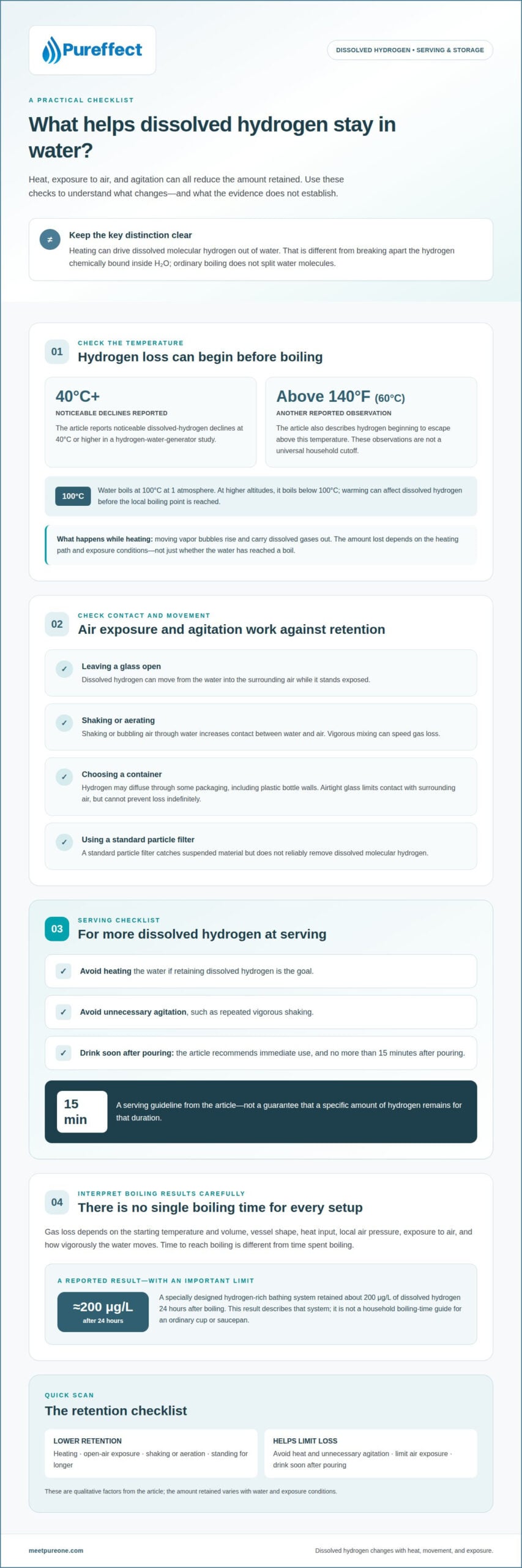
Dissolved molecular hydrogen can escape as water warms, sits exposed to air, or is agitated. Serving temperature, container, and time after pouring all affect how much remains.
Boiling, Shaking, and Aerating Water
Boiling, shaking, and aerating can all help dissolved gas escape, but in different ways. Shaking or bubbling air through water increases contact between water and air; boiling adds heat and moving vapor bubbles. Both warming and agitation can speed hydrogen loss, so vigorous mixing works against keeping the gas dissolved.
Consider a glass poured for drinking: leaving it open gives dissolved hydrogen a route into the surrounding air, while shaking repeatedly disturbs the water. Neither action creates the same heat as boiling, but both can reduce the amount retained. Hydrogen water is recommended for immediate use, and not more than 15 minutes after pouring.
Hydrogen can also diffuse through some packaging. For example, it may pass through the walls of a plastic bottle. An airtight glass container limits contact with surrounding air, but cannot prevent loss indefinitely. Oxygen is another dissolved gas, and how much of either gas remains depends on its properties and the water’s exposure conditions.
Filtering and standing affect water differently. A standard particle filter catches suspended material but does not reliably remove dissolved molecular hydrogen. Hydrogen can escape gradually when water stands, especially in an open container, as it moves from the liquid into the surrounding air.
Boiling Time for Dissolved Gas Removal
There is no single boiling duration that describes the loss of every dissolved gas in every container. At 1 atmosphere, water boils at 100°C, but hydrogen begins escaping earlier: reported observations place the start above 140°F (60°C), with noticeable declines at 40°C or higher in a hydrogen-water-generator study.
The change begins during heating, not only once a pot reaches a rolling boil. As boiling continues, bubbles rise and vapor leaves the water, carrying dissolved gases with it. The result depends on the starting temperature, vessel shape, exposure to air, and how vigorously the water moves.
Measured results also show why timing cannot be reduced to one universal number. A specially designed hydrogen-rich bathing system retained about 200 μg/L of dissolved hydrogen 24 hours after boiling. That finding describes that system, not an ordinary cup or saucepan, so it shouldn’t be used as a household boiling-time guide.
Boiling does not preserve dissolved hydrogen. If you want to retain it, avoid heating and unnecessary agitation, and drink the water soon after pouring. Hydrogen continues to exchange with the air while water stands exposed, so even a short wait can matter.
Hydrogen loss when water is heated or boiled
Heating reduces the amount of molecular hydrogen dissolved in water. The dissolved-gas concentration can fall before water boils, so boiling isn’t the starting point for hydrogen loss.
Hydrogen begins escaping as water warms. The supplied topic data places the start above 140°F (60°C), with noticeable declines at 40°C or higher. These temperatures describe dissolved hydrogen loss, not the point where water molecules break apart.
Does water temperature or altitude affect how quickly dissolved hydrogen escapes? Yes. Higher water temperatures speed the loss of dissolved hydrogen. At higher altitudes, lower atmospheric pressure makes water boil below 100°C, changing its boiling temperature but not turning ordinary boiling into a process that splits H₂O.
When warming water for a recipe, the relevant question isn’t only whether it has reached a boil. Hydrogen can escape as the water heats. The starting temperature and heating method shape its temperature history, while an open surface gives gas a path into the surrounding air.
A single boiling-point reading cannot describe the full change in dissolved-gas concentration. Two portions of water may reach the same final temperature after different heating paths. Their exposure to air and movement during warming may also differ, affecting how much dissolved hydrogen remains.
Altitude changes the local boiling point; it does not prevent warm water from losing dissolved hydrogen. Water at elevation still heats toward its local boiling temperature. The distinction is between heat exposure, which affects dissolved gas, and the chemical bonds in H₂O, which ordinary heating does not split.
If you want to drink water with dissolved hydrogen, avoid heating it. A hydrogen generator can prepare hydrogen-infused water for a separate drinking routine. This is an option when you want freshly prepared water rather than water heated for cooking or another purpose.
The loss of dissolved hydrogen is different from the much more extreme conditions needed to split water itself. One estimate puts the temperature needed to split water above twenty-five thousand degrees Celsius. The heating discussed here concerns hydrogen escaping from water, not H₂O breaking apart. The estimate does not change the practical point: dissolved hydrogen can decline as water warms, long before such temperatures are involved.
Heating hydrogen water at high temperature causes its hydrogen content to evaporate, leaving alkaline ionized hydrogen water with the characteristics of normal water. A heated sample may therefore no longer retain the hydrogen content it had before heating. For someone seeking dissolved hydrogen, avoiding heat remains relevant; the extreme temperature associated with splitting water is a separate issue.
How long must water boil to remove dissolved gases?
There is no single boiling time that applies to every pot or every dissolved gas. The time depends on the water’s starting temperature and volume, the vessel’s shape, heat input, and local air pressure. A small, uncovered pan and a deep pot do not heat or exchange gas with the air in the same way.
First, distinguish the time it takes to reach boiling from the time spent boiling. Water taken from a cool room takes longer to reach its local boiling point than water that is already warm. Burner output, contact between the pan and burner, and the amount of water all affect the warm-up period.
Vessel shape matters, too. A wide pan exposes more water surface to the air than a narrow pot holding the same volume. A lid changes how vapor moves away and how air meets the surface. As a result, two pots on the same stove can behave differently, even with equal amounts of water.
Altitude adds another variable. Lower atmospheric pressure at higher elevations lowers water’s boiling temperature, so the boiling point differs from the familiar sea-level reference. This does not create a universal adjustment to boiling time: starting temperature, vessel, heat source, and water volume still affect how long it takes.
The phrase “remove dissolved gases” also needs a clear endpoint. A rolling boil is observable, but it does not reveal the concentration of each gas remaining in the water. Hydrogen and other dissolved gases do not necessarily behave identically. Without measuring a specific gas in a specific sample, elapsed time alone cannot establish that every gas has been removed.
For example, compare a kettle filled near capacity with a shallow saucepan holding less water. The smaller volume may reach boiling sooner, while the broader surface and different exposure affect gas exchange. A covered vessel changes those conditions again. The burner setting and consistency of the boil add further variation.
Use the purpose of boiling to decide when to stop, rather than treating a fixed duration as a universal gas-removal rule. For dissolved hydrogen, the water’s heating history and exposure matter more than a timer alone. A kitchen clock can tell you how long the water boiled, but not the concentration of gas remaining.
Does boiling water remove hydrogen atoms from H2O molecules?
For ordinary boiling, no. The question concerns a different chemical event: thermal dissociation, in which heat breaks molecular bonds. The energy figures help show why this distinction matters outside the kitchen. A kettle changes water’s physical state, while dissociation requires far more energy and extreme temperatures.
Breaking one O-H bond in water requires 464 kilojoules per mole, according to the supplied topic data. Breaking both bonds in a mole of water requires 928 kJ/mol. These values describe bond breaking, not the energy needed simply to warm a drink or produce steam.
The comparison with boiling makes the scale clearer. The supplied data gives 2257 kJ/kg as the energy needed to boil water already at 100°C, and says splitting water takes over twenty-two times the energy needed to boil it. These figures use different units and conditions, so they illustrate the energy gap rather than provide a direct kitchen calculation.
Temperature is another key difference. The topic data places the start of thermal dissociation around 3000°C, far above water’s boiling temperature at ordinary pressure. At 2,200°C, about 3% of water molecules are reported as dissociated into various combinations of hydrogen and oxygen atoms. Those conditions are not reached in normal cooking.
That example also shows why “starts” doesn’t mean “all molecules split.” At 2,200°C, the reported share is only about 3%, and the products can include different combinations of atoms. Thermal dissociation depends on extreme heat; it isn’t the same as the dissolved-gas loss that occurs during everyday water heating.
The practical distinction is simple: ordinary boiling does not remove the hydrogen atoms from H₂O. At cooking temperatures, water molecules are not expected to split through heat alone. Figures for the much higher temperatures involved describe unusual scientific or industrial conditions, not a kettle, saucepan, or cup of boiled water.
Pureffect: PureONE Molecular Hydrogen Generator
PureONE Molecular Hydrogen Generator lets you make hydrogen-infused water at home without boiling. It’s designed for people who want to prepare water for drinking, rather than heat it and lose dissolved hydrogen. The device also offers inhalation and topical-use modes, so you can choose how to use it. It does not change the distinction explained above: dissolved molecular hydrogen is separate from the hydrogen atoms bonded within water molecules. If you’re considering a home device for making hydrogen water, PureONE offers a practical way to prepare it. Contact Pureffect to learn more about the PureONE Molecular Hydrogen Generator.
Choose the Preparation That Fits Your Routine
Choose your next step based on what you want from your water. A hot drink and hydrogen-infused water serve different purposes, so decide what you’re preparing before choosing how to heat or serve it. That simple pause can help you avoid treating different kinds of water preparation as interchangeable.
If you’re still wondering whether boiling water removes hydrogen, use the answer to guide your routine rather than expecting boiling to serve two different goals. Consider when you prefer hot water and when you want hydrogen-infused water. Knowing your preference makes it easier to choose a preparation method that suits your day.
Pureffect offers the PureONE Molecular Hydrogen Generator for people exploring hydrogen water at home. Explore the PureONE Molecular Hydrogen Generator and consider whether it fits your routine. You can take the next step at your own pace, with a clearer idea of what you want from your water.
Frequently Asked Questions
Does Boiling Hydrogen Water Remove the Hydrogen?
Yes. Boiling drives dissolved hydrogen out of water, so a reheated serving no longer retains its original dissolved-gas content. For example, warming hydrogen water for a hot drink changes its dissolved hydrogen compared with drinking it freshly prepared. The water remains water; the change concerns dissolved molecular hydrogen, not the hydrogen atoms in each water molecule.
Is It Safe To Boil Hydrogen Water?
Boiling hydrogen water does not split its water molecules under ordinary kitchen conditions. Handle it like other hot water: steam and hot liquid can burn, and cookware should be designed for heating water. This matters when deciding whether to heat a serving. The chemistry explains the loss of dissolved hydrogen, but it does not establish whether a particular bottle or device is suitable for heating.
What Happens When Hydrogen Water Heats Up?
As hydrogen water warms, dissolved molecular hydrogen escapes into the surrounding air, reducing the amount left in the liquid. For example, when a serving is heated in a saucepan, heat encourages gas to escape, while steam and bubbles provide routes out. Under ordinary cooking conditions, H₂O molecules remain water molecules; heating changes the dissolved-gas content, not water’s basic composition.
Does boiling water remove dissolved hydrogen gas?
Yes. Boiling removes dissolved hydrogen gas from water; the stated benchmark is that no active dissolved hydrogen remains at the boiling point. This refers to molecular hydrogen dissolved in the water, not hydrogen chemically bonded within H₂O. That distinction matters when interpreting a hydrogen-water measurement: it concerns the gas in the sample, not a change in the water molecules.
How much dissolved hydrogen is lost when water is boiled?
At the boiling point, the stated benchmark is no active dissolved hydrogen remaining, but measured results can vary by system. For example, a specially designed hydrogen-rich bathing system retained 175-300 μg/L between 1 and 6 hours after boiling. That result describes the bathing system, not a kitchen pot or drinking glass, so it can’t be used as a universal percentage for boiled drinking water.
Does boiling remove hydrogen from hydrogen-rich water completely?
At water’s boiling point, the stated benchmark is that no active dissolved hydrogen remains. Results from specially designed systems can differ, as measurements from hydrogen-rich bathing systems show. For typical drinking water, boiling should be understood as removing dissolved hydrogen, not destroying the hydrogen atoms bonded in H₂O. These are separate forms of hydrogen.
Disclaimer
The information provided by Pureffect and any of its products are for educational and informational purposes only and is not intended as medical advice. Individual results may vary, and no specific health outcomes are guaranteed. Always consult a qualified healthcare professional before starting any wellness practice or product.