
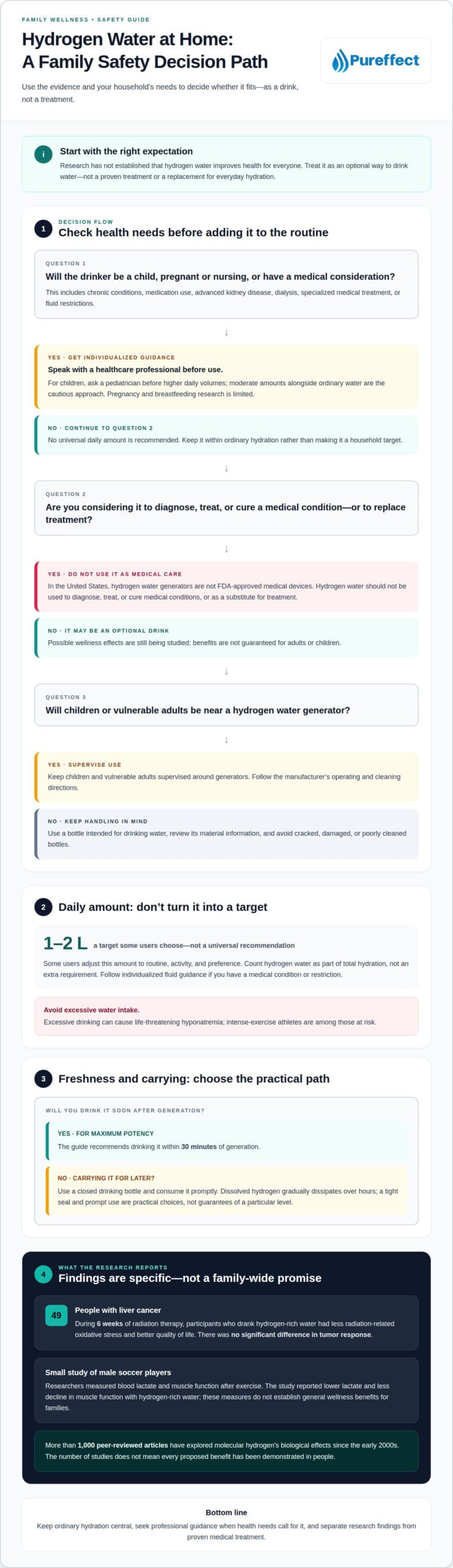
Could hydrogen water become a simple part of your family’s wellness routine? It’s understandable to be curious about hydrogen water for family wellness, but research has not established that it improves health for everyone. Consider it an optional way to drink water, not a proven treatment or a replacement for everyday hydration.
It’s reasonable to ask what the research supports. Studies have explored possible effects, but they do not show that hydrogen water is guaranteed to benefit adults or children. Age, health needs, and how a product fits your family’s routine all matter.
This guide explains what hydrogen water is, what research suggests, and what its limits are. It also compares portable bottles with countertop and under-sink systems, helping you weigh convenience and home use without losing sight of the evidence. The aim is a practical picture of what hydrogen water may offer your household and what it cannot promise.
Key Takeaways
- For children, pregnancy, or medical conditions, weigh safety and hydration needs with a healthcare professional before adding hydrogen water.
- In a study of 49 people with liver cancer, those who drank hydrogen-rich water during 6 weeks of radiation therapy had less radiation-related oxidative stress and better quality of life, with no significant difference in tumor response.
- Compare portable bottles, pitchers, countertop systems, and under-sink options by how your household plans to make and use the water.
- Look beyond convenience when considering a home generator: product features and intended use can shape whether it fits your routine.
- Separate possible wellness benefits from established medical treatment, and choose a setup that suits your family’s needs and preferences.
Hydrogen Water Safety for Families
Hydrogen water safety depends on age, health needs, handling, and everyday hydration. Treat it as a drink, not a treatment for oxidative stress or harmful free radicals.
Safety for Children and Other Groups
Children can drink hydrogen water in moderate amounts as part of normal hydration, but ask a pediatrician before offering higher daily volumes. Pregnant or nursing people should consult a clinician because research during pregnancy and breastfeeding is limited. People with chronic conditions, those taking medication, and people with advanced kidney disease, on dialysis, receiving specialized medical treatments, or following fluid restrictions should speak with a healthcare professional before drinking it.
Children and vulnerable adults should be supervised when using hydrogen water generators. No major side effects have been reported with normal consumption, but this does not establish benefits or safety for every person. In the United States, these generators are not FDA-approved medical devices and should not be used to diagnose, treat, or cure medical conditions.
Daily Intake Considerations
There is no universal recommended daily amount for hydrogen water. Some users target 1-2 liters per day, adjusting to routine, activity, and preference; count it as part of total hydration, not an extra requirement. Drinking excessive water can cause life-threatening hyponatremia, with intense-exercise athletes among those at risk.
For children, moderate amounts alongside ordinary water are the cautious approach; consult a pediatrician before higher-volume use. Don’t turn a wellness drink into a hydration target for the household. The antioxidant effects sometimes discussed in relation to molecular hydrogen do not replace individualized fluid guidance for medical conditions.
Storage and Dissolved Hydrogen Retention
Hydrogen gradually dissipates from water over hours, rather than disappearing instantly. For maximum potency, drink it within 30 minutes of generation. If you need to carry it for travel, keep it in a closed drinking bottle and consume it promptly; the longer it sits, the less dissolved hydrogen it may retain.
Choose a bottle intended for drinking water, review its material information, and follow its cleaning instructions. Avoid using a cracked, damaged, or poorly cleaned bottle. Whatever the container, a tight seal and prompt use are practical choices, not guarantees that dissolved hydrogen will remain at a particular level.
Device design also deserves careful consideration. The National Institute of Standards and Technology describes a water molecule as one oxygen atom and two hydrogen atoms; molecular hydrogen added to water is a separate dissolved gas. A device’s materials and intended use matter, but a stainless-steel component alone does not establish medical safety. Follow the manufacturer’s operating and cleaning directions, and supervise children around equipment.
Portable Bottles, Countertop Systems, and Under-Sink Systems
Hydrogen water is drinking water infused with dissolved molecular hydrogen (H₂). Portable bottles, pitchers, countertop units, and under-sink systems differ mainly in where they fit and how much water they prepare.
Portable hydrogen water bottles vary in price, so compare current listings when choosing one. These are market ranges, not a single product’s price.
A bottle suits individual use, travel, or making a serving away from the kitchen. The guide recommends looking for at least 1-1.5 ppm of dissolved hydrogen in bottle output. A pitcher can serve several people at home, while a combination system may offer more than one way to prepare or use hydrogen. Compare the intended use and output rather than assuming every format is interchangeable.
Countertop systems stay in the kitchen and suit households that want a fixed preparation spot. Under-sink systems keep the main unit out of sight, but installation depends on the sink area. Typical requirements include a faucet hole about 1.0-1.375 inches (25-35 mm), deck thickness up to about 1.5 inches (38 mm), and an outlet within about 6 feet (1.8 m). Measure the space before choosing that format.
For dissolved hydrogen, the guide recommends a concentration above 0.5 ppm; bottle shoppers can compare that with the 1-1.5 ppm recommendation. Daily-use generators typically produce about 0.8-1.6 ppm, depending on mode and water source. In the United States, hydrogen water generators are not FDA-approved medical devices, so don’t treat a certification label as proof of medical effectiveness or use the water as a substitute for treatment.
Studies of hydrogen-rich water concern possible health effects, not a reason to expect reduced inflammation or fatigue from a particular bottle. To explore how a home-use generator fits alongside portable bottles and pitchers, review these home hydrogen generator details as one system format to consider.
Potential Benefits and Areas of Research
Since the early 2000s, more than 1,000 peer-reviewed articles have explored molecular hydrogen’s biological effects, but that volume does not show that every proposed benefit has been demonstrated in people. For example, a small study of male soccer players measured blood lactate and muscle function after exercise; it reported lower lactate and less decline in muscle function with hydrogen-rich water. Those measures do not establish benefits for families’ general wellness or for people with health conditions.
Claims about heart health, digestion, and sleep need separate evaluation. A study measuring a digestive symptom or sleep measure cannot establish an effect on heart health. The population, intervention, measured outcome, and result all matter when judging what families might expect.
Biological measures also differ from how someone feels or functions. A change in a laboratory marker does not automatically mean better daily energy, mental wellbeing, or recovery. Researchers need to connect measured changes to outcomes that matter to participants, including when assessing claims about antioxidant activity or metabolic effects.
Similarly, findings about exercise recovery apply to the people and outcomes studied; they do not establish that hydrogen water relieves an inflammatory condition. General discussion of oxidative processes is not evidence of that clinical benefit.
Molecular hydrogen is widely studied, but possible benefits remain specific to the outcomes and groups examined. “Hydrogen water for family wellness” may describe an interest, not a proven result. Keep everyday hydration and prescribed care separate from experimental wellness claims, and consult a healthcare professional before using hydrogen water alongside care for a health concern.
Hydrogen Water Generators for Home Use
A home generator makes hydrogen-rich water available as part of a household routine. Its value depends on practical fit, not on a promise to prevent disease. Consider who will use it, where it will sit, and whether preparing water at home suits your day. A glass with breakfast, for example, is a different routine from carrying a hydrogen water bottle while running errands.
Daily-use generators typically produce about 0.8-1.6 ppm of dissolved hydrogen, depending on mode and water source. That range describes output, not a proven health effect. Research into molecular hydrogen includes questions about oxidative stress, but a measured concentration alone cannot show that a family member will experience a particular result.
Your routine matters, too. Hydrogen gradually leaves water over time, so a household that prepares a serving and drinks it promptly may find a generator more practical than storing batches. Someone who prefers water on the go may favor a bottle instead. Compare formats based on what your family will actually use, rather than on a theoretical benefit disconnected from daily habits.
Before choosing a generator, consider its intended uses, cleaning directions, and how its output is described. A clear product description should distinguish dissolved hydrogen concentration from claims about treatment or health effects. In the United States, these devices are not FDA-approved medical devices and are not for diagnosing, treating, or curing conditions. A device label cannot establish that hydrogen water reduces inflammation or fatigue.
Consider possible side effects as carefully as potential benefits. No major side effects have been reported with normal consumption, but that does not settle every individual situation. People with advanced kidney disease, taking medication, or following fluid restrictions should consult a healthcare professional before adding it to their routine. Supervise children and vulnerable adults when they use a generator.
A home generator is best understood as a way to prepare a drink, not as advanced medical care. If you’re exploring hydrogen water at home, weigh convenience against your family’s health needs and hydration habits. Keep prescribed treatments and established care separate from wellness claims.
To see how a home-use system may fit your routine, explore the home hydrogen generator.
Pureffect: PureONE Molecular Hydrogen Generator
The PureONE Molecular Hydrogen Generator gives households a home system for drinking hydrogen-infused water, inhaling a hydrogen-oxygen gas mixture, or applying hydrogen directly to the skin. Consider it if you want these options in one device rather than a bottle designed only for drinking. Its multiple uses do not make it a medical treatment or establish that it will improve a health condition.
PureONE offers four therapeutic modes: drinking hydrogen-infused water, applying it to the skin, applying hydrogen gas directly to the body, and inhaling hydrogen gas. This flexibility may suit households interested in exploring different forms of molecular hydrogen use at home. Because the device does more than prepare a drink, consider which modes actually fit your routine.
For a family focused on drinking water, the relevant mode is hydrogen infusion. The device is manufactured in Canada and uses a proprietary stainless steel condenser. It produces a consistent gas mixture of 66% molecular hydrogen and 33% oxygen. Those figures describe the produced mixture, not a measured health benefit or a promise of improved wellness.
Research into molecular hydrogen examines possible biological effects, including its relationship to oxidative stress. That research does not establish that PureONE prevents inflammation, treats disease, or improves outcomes for every user. If someone in your household has a chronic condition, takes medication, needs controlled fluid intake, or is considering hydrogen inhalation, consult a qualified healthcare professional before use.
A home generator may be worth considering if you value more than portable drinking-water preparation and can follow the device’s directions for its intended uses. If you mainly want a serving while traveling, a portable bottle may suit you better. When weighing a home system, focus on the use you want, the space available, and whether its modes suit your household.
PureONE is an option for families exploring hydrogen water and other at-home uses. Explore the PureONE Molecular Hydrogen Generator or contact Pureffect with questions.
Choose a Routine That Fits Your Household
Base your decision on routine, not promises. Think about who would use hydrogen water, when they would drink it, and whether a home device would make the habit easier. A setup that fits your household’s day is more useful than one chosen for broad wellness claims. Keep the focus on hydration and care that already supports your family’s health.
If you’re considering hydrogen water for family wellness, start by identifying what you want from a home system. Is your priority preparing water at home, or exploring a device with other intended uses? Discuss health-related questions with a qualified healthcare professional. That keeps the decision personal, practical, and grounded.
Pureffect offers the PureONE Molecular Hydrogen Generator for home use. If you have questions about a home system, you can discuss your home-system questions with Pureffect. Take your time, ask what matters to you, and choose the next step that feels right for your family.
Frequently Asked Questions
Bottles vs Machines: Which Fits Your Life?
A bottle suits someone who wants a portable serving; a home machine suits a routine centered on preparing water at home. Think about a weekday commute versus a shared kitchen routine. Some machines, including PureONE, also offer uses beyond drinking water. That versatility matters only if those modes fit your household’s interests. Choose based on where and how you expect to use the device, not an assumption that one format delivers better health outcomes.
Hydrogen vs Alkaline: What’s the Difference?
Hydrogen water refers to water with dissolved molecular hydrogen, while alkaline water has a higher pH. These terms describe different properties, so “hydrogen” and “alkaline” are not interchangeable labels. A product may be marketed with one or both terms, but the label alone does not show that it provides a particular health effect. For a practical comparison, identify the property being described and look at the evidence for the specific claim you care about.
What Is Molecular Hydrogen?
Molecular hydrogen is hydrogen gas in the form H₂, made of two bonded hydrogen atoms. It differs from the hydrogen atoms chemically bound within water molecules. The National Institute of Standards and Technology describes a water molecule as containing two hydrogen atoms and one oxygen atom. In hydrogen water, molecular hydrogen is dissolved in the drinking water; it is not another name for water itself.
What Is Hydrogen Therapy?
Hydrogen therapy is a broad term for using molecular hydrogen in wellness or research contexts. Possible approaches include drinking hydrogen-infused water, inhaling hydrogen-oxygen gas, or applying hydrogen to the skin. PureONE offers these uses through its device’s modes, but the word “therapy” does not establish that a method treats disease. Keep that distinction clear, and do not replace prescribed care or a clinician’s advice with a wellness device.
What Health Benefits of Hydrogen Water Are Supported by Human Clinical Studies?
Human research has examined possible effects in specific settings, but it has not established broad health benefits for families. A finding in a defined patient group or treatment context cannot automatically demonstrate the same effect in healthy adults, children, or people with different conditions. Look at who participated, what outcome researchers measured, and whether the study directly tested drinking hydrogen water. These details help distinguish a research signal from a proven everyday benefit.
Does Hydrogen Water Help With Energy, Inflammation, Digestion, or Athletic Recovery?
Current evidence does not establish reliable improvements in energy, inflammation, digestion, or athletic recovery for everyone. These are distinct outcomes, so evidence about one does not prove the others. For example, feeling less tired after a workout could have many explanations, including rest and hydration. Treat hydrogen water as a beverage, not a performance aid or treatment, and discuss its use with a healthcare professional if you have a health concern.
Disclaimer
The information provided by Pureffect and any of its products are for educational and informational purposes only and is not intended as medical advice. Individual results may vary, and no specific health outcomes are guaranteed. Always consult a qualified healthcare professional before starting any wellness practice or product.