
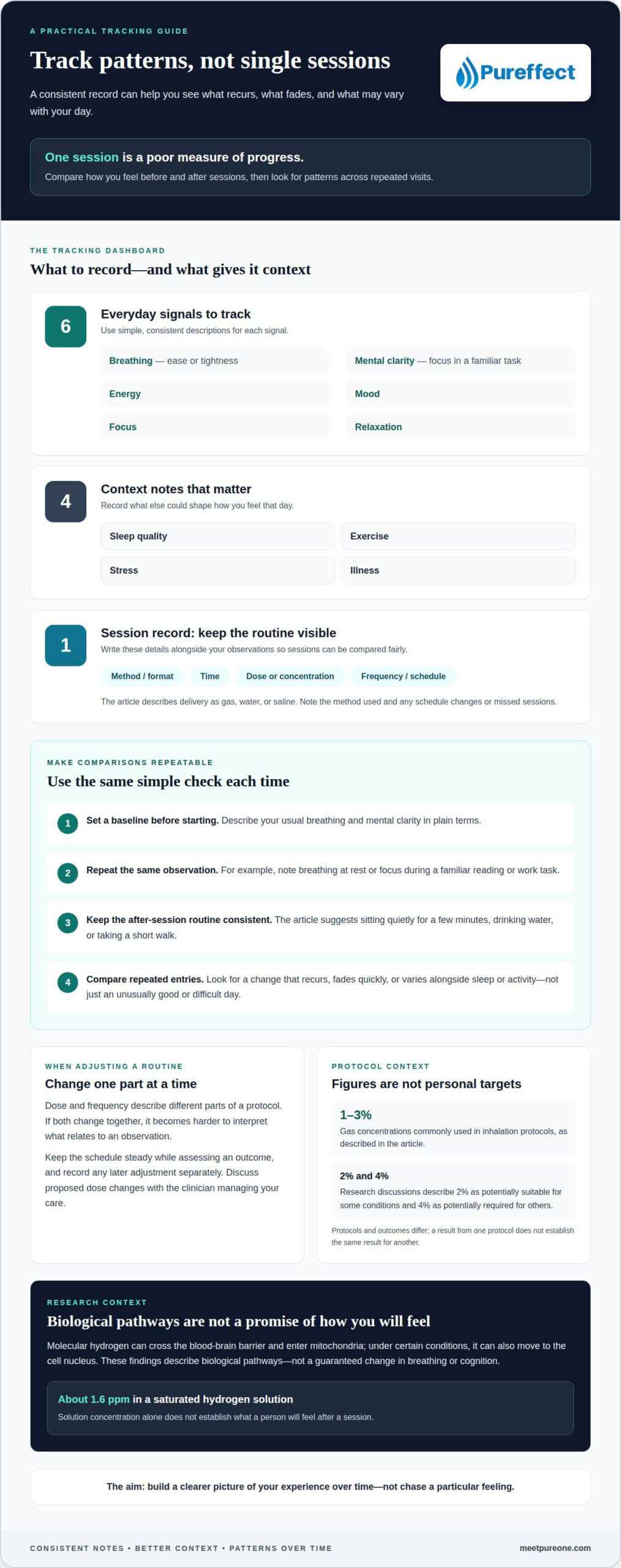
One session is a poor measure of progress. To track progress with hydrogen therapy, note how you feel before and after sessions, then compare patterns over time. Track breathing, mental clarity, energy, mood, focus, and relaxation, along with the method and frequency you use.
It’s natural to look for a clear sign of change. But wellbeing can vary from day to day for many reasons. A consistent record helps distinguish a recurring pattern from an unusually good or difficult day. Note what you observe after sessions and keep the method and schedule alongside those observations.
Use practical measures for breathing, mental clarity, energy, and mood, and account for context when comparing sessions. The goal isn’t to chase a particular feeling. It’s to build a clearer picture of your experience over time.
Key Takeaways
- Compare breathing and mental clarity before and after sessions, then look for patterns across visits rather than judging from one day.
- Record the session dose and frequency alongside your observations so you can see how your routine relates to changes over time.
- Track energy, mood, focus, and relaxation in simple, consistent terms to make subtle shifts easier to notice.
- Set a baseline before starting, including your usual symptoms and relevant health measures, so later comparisons have context.
- Learn how a home-use option such as the PureONE Molecular Hydrogen Generator can fit into a consistent routine for tracking your experience.
Noticing breathing and mental clarity after sessions
Start by noting how breathing feels and how clearly you can think. After a session, follow the same quiet routine each time, such as sitting for a few minutes, drinking water, or taking a short walk. Consistency makes it easier to compare observations without confusing them with changes in activity or timing.
Before your first session, describe your usual breathing and mental clarity in plain terms. For example, note whether breathing feels comfortable at rest, or whether you lose focus during a familiar task. After each session, record the same details. Include the session format, time, dose, and frequency, since molecular hydrogen may be delivered as gas, water, or saline. Don’t treat a single unusually good or difficult day as a trend.
- Breathing: Note ease, any sense of tightness, and whether a short walk feels different from your usual walk.
- Mental clarity: Record focus during a familiar activity, such as reading a page or completing routine work.
- Context: Add sleep quality, exercise, stress, or illness that day. These can affect normal physiology and your observations.
Compare notes across repeated sessions, not only immediately after one. A brief daily entry can show whether a change recurs, fades quickly, or varies alongside sleep or activity. That pattern is more informative than a broad label such as “better.”
Molecular hydrogen can cross the blood-brain barrier and enter mitochondria; under certain conditions, it can also move to the cell nucleus. These findings describe biological pathways, not a guaranteed change in breathing or cognition. A saturated hydrogen solution contains about 1.6 ppm molecular hydrogen, but solution concentration alone doesn’t establish what a person will feel after a session.
How can progress be compared with standard treatment or placebo? Use the same breathing and clarity measures before and after each approach, over comparable periods. In a clinical study, a placebo comparison helps separate the treatment effect from expectation and ordinary fluctuation; keep prescribed care unchanged unless the prescribing clinician adjusts it.
How much does therapy cost in the United States, and is it covered by insurance? Cost varies by delivery method and session arrangement, and coverage depends on the terms of an individual health plan. Compare the full schedule and method, not just the price of one session.
Which objective tests or biomarkers can track response? Depending on the health question, breathing measures may include respiratory rate, oxygen saturation, or spirometry results. For mental clarity, use the same brief attention task each time. No single measure captures every aspect of cellular function or wellness.
What are the risks, side effects, and safety precautions? Approximately 15 published case studies involved hydrogen-machine deflagrations. Treat hydrogen gas equipment carefully, follow its operating directions, and keep it away from ignition sources; record any unwanted symptoms alongside session observations.
How can someone find a qualified clinician or reputable provider in the United States? Look for a licensed clinician whose scope covers your health concern and who can coordinate with your existing care team. Clear information about the method, dose, and safety practices helps you assess whether the approach fits your needs.
Dosing and frequency considerations
Dose and frequency describe different parts of a protocol. Dose concerns the amount or concentration used, while frequency describes how sessions are spaced. Hydrogen inhalation protocols commonly use gas concentrations of 1-3%. Research discussions describe 2% as a level that may suit some conditions, while 4% may be required for others. These figures describe protocols, not a universal personal target.
When tracking progress with hydrogen therapy, change one part of your routine at a time. Changing concentration and frequency together makes it harder to interpret the result. Keep the schedule steady while assessing an outcome, and record any later adjustment separately. This helps distinguish a change in routine from a change in what you’re measuring.
Compare research findings with care: studies may use different concentrations, delivery methods, schedules, or outcomes, so their results may not describe the same exposure. A finding from one protocol doesn’t establish that another concentration or frequency will produce the same result. Researchers interpret dose in light of the condition and outcome studied.
- Concentration: Record the value used when it’s available, rather than describing a session only as “stronger.”
- Schedule: Note changes in timing or missed sessions, so the routine remains clear.
- Interpretation: Compare observations from similar protocols before drawing conclusions about a dose.
How long should hydrogen therapy be tried before evaluating progress? Choose a review point that fits the outcome and protocol, then compare observations collected in a consistent way. A short-term response and a pattern that develops during a steady routine are different findings.
Tracking progress with hydrogen therapy is more useful when you consider one planned change at a time. If a chronic condition or medication change could affect the same outcome, include that context in your review. Discuss proposed dose changes with the clinician managing your care so they remain aligned with your treatment plan.
If you want a home-use option for a consistent routine, explore how the PureONE Molecular Hydrogen Generator may fit your approach. Choose a method and schedule you can follow steadily, then assess your observations in that context.
Reported changes in energy, mood, focus, and relaxation
People tracking their wellbeing may notice a change in everyday tasks before they can describe a broader shift. Some users report clearer engagement during work or errands after hydrogen inhalation, with a perceived change lasting several hours. Treat this as a personal observation, not proof of a clinical effect or a prediction for someone else.
Track energy, mood, focus, and relaxation as separate outcomes. For example, note whether you completed a familiar task without losing your place, felt settled during an ordinary evening, or needed your usual rest after errands. Use the same simple scale and wording each time. “Steady energy through afternoon chores” is more useful than “felt great.”
How should symptoms and treatment sessions be logged? Record the date, delivery method, session details, and each outcome in the same entry. Note symptom intensity, timing, sleep, activity, and medication changes to give later comparisons useful context.
- Energy: Describe what you did, such as completing routine chores without an unplanned break.
- Mood: Note a specific moment, such as feeling calmer during a usual source of stress.
- Focus: Choose a repeated task, then note whether attention felt easier to sustain.
- Relaxation: Record whether settling into a normal evening routine felt different.
Scientific findings suggest possible mechanisms, not a direct scorecard for daily experience. Research on molecular hydrogen describes potential support for antioxidant defenses, including enzymes such as superoxide dismutase and catalase, which help manage oxidative stress. It also examines effects on inflammatory signaling pathways. These cellular findings don’t establish that a person will feel more energetic, focused, or relaxed.
Some studies report changes in markers related to cell protection, including reduced activation of caspase-3, a protein involved in apoptosis. In rat models of focal ischemia and reperfusion, hydrogen was associated with reduced oxidative stress and inflammation, increased Bcl-2, and reduced Bax and caspase-3. Those animal findings are not evidence of improved mood or longevity in people.
Keep your interpretation grounded. A better afternoon could reflect sleep, workload, activity, or other changes, not just a session. Review notes across repeated sessions and check whether the same outcome shifts in a similar context. Keep distinct outcomes separate rather than combining them into one “wellness” rating. This makes effects easier to discuss and helps avoid mistaking a temporary change for a lasting pattern.
After each hydrogen inhalation session, note breathing and mental clarity, then compare those observations across sessions. Keep these impressions separate from energy, mood, focus, and relaxation. Repeated notes can show whether a change appears consistently or only in a particular setting, without turning a personal impression into proof of a treatment effect.
Mechanistic findings provide context, but they do not confirm what someone will feel. In macrophages, molecular hydrogen was reported to inhibit LPS/IFNγ-induced nitric oxide production, reducing inflammation in Type I allergies. The review reports that molecular hydrogen may inhibit the TNF-α/NFκβ, Ras-ERK1/2-MEK1/2, and Akt pathways. In rat models of transient ischemia and reperfusion, hydrogen-rich saline was reported to reduce TNF-α, NF-κB, and IL-6 expression and activity. These findings concern cellular or animal research, so keep them distinct from personal observations recorded after sessions.
What baseline health measures should be recorded before starting hydrogen therapy?
A useful baseline describes your usual health before sessions begin. Record the symptom or daily function you want to follow, how often it affects you, and what seems to make it better or worse. For example, if fatigue disrupts meal preparation, note which tasks feel difficult and when.
Focus your record on outcomes that matter in daily life, and describe them consistently rather than relying on memory later. Brief notes about sleep, breathing comfort, concentration, or completing a familiar activity give you a starting point for comparison. Include good and difficult days, not only moments that seem connected to treatment.
- Current symptoms: Describe location, timing, triggers, and impact. For headaches, for instance, note whether they occur during work or after activity.
- Daily function: Record a repeatable task, such as walking to a regular destination or finishing a usual household chore.
- Sleep and routine: Note bedtime patterns, exercise, stress, and major schedule changes that could affect how you feel.
- Health context: List existing diagnoses, current medicines, supplements, and recent changes in care.
Include objective measurements only when they relate to your health concern and are collected consistently. These might be results from a clinician’s assessment or a test already used to monitor a diagnosed condition. Record the date, setting, and method with each result, since readings taken under different conditions may not be directly comparable.
Research measures biological activity, such as oxidative stress or inflammatory signaling, but those laboratory findings aren’t interchangeable with personal progress. As of June 2024, hydrogen therapy research had produced more than 100 clinical trials. That breadth doesn’t mean every trial measured the same outcome or that a lab marker predicts how you’ll feel. Keep your personal baseline separate from research endpoints.
Before starting, decide which outcomes you’ll review and how you’ll describe them. If concentration is your priority, choose a familiar activity and note whether you complete it comfortably. If sleep is the focus, record your usual pattern and how rested you feel on waking. Consistency matters more than collecting unrelated measurements.
Bring this baseline and your treatment log to the clinician who manages your care. A concise record of symptoms, medicines, and relevant test results can help distinguish a change in your health from a change in routine. For a home-based approach, explore the PureONE Molecular Hydrogen Generator as an option for incorporating hydrogen sessions into a trackable routine with Pureffect.
Tracking personal metrics helps you separate meaningful progress over time from ordinary fluctuations. Hydrogen was used to measure blood flow in the 1960s, a historical research use distinct from tracking personal symptoms or daily function.
Pureffect: PureONE Molecular Hydrogen Generator
Pureffect’s PureONE Molecular Hydrogen Generator is a home-use option for people who want to include hydrogen sessions in a routine they can track. Its four modes let users inhale hydrogen gas, drink hydrogen-infused water, or apply hydrogen-infused water or hydrogen gas directly to the skin or body. Choose a consistent mode and record it in your notes, since observations from different delivery methods aren’t directly interchangeable.
Made in Canada, the generator produces a consistent mixture of 66% molecular hydrogen and 33% oxygen. This is a practical next step if you want to follow your routine at home while keeping notes on method and personal experience. Explore the PureONE Molecular Hydrogen Generator and visit meetpureone.com to learn more.
Make your next step evidence-led
Use your notes to decide what you want to learn next: whether the routine feels manageable, which outcome matters most, or what you’d like to discuss with your healthcare professional. This makes tracking progress with hydrogen therapy a practical decision tool, rather than a search for one dramatic sign.
Keep expectations grounded. Personal observations can help you spot patterns, but they can’t prove that hydrogen therapy caused a change or replace medical assessment. If your health changes, prioritize appropriate medical care and share relevant notes with your clinician.
If a home-use option fits your plans, explore Pureffect’s PureONE Molecular Hydrogen Generator and consider whether its features suit the routine you want to track.
Explore the PureONE Molecular Hydrogen Generator, and take your next step at a pace that feels right for you.
Frequently Asked Questions
What outcomes can hydrogen therapy realistically improve, and what evidence supports them?
No specific improvement can be promised across all conditions. Peer-reviewed studies have examined potential effects of molecular hydrogen, but findings vary by condition, delivery method, and outcome measured. The number of published studies or clinical trials alone doesn’t establish that a treatment will work for a particular person. Treat research as context, not a forecast. Individual results may vary, and hydrogen therapy shouldn’t replace established medical care.
What changes in symptoms or test results count as meaningful improvement?
A meaningful change is repeatable and matters to daily life, such as returning to an activity that symptoms previously interrupted. For test results, compare measurements taken with the same method and under similar conditions, and consider them alongside symptoms and function. One improved reading may reflect ordinary variation; a consistent shift across comparable assessments gives you a more useful basis for discussion with your healthcare professional.
Disclaimer
The information provided by Pureffect and any of its products are for educational and informational purposes only and is not intended as medical advice. Individual results may vary, and no specific health outcomes are guaranteed. Always consult a qualified healthcare professional before starting any wellness practice or product.