
What if the very antioxidants you take to recover are actually muting your body’s ability to get stronger? It’s a frustrating paradox many athletes face. You push through a high-intensity interval session, only to be sidelined by DOMS or a performance plateau. If you’re looking into molecular hydrogen for athletic recovery, you’ve likely realized that traditional methods have their limits. You need a way to clear the cellular “trash” without turning off the signals that build muscle. Is it possible to have both?
We believe so. With over 1,300 peer-reviewed papers published by 2026, the data is clear. One 2026 meta-analysis highlights significant improvements in lactate clearance and mitochondrial efficiency. This isn’t just about feeling less sore; it’s about optimizing ATP production at the source. In this guide, we’ll show you how this selective antioxidant targets only the most harmful free radicals while preserving the beneficial ones. We’ll explore how these cellular shifts lead to an improvement of up to 3.4% in sprint times and a much faster return to training. Let’s dive into the science together.
Key Takeaways
- Understand why high-dose Vitamin C can actually block muscle growth and how selective antioxidants offer a smarter way to manage oxidative stress.
- Review the 2026 data on molecular hydrogen for athletic recovery, which shows a 3.4% improvement in sprint performance and faster lactate clearance.
- Learn to optimize your “Pre-Game” protocol by using inhalation to saturate the nervous system before your heaviest training sessions.
- Discover how hydrogen supports mitochondrial function, allowing your body to restore ATP levels and return to training sooner.
- Identify why the specific 66/33 hydrogen-oxygen ratio provides the respiratory support needed for long-term athletic longevity.
Why Athletic Recovery is a Cellular Redox Challenge
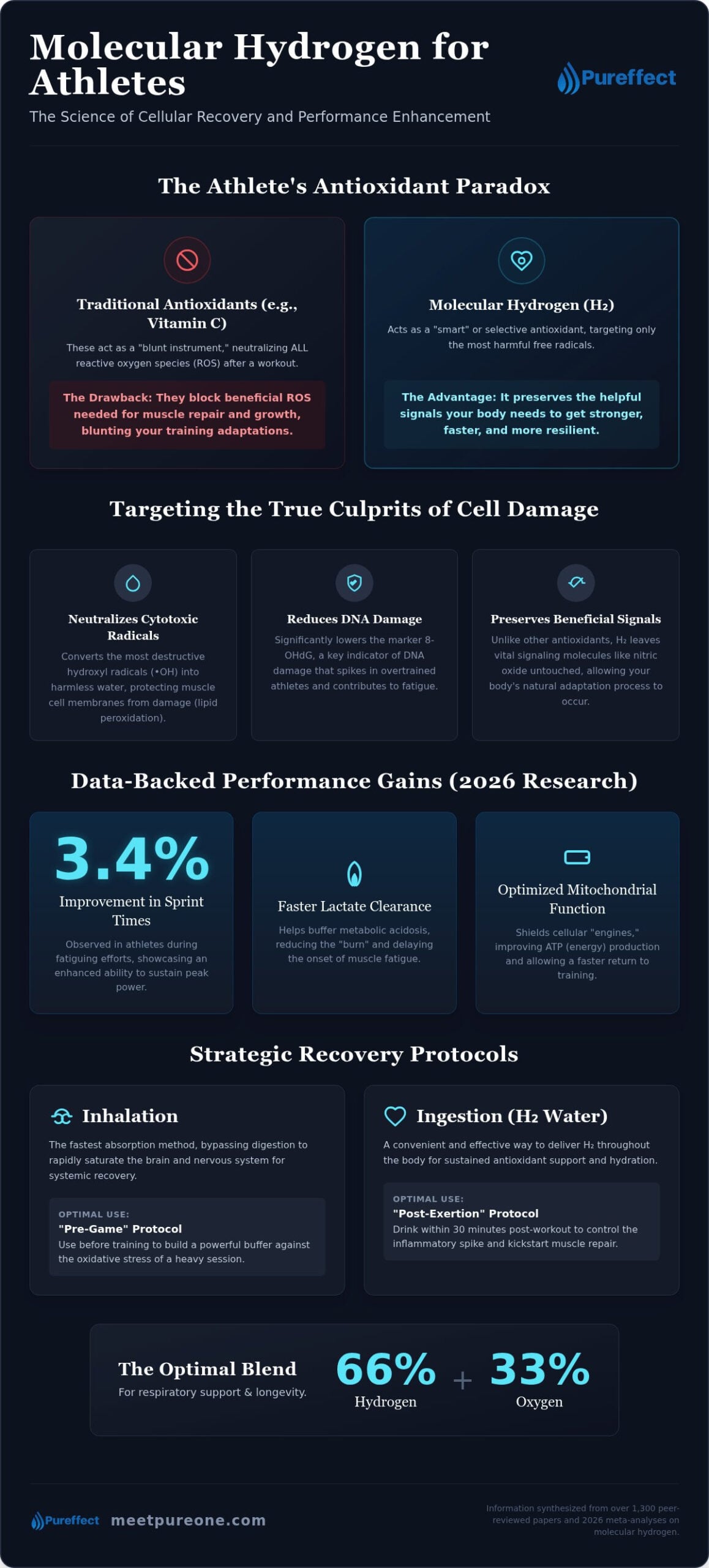
Ever wondered why your recovery feels like an uphill battle despite taking every supplement in the book? When you push through a heavy HIIT session, your body ignites a literal firestorm of reactive oxygen species (ROS). While some ROS are actually helpful signals for muscle growth, others are just plain destructive. This is the “Antioxidant Paradox.” Traditional high-dose antioxidants like Vitamin C can’t tell the difference. They often end up blocking the very adaptations you’re training for by blunting the stress signals your muscles need to get bigger and stronger.
Molecular hydrogen for athletic recovery changes the game because it’s a selective antioxidant. It doesn’t just mop up everything. Instead, it targets the real culprits like 8-OHdG. This is a specific marker of DNA damage that spikes significantly in overtrained athletes. By focusing on these bad actors, you keep the signals that make you stronger while clearing out the noise that causes fatigue.
The Role of Cytotoxic Hydroxyl Radicals
Why is the hydroxyl radical such a problem? It’s the most reactive of the ROS, specifically targeting the fatty acids in your muscle cell membranes. This process, known as lipid peroxidation, is the primary enemy of rapid muscle tissue repair. Hydrogen therapy works by neutralizing these cytotoxic radicals into harmless water without affecting signaling molecules like nitric oxide. In 2026, selective antioxidant therapy is defined as the targeted neutralization of cytotoxic radicals to preserve beneficial redox signaling for physiological adaptation.
Inflammation Markers: Beyond the Burn
DOMS isn’t just about “feeling the burn.” It’s a systemic inflammatory response. High-intensity training causes a sharp spike in pro-inflammatory cytokines like TNF-alpha. These markers are directly linked to the lingering soreness and systemic fatigue that prevents you from hitting your next session at full power. We’re seeing a massive shift in 2026 toward managing “Redox Balance” rather than just “Antioxidant Loading.” Instead of trying to suppress all inflammation, the goal is to keep it within a range where the body can actually use it to recover faster. It’s about precision, not power.
The 2026 Research: How Hydrogen Resets the Athletic Body
What does the science actually say? By 2026, the data on molecular hydrogen for athletic recovery has moved from experimental to essential. A recent scientific review of hydrogen’s effects and mechanisms highlights how this tiny molecule acts as a signal modulator. It doesn’t just react with radicals; it changes how your genes express themselves. This means your body gets better at producing its own internal antioxidant enzymes like superoxide dismutase. Recent clinical trials with elite cyclists and runners now show a significant reduction in perceived exertion and muscle fatigue during back-to-back training days.
Mitochondrial Resilience and Energy Currency
Your mitochondria are the engines of your performance. During high-intensity bouts, the electron transport chain inside these organelles can become “leaky,” leading to energy loss and cellular damage. Hydrogen acts as a protective shield for these engines. Research shows it enhances ATP utilization, allowing you to sustain power for longer. If you want to dive deeper into the mechanics of cellular power, check out our How to Increase Cellular Energy: A Research-Driven Guide. It’s about making your cellular “batteries” more efficient.
Lactate Clearance and pH Balancing
We’ve all felt that heavy, leaden feeling in our legs during a final sprint. This metabolic acidosis is a major performance killer. A 2026 meta-analysis confirmed that hydrogen-rich water helps buffer this acidity, leading to a modest but significant 0.6% improvement in time trials for national-level finswimmers. Even more impressive? Sprint times in fatiguing efforts improved by up to 3.4%. This happens because hydrogen helps clear lactate faster and stimulates the release of fibroblast growth factor 21 (FGF21), a hormone that improves energy metabolism. To start applying these findings to your own routine, you might consider a professional tool like the PureONE Molecular Hydrogen Generator for your home recovery lab.
Strategic Recovery Protocols: Inhalation vs. Ingestion
Most people think of hydrogen water first. It’s convenient, sure. But inhalation is the fastest route to saturate your brain and nervous system. Why? Because it bypasses the digestive bottleneck entirely. When you breathe hydrogen gas, it enters the bloodstream through the lungs and reaches every cell in minutes. To perform a post-training inhalation session for a neuro-muscular reset, follow these steps:
- Secure your nasal cannula and ensure a snug fit.
- Sit in a comfortable, upright position to allow for full lung expansion.
- Breathe naturally for 30 minutes, focusing on deep, diaphragmatic breaths.
- Relax your mind; this is as much a neurological reset as a physical one.
This direct path is why many high-performance coaches are moving toward gas over water for deep recovery. You can read more about the differences in our guide on the Hydrogen Inhalation Machine vs. Water Bottle.
Dual-Action Recovery: Inhale and Hydrate
Effective molecular hydrogen for athletic recovery often requires a dual-action approach. While inhalation handles systemic saturation, drinking hydrogen-infused water supports gut-axis health. This is particularly vital for endurance athletes who experience “leaky gut” symptoms after long runs. A meta-analysis of molecular hydrogen studies confirmed that these protocols significantly improve blood lactate clearance and alleviate fatigue markers.
Beyond the physical, using hydrogen therapy in the evening can improve sleep quality by lowering the systemic inflammation that keeps your nervous system “wired” after a late-night gym session. The optimal hydrogen concentration for elite athletic recovery is achieved by maintaining high tissue saturation through high-flow inhalation sessions paired with consistent intake of hydrogen-enriched water. Ready to upgrade your protocol? You can find professional-grade equipment like the PureONE Molecular Hydrogen Generator to bring these results into your home.
Why PureONE is the Gold Standard for High-Performance Athletes
Is your recovery setup ready for the demands of 2026? Integrating molecular hydrogen for athletic recovery into your home lab requires more than just a portable bottle. It demands a professional system that can handle the rigors of daily use across multiple therapy modes. PureONE stands out because it offers four distinct ways to recover: inhalation for your nervous system, hydrogen water for metabolic health, and even topical applications for stubborn joint inflammation. It’s a foundational tool designed for those who take their longevity as seriously as their PRs.
The Importance of the 66/33 Oxygen Blend
Why is the 66/33 ratio a dealbreaker for elite athletes? Inhaling pure hydrogen gas without integrated oxygen can be counterproductive during long recovery sessions. The PureONE delivers a precise mixture of 66% hydrogen and 33% oxygen. This specific blend supports mitochondrial respiration, ensuring your cells have the oxygen they need to process energy while the hydrogen neutralizes oxidative stress. It’s the difference between a quick fix and a foundational strategy for ATP restoration. You can see the full technical breakdown on the PureONE Product Page.
Precision Engineering for Serious Performance
We’ve moved past the era of simple biohacking gadgets. Today, serious performers demand expertly engineered systems that focus on gas purity and long-term durability. Pureffect’s PureONE features a proprietary stainless steel condenser. This component ensures that the gas you inhale remains pure and consistent over years of heavy use. It won’t degrade like the plastic components found in consumer-grade units.
We’re so confident in this professional standard that we offer a 365-day risk-free trial. This gives you a full year to track your lactate clearance and DOMS reduction before fully committing. It’s about Investing in Preventative Health at Home to build a body that’s as resilient as it is powerful. Stop settling for temporary relief and start building cellular resilience from the ground up.
Take Control of Your Cellular Resilience
PureONE is built to be the foundation of your home recovery lab. Endorsed by high-performance figures like Howie Mandel, it features Canadian-made engineering and a proprietary stainless steel condenser for absolute gas purity. With our unique 66/33 H2-O2 ratio, you get the metabolic support needed to sustain high-level output year after year. It’s time to stop guessing and start optimizing with a professional standard.
Upgrade your recovery with the PureONE Molecular Hydrogen Generator and start your 365-day risk-free trial. We’re here to help you push your limits and recover faster than ever before.
Frequently Asked Questions
How soon after a workout should I use hydrogen therapy for recovery?
You should aim to start your session within the 30-minute post-exercise window. This immediate application helps you get ahead of the inflammatory spike and the rise of cytokines like TNF-alpha. By using molecular hydrogen for athletic recovery during this critical period, you neutralize destructive hydroxyl radicals before they can cause lingering damage to muscle cell membranes. A 30-minute inhalation session right after training is often enough to kickstart the cellular repair process.
Is hydrogen inhalation more effective for athletes than drinking hydrogen water?
Inhalation is the most efficient delivery method because it bypasses the digestive bottleneck. While drinking hydrogen water supports gut health and metabolic balance, inhalation allows for much higher concentrations to reach the bloodstream and nervous system quickly. For athletes focusing on systemic recovery, the PureONE inhalation mode provides the rapid saturation needed to protect mitochondria and restore ATP levels after high-intensity bouts of training.
Can molecular hydrogen help reduce Delayed Onset Muscle Soreness (DOMS)?
Hydrogen therapy is highly effective for managing DOMS because it addresses the underlying oxidative stress. By clearing cytotoxic radicals, it reduces the muscle damage markers that lead to that heavy, leaden feeling the day after a workout. A 2018 study involving elite soccer players found that hydrogen supplementation significantly lowered levels of creatine kinase. This means you can return to consistent training without being sidelined by excessive soreness.
Does hydrogen therapy interfere with the muscle-building benefits of exercise?
It doesn’t interfere with your gains because it’s a selective antioxidant. Traditional supplements like high-dose Vitamin C can actually block the signals your body needs to build muscle. Hydrogen is different. It only neutralizes the most harmful free radicals while leaving beneficial signaling molecules untouched. This allows your muscles to adapt and grow stronger from the stress of exercise without the collateral damage of excessive oxidative stress.
Is it safe for professional athletes to use the PureONE generator every day?
It’s absolutely safe and actually recommended for daily use. The PureONE generator is built to professional standards in Canada, featuring a proprietary stainless steel condenser to ensure gas purity. Its specific 66/33 hydrogen-to-oxygen ratio provides the respiratory support necessary for long-term use. Professional athletes often use it as a foundational tool in their home recovery labs to maintain peak mitochondrial efficiency and consistent performance throughout a demanding season.
How does molecular hydrogen compare to traditional ice baths for recovery?
Hydrogen therapy and ice baths target different mechanisms. While ice baths use cold to constrict blood vessels, molecular hydrogen for athletic recovery works at the cellular level to improve mitochondrial function and clear lactate. 2026 meta-analysis findings show that hydrogen helps buffer metabolic acidosis more effectively than cold therapy alone. It supports your body’s natural recovery processes without the risk of blunting the adaptive signals required for building long-term strength.
Disclaimer
The information provided by Pureffect and any of its products are for educational and informational purposes only and is not intended as medical advice. Individual results may vary, and no specific health outcomes are guaranteed. Always consult a qualified healthcare professional before starting any wellness practice or product.