
What if that heavy, “vacation-is-over” exhaustion isn’t just a lack of sleep, but a temporary state of systemic inflammation? You know the feeling. You’ve just stepped off a long-haul flight and your brain feels like it’s wrapped in cotton wool. Your joints are stiff. Your stomach is bloated. Your productivity is plummeting. It’s frustrating to spend your first few days back in the office struggling to remember a simple password. We’ve all been there. It’s a common struggle, but it doesn’t have to be your reality. Learning how to manage post-travel recovery at home is the secret to reclaiming your week.
We’ve developed this guide to help you master your return using protocols that address the cellular stress caused by air travel. You can “reset” your system in as little as 24 to 48 hours. Can you actually bypass the week-long slump? Recent 2026 research into mitochondrial health suggests that travel triggers a specific cascade of oxidative stress. In this guide, we’ll dive into the science of travel-induced inflammation. We will explore how to support your cellular energy centers, discuss why 2026 trends like “movement snacking” beat the gym after a flight, and provide a clear protocol to get you back to peak performance. It’s time to stop treating jet lag with just caffeine. Let’s start healing from the inside out.
Key Takeaways
- Understand how cabin pressure triggers “Travel-Induced Oxidative Stress” and why brain fog is actually a measurable cellular inflammatory response.
- Master a 24-hour protocol for post-travel recovery at home that uses environmental controls to reset your internal clock and restore deep hydration.
- Learn to resync your mitochondria through targeted light exposure and temperature shifts to regain productivity faster than traditional rest.
- Discover how a specific mixture of molecular hydrogen and oxygen can neutralize travel-induced free radicals and clear mental sluggishness.
The Biological Toll: Why Travel Triggers Systemic Inflammation
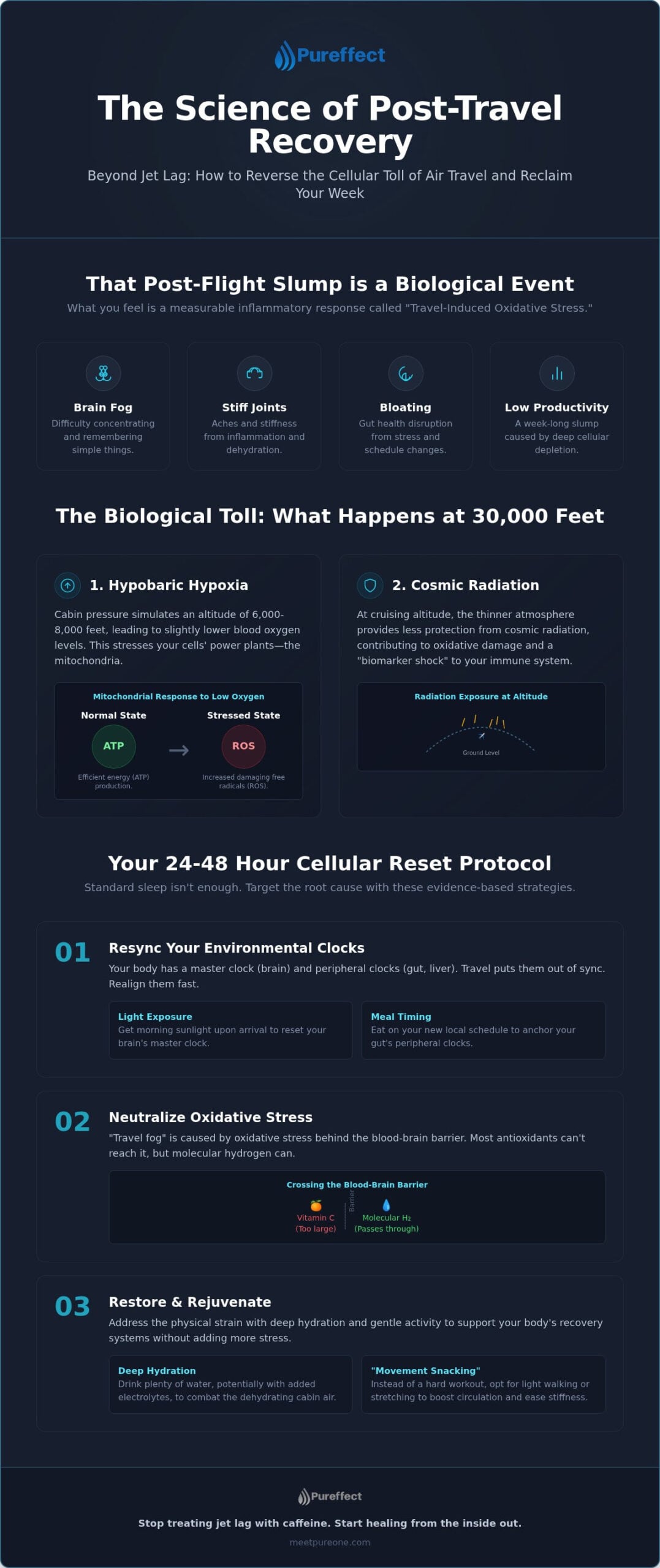
Ever wonder why you feel physically bruised after a six-hour flight? It isn’t just the cramped seats or the mediocre airport food. What you’re experiencing is a biological event called “Travel-Induced Oxidative Stress.” This is the primary driver of that deep, bone-weary depletion that makes post-travel recovery at home feel so daunting. While we often focus on the external clock, your internal chemistry is fighting a silent battle against an influx of reactive oxygen species (ROS).
During long-haul flights, your body undergoes a “light” version of a cytokine storm. This is an immune response where inflammatory markers spike in response to environmental stressors. It creates a state of systemic inflammation that affects everything from your gut health to your cognitive speed. We call this “metabolic jet lag.” It’s a disruption of your cellular energy production that lingers long after you’ve adjusted to the local time zone. Why does this happen? It starts with the air you breathe at 30,000 feet.
Hypobaric Hypoxia and Your Mitochondria
Airplane cabins are pressurized to simulate an altitude of 6,000 to 8,000 feet. This leads to hypobaric hypoxia, a condition where your blood oxygen saturation levels drop slightly but significantly. When oxygen levels dip, your mitochondria, the power plants of your cells, struggle to keep up. Research shows that this slowdown increases the production of ROS, which damages cell membranes and leads to localized tissue inflammation. In the context of altitude shifts, mitochondrial oxidative phosphorylation is the metabolic pathway where cells use enzymes to oxidize nutrients and produce the ATP required for energy. When this process is hindered, you don’t just feel tired; you feel depleted at a molecular level.
The Impact of Cosmic Radiation and Environmental Shifts
Did you know that a cross-country flight exposes you to a measurable increase in cosmic radiation? At cruising altitudes, the atmosphere is thinner, offering less protection from high-energy particles. This contributes to “biomarker shock,” where your immune system reacts to the sudden shift in environmental radiation and pressure. This is a key reason why Jet lag is often accompanied by intense “brain fog” and a heavy, leaden feeling in the limbs. It’s a sign of oxidative damage that requires more than just a nap to fix. Effective post-travel recovery at home must address these microscopic stressors to truly restore your vitality. Recent 2026 findings emphasize that mitochondrial health is the foundation of recovery, necessitating habits that specifically neutralize these oxidative threats.
Resetting the Cellular Clock: Mitochondrial Recovery Protocols
Have you ever slept for ten hours after a trip and still woken up feeling like a zombie? It’s a common frustration. The reason is simple: your central brain clock might be adjusting, but your cellular “batteries” are still lagging behind. Standard sleep isn’t enough because it doesn’t address the deep oxidative damage occurring in your tissues. To truly master your post-travel recovery at home, you need to sync your mitochondrial function with your new environment.
Circadian Biology and Peripheral Clocks
Your body is a symphony of clocks. While your brain’s master clock responds to light, the peripheral clocks in your liver and digestive tract respond primarily to when you eat. When these clocks are out of sync, you experience the gastrointestinal distress and fatigue typical of Jet Lag Disorder. Research indicates that mitochondrial energy production follows a strict 24-hour cycle. By anchoring your meal times to your home time zone immediately upon arrival, you give your mitochondria a clear signal to resume normal operations.
Targeting Mitochondrial Dysfunction with Antioxidants
Most people reach for a Vitamin C tablet when they land, but traditional oral antioxidants often struggle to reach the areas where they are needed most. The “travel fog” you feel is often located behind the blood-brain barrier, a protective shield that many supplements cannot cross. Molecular-level interventions are different. Because of their tiny size, certain antioxidants can diffuse through cell membranes to neutralize reactive oxygen species (ROS) at the source. For a deeper look at these mechanisms, check out our guide on how to increase cellular energy. If you want to accelerate this process, using a molecular hydrogen generator while you relax post-trip can provide the targeted support your brain needs to clear that lingering fog.
Evidence-Based Home Strategies for Rapid Rejuvenation
Is your first instinct after a trip to crawl into bed and stay there? You aren’t alone. However, “just sleeping it off” is often the reason recovery takes so long. It creates a “recovery tail” where your body remains in a state of metabolic limbo for days. Instead of passive rest, you need an active 24-hour Home Recovery Zone. This involves controlling your environment to signal a total system reset. A proactive approach to post-travel recovery at home focuses on clearing the biological debris of your journey rather than just masking the fatigue.
Molecular Hydration and Electrolyte Balance
Why do you feel parched even after drinking liters of water on the plane? The answer is intracellular dehydration. Airplane cabins are notoriously dry, often with humidity levels below 20 percent. This environment pulls moisture directly from your cells. Simply gulping tap water won’t fix this if your cell membranes are stressed and less permeable. Research suggests that hydrogen-infused water can improve cellular hydration markers more effectively than plain water. It supports the movement of fluid into the cells where it’s needed for energy production. To fix the “dry” feeling in your fascia and connective tissues, try sipping hydrogen-rich water paired with trace minerals every hour for the first day back.
Active Recovery: Movement for Lymphatic Clearance
Your lymphatic system is your body’s waste disposal service. Unlike your heart, it doesn’t have a pump; it requires muscle contraction to move fluid. When you sit for hours in a pressurized cabin, your lymph stagnates. This leads to the joint stiffness and facial puffiness we all recognize. Gentle, low-impact movement is the solution. Short bursts of stretching or a 15-minute walk can significantly reduce the concentration of inflammatory cytokines in your system. As noted by Harvard Health on jet lag, light physical activity during daylight hours helps anchor your circadian rhythm to your home environment. Ready to optimize your cellular hydration? You can easily incorporate the Pureffect Molecular Hydrogen Generator into your home routine to help flush out those travel-induced toxins while you unpack.
Molecular Hydrogen: The 2026 Frontier of Post-Trip Recovery
Ready to graduate from simple electrolytes to molecular intervention? The PureONE generator represents the 2026 gold standard for post-travel recovery at home. It isn’t just a gadget. It’s a professional-grade tool designed to neutralize the reactive oxygen species (ROS) that accumulate during air travel. By addressing the root cause of travel fatigue at a cellular level, you can shorten your recovery window from days to hours. Why settle for a week of sluggishness when you can reset your system before your next morning meeting?
The 66/33 Ratio: Why Hydrogen and Oxygen Together Matter
Why use a mixture of 66% hydrogen and 33% oxygen? It’s a matter of biological synergy. Hydrogen acts as a selective antioxidant. It targets the most harmful free radicals while leaving beneficial signaling molecules untouched. Meanwhile, the oxygen component provides the metabolic fuel your mitochondria need to recover from the hypobaric hypoxia of a long flight. This specific ratio supports rapid brain clarity without the oxidative risks of breathing pure oxygen. The PureONE proprietary stainless steel condenser ensures gas purity by effectively managing moisture and temperature during the generation process.
Integrating Hydrogen into Your Post-Travel Routine
How do you fit this into your return? We recommend a 30-minute inhalation session as soon as you walk through the door. You can easily use the device while you’re unpacking or sorting through mail. While drinking hydrogen-rich water is excellent for gut health and digestion, inhalation is the most direct way to address neurological “brain fog.” The gas diffuses quickly into the bloodstream and moves easily through the blood-brain barrier. Medical research has shown that hydrogen inhalation can measurably reduce muscle soreness and overall fatigue markers. For more on how these principles apply to physical exhaustion, explore our research on hydrogen therapy for athletic recovery. It’s the final piece of the puzzle for the modern frequent flyer.
Reclaiming Your Vitality After the Flight
Travel shouldn’t leave you in a week-long fog. We’ve explored how pressure shifts and cosmic radiation at 30,000 feet create a measurable biological toll that lingers in your tissues long after you land. By prioritizing mitochondrial health and addressing intracellular dehydration, you can transform your return. Mastering post-travel recovery at home is about giving your cells the specific tools they need to neutralize oxidative stress rather than just waiting for the fatigue to fade. It’s time to shift from passive rest to active molecular support.
Why wait for your body to catch up on its own? You can invest in your post-travel recovery with the PureONE Molecular Hydrogen Generator and experience professional-grade support in your own living room. It’s manufactured in Canada with medical-grade components and endorsed by wellness experts and public figures like Howie Mandel. With our 365-day risk-free home trial, you can verify the logic for yourself. You’ve done the hard work of traveling; now let science do the work of restoring you. Welcome home to a clearer, more energized version of yourself.
Frequently Asked Questions
How long does it typically take to recover from travel-induced inflammation?
Most travelers find that natural recovery takes between three and five days. However, with a targeted protocol for post-travel recovery at home, you can often shorten this window to 24 or 48 hours. This accelerated timeline is possible when you address oxidative stress immediately upon landing. By neutralizing free radicals early, you prevent the secondary inflammatory cascade that typically causes the “third-day slump” after a long-haul journey.
Can molecular hydrogen help with jet lag-related insomnia?
Yes, by lowering the neuroinflammation that disrupts your internal clock. Research published in 2024 suggests that molecular hydrogen can influence the expression of clock genes in the brain. This helps your master circadian rhythm align more quickly with your local time zone. Many users find that a session before bed helps calm the “wired but tired” feeling, making it easier to fall into restorative deep sleep after crossing multiple time zones.
Why is plain water not enough to rehydrate after a long flight?
Plain water often lacks the osmotic pressure and molecular size to penetrate stressed cell membranes. During travel, your cells become less permeable due to oxidative damage. This means the water you drink may simply sit in your extracellular space, leading to the common post-flight bloating and puffiness. Molecular hydrogen acts as a delivery vehicle, improving cellular permeability and ensuring that hydration actually reaches the mitochondria where it is needed for energy production.
Is hydrogen inhalation safe to use every day after a trip?
Hydrogen inhalation is considered very safe for daily use. The FDA designated molecular hydrogen as “Generally Recognized As Safe” (GRAS) in late 2025 for use in beverages. For inhalation, hydrogen is a non-toxic gas that your body naturally produces in small amounts during digestion. Using it for 30 to 60 minutes daily during your recovery window provides a consistent supply of selective antioxidants without the risk of over-supplementation or adverse side effects.
What are the first signs that my body is suffering from oxidative stress after travel?
The earliest indicators are often neurological and physical sluggishness. You might notice a “heavy” feeling in your limbs or a persistent inability to focus on complex tasks. These aren’t just signs of tiredness; they are symptoms of reactive oxygen species damaging your cellular membranes. Other signs include localized puffiness in the face and hands, which indicates that your lymphatic system is struggling to clear out the inflammatory byproducts of your journey.
How does the PureONE 66/33 ratio differ from other hydrogen machines?
Most machines on the market produce only pure hydrogen gas. The PureONE is unique because it generates a precise mixture of 66% hydrogen and 33% oxygen. This 2:1 ratio is significant because it provides the antioxidant benefits of hydrogen alongside the metabolic fuel of oxygen. It is a more holistic approach to post-travel recovery at home, as it supports both the neutralization of toxins and the immediate restoration of cellular energy levels.
Disclaimer
The information provided by Pureffect and any of its products are for educational and informational purposes only and is not intended as medical advice. Individual results may vary, and no specific health outcomes are guaranteed. Always consult a qualified healthcare professional before starting any wellness practice or product.