
What if the “wired but tired” feeling isn’t just in your head, but a measurable chemical imbalance in your cells? You know that mid-afternoon wall where your brain feels like static and your patience is paper-thin. It’s exhausting to feel physically drained yet mentally racing when the day finally ends. Most advice on managing daily stress naturally stops at deep breathing or a warm bath. While these help, they often fail to address the underlying oxidative damage caused by chronic cortisol spikes. Does your current routine actually lower your physiological stress markers, or is it just a temporary distraction?
You deserve a strategy that works at a molecular level. This guide explores how to neutralize the biological impact of pressure using science-backed natural methods and molecular hydrogen therapy. We’ll dive into specific 2018 research on autonomic nervous system balance and explain how targeted inhalation can help with emotional regulation. By the end, you’ll have a simple, research-driven routine to improve sleep quality and clear the brain fog for good. Let’s look at the data together and find a path toward genuine resilience.
Key Takeaways
- Understand the physiological cascade where cortisol triggers the overproduction of Reactive Oxygen Species, leading to cellular fatigue.
- Learn how optimizing your sleep architecture and gut-brain axis provides a foundational strategy for managing daily stress naturally.
- Discover the unique ability of molecular hydrogen to permeate cell membranes and neutralize oxidative stress at the mitochondrial level.
- Review specific 2018 research findings on how hydrogen therapy helps balance the autonomic nervous system for better emotional regulation.
- Build a simple, passive daily routine using the Pureffect generator to support long-term resilience without adding to your to-do list.
The Biological Blueprint: How Daily Stress Becomes Oxidative Stress
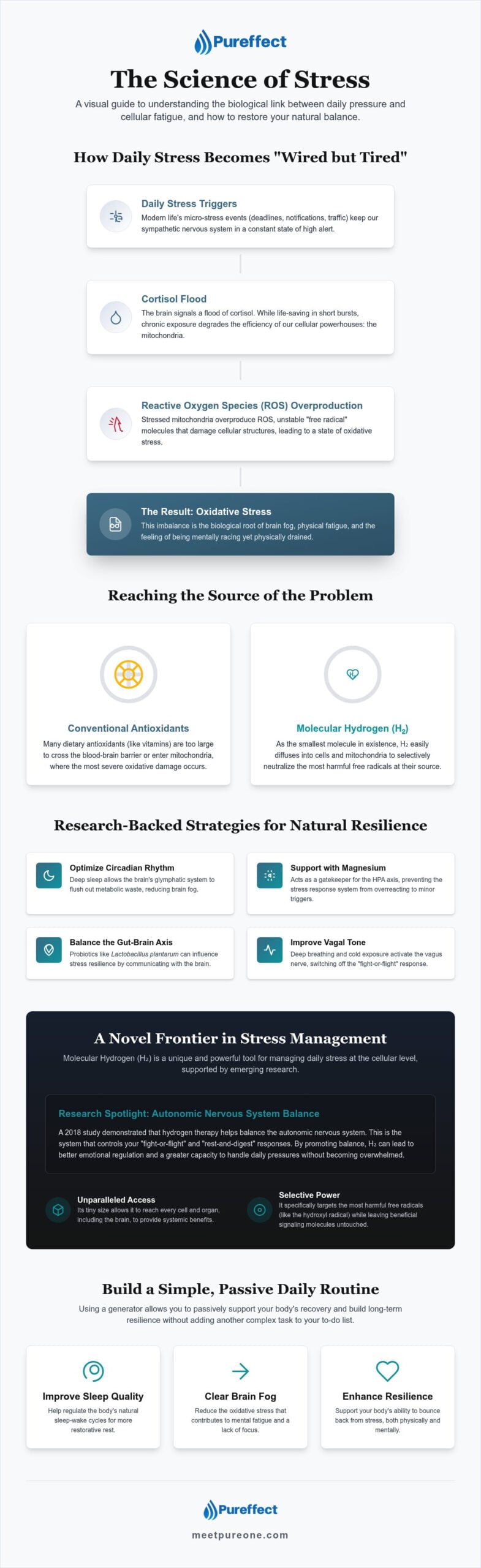
Stress is more than just a feeling of being overwhelmed. It is a precise physiological cascade. When a deadline looms or a car cuts you off, your brain triggers a flood of cortisol and adrenaline. In short bursts, this is life-saving. But what happens when the tap stays open? Chronic pressure causes your cells to overproduce Reactive Oxygen Species (ROS). These are unstable molecules that damage everything they touch. When these free radicals outnumber your body’s ability to clean them up, you land in a state called oxidative stress. This isn’t just a technicality; it is the biological root of that heavy brain fog and the “wired but tired” fatigue you feel every afternoon.
The Fight-or-Flight Hangover
Modern life doesn’t usually involve tigers, but our sympathetic nervous system can’t tell the difference between a predator and a passive-aggressive email. These micro-stress events keep us in a constant state of high alert. Why is it so hard to just relax? The body often struggles to flip the switch back to the “rest and digest” state. Medical research shows that persistent cortisol levels actively degrade mitochondrial efficiency. Your mitochondria are the tiny engines inside your cells. When they are bathed in cortisol for too long, they start to sputter and leak waste products. This makes managing daily stress naturally a requirement for basic cellular health, not just a luxury for the weekend.
Why Antioxidants Aren’t Always Enough
You might think a handful of vitamins can fix the problem. Unfortunately, biology is a bit more complicated. Many common dietary antioxidants are physically too large to cross the blood-brain barrier or enter the mitochondria where the real damage happens. They are like trying to fit a beach ball through a keyhole. We need something more agile. Scientific findings highlight the power of selective antioxidants. These unique molecules don’t just neutralize everything; they specifically target the most harmful radicals while leaving the helpful ones alone. Oxidative stress is the imbalance between free radicals and cellular repair. To tip the scales back in your favor, you need a solution that reaches the deepest parts of your cells. This is where the strategy for managing daily stress naturally moves from the kitchen to the molecular level.
Research-Backed Natural Interventions for Cortisol Regulation
How do we move from understanding cellular damage to active repair? Managing daily stress naturally requires more than willpower; it requires biological alignment. Your circadian rhythm acts as a master clock for cortisol. Ideally, cortisol peaks in the morning to wake you up and tapers off as the sun sets. When this curve is disrupted by blue light or late-night emails, your body loses its ability to recover. During deep sleep, the brain’s glymphatic system works like a dishwasher to flush out metabolic debris. If sleep architecture is fragmented, this waste accumulates, leading to the brain fog we discussed earlier.
Magnesium acts as a vital gatekeeper for the Hypothalamic-Pituitary-Adrenal (HPA) axis. It prevents the system from overreacting to minor triggers. Without enough magnesium, your stress response stays “on” longer than necessary. Similarly, the gut-brain axis plays a massive role in how you handle pressure. Research into probiotics, specifically strains like Lactobacillus plantarum, suggests they can actually influence stress resilience by communicating directly with the brain. This is why managing daily stress naturally often starts with supporting your microbiome.
The Vagus Nerve and Autonomic Balance
Think of the vagus nerve as your body’s internal reset button. It is the main component of the parasympathetic nervous system, responsible for switching off the fight-or-flight response. Research indicates that brief cold exposure, such as splashing your face with ice water, can significantly improve vagal tone. Deep, diaphragmatic breathing works similarly by physically signaling the brain that the “threat” has passed. These practices improve your Heart Rate Variability (HRV), which is a key metric of how well your body bounces back from tension.
Nutritional Resilience: Beyond Comfort Food
Phytonutrients found in dark leafy greens and colorful berries support your body’s endogenous antioxidant production. L-theanine, an amino acid found in green tea, is well-documented for its ability to increase alpha brain wave activity. This promotes a state of “alert relaxation” without the sedative effects of medication. Optimizing these pathways is essential for learning how to increase cellular energy: a research-driven guide. While you refine your habits, using a PureONE generator can help neutralize the oxidative fallout from daily life, giving your body the space it needs to find its natural balance again.
Molecular Hydrogen: A Novel Frontier in Stress Management
How can we go deeper than just lifestyle habits? Molecular hydrogen (H2) is emerging as a critical tool for managing daily stress naturally because of its unique physical properties. It is the smallest molecule in existence. This incredibly small size allows it to diffuse through cell membranes effortlessly, reaching the mitochondria and the nucleus where other antioxidants simply cannot go. Research confirms that H2 effectively crosses the blood-brain barrier, offering direct protection to the central nervous system. For therapeutic inhalation, a ratio of 66% hydrogen and 33% oxygen is particularly significant. This specific mixture ensures the body receives a high concentration of H2 while maintaining optimal oxygen levels for cellular respiration.
Clinical Evidence: H2 and the Nervous System
A specific 2018 study on hydrogen and autonomic nervous system balance investigated how inhalation affects our internal equilibrium. The findings demonstrated that H2 helps shift the body from a sympathetic state to a parasympathetic state, effectively calming the “fight-or-flight” response. This suggests a direct impact on emotional regulation and resilience. Beyond this, hydrogen appears to influence the secretion of ghrelin. While often called the “hunger hormone,” ghrelin is also deeply linked to mood and stress response. By reducing pro-inflammatory cytokines in the brain, H2 helps neutralize the neuro-inflammation that often follows chronic daily pressure.
Inhalation vs. Ingestion for Stress Support
While drinking hydrogen water is beneficial for gut health, inhalation offers a different level of systemic reach. When you inhale H2 gas, it enters the bloodstream via the lungs and reaches the brain and heart within seconds. This rapid delivery makes it a preferred method for neurological support and managing daily stress naturally. It bypasses the digestive process entirely, allowing for a higher dosage to reach the areas most affected by cortisol spikes. To understand the broader implications of this technology, you can read our full breakdown on what is molecular hydrogen? the science of cellular health. If you are looking for a practical way to apply these findings, the PureONE generator provides the precise 66/33 gas mixture needed for effective, research-driven home therapy.
The Cellular Resilience Protocol: Integrating PureONE
How do we turn these research findings into a workable life? Managing daily stress naturally is most effective when it is automated. You don’t need another high-pressure chore on your to-do list. Instead, integrate molecular hydrogen into your existing rhythm. Start your day with early morning sunlight to set your cortisol curve. During your most intense work blocks, use hydrogen inhalation as a passive shield against oxidative spikes. It works while you type, read, or even watch a movie. Consistency is the anchor here. Just as chronic stress builds over time, cellular resilience is a cumulative process that rewards daily repetition.
Pair your H2 sessions with light-blocking strategies in the evening. As we discussed earlier regarding sleep architecture, clearing metabolic waste requires deep, uninterrupted rest. Using blue-light-blocking glasses alongside a 30-minute inhalation session before bed can signal your brain that it’s safe to downregulate. This combination helps transition the nervous system from high-alert “beta” waves to the restorative alpha and theta states needed for emotional regulation.
Using the PureONE Molecular Hydrogen Generator
Why struggle with complicated clinical setups? The PureONE device is designed for home-based stress management without the fuss. It features four therapeutic modes tailored to different wellness goals. For those focused on mental clarity and nervous system balance, the inhalation mode is the primary tool. It delivers the precise 66/33 hydrogen-to-oxygen ratio mentioned in the clinical research. We want you to feel confident in this science. That is why the generator comes with a 365-day risk-free trial. It allows you to verify the logic of molecular health in your own living room over a full year.
Optimizing Your Environment for Calm
Digital hygiene is often the missing piece of the puzzle. Constant notifications keep your brain in a state of high-frequency alert, which contributes to the oxidative state of the brain. Try scheduling specific time blocks for your therapy, perhaps during your evening wind-down. This creates a dedicated window where you disconnect from the digital world and reconnect with your biology. Experience the calming benefits of the PureONE Molecular Hydrogen Generator and start building your foundation for long-term resilience today. Managing daily stress naturally isn’t about avoiding life’s pressures, but about ensuring your cells have the tools to handle them.
Building Your Molecular Defense System
Is it time to trade the “wired but tired” cycle for genuine cellular calm? We’ve explored how stress isn’t just a mental state, but a physical byproduct that clogs your mitochondrial engines. Managing daily stress naturally requires a shift in focus. It’s about clearing the oxidative waste that leads to brain fog and irritability. By aligning your circadian rhythm and introducing molecular hydrogen, you give your body the tools it needs to flip the switch from fight-or-flight back to rest and repair.
The PureONE generator makes this transition effortless. Manufactured in Canada with medical-grade materials, it delivers the consistent 66/33 hydrogen-to-oxygen ratio endorsed by Howie Mandel. You don’t have to take our word for the science; you can experience it in your own home. Start your 365-day risk-free trial of the PureONE Hydrogen Generator and discover how it feels to live with a resilient nervous system. You’ve done the research. Now it’s time to let your biology find its balance again. We are excited to see where this journey takes you.
Frequently Asked Questions
How does molecular hydrogen actually reduce stress in the body?
Molecular hydrogen acts as a selective antioxidant that neutralizes the most toxic free radicals, like the hydroxyl radical, which spike during chronic pressure. Unlike larger antioxidants, H2 is small enough to penetrate the blood-brain barrier and reach the mitochondria. By reducing this oxidative burden at the cellular source, it helps lower physiological stress markers. This allows your cells to recover from the “wired but tired” state more effectively.
Is hydrogen inhalation safe to use every day for stress?
Yes, hydrogen inhalation is considered safe for daily use because hydrogen is a gas your body already produces during gut fermentation. Research has shown no toxic effects even at high concentrations. Since it is a natural element, the body simply exhales any excess that it doesn’t use. This makes it a sustainable tool for managing daily stress naturally over the long term without the risk of dependency.
How long do I need to use a hydrogen generator to feel a difference?
Many people report an immediate sense of calm or improved mental clarity during their first 30 minute session. However, the most significant physiological changes, such as improved autonomic balance and better sleep quality, typically become measurable after two to four weeks of consistent use. Think of it as a cumulative investment in your cellular resilience. Daily sessions help maintain the antioxidant levels needed to buffer against modern micro-stresses.
Can I use molecular hydrogen therapy alongside other natural stress remedies?
Absolutely. Molecular hydrogen works through a unique pathway, making it a perfect partner for other natural interventions like magnesium or L-theanine. While supplements provide raw materials for nervous system health, H2 focuses on clearing the oxidative static that prevents these remedies from working their best. It effectively preps the cellular environment. This allows your other wellness habits to be more impactful and efficient than they are currently.
What is the difference between a hydrogen generator and a standard air purifier?
An air purifier is designed to remove pollutants like dust and pollen from the environment. In contrast, a hydrogen generator like the PureONE produces a therapeutic gas mixture of 66% hydrogen and 33% oxygen for direct inhalation. One cleans the air around you. The other delivers a bioactive molecule directly into your bloodstream to neutralize oxidative damage. They serve completely different roles in a health conscious home.
Does research support the use of hydrogen for anxiety and mood regulation?
Yes, growing research supports these benefits. A 2018 study specifically highlighted how hydrogen inhalation helps balance the autonomic nervous system, which is crucial for emotional stability. By reducing neuro-inflammation and potentially regulating hormones like ghrelin, H2 therapy supports a more stable mood. It provides a biological foundation for managing daily stress naturally. This helps the brain stay resilient and clear even when your external environment feels chaotic.
Disclaimer
The information provided by Pureffect and any of its products are for educational and informational purposes only and is not intended as medical advice. Individual results may vary, and no specific health outcomes are guaranteed. Always consult a qualified healthcare professional before starting any wellness practice or product.