

What if the traditional antioxidants you use for recovery are actually blunting your body’s natural ability to adapt to training? It’s a frustrating reality for many athletes who find themselves stuck in a cycle of persistent muscle soreness and systemic inflammation. You push your limits, yet the recovery phase feels like a bottleneck. You’ve likely seen hydrogen therapy for athletic recovery mentioned in elite circles, but you’re probably skeptical of anything that lacks a solid clinical foundation. We understand that skepticism. It’s why we prioritize data over hype.
A 2023 meta-analysis found moderate evidence that hydrogen supplementation helps alleviate fatigue in healthy adults by acting as a selective signaling modulator. Unlike generic supplements, molecular hydrogen targets harmful free radicals without disrupting the beneficial oxidative stress required for muscle growth. This article will show you how to leverage these biological markers to accelerate your return-to-play. We’ll dive into the specific advantages of the 66/33 hydrogen-oxygen ratio and explain how the PureONE Molecular Hydrogen Generator provides a research-driven path to peak performance. Ready to see what the science actually says?
Key Takeaways
- Understand how molecular hydrogen functions as a selective antioxidant, neutralizing cytotoxic hydroxyl radicals while preserving the signaling molecules essential for muscle adaptation.
- Review clinical data from the 2012 soccer study demonstrating how hydrogen therapy for athletic recovery significantly lowers blood lactate levels and muscle fatigue after intense exercise.
- Discover the specific impact of hydrogen on biological markers like Creatine Kinase and pro-inflammatory cytokines to reduce the 48-hour pain peak of DOMS.
- Learn the strategic benefits of 66% hydrogen and 33% oxygen inhalation protocols for improving tissue oxygenation and optimizing your pre- and post-workout recovery window.
The Biological Mechanism: How H2 Targets Exercise-Induced Oxidative Stress
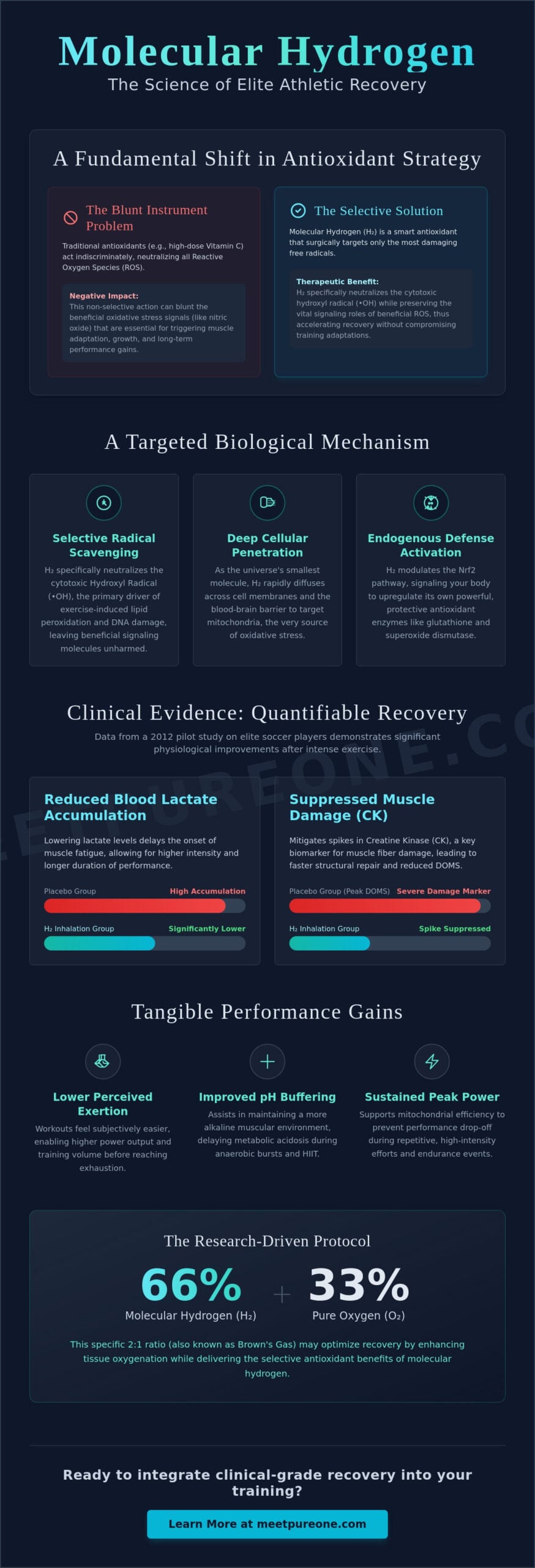
Why is molecular hydrogen different from every other antioxidant in your gym bag? Most supplements act like a blunt instrument. They neutralize every reactive oxygen species (ROS) they encounter. While that sounds helpful, your body actually needs some of those ROS molecules to signal muscle growth and adaptation. Hydrogen therapy offers a more surgical approach. It is a mitochondria-targeted antioxidant that practices “selective scavenging.” This means H2 specifically hunts for the cytotoxic hydroxyl radical (•OH) while leaving beneficial signaling molecules, like nitric oxide, alone.
This distinction is vital for hydrogen therapy for athletic recovery. High doses of traditional antioxidants, such as Vitamin C, have been shown to blunt the very training adaptations you’re working for. H2 doesn’t have that downside. Because it’s the smallest molecule in existence, it diffuses rapidly through cell membranes and even the blood-brain barrier. It reaches the deep interior of the mitochondria where the most intense oxidative damage happens. Utilizing a tool like the PureONE Molecular Hydrogen Generator allows you to deliver this gas directly to the tissues that need it most after a grueling session.
The Role of Hydroxyl Radicals in Muscle Damage
Intense exertion creates a massive surge in ROS. While some ROS are useful messengers, the hydroxyl radical is purely destructive. It causes lipid peroxidation, which tears through cellular membranes and damages DNA. This oxidative stress is a primary driver of the structural damage that leads to muscle fatigue and long recovery times. By neutralizing •OH specifically, H2 protects the cell’s integrity without interfering with the metabolic “stress” required for performance gains.
Gene Expression and Cytoprotective Pathways
H2 doesn’t just neutralize radicals directly. It also talks to your DNA. Research indicates that molecular hydrogen modulates the Nrf2 pathway to boost your body’s own endogenous antioxidants. Nrf2 is the body’s master switch for antioxidant defense. By activating this pathway, H2 helps your cells build a more resilient environment for your next workout. It’s a biological nudge that empowers your body to protect itself more effectively from the inside out. The same cytoprotective mechanisms that support athletic recovery are also central to understanding how can hydrogen therapy help extend your life by activating pathways like autophagy to clear damaged cellular components over time.
Clinical Evidence: Reducing Muscle Fatigue and Blood Lactate
How do we move from laboratory theory to actual field results? We look at the data. A 2012 pilot study involving ten elite soccer players provides a compelling starting point. Researchers discovered that athletes using hydrogen showed significantly lower blood lactate levels after intense exercise compared to a placebo group. This isn’t just a minor fluctuation. It’s a measurable shift in how the body handles metabolic waste. When lactate stays low, your muscles don’t hit that “wall” quite as early.
Beyond lactate, we have to look at Creatine Kinase (CK). This enzyme is a primary biological marker for muscle damage. When you tear muscle fibers during a heavy lift or a sprint, CK leaks into your bloodstream. High CK levels are a hallmark of overtraining. Clinical evidence suggests that hydrogen therapy for athletic recovery helps suppress these spikes. By keeping CK levels in check, you aren’t just masking the pain; you’re actually mitigating the underlying structural damage. This allows for a much faster return to your next session.
It’s also about your brain’s perception of the work. A Clinical Review of Hydrogen Water for Performance indicates that hydrogen can lower the Rating of Perceived Exertion (RPE). If a workout feels easier, you can maintain a higher power output for longer. If you want to test these findings in your own training, the PureONE Molecular Hydrogen Generator offers a way to integrate this clinical-grade support into your daily routine. For a deeper look at the research underpinning these performance benefits, the scientific evidence for hydrogen therapy drawn from over 2,000 publications and 100 clinical trials provides the technical foundation behind these findings.
Impact on Anaerobic Performance
High-intensity interval training (HIIT) creates a metabolic “burn” that eventually shuts down performance. This is caused by metabolic acidosis. Molecular hydrogen helps by improving the pH buffering capacity in muscle tissue. It assists in maintaining a more alkaline environment, which delays the onset of muscle fatigue during explosive, anaerobic bursts.
Endurance and Peak Power Output
For endurance athletes, the focus shifts to mitochondrial efficiency. Clinical findings show that hydrogen helps maintain peak power during repetitive sprint tasks. It prevents the typical drop-off in performance seen in the later stages of a race. By supporting the mitochondria, hydrogen ensures that your energy production remains stable even under prolonged aerobic stress.
Managing DOMS and Soft Tissue Injury Recovery
We’ve all felt it. That deep, stiff ache that peaks two days after a heavy session. This is Delayed Onset Muscle Soreness (DOMS). While it’s a sign of hard work, excessive inflammation can derail your training schedule. Hydrogen therapy for athletic recovery addresses this by suppressing pro-inflammatory cytokines like IL-6 and TNF-α. According to a Systematic Review of Molecular Hydrogen for Exercise, this modulation helps flatten the 48-hour pain curve. It’s not just about comfort. It’s about maintaining your range of motion so you can get back to work sooner. To understand precisely how H2 achieves this at a cellular level, the hydrogen gas mechanism for reduction in inflammation has been mapped across 45 studies examining its impact on musculoskeletal health.
In the field of sports traumatology, H2 is showing promise for more than just soreness. It appears to accelerate the healing of fractures and ligaments by reducing oxidative stress at the injury site. There’s also the issue of ischemia-reperfusion injury. When you use compression gear or perform intense isometric holds, blood flow is temporarily restricted. When blood rushes back, it brings a surge of oxygen that can actually cause tissue damage. Molecular hydrogen acts as a protective shield during this re-oxygenation phase, preventing the “second wave” of cellular injury. The same anti-inflammatory and cellular-protective properties that aid injury recovery are also at the core of research exploring how hydrogen therapy can help extend your life by reducing the chronic systemic inflammation linked to age-related disease.
Recovery doesn’t have to be a passive waiting game. If you’re tired of being sidelined by inflammation, you can take control of your biology. You can optimize your recovery window with the PureONE Molecular Hydrogen Generator and start seeing these clinical benefits in your own training cycle.
Targeting the NF-κB Signaling Pathway
How does H2 actually stop the swelling? It inhibits NF-κB, the master regulatory switch for inflammation. When NF-κB is activated, it triggers a cascade of inflammatory responses. By keeping this switch in the “off” position post-exercise, hydrogen reduces the total inflammatory load on your system. The result? Less swelling and a faster return to full mobility.
Joint Health and Synovial Protection
Athletic Protocols: Implementing Hydrogen Inhalation at Home
When is the best time to start your session? While some research suggests that pre-workout inhalation can prime the mitochondria, the post-workout window is where hydrogen therapy for athletic recovery truly shines. Using a device like the PureONE Molecular Hydrogen Generator within the first hour after training allows you to hit the peak of the inflammatory response. This timing is critical. It enables the gas to modulate the cytokine surge before it becomes overwhelming and hinders your next training block.
The specific mixture you inhale also impacts your results. The 66% hydrogen and 33% oxygen ratio, often called Brown’s Gas, provides a unique dual benefit. You get the selective antioxidant power of H2 paired with supplemental oxygen. This combination supports cellular respiration and tissue oxygenation. It’s particularly useful after high-intensity anaerobic work that leaves you in a significant oxygen debt. By delivering both gases simultaneously, you support the metabolic recovery of the muscle tissue while neutralizing the hydroxyl radicals produced during the session. For a comprehensive breakdown of the precise biological pathways involved, exploring the hydrogen gas mechanism for reduction in inflammation reveals how H2 acts as a selective signaling modulator rather than a broad-spectrum suppressant.
The PureONE Recovery Protocol
Establishing a consistent “recovery window” protocol is essential for measurable results. For a research-driven approach to your daily routine, consider this step-by-step guide:
- Schedule a 30-minute inhalation session immediately following your training cool-down.
- Use the PureONE device to infuse your hydration source, creating high-concentration hydrogen water for intra-workout sips.
- Maintain this frequency daily, even on rest days, to keep your endogenous antioxidant pathways active.
This dual-delivery method ensures that hydrogen is present in both the bloodstream and the digestive system. It creates a synergistic effect that maximizes cellular protection.
Safety and Long-Term Usage
Is it safe for long-term use? Molecular hydrogen has a remarkable biological profile. The FDA has granted hydrogen gas “Generally Recognized as Safe” (GRAS) status. There is no known toxicity because any excess gas is simply exhaled through the lungs. However, the purity of the gas is vital. Our system uses a proprietary stainless steel condenser to ensure the output remains clean and free from impurities. If you’re deciding between different delivery methods, read our comparison of a Hydrogen Inhalation Machine vs. Water Bottle to see which protocol matches your training volume.
Take Control of Your Biological Recovery
You’ve seen the clinical data. Molecular hydrogen isn’t just another supplement; it’s a precision tool for your cellular health. It targets the specific hydroxyl radicals that cause structural damage while leaving your body’s natural growth signals intact. By lowering blood lactate and suppressing pro-inflammatory cytokines, you’re effectively shortening the gap between your hardest sessions. This research-driven approach to hydrogen therapy for athletic recovery is about working with your biology rather than trying to override it. It’s a way to maintain peak power without the typical post-training burnout.
If you’re ready to see these results for yourself, you can experience elite-level recovery with the PureONE Molecular Hydrogen Generator. It’s the same system endorsed by public figures like Howie Mandel. Every unit is manufactured in Canada with our proprietary stainless steel condenser technology to ensure the highest gas purity. We’re so confident in the science and our build quality that we offer a 365-day risk-free trial. Your next personal best is waiting on the other side of better recovery. We’re excited to help you get there.
Frequently Asked Questions
Is hydrogen therapy safe for professional athletes under anti-doping regulations?
Molecular hydrogen is entirely safe for professional athletes and is not included on the World Anti-Doping Agency (WADA) Prohibited List. Since H2 is a naturally occurring gas that your own gut bacteria produce during the fermentation of fiber, it is considered a biological nutrient. It doesn’t function as a stimulant or a hormonal modulator. Instead, it acts as a selective signaling molecule that helps manage the physiological stress of elite-level training without violating any competitive standards.
How soon after a workout should I use hydrogen therapy for maximum recovery?
You’ll see the best results when you implement hydrogen therapy for athletic recovery within 60 minutes of completing your session. This specific window allows the gas to modulate the initial surge of pro-inflammatory cytokines before they peak. By intervening early, you help stabilize the cellular environment and reduce the secondary oxidative damage that leads to muscle stiffness. A secondary 20-minute session before bed can also support the body’s natural repair cycles during deep sleep.
Can hydrogen inhalation replace traditional ice baths or compression therapy?
Hydrogen therapy should be viewed as a complementary biological tool rather than a direct replacement for mechanical recovery methods. Ice baths and compression focus on temperature regulation and lymphatic drainage through physical pressure. Molecular hydrogen works at a deeper chemical level by neutralizing cytotoxic radicals and protecting mitochondrial function. Using H2 alongside your current routine provides a multi-layered approach that addresses both the physical and the biochemical aspects of exercise-induced stress.
What is the benefit of the 66/33 hydrogen-to-oxygen ratio for athletes?
The 66/33 ratio provides a strategic combination of hydrogen for antioxidant support and oxygen for cellular respiration. This mixture, often referred to as Brown’s Gas, ensures that you aren’t just neutralizing harmful radicals but also supporting the aerobic pathways required for ATP production. For an athlete, this dual approach means you can manage oxidative stress while simultaneously replenishing the oxygen levels necessary for efficient tissue repair and metabolic stabilization after anaerobic exertion.
Does hydrogen therapy help with sports-related brain fog or mental fatigue?
Hydrogen therapy is highly effective for cognitive recovery because the H2 molecule is small enough to cross the blood-brain barrier with ease. Intense physical exertion often leads to neuroinflammation and oxidative stress in the central nervous system, which manifests as mental fatigue or “brain fog.” By targeting hydroxyl radicals within the brain’s mitochondria, molecular hydrogen helps protect neurons and restore cognitive clarity. This allows you to maintain focus and mental energy even after the most taxing endurance sessions.
Disclaimer
The information provided by Pureffect and any of its products are for educational and informational purposes only and is not intended as medical advice. Individual results may vary, and no specific health outcomes are guaranteed. Always consult a qualified healthcare professional before starting any wellness practice or product.