
A purity figure alone doesn’t tell you which inhalation machine is the better fit. In the Vital Reaction vs PureONE inhalation machine comparison, focus on how each documents hydrogen purity, what it says about gas output, and how much pump noise to expect. PureONE produces a consistent mixture of 66% molecular hydrogen and 33% oxygen.
It’s sensible to review clear records before comparing devices. Purity percentages, output rates, and operating noise describe different things, so assess them separately. A headline figure alone may leave important questions unanswered.
This article explains how to read gas-composition information, distinguish concentration from output, and assess pump noise in practical terms. You’ll get a clearer framework for comparing the machines, including what PureONE’s stated gas mixture does and does not tell you.
Key Takeaways
- Compare purity records and output as separate measures; a concentration figure alone doesn’t show how much gas a machine delivers.
- Look for specifications that distinguish pure-hydrogen output from a hydrogen-and-oxygen mixture.
- Use pump noise as a practical comparison point, alongside the machine’s stated output and gas mixture.
- PureONE is described as producing a consistent mixture of 66% molecular hydrogen and 33% oxygen; the article explains what that figure means for comparison.
- Assess health claims and possible risks separately from machine specifications, since performance details alone don’t establish clinical benefit or suitability.
What technology and substances does each inhalation machine use?
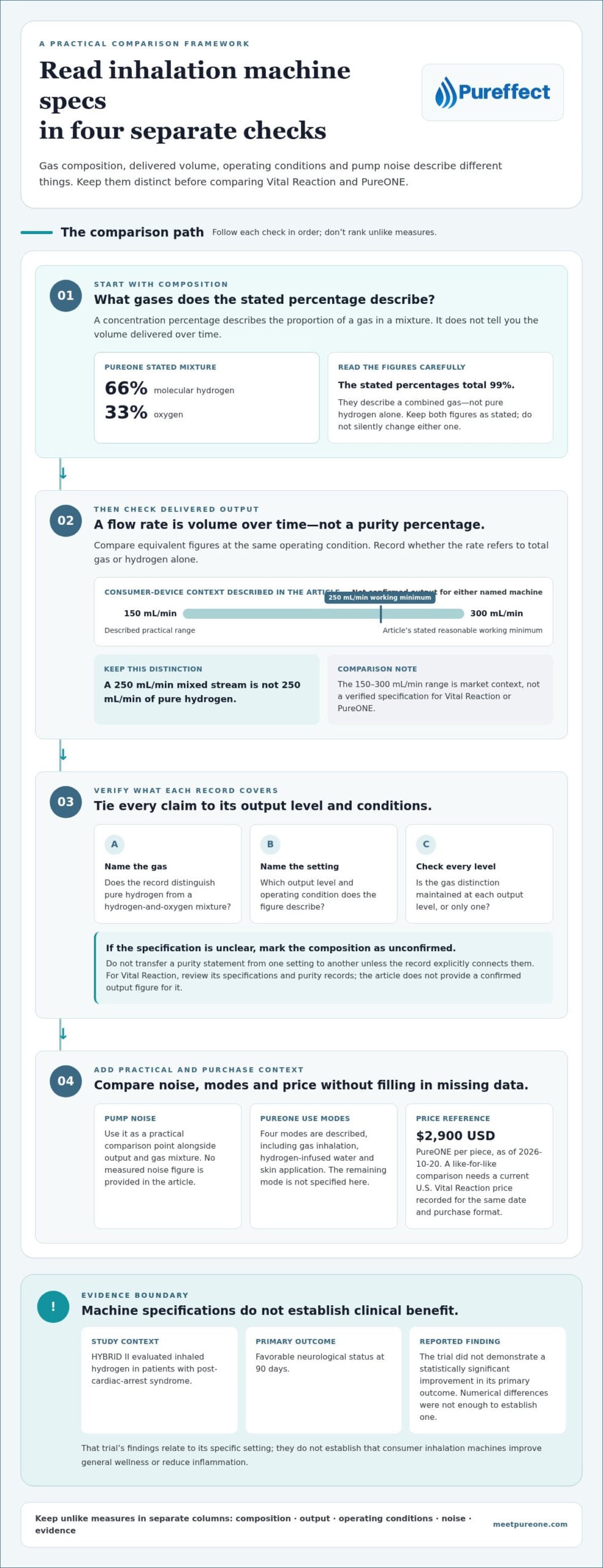
For a Vital Reaction vs PureONE inhalation machine comparison, separate three factors: gas composition, output rate, and how clearly each is documented. A concentration percentage describes the proportion of a gas in a mixture; a flow rate describes the volume delivered over time. Neither figure provides the full picture on its own, so compare equivalent specifications.
The Canadian-made machine uses a proprietary stainless steel condenser and produces a consistent mixture of 66% molecular hydrogen and 33% oxygen. Those percentages describe a combined gas, not pure hydrogen alone. The stated figures total 99%, so avoid silently changing either number or treating the mixture as 100% hydrogen. Its four modes include inhaling gas, drinking hydrogen-infused water, and applying it to the skin; the remaining mode is part of the machine’s multi-mode design.
For the Vital Reaction model, review its specifications and purity records to identify the gases in the output. Check whether they distinguish pure hydrogen from a hydrogen-and-oxygen mixture, and whether that distinction applies at every output level. A mixed-gas percentage and a pure-hydrogen flow rate describe different things, so they should not be compared as equivalent figures.
Consumer-grade hydrogen inhalation devices are described as producing 150-300 mL/min in practice, with 250 mL/min presented as a reasonable working minimum. Treat these as market context, not as confirmed output figures for either named machine. Compare each device’s documented flow rate at the same operating condition, and note whether the figure refers to total gas or hydrogen alone. A 250 mL/min mixed stream, for example, should not be read as 250 mL/min of pure hydrogen.
Records matter as much as the numbers. Compare the gas composition, output rate, and the conditions attached to each figure. If one document reports mixture percentages while another reports hydrogen-only output, put those measures in separate columns instead of ranking them directly. The machine’s gas composition and use modes provide a concrete reference point for that comparison. This simple distinction helps you read both specifications without confusing concentration with delivered volume.
Use the specification as a set of questions rather than relying on a single headline description. Check whether it identifies the gas being delivered and whether its wording distinguishes hydrogen by itself from a hydrogen-and-oxygen mixture. The key check is whether that distinction is maintained at every output level; a statement covering only one setting does not answer the question for the others. If the document leaves the point unclear, treat the composition as unconfirmed rather than assuming that a figure applies throughout the machine’s range.
When reviewing the wording, keep the gas description attached to the particular output level it describes. Do not transfer a purity statement from one level to another unless the specification explicitly makes that connection. This approach keeps unlike descriptions from being treated as equivalent and makes gaps in the available information visible. A useful comparison records what is stated, which output level the statement concerns, and whether pure hydrogen is distinguished from mixed hydrogen and oxygen at every level. If those details are not provided, note that limitation rather than filling it with an inference.
What are the current prices of Vital Reaction and PureONE in the United States?
PureONE Molecular Hydrogen Generator is priced at $2,900 USD per piece as of 2026-10-20. A reliable comparison with Vital Reaction needs a current U.S. price for that machine, recorded on the same date and for the same purchase format. Without matching figures, a simple “cheaper” or “more expensive” label can mislead.
Price is only one part of the buying decision. First establish what each amount covers: the machine alone, a package, or another configuration. Record the currency, date, and unit, too. Compare a per-unit price with another per-unit price, not with a bundle total, and keep these details beside each figure.
For Vital Reaction, use its current U.S. listing or purchase quote as the comparison figure. Avoid substituting an old promotion, a resale price, or an amount from another country, since these may reflect different offers. Record the date alongside the figure so readers can distinguish a current amount from an outdated one.
Separate the listed price from any purchase terms shown with it. Note the currency, whether the amount covers one machine, and any additional charges stated by the seller. Report these details as written rather than assuming them. If the listings use different units or formats, explain the difference instead of forcing a direct price ranking.
For a useful Vital Reaction vs PureONE inhalation machine price comparison, place the dated figures side by side, then compare specifications and intended use. A lower price alone does not establish better value if gas composition, modes, or output information differ. Put those features in separate columns, so readers can see what each price covers without confusing cost with performance.
PureONE’s listed price is $2,900 USD per piece as of 2026-10-20. Use that dated figure as one reference point, and pair it with Vital Reaction’s current U.S. amount when making a like-for-like comparison. To review the PureONE Molecular Hydrogen Generator alongside its product details, consider how its documented features fit your priorities as well as your budget.
What clinical evidence supports the health claims made for each machine?
Clinical evidence must match the claim, delivery route, and population studied. For example, the HYBRID II clinical trial evaluated inhaled hydrogen in patients with post-cardiac-arrest syndrome. Its findings relate to that specific context; they do not establish that consumer inhalation machines improve general wellness or reduce inflammation.
HYBRID II did not demonstrate a statistically significant improvement in its primary outcome, favorable neurological status at 90 days. The trial reported numerical differences between groups, but those differences weren’t enough to establish a clear treatment effect on that primary measure. The finding is important precisely because it limits what can be claimed: studying inhaled hydrogen in a serious clinical setting isn’t proof of benefit for other populations or purposes.
HYBRID II studied a clinical treatment in a defined patient group, not Vital Reaction or PureONE as consumer devices. Its findings are therefore not product-specific evidence for either machine. Nor do findings about inhaled hydrogen automatically support claims about hydrogen-infused water or topical use. Each route and intended outcome requires evidence that directly addresses it.
For either product, assess a health claim by checking whether the supporting study matches these points:
- Population: whether participants resemble the people named in the claim.
- Route: whether the study tested inhalation, rather than another form of hydrogen use.
- Outcome: whether researchers measured the stated benefit, such as a specific symptom.
- Design: whether the comparison group and study methods support a reliable conclusion.
- Product: whether the research tested the actual machine or only the substance.
A change in a laboratory marker, for example, does not by itself prove symptom relief. And a result in post-cardiac-arrest patients does not establish a general wellness effect. In comparing Vital Reaction and PureONE, keep device specifications separate from clinical findings. Assess each claim against research on the same delivery route, population, and outcome to understand what the evidence supports and what it cannot establish.
A separate point to keep in view is what respiratory guidance actually addresses. The American Association for Respiratory Care clinical practice guidelines state that ventilator gas delivery should provide at least 30 mg H2O/L of humidity at 30°C. That statement concerns humidity in ventilator gas delivery; it does not, by itself, establish a health benefit from hydrogen or validate a consumer machine. A guideline value for one aspect of gas delivery should not be treated as a clinical outcome, such as symptom improvement, or as evidence that a particular device achieves a claimed effect.
When reviewing evidence for either machine, keep this type of technical guidance distinct from studies designed to test health outcomes. Ask whether a study measured the benefit being promoted, in the relevant population, using the same route of delivery and the device in question. If evidence concerns a different treatment context, it may help frame a question, but it cannot fill the gap in product-specific evidence. The same caution applies when a source addresses a delivery condition rather than an outcome: it may be relevant to understanding the equipment, yet it does not demonstrate that a health claim is supported. That distinction helps prevent a specification or recommendation from being presented as proof of clinical effectiveness.
What risks, side effects, or contraindications are associated with each inhalation machine
Compare safety information by device and intended use, not brand reputation. For Vital Reaction and PureONE, review the warnings and operating directions for inhalation separately from directions for drinking or topical use. Do not apply a restriction for one use automatically to another. A gas specification alone does not establish that a device is safe.
Side-effect information is most relevant when it matches the use being assessed. A clinical report about inhalation, for example, is more relevant to an inhalation question than one about hydrogen-infused water. Read reported adverse events in the context of the participants and treatment method. A study focused on another outcome cannot, by itself, establish the full safety profile of either consumer machine.
Product instructions are another important part of the comparison. For each device, identify the intended route, setup and operating directions, cleaning guidance, and any stated contraindications. Note the exact wording and the use it applies to. If one manual covers inhalation and the other covers several modes, compare the inhalation-specific directions first, then assess additional modes separately.
A side-by-side checklist can keep the details organized:
- Intended use: record whether the direction concerns inhalation, drinking, or topical application.
- Warnings: note each stated restriction and the group or situation it names.
- Operation: compare setup, use, and cleaning directions for each machine.
- Reported effects: identify adverse events documented for the same route of use.
- Response instructions: follow the product’s guidance for discomfort or an unexpected reaction.
Keep operating characteristics in the right category. Pump noise describes how a machine sounds during use; it does not establish a side effect or contraindication. A list of modes describes intended functions, not who should avoid them. Base safety comparisons for Vital Reaction and PureONE on instructions and evidence relevant to the use being considered.
That approach also prevents a warning about one route from becoming a blanket statement about every mode. Review the PureONE product details and use modes alongside the relevant instructions, and keep each safety point tied to its stated context. Clear categories make it easier to compare the machines without turning a specification into a medical conclusion.
Pureffect: PureONE Molecular Hydrogen Generator
PureONE Molecular Hydrogen Generator gives you a home-use option to compare against the criteria in this guide. Its four modes include hydrogen inhalation, hydrogen-infused water, and topical application to the skin. That range may suit readers who want one device for more than inhalation, while keeping the machine’s specifications distinct from evidence about health outcomes.
Consider PureONE if its documented modes and home use fit your priorities. Review its specifications alongside your comparison of gas composition, output, and clinical evidence, rather than treating a machine feature as proof of a medical benefit. Explore PureONE at meetpureone.com.
Choose the comparison criteria that matter to you
Your next step is to decide what matters for your routine: how you expect to use a machine, which product information you need, and how you’ll distinguish documented features from health claims. A thoughtful Vital Reaction vs PureONE inhalation machine comparison starts with priorities that matter to you.
Before making a decision, write down the questions that remain and revisit the relevant product information. This keeps your choice grounded in the details you care about, rather than a single headline or broad claim. If you’d like to explore PureONE further, view its product details.
Take time to compare the information and choose the next step that suits you.
Disclaimer
The information provided by Pureffect and any of its products are for educational and informational purposes only and is not intended as medical advice. Individual results may vary, and no specific health outcomes are guaranteed. Always consult a qualified healthcare professional before starting any wellness practice or product.