
Endurance isn’t built by choosing aerobic or anaerobic exercise alone. Aerobic activities such as running, cycling, rowing, and swimming can be done for 20 to 30 minutes, while anaerobic efforts rely on shorter, more intense bursts. A practical approach to enhancing endurance with natural methods brings both types of training together with steady conditioning, hydration, and food that supports your effort.
It makes sense to start with exercise: training challenges your body to keep going. But how you fuel and recover also affects how well you handle that work. The useful question isn’t which single method is best, but how the pieces fit together.
This guide explains aerobic and anaerobic exercise, how conditioning builds stamina, and how fluids, electrolytes, and macronutrients contribute. You’ll get a practical framework for putting these habits into practice, without treating any one workout or food as a shortcut.
Key Takeaways
- Build endurance with consistent conditioning and gradual increases in training demand, rather than pushing harder every session.
- Use easy aerobic exercise to develop your base, and understand how shorter, intense anaerobic efforts serve a different purpose.
- Plan fluids and electrolytes around exercise conditions and effort, since both hydration and sodium balance matter for sustained activity.
- Match food choices to training: carbohydrates help fuel endurance work, while a balanced intake supports recovery and overall nutrition.
- Learn where PureONE Molecular Hydrogen Generator fits as a home wellness option, separate from the core habits of training, hydration, and nutrition.
1. How do conditioning exercises improve endurance?
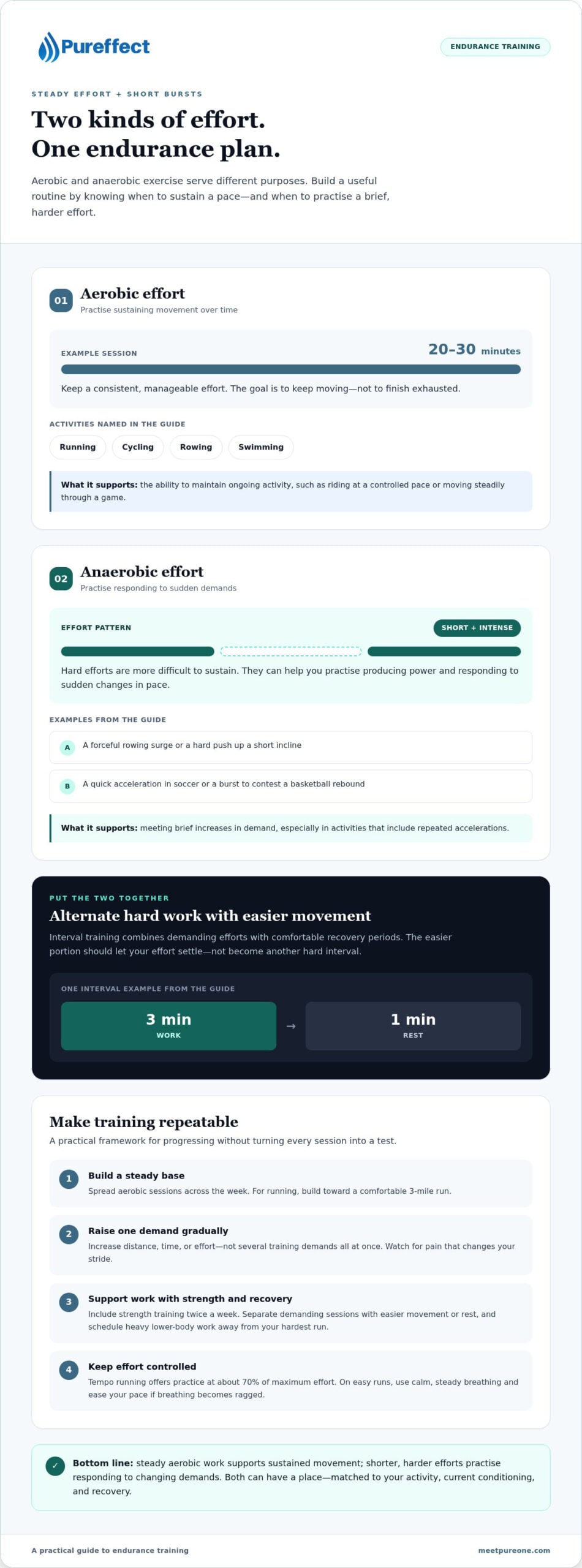
Conditioning asks your heart, lungs, and muscles to repeat work. With consistent training, the body adapts to familiar demands: muscles become better at using oxygen, and movement can feel more economical. A practical path to enhancing endurance with natural methods starts with manageable sessions, then gradually increases duration or intensity. For running, build toward a 3-mile run at a comfortable pace. One interval example is 3 minutes of work followed by 1 minute of rest.
What is the best weekly workout schedule for endurance? Spread aerobic sessions across the week and include strength training twice a week. Separate demanding workouts with easier movement or rest so the same muscles aren’t repeatedly challenged without time to recover.
Progressive overload means raising one training demand gradually, such as distance, time, or effort. Tempo running offers controlled practice at about 70% of maximum effort. Skipping and bag work can develop coordination alongside cardiovascular conditioning; a coach recommends 3 rounds of each. During runs, stay upright rather than hunching or leaning forward, which can add strain to the back and joints.
Strength training supports the muscles that stabilize and propel you. Squats, lunges, and step-ups engage your hips, knees, and ankles, while planks challenge trunk control. These compound movements train several muscle groups and support everyday tasks such as climbing stairs or carrying groceries. Schedule heavy lower-body work away from your most demanding run to give your legs time to recover.
Physical therapy can tailor conditioning when pain, a previous injury, or limited movement affects exercise. A therapist may assess your gait, balance, and joint range, then adapt movements to your current function. A session that appropriately challenges one runner may overload another, so build around your own movement capacity, not someone else’s pace or distance.
How can breathing techniques improve endurance performance? Practise calm, steady breathing during easy runs, and ease your pace if your breathing becomes ragged. This helps you regulate effort and avoid turning a manageable session into an unintended all-out workout.
What are the risks of increasing endurance training too quickly? Adding distance and intensity rapidly can outpace recovery, raising the risk of persistent soreness or overuse injury. Change one training demand at a time and watch for pain that alters your stride.
How long does it take to improve endurance naturally? The timeline depends on your starting fitness, consistency, recovery, and how you progress your training. Track a familiar route or workout to notice changes in perceived effort. When enhancing endurance with natural methods, repeatable progress matters more than one standout session. Consistent sleep also supports recovery.
2. Aerobic vs anaerobic exercises: What’s the difference?
Aerobic and anaerobic exercise describe how your body meets energy demands, not two completely separate workout categories. During steady activity, aerobic metabolism uses oxygen to help release energy over time. During intense efforts, anaerobic pathways supply energy rapidly when demand rises faster than oxygen-based processes can meet it. Both contribute during most sports, but pace and effort affect which pathway contributes more.
Cycling, rowing, running, and swimming are common aerobic activities. A steady session of 20 to 30 minutes gives you time to practise maintaining a consistent effort. The goal here isn’t to finish exhausted. Instead, focus on sustaining the activity and noticing how your breathing and muscles respond as the session continues.
Anaerobic work feels different: think of a forceful rowing surge, a quick acceleration in soccer, or a hard push up a short incline. These brief, demanding efforts draw heavily on rapidly available energy. They can train your ability to produce power and respond to sudden changes, but they are harder to sustain than steady aerobic movement.
Why does the distinction matter? A basketball player needs to move steadily through a game and accelerate to contest a rebound. A recreational cyclist may ride mostly at a controlled pace but still need a short burst to climb a steep pitch. Aerobic capacity supports ongoing activity; anaerobic capacity helps meet sudden increases in demand. Neither replaces the other.
Interval training combines both kinds of effort by alternating harder work with easier movement or rest. For example, a rower could alternate forceful strokes with relaxed rowing, keeping the easier periods genuinely comfortable. Hard intervals challenge rapid energy supply, while lower-intensity periods let effort settle. This differs from maintaining one steady pace throughout.
Choose the emphasis based on your goal and how the activity feels. For longer recreational events, steady aerobic exercise develops your ability to sustain movement. For sports with repeated accelerations, such as soccer or basketball, controlled anaerobic intervals can help you practise meeting those demands. Athletes often need both; the right balance depends on the activity, current conditioning, and recovery between sessions. Use the distinction to make each workout purposeful, rather than treating every session as a test of maximum effort.
3. Hydration and electrolytes
Fluid balance affects circulation during exercise. Sweating reduces body water, and blood volume can fall as fluid losses grow. A deficit of 2% of body weight can measurably impair endurance performance. That finding helps explain why a familiar pace may feel harder when fluid losses accumulate, particularly during a warm outdoor session. Hydration supports the body’s ability to deliver oxygen and regulate temperature, but drinking more than you lose isn’t the goal.
Performance effects can show up during specific efforts. At a fluid deficit of 2% of body weight, longer efforts such as 5K and 10K runs may see roughly a 5% performance decline. Fluid losses beyond 5% of body weight can reduce work capacity by around 30%. These figures describe substantial impacts, not personal targets. They also don’t mean every runner needs the same drinking schedule; temperature, pace, clothing, and sweat rate change fluid loss.
Start a workout normally hydrated, then drink according to thirst, conditions, and the session’s demands. A short, comfortable indoor workout differs from a long run in hot weather. If you repeatedly finish demanding sessions feeling depleted, note the temperature, duration, and how much you drank. Comparing similar workouts offers more useful feedback than following a rigid plan that ignores the day’s conditions.
Sweat also carries sodium, an electrolyte involved in fluid balance and nerve and muscle function. For exercise beverages, a sodium concentration of 30-50 mmol/L can support absorption and help prevent hyponatremia. The appropriate choice depends on exercise duration and sweat losses. A brief, easy session may not require a specialized drink, while prolonged activity with heavy sweating makes electrolyte replacement more relevant.
There’s a balance to protect. Drinking more than you lose can dilute sodium in the blood and contribute to exercise-associated hyponatremia. Avoid forcing yourself to drink a large volume to follow a fixed schedule. For longer events, practise a reasonable drinking approach during training, paying attention to thirst and comfort instead of trying an unfamiliar strategy on event day.
After exercise, replace fluids alongside ordinary meals and snacks. Soup, bread, and a regular meal can provide fluid and sodium, while water helps replace fluid losses. Pay attention to how you feel during your next workout, too. Unusual fatigue or a stronger sense of effort may prompt you to review heat exposure, pace, recovery, and drinking habits together. Hydration supports endurance preparation, but it does not replace conditioning or rest.
4. Endurance-focused macronutrients
Food helps determine whether your muscles can sustain activity and recover afterward. Carbohydrates are a key fuel for prolonged exercise because they supply glucose and help replenish glycogen, the stored form of carbohydrate in muscles. Endurance runners may get as much as 65% of their calories from carbohydrates. That figure is a possible upper share, not a fixed target for every person or training day.
Match carbohydrate-rich foods to the work ahead. Oatmeal, fruit, rice, potatoes, and bread can provide energy around longer sessions, while a meal containing carbohydrates and protein supports recovery afterward. The right amount depends on workout duration, intensity, appetite, and the rest of your diet. A short, easy activity and a sustained long run don’t place the same demands on stored fuel.
Protein provides amino acids that help maintain and repair muscles after exercise. Include familiar sources such as eggs, yogurt, beans, tofu, fish, or poultry in regular meals. A practical post-workout meal could pair rice and beans, or yogurt with oats and fruit. Protein matters, but it doesn’t replace carbohydrates as fuel for sustained endurance activity.
Dietary fat also belongs in a balanced eating pattern. Nuts, seeds, olive oil, and avocado provide energy and help meals feel satisfying. They’re useful parts of everyday nutrition, but a high-fat meal just before running may feel uncomfortable for some people. Try richer foods away from demanding sessions, and choose options that sit well before exercise.
Beetroot contains dietary nitrate, which the body can convert into nitric oxide, a molecule involved in blood-vessel function. That gives researchers a reason to study beetroot and exercise, but it doesn’t make a serving a guaranteed boost or a substitute for proper fueling. Try it during a routine workout first, and note how your stomach and effort respond. A food diary can help you connect meal timing with energy and recovery across training periods.
For a practical takeaway, build meals around carbohydrate-rich staples, add protein for muscle repair, and include unsaturated fats throughout the day. If you’re also exploring at-home wellness options, learn about molecular hydrogen for home use.
Pureffect: PureONE Molecular Hydrogen Generator
Pureffect’s PureONE Molecular Hydrogen Generator offers a home-use option for people exploring molecular hydrogen alongside established endurance habits. Its modes let users inhale hydrogen gas, drink hydrogen-infused water, or apply it to the skin. It isn’t a replacement for progressive training, adequate fluids, or food that supports activity, and it shouldn’t be presented as a proven way to increase endurance. Consider it only as a separate wellness choice, not as a shortcut to stronger performance or recovery.
For endurance, keep the fundamentals in view: consistent conditioning, appropriate hydration, balanced meals, and recovery remain the practical foundation. If you’d like to learn more about the device and its intended uses, explore the PureONE Molecular Hydrogen Generator, or contact Pureffect with your questions.
Make your next step personal
A steady approach to enhancing endurance with natural methods starts with noticing how your body responds, not chasing a perfect plan. Choose one habit to refine next, such as keeping a simple training and meal journal or adjusting your recovery routine. A few notes after each workout can reveal patterns in energy, comfort, and consistency that are easy to miss in the moment.
Keep your goals practical. Your routine should fit your schedule, preferences, and current needs, then adapt as those needs change. Molecular hydrogen is a separate wellness area to explore, not a substitute for endurance-supporting habits. Pureffect offers the PureONE Molecular Hydrogen Generator for home use.
If you’re curious whether it belongs in your broader wellness routine, explore the PureONE Molecular Hydrogen Generator. Keep building at a pace that works for you, and let steady, thoughtful choices guide your next step.
Frequently Asked Questions
How do conditioning exercises improve endurance?
Conditioning helps your body repeat physical effort with better control. A brisk uphill walk, for example, challenges your heart and leg muscles differently from a flat walk while still letting you manage your pace. Keep a simple training log with the route, perceived effort, and how you felt afterward. Comparing similar workouts can show whether everyday tasks, such as climbing stairs, are becoming more comfortable.
What natural methods can improve endurance?
Consistent exercise, balanced meals, adequate fluids, and sleep are practical foundations for improving endurance. Choose activities you can sustain, such as dancing, hiking, or cycling to run errands, and make them part of your routine. Include carbohydrate-rich staples and protein-containing foods in meals. These habits work together; relying on a single food, supplement, or wellness product won’t replace regular training.
How should beginners build endurance with aerobic training?
Beginners can start with an activity that feels manageable and adjust the pace before discomfort becomes excessive. For instance, alternate gentle jogging with walking, or choose a stationary bike if running feels uncomfortable. Keep the route familiar and note changes in your breathing and energy. As the same session becomes easier, gradually extend the active portions rather than adding speed and distance at once.
How much protein and carbohydrates support endurance training?
Endurance runners may get as much as 65% of their calories from carbohydrates, though needs vary with training demands and overall diet. Protein needs also depend on factors such as body size, activity, and recovery, so a single amount won’t suit everyone. A practical meal might pair rice or potatoes with eggs, tofu, beans, fish, or poultry. Spread protein-containing foods across regular meals.
How much water and electrolytes should you drink during endurance exercise?
Fluid needs depend on exercise duration, heat, pace, and how much you sweat, so use thirst and conditions to guide drinking rather than forcing a fixed amount. For longer sessions with substantial sweat loss, sodium replacement may be useful; a beverage with 30-50 mmol/L sodium can support absorption and help prevent hyponatremia. Avoid drinking beyond losses, since excessive fluid intake can dilute blood sodium.
How much sleep and recovery do endurance athletes need?
Aim for 7-9 hours of uninterrupted sleep to support recovery. Pay attention to more than time in bed: persistent tiredness, soreness that affects normal movement, or declining performance can signal that your routine needs easier training. For example, replace a hard workout with gentle walking when fatigue carries into the day. Regular meals and rest between demanding sessions also give your body room to recover.
Disclaimer
The information provided by Pureffect and any of its products are for educational and informational purposes only and is not intended as medical advice. Individual results may vary, and no specific health outcomes are guaranteed. Always consult a qualified healthcare professional before starting any wellness practice or product.