
To assess hydrogen enriched water benefits, look past broad claims and ask what researchers actually measured. Early findings can be interesting without establishing a reliable health effect, especially when a study involves a specific group or tracks an outcome for a limited time.
Human studies have examined different questions, from antioxidant markers to quality of life. For example, a six-week study involving 49 people with liver cancer examined hydrogen-rich water during radiation therapy and reported improved quality of life. That result is specific to the study group and setting. It does not show that hydrogen water treats cancer.
This article reviews the potential benefits researchers have studied, what the results can and can’t tell us, and why participants, comparison groups, and measured outcomes matter. It also distinguishes drinking hydrogen-enriched water from other hydrogen-based approaches, so you can assess the evidence without treating the water as medical care.
Key Takeaways
- Hydrogen-enriched water describes water containing dissolved molecular hydrogen. Proposed health effects remain research questions, not guaranteed outcomes.
- Researchers have examined inflammation-related and antioxidant markers, as well as quality-of-life outcomes. A change in a biomarker does not automatically mean a noticeable health improvement.
- To assess a study, check who participated, what they drank, what the comparison was, and which outcomes researchers measured.
- Keep evidence about drinking hydrogen-enriched water separate from studies of other hydrogen-based approaches.
- Maintain ordinary hydration habits. Hydrogen water should not replace medical advice or prescribed treatment.
Hydrogen Enriched Water Benefits: What Does the Term Mean?
The term hydrogen-enriched water describes its composition, not what it will do for your health. That distinction is important when weighing claims: a proposed effect is a question for research, not a guaranteed outcome for everyone.
What makes water hydrogen-enriched?
Hydrogen-enriched water is drinking water containing dissolved molecular hydrogen gas (H₂); the term describes its composition, not a medical treatment or a promise of health benefits. Molecular hydrogen consists of two hydrogen atoms. For more background on H₂, see our explainer on molecular hydrogen. The broader Hydrogen therapy overview also describes proposed uses and the state of clinical research.
Drinking hydrogen water is one way researchers study molecular hydrogen. It differs from inhaling hydrogen-containing gas or using another delivery approach. Findings from one method do not automatically apply to another. When reading a study, check how hydrogen was delivered and what the researchers measured.
Which benefits do researchers investigate?
Researchers have explored questions involving inflammation and oxidative stress. A 2021 randomized controlled trial in Japan reported reduced C-reactive protein, an inflammation marker, after participants drank 1.5 liters of hydrogen-rich water daily for 12 weeks. A 2020 randomized controlled trial reported changes in the NF-κB inflammatory pathway and antioxidant levels after four weeks of hydrogen-water consumption among participants over 30.
These are findings from particular studies, not proof that hydrogen water prevents or treats disease or that everyone will experience the same effects. A change in a biomarker can help researchers investigate the body’s response, but it does not by itself establish a meaningful improvement in health. When you see a claim about hydrogen enriched water benefits, check the population, comparison group, amount consumed, study duration, and outcome before drawing conclusions.
What Does Medical Research Say About Hydrogen Enriched Water Benefits?
Human research on drinking hydrogen-enriched water has examined biological markers as well as outcomes that matter to participants. The findings provide questions for further study, but do not establish broad health benefits. To interpret a result, look at who took part, what researchers measured, and whether similar findings have been reported elsewhere.
What have human studies measured?
A 2024 systematic review of 25 human clinical trials reported evidence related to antioxidant and anti-inflammatory effects. The review summarizes a varied body of research rather than one definitive result. Biological markers can help researchers explore how the body responds, but a marker change alone does not show that participants felt better or had improved long-term health.
Researchers are also studying outcomes such as fatigue and daily functioning. The ClinicalTrials.gov record NCT07753122 describes a controlled study of drinking hydrogen water three times daily for 16 weeks in people with myalgic encephalomyelitis/chronic fatigue syndrome (ME/CFS). It is designed to assess fatigue and daily functioning. A registry entry describes a study plan, not evidence that the intervention works.
How strong and consistent is the evidence?
A systematic review can show patterns across studies, but the number of trials does not tell you whether each study was large, well-controlled, or long enough to assess lasting effects. Small studies can point to useful questions; independent replication helps determine whether findings hold up in other groups. Results in people with a particular condition may not apply to the general population.
| Research area | What was measured | Finding or study aim | Evidence caveat |
|---|---|---|---|
| Human-trial review | Antioxidant and inflammation-related outcomes | A 2024 review covered 25 clinical trials and reported evidence in these areas | Studies and outcomes varied; this does not establish a general clinical benefit. |
| ME/CFS | Fatigue and daily functioning | Registered controlled study planned 16 weeks of drinking hydrogen water | The registry describes what researchers plan to test, not trial results. |
Human research offers early signals, but it does not establish hydrogen enriched water benefits as reliable medical outcomes. Keep research findings separate from product features. If you are considering a home option for preparing hydrogen-enriched water, explore the Pureffect Molecular Hydrogen Generator. A product features can explain how it fits into a routine, but they are not proof of a health effect.
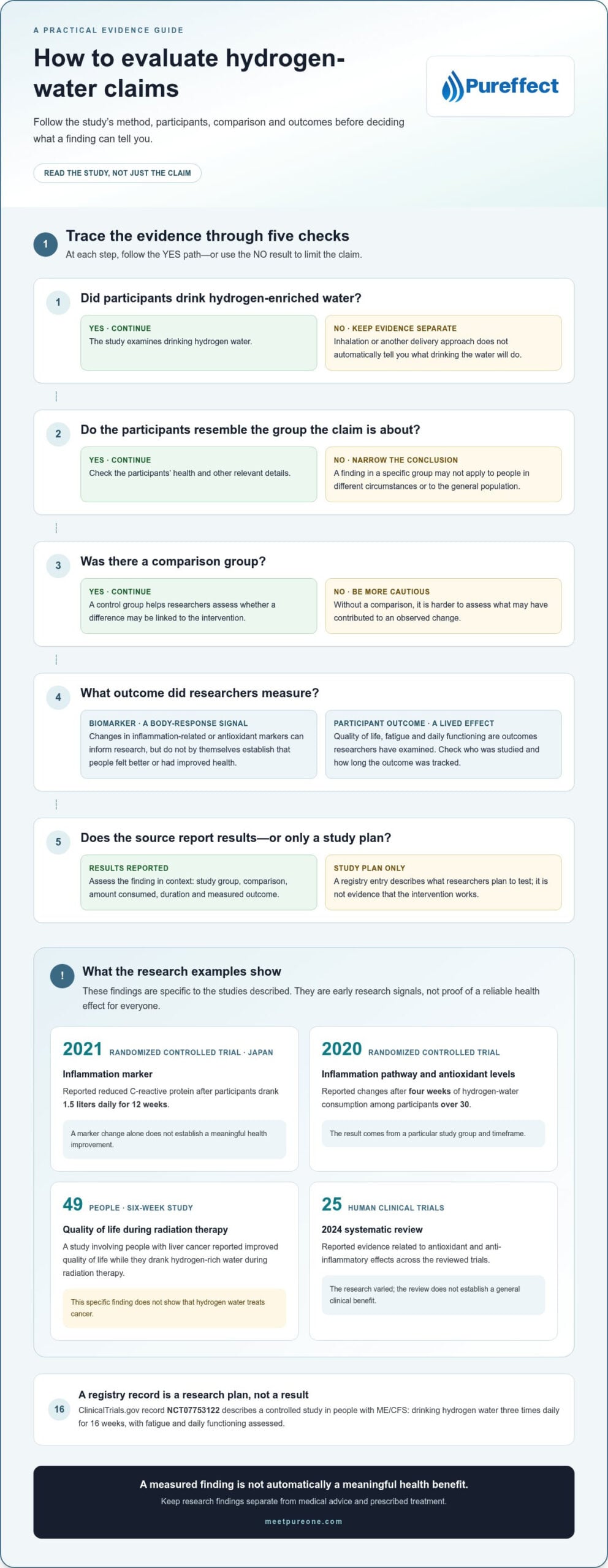
How to Evaluate Hydrogen Enriched Water Benefits and Claims
A health claim is only as useful as the research behind it. Trace claims about hydrogen enriched water benefits back to the study and see whether the evidence matches the wording. This checklist can help you distinguish a promising research question from a result that can support a health decision.
A simple checklist for reading hydrogen-water studies
- Check the delivery method. Did participants drink hydrogen-enriched water, or did the study examine inhalation or another approach? Evidence from one method does not automatically apply to another. Our comparison of hydrogen inhalation machines and water bottles can help clarify the distinction.
- Look at who took part. Note the participants’ health, age range, and other relevant details. A finding in a specific group may not apply to people in different circumstances.
- Check the comparison. Was hydrogen water compared with similar water without added hydrogen, or was there no comparison group? A control group helps researchers assess whether an observed difference may be linked to the intervention.
- Understand the exposure. Check how much participants consumed and for how long. A study’s amount and duration do not necessarily match everyday use.
- Read the outcome and limitations. Was the result a laboratory marker, a symptom, or a measure of daily functioning? Consider the study size, follow-up period, and whether other research found similar results.
For any wellness claim, ask: who was studied, what did they receive, what was it compared with, what outcome changed, and has the result been independently repeated?
What benefits should not be assumed?
A laboratory finding or biomarker change can help researchers understand a possible biological response. On its own, it does not establish that someone will feel better, function differently, or avoid illness. It also should not be turned into a claim that hydrogen water cures, prevents, or treats disease. Individual results can differ, and a study’s findings do not guarantee a personal outcome.
Keep claims tied to the research cited. If you’re considering a home option for drinking hydrogen-enriched water, explore the PureONE Molecular Hydrogen Generator and assess its product details separately from evidence about health outcomes.
Adding Hydrogen-Enriched Water to a Routine: Evidence, Expectations, and PureONE
What to consider before trying hydrogen-enriched water
How PureONE fits a home hydration routine
PureONE is a home-use molecular hydrogen generator with a mode for preparing drinking water. The device also offers modes for inhaling hydrogen gas and applying it directly to the skin. These product options describe ways to use the device, not proven health effects. Research on drinking hydrogen-enriched water should not be treated as evidence for other modes, or vice versa.
When considering a home hydration option, think about whether preparing the water fits your everyday habits and keep expectations proportionate to the evidence. Research into hydrogen enriched water benefits remains an area of investigation. Do not use hydrogen water to delay care, replace prescribed treatment, or change a care plan without professional guidance.
If you’re looking for a home option for preparing hydrogen-enriched water, explore the PureONE Molecular Hydrogen Generator and review its product details with these evidence-based expectations in mind.
Make an Informed Choice About Hydrogen Water
Research into hydrogen enriched water benefits is still developing. Human studies have examined biological markers and quality-of-life outcomes, but early findings do not establish that hydrogen water prevents or treats disease. Study details matter, and results from one group or delivery method should not be assumed to apply to everyone.
If you choose to try it, maintain your everyday hydration habits and treat your own observations as personal experience, not clinical proof. Hydrogen-enriched water should not replace prescribed treatment or professional medical advice. Talk with a qualified healthcare professional about health concerns or changes to your care.
For a home option, PureONE is a Canadian-manufactured molecular hydrogen generator with a drinking-water mode. Its features describe a way to incorporate hydrogen-enriched water into a routine, not evidence of a health outcome. Explore the PureONE Molecular Hydrogen Generator and review its product details as you decide what fits your routine. Keep expectations grounded and make an informed choice.
Frequently Asked Questions
What are the potential benefits of hydrogen-enriched water?
Researchers have investigated whether drinking hydrogen-enriched water may affect markers related to oxidative stress and inflammation, as well as outcomes such as quality of life. These are research areas, not proven benefits for everyone. A change in a lab result does not necessarily mean a noticeable improvement in health. Potential hydrogen enriched water benefits depend on what researchers measured, who participated, and whether other studies report similar results.
Is hydrogen-enriched water scientifically proven to improve health?
No. Human studies have reported findings in particular groups and on specific outcomes, but the evidence does not establish broad, reliable health improvements for everyone. Study size, duration, comparison groups, and replication all affect how much confidence to place in a result. Promising early findings can guide further research, but they are not proof that hydrogen water prevents or treats a health condition.
Can hydrogen-enriched water reduce inflammation?
It may influence inflammation-related markers, but that has not been established as a reliable health effect. One Japanese randomized controlled trial discussed above reported a reduction in C-reactive protein after participants drank 1.5 liters daily for 12 weeks. CRP is a marker, and a change in it does not by itself show that symptoms improved or disease risk fell. More evidence is needed.
How much hydrogen-enriched water should you drink?
There is no established amount proven to provide a health benefit. Researchers have used different amounts and schedules. For example, one trial discussed in this article used 1.5 liters daily for 12 weeks. That was the study protocol, not a general drinking recommendation. Keep to your usual hydration habits, and ask a qualified healthcare professional about fluid intake if you have a health concern or specific medical guidance.
Is hydrogen-enriched water the same as hydrogen inhalation?
No. Hydrogen-enriched water delivers dissolved molecular hydrogen when you drink it. Inhalation involves breathing hydrogen-containing gas, so the route of exposure differs. A study of one approach does not automatically establish effects for the other. Check which method a study tested before applying its findings to drinking water. A product may offer different modes, but that does not make the research interchangeable.
Can hydrogen-enriched water replace medical treatment?
No. Hydrogen-enriched water should not replace prescribed treatment, delay medical care, or take the place of advice from a qualified healthcare professional. Research findings about biomarkers or other outcomes do not establish it as a treatment for disease. If you have a health concern or are considering a change to your care, discuss it with your healthcare professional and continue following your prescribed treatment plan.
Disclaimer
The information provided by Pureffect and any of its products are for educational and informational purposes only and is not intended as medical advice. Individual results may vary, and no specific health outcomes are guaranteed. Always consult a qualified healthcare professional before starting any wellness practice or product.