
What if the biggest hydrogen therapy mistake isn’t choosing the wrong device, but expecting every delivery method to do the same thing? Common mistakes with hydrogen therapy often start with unclear claims, confusing hydrogen water with inhalation, or treating early research as proof of a health benefit. It’s reasonable to want clear answers before bringing a device into your home.
Research has grown since a 2007 study by Shigeo Ohta and colleagues in Nature Medicine helped launch modern interest in molecular hydrogen. By June 2024, more than 2,000 studies and 100 clinical trials had been published. That volume shows growing research interest, but it doesn’t mean every claimed benefit is established. Human studies remain preliminary for many uses, and larger, longer trials are needed.
In this article, you’ll learn how to weigh claims against the evidence, compare delivery methods without assuming they’re interchangeable, and assess concentration and realistic goals. You’ll also see which device details are useful when considering home use, so you can make an informed decision without relying on promises.
Key Takeaways
- Assess human research by checking who was studied, what outcome was measured, and which delivery route was used.
- Common mistakes with hydrogen therapy include treating water, skin application, and inhalation as though they have equal research support.
- Set a realistic goal and compare route-specific evidence. More exposure or a longer session doesn’t automatically mean better results.
- When evaluating a home device, look for clear information about its output composition, available routes, and stated use limits.
- Separate device features from health claims, and consider how home use fits alongside your existing medical care.
Common mistakes with hydrogen therapy start with confusing claims and evidence
Molecular hydrogen therapy refers to using molecular hydrogen through routes such as inhalation, hydrogen-rich water, or topical application. These routes aren’t interchangeable: a finding from one doesn’t automatically apply to another. When you encounter a claim, start with three questions: what was studied, who took part, and which method was used?
A 2023 review surveyed a broad research landscape, including clinical studies, safety, trial registrations, and efficacy. It reported more than 2,000 publications related to hydrogen gas as a potential drug substance. That number indicates research activity, not proof that a therapy works. For a general overview of proposed mechanisms and where evidence remains uncertain, see Understanding Hydrogen Therapy: A Wikipedia Overview.
Mistake one: treating promising research as proven treatment
Different kinds of studies answer different questions. Laboratory research can explore how hydrogen might affect cells, while animal studies can examine effects in living organisms. Neither establishes that people with a particular condition will benefit. Human studies provide more direct evidence, but their findings still depend on the condition, study design, participants, delivery route, and outcomes measured.
A broad review can help map what researchers have investigated; it doesn’t certify every use. A possible biological effect or encouraging early finding is not the same as a confirmed clinical benefit for a specific condition. A promising research area is not the same as a proven treatment.
Mistake two: assuming every hydrogen therapy method is interchangeable
Inhaling hydrogen gas, drinking hydrogen-rich water, and applying hydrogen-infused water or hydrogen gas to the skin involve different routes of exposure. That matters when reading a study: its results relate to the method and conditions researchers tested. An inhalation study, for example, can’t establish the effect of drinking hydrogen water. The same caution applies when comparing topical approaches with either route.
When a claim sounds compelling, trace it back to the study. Which route did researchers use, and did they measure an outcome relevant to your goal? For a plain-language introduction to the molecule itself, consult the guide titled “What is Molecular Hydrogen?” Keeping the route and the evidence together makes the common mistakes with hydrogen therapy easier to spot and keeps expectations tied to what research actually examined.
What human research says about hydrogen therapy, and what it cannot yet prove
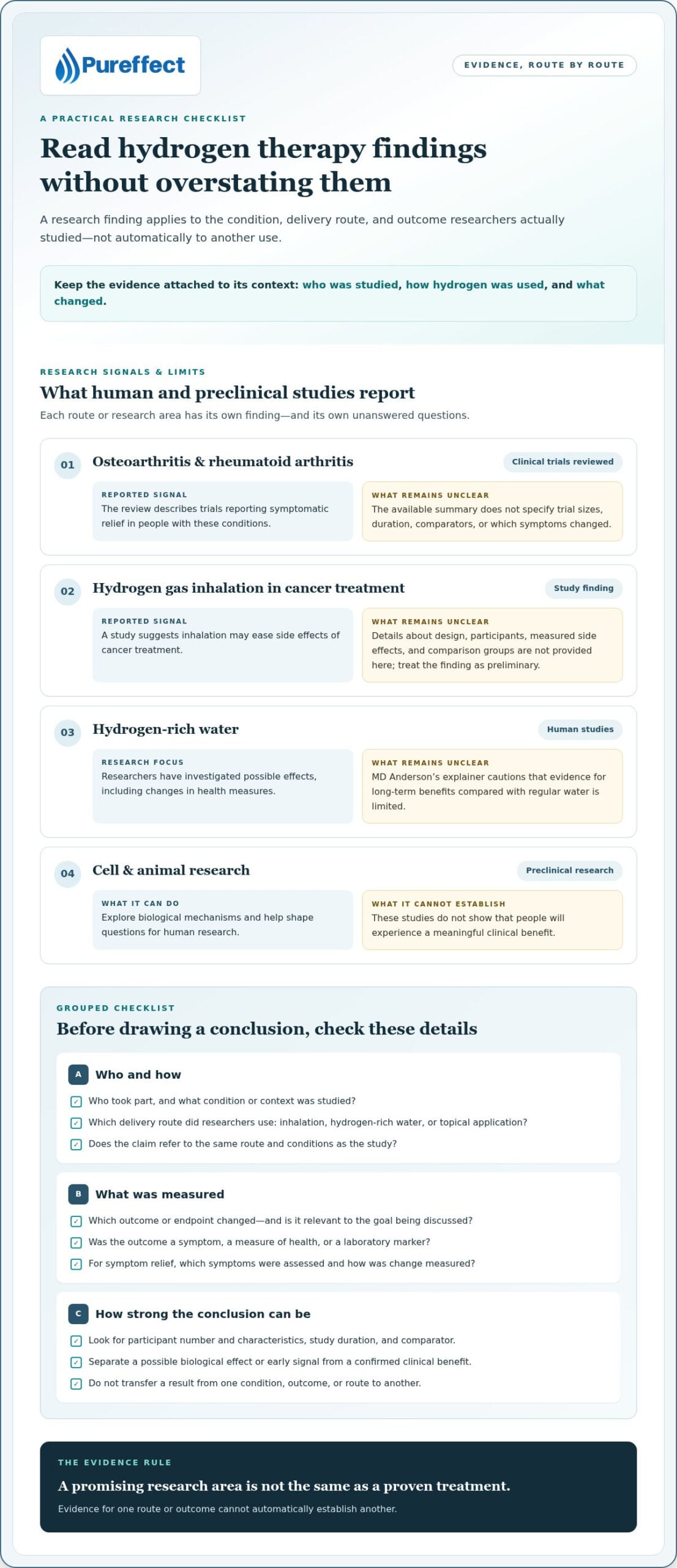
Human findings are more useful when you can identify the condition, delivery route, and outcome being studied. A 2023 clinical review covers varied indications and methods, but that breadth doesn’t mean hydrogen has one established effect across conditions. More recent research offers specific signals worth examining, alongside gaps that limit what can be concluded.
| Route or research area | Research type | Reported finding | Key limitation |
|---|---|---|---|
| Hydrogen therapy for osteoarthritis and rheumatoid arthritis | A 2026 review of clinical trials | The review reports trials describing symptomatic relief in people with these conditions. | The available summary doesn’t specify trial sizes, duration, comparators, or which symptoms changed, so it can’t establish the strength or persistence of the effect. |
| Hydrogen gas inhalation in cancer treatment | A 2026 study | The study suggests inhalation may ease treatment side effects. | Without details on design, participants, measured side effects, and comparison groups, the finding should be treated as preliminary rather than proof of benefit. |
| Hydrogen-rich water | Human studies | Researchers have investigated possible effects, including changes in health measures. | MD Anderson’s explainer cautions that evidence for long-term benefits compared with regular water is limited. |
| Cell or animal research | Laboratory and animal studies | These studies can explore biological mechanisms and inform questions for human research. | They don’t show that people will experience a meaningful clinical benefit. |
How to read findings without overstating them
For any trial, look for the number and characteristics of participants, study duration, comparator, and measured endpoint. “Symptom relief” is a patient-relevant outcome, but its meaning depends on which symptoms were assessed and how change was measured. A shift in a laboratory marker, by contrast, doesn’t necessarily mean someone feels or functions better. These details help distinguish an early signal from evidence strong enough to guide care.
Why route and research design matter
The 2023 review spans different disease areas and administration methods. A result from one setting can’t establish the effect of another route or condition. For example, evidence about inhalation in a cancer-treatment context doesn’t show that hydrogen-rich water eases arthritis symptoms. The guide Hydrogen Therapy for Athletic Recovery likewise concerns a distinct study context, not a universal result.
Evidence for one route or outcome cannot automatically establish another. Research can be promising while leaving important questions open, including who may benefit, how durable an effect is, and whether it applies beyond the specific study. PureONE’s modes are device options, not evidence that each route has equivalent clinical support. The PureONE Molecular Hydrogen Generator offers four ways to use it: drink hydrogen-infused water, apply that water to the skin, apply hydrogen gas to the body, or inhale the gas.
Avoid hydrogen therapy mistakes by matching the method to realistic expectations
A practical decision starts with a clear purpose, not a promise. Use this sequence to decide whether hydrogen therapy is worth exploring for your situation and what boundaries will help keep your expectations grounded.
- Define your goal. Identify what you hope to learn or support, such as a specific symptom or recovery concern. A focused question makes it easier to judge whether a study or device information is relevant to you.
- Check the evidence for your intended use. Look for human research that addresses your goal and the method you’re considering. A comparison such as Hydrogen Inhalation Machine vs. Water Bottle can help clarify which format fits your preferences, without treating convenience as proof of effectiveness.
- Set practical limits. More exposure or a longer session doesn’t automatically mean a better result. Follow the device’s stated instructions, and don’t increase use simply because you haven’t noticed an effect.
- Review your care context. If you have a health condition, treatment questions, or medication concerns, discuss hydrogen use with a qualified clinician before making it part of your routine.
Choose a route based on the question, not the marketing
Choose based on the evidence and your practical needs, not a broad claim that one format is “best.” Consider whether the routine is manageable, whether you understand the instructions, and what outcome you’ll use to assess whether it suits you. Keep expectations modest, especially when research doesn’t directly address your goal.
Set boundaries for safe, evidence-aware use
Hydrogen therapy shouldn’t be a reason to stop prescribed medication, delay an assessment, or change a treatment plan on your own. If you and your clinician decide it may fit as an adjunct, agree on sensible boundaries and continue the care already recommended for your health needs.
PureONE brings four use modes together in one home-use device. Compare the modes as options for your routine, not as a guarantee of a health outcome.
Evaluate a home hydrogen therapy device without expecting guaranteed results
A device’s specifications can help you understand what it does, but they can’t predict a health outcome. Before deciding, look for clear information about output, delivery options, use limits, support, and return terms. This makes it easier to compare practical features with your goals without confusing device capability with clinical evidence.
- Check output composition. PureONE produces a mixed HHO/hydroxy stream of approximately 66% hydrogen and 33% oxygen, not pure H₂.
- Review route options. PureONE supports drinking hydrogen-infused water from the included bubbler, applying hydrogen-infused water to the skin, applying hydrogen gas directly to the body, and inhaling the gas. A range of functions doesn’t mean every method has equal research support.
- Look for specific performance limits. PureONE’s bubbler infuses one litre of water in ten minutes at 100% duty cycle to about 0.8 ppm dissolved hydrogen. The water reaches maximum saturation at that point; longer infusion doesn’t increase the concentration. The front-panel control changes the gas production rate, not its composition.
- Understand support and return terms. Phone and email support is provided by Molecular Hydrogen Institute-certified H₂ advisors. The 365-day money-back guarantee applies to the machine; shipping costs aren’t refundable.
Read device specifications and limits carefully
Specific figures are more useful than a broad claim of “high output.” PureONE’s stated water-infusion result gives a volume, duration, and concentration, offering a practical reference for use. The control’s stated function also clarifies what an adjustment changes. Read each specification in context, and don’t treat a performance figure as evidence of a particular health effect.
Make a decision with support and clear trial terms
A transparent specification describes both what a device does and its stated limits. PureONE’s customer support is available by phone and email, and the 365-day money-back guarantee applies to the machine after a year of use. Shipping costs aren’t refundable. A trial period can help you evaluate whether a machine fits your routine; it can’t prove that using it will produce a health outcome.
Review the PureONE molecular hydrogen generator’s specifications and terms as you consider whether its features fit your needs.
Take your next step with clear expectations
A thoughtful decision doesn’t need to settle every question about hydrogen therapy. Start by identifying what you want to learn, what kind of evidence would help you assess that goal, and what would make you pause. Keep those standards in view as you compare claims and consider whether a home device fits your routine. That way, common mistakes with hydrogen therapy are less likely to steer your decision.
Keep product functions separate from promises about health outcomes, and weigh the device’s stated features against your preferences and expectations.
Explore the PureONE molecular hydrogen generator and review its features and terms to decide whether it fits your home routine.
Frequently Asked Questions
Is hydrogen therapy proven to work?
Not as a treatment for every condition. Current research doesn’t establish a reliable benefit for all uses. A study may find a change in a specific measure without showing that people feel better or have improved health over time. To assess a claim, look for human research on the condition and outcome you care about, and note whether the finding has been replicated. That distinction helps avoid common mistakes with hydrogen therapy.
Can hydrogen therapy replace medication or medical treatment?
No. Don’t stop prescribed medication, delay an assessment, or change a treatment plan because of a hydrogen therapy claim. If you’re considering adding a device or hydrogen water to your routine, discuss it with your healthcare professional, especially if you have a health condition or take medication. Bring the specific product and intended method into the conversation. That gives your clinician a clearer basis for discussing possible risks and how it fits with your care.
How much hydrogen should hydrogen water contain?
There isn’t one established concentration that applies to every person or purpose. Concentration alone doesn’t establish a universal dose or guarantee a benefit. It’s also useful to know how much water is infused and how long the infusion takes. With PureONE, one litre of water reaches about 0.8 ppm dissolved molecular hydrogen after ten minutes at 100% duty cycle. Longer infusion doesn’t increase that concentration. In an open container, dissolved hydrogen can fall over time, so freshly prepared water may differ from water left standing.
What happens if I use hydrogen water and inhalation as if they were the same?
You may assume evidence for one method applies to the other, even though the exposure route and study protocol differ. For example, a result from a trial using hydrogen-rich water doesn’t show that inhalation produces the same outcome. Compare research using the method you’re considering, including how it was delivered and what researchers measured. Treating the routes as equivalent can lead to unrealistic expectations or a routine that doesn’t match the evidence.
Can an ORP meter tell me the exact hydrogen concentration in water?
No. An oxidation-reduction potential (ORP) meter measures electrical potential, not dissolved hydrogen concentration directly. Its reading can be affected by factors such as water chemistry, so it shouldn’t be treated as an exact ppm value. If you want to compare hydrogen concentrations, use a measurement method designed to assess dissolved hydrogen and follow its instructions. A single ORP reading can’t confirm a precise concentration or demonstrate a health effect.
Does PureONE produce pure hydrogen gas?
No. PureONE produces a mixed HHO, or hydroxy, stream of approximately 66% molecular hydrogen and 33% oxygen. That composition is different from pure hydrogen, so read the output description accurately rather than relying on a general label such as “hydrogen gas.” This distinction describes the device’s output; it doesn’t establish that any particular use mode will produce a health benefit.
Disclaimer
The information provided by Pureffect and any of its products are for educational and informational purposes only and is not intended as medical advice. Individual results may vary, and no specific health outcomes are guaranteed. Always consult a qualified healthcare professional before starting any wellness practice or product.