
What if the best way to preserve hydrogen-rich water is not to store it for long at all? If you’ve wondered how to properly store hydrogen-rich water, start with what can change after preparation: dissolved molecular hydrogen can move from the water into the air above it and escape when the container is opened. The container, how much air space it holds, and how often it is opened are all practical considerations. A bottle in the fridge may be convenient, but refrigeration alone cannot guarantee that the water keeps a fixed concentration.
This guide explains how to handle prepared water and how to assess storage claims. You’ll learn why sealing a container promptly and limiting empty space are sensible precautions, why study results need to be read alongside their methods, and when fresh preparation may be simpler. Storage advice concerns dissolved hydrogen, not a promised health outcome. The goal is to make informed choices without wasting water or relying on an unsupported shelf-life estimate.
Key Takeaways
- To learn how to properly store hydrogen-rich water, limit unnecessary exposure to open air, but don’t treat any handling step as a guarantee of a specific shelf life.
- Compare retention findings only when you know the container, timing, and measurement method used.
- Separate practical precautions from verified ways to preserve a particular concentration, and consider preparing a fresh serving when that is easier.
- PureONE’s stated specification is 1 litre infused in 10 minutes at 100% duty cycle, reaching about 0.8 ppm dissolved molecular hydrogen.
Why hydrogen-rich water may not stay the same after preparation
You’ve prepared hydrogen-rich water, but does it still contain the same amount of dissolved hydrogen later? Not necessarily. Molecular hydrogen can move from the water into the air above it, then escape when the container is open. The water may look and taste the same even if its dissolved-hydrogen concentration has changed.
Hydrogen-rich water contains dissolved molecular hydrogen, or H₂. The term describes what is in the water; it does not guarantee a health outcome. Dissolved hydrogen is also different from hydrogen gas in the space above the water. That space, called the headspace, matters because gas can move between the liquid and the air above it.
What does “hydrogen-rich” mean in water?
Researchers commonly report dissolved hydrogen concentration in parts per million (ppm). In water, ppm expresses the amount of hydrogen relative to the amount of water. It describes a measured concentration, not whether drinking the water will produce a medical benefit. For foundational context, see the science of molecular hydrogen and the basic Properties of Hydrogen.
Why does storage advice need context?
How to properly store hydrogen-rich water depends partly on how it was prepared and what happens afterward. To interpret a retention result, look at the preparation method, container and closure, amount of empty space, storage temperature, and time between preparation and measurement. The measurement method matters as well. Differences in these conditions can make results difficult to compare with what happens to a glass or bottle at home.
A result from an open vessel does not automatically predict what happens in a tightly closed container. Likewise, measurements taken at a few timepoints cannot show every change between them. When assessing a claim, look for the actual storage conditions and measurement method rather than relying on a headline number.
A measured hydrogen concentration describes what was detected under specific conditions. The word “fresh” does not tell you how much hydrogen remains. This distinction is especially useful when storage advice gives an exact number of minutes or hours without explaining how it was measured. Start with the conditions behind the claim, and avoid treating a single result as a universal shelf life.
What research can, and cannot, tell us about hydrogen retention
A useful retention claim should be based on a measurement of dissolved hydrogen over time. To judge whether the finding applies to your routine, you need details such as the container, closure, headspace, temperature, timing, and measurement method. Without those details, a statement such as “most hydrogen is gone by a certain time” cannot be meaningfully compared with a different preparation or storage setup.
Which storage variables have researchers measured?
When reading a study, look for how the water was prepared, whether the container was open or closed, its material and headspace, the storage temperature, and when samples were tested. Check how dissolved hydrogen was measured, too. These details determine what the result can tell you. If a report omits key information, it cannot support a fair comparison between container materials or a precise storage deadline for home use.
The U.S. Department of Energy’s overview of Hydrogen Storage Technologies provides broader context on hydrogen storage, but it does not give measurements for hydrogen dissolved in drinking water. It should not be used to set a water-storage timeframe.
How should readers interpret retention claims?
Begin with what the researchers actually measured, then check the conditions and timepoints. A concentration recorded in a particular sealed vessel applies to that tested setup. It does not establish the same result for a different vessel or routine. If a source gives a retention number without a clear method, treat it as an unverified claim rather than a practical deadline.
Check the type of measurement, too. Dissolved hydrogen concentration is reported as a concentration, often in ppm. Oxidation-reduction potential (ORP) is a separate reading and cannot, by itself, establish a dissolved-hydrogen concentration. The two measures answer different questions.
There is no universal retention time that can be applied to every serving of drinking water. That makes it difficult to turn research into a fixed rule for how to properly store hydrogen-rich water. Retention measurements also do not establish health effects; those require separate clinical evidence.
If fresh preparation at home suits your routine, explore the PureONE Molecular Hydrogen Generator.
How to handle and store hydrogen-rich water in everyday use
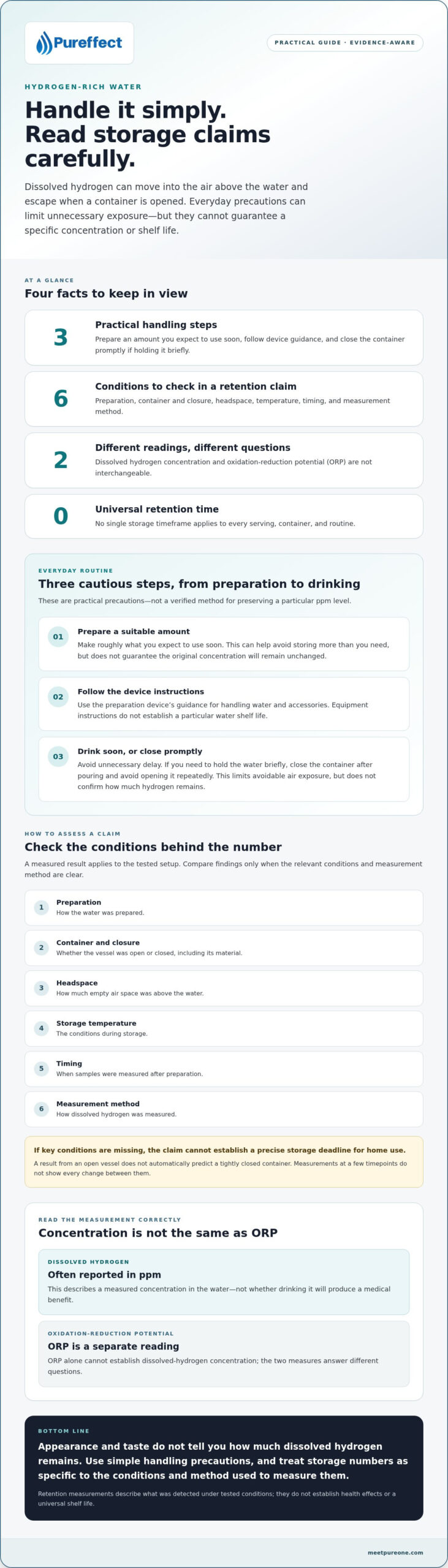
A simple routine can reduce unnecessary handling, although it cannot guarantee a particular hydrogen concentration. Prepare an amount you expect to drink soon, and avoid leaving it exposed or opening the container repeatedly. These are practical precautions, not a verified way to preserve a specific ppm level.
A cautious routine from preparation to drinking
- Prepare a suitable amount. Make roughly what you expect to use soon. This helps avoid storing more than you need, but does not guarantee that the water’s original concentration will remain unchanged.
- Follow the device instructions. Use the preparation device’s guidance for handling water and accessories. Instructions for equipment help you use it appropriately; they do not establish a particular hydrogen-water shelf life.
- Drink it, or close it promptly. If you’ll drink the water shortly, avoid unnecessary delay. If you need to hold it briefly, close the container after pouring and avoid opening it repeatedly. Keeping a container closed limits avoidable exposure to air, but does not confirm how much hydrogen remains.
What about a partly used bottle on a counter, or water poured into a glass and left while you finish a task? There’s no need to panic over ordinary handling. Just don’t assume the water still has its initial concentration based on appearance, taste, or elapsed time alone. Without a comparable measurement, the amount of dissolved hydrogen remaining is unknown.
What should you avoid assuming?
Refrigeration, darkness, and a particular container may sound like easy fixes, but none should be treated as proof that a specific concentration has been preserved. Storage conditions matter, and a result measured under one set of conditions may not apply to another. Use sensible handling precautions without assuming they maintain a set ppm level.
Storage findings and health-outcome findings answer different questions. Research on hydrogen therapy for athletic recovery, for example, concerns outcomes studied in an athletic context. It does not show how much dissolved hydrogen remains in stored water. A storage observation alone cannot establish a health effect either.
For a straightforward approach to how to properly store hydrogen-rich water, prepare what you’re likely to drink, limit unnecessary air exposure, and don’t treat an unverified time limit as a guarantee. If fresh preparation at home fits your routine, explore the PureONE Molecular Hydrogen Generator.
Fresh preparation with PureONE: use the product specifications, not a shelf-life promise
Fresh preparation is a practical alternative to relying on an assumed storage window. PureONE makes hydrogen-infused water at home with its included bubbler. Its stated specification is 1 litre infused in 10 minutes at 100% duty cycle, reaching about 0.8 ppm dissolved molecular hydrogen.
What PureONE’s infusion specification means
These figures describe the product’s stated infusion capacity, not a guarantee that every serving will measure identically. Water characteristics, measurement conditions, and handling after preparation can affect a reading. About 0.8 ppm is the stated maximum concentration, not a promise of a fixed concentration after storage.
Infusing for longer does not increase the stated ppm. PureONE generates a mixed-gas HHO/hydroxy stream of approximately 66% H₂ and 33% O₂, not pure hydrogen alone. These specifications describe the product; they do not establish how long hydrogen remains dissolved after the water is prepared.
A practical next step for making water fresh at home
If you want water for a particular moment, prepare an amount you expect to use rather than making extra based on an unverified shelf-life estimate. If plans change and you need to hold it briefly, use the cautious handling steps above, while remembering that they cannot confirm a remaining concentration.
The stated infusion time helps set expectations for preparation, while the stated concentration describes the product specification. Neither figure is a storage-duration claim. Rather than trying to make a serving last for a precise number of hours, choose fresh preparation when it suits your routine.
If preparing hydrogen-rich water at home fits your approach, explore the PureONE generator and its stated infusion specifications. Fresh preparation is a practical option, not a promise of a particular health outcome or a guaranteed concentration after preparation.
Make freshness part of a routine that works for you
For how to properly store hydrogen-rich water, keep the next step practical: prepare with your intended use in mind, follow the device instructions, and avoid treating an estimate as a measurement. You don’t need to make the process complicated. Notice what works for you and adjust your routine if it doesn’t.
PureONE is made for preparing hydrogen-infused water at home. If that suits the way you want to build your routine, explore PureONE for fresh hydrogen-infused water at home.
Frequently Asked Questions
How long does hydrogen-rich water last after opening?
There isn’t one timeframe that applies to every serving. Retention can depend on how the water was prepared and handled, including how often the container is opened. To judge whether a study applies to your situation, look for research that reports comparable preparation, container, closure, temperature, timepoints, and measurement methods. A result from different conditions cannot reliably set a deadline for your opened bottle.
Does hydrogen-rich water lose dissolved hydrogen when left uncovered?
Exposure to air may affect the concentration of dissolved hydrogen, but don’t assume a specific rate or amount of change without a relevant measurement. The general movement of gas between water and air does not tell you how quickly hydrogen leaves a particular serving. A finding from an uncovered sample also cannot establish the storage life of every product or preparation method.
Should hydrogen-rich water be refrigerated?
Refrigeration is not a universal requirement for preserving a particular dissolved-hydrogen concentration. Cooling should not be treated as a guarantee that a specific ppm level will be maintained. If you refrigerate a serving for convenience, follow the preparation device’s care instructions and don’t interpret that choice as a verified ppm-preserving method.
Can you freeze hydrogen-rich water to preserve it?
Don’t assume freezing preserves dissolved hydrogen. A useful answer would require measurements before freezing and after thawing, with the container, procedure, and measurement method clearly reported. Ordinary food-storage habits cannot establish what happens to dissolved hydrogen. Avoid relying on freezing as a preservation method without directly relevant evidence.
Does an ORP meter tell you the exact dissolved hydrogen concentration?
No. An ORP meter reading is not an exact ppm result. If you’re logging readings, record the meter model and follow its instructions consistently so you can interpret changes within the method’s limits. PureONE’s stated ppm level is not accompanied by an independent laboratory certificate, so an ORP display should not be presented as independent verification of that figure.
Is hydrogen-rich water the same as alkaline water?
Disclaimer
The information provided by Pureffect and any of its products are for educational and informational purposes only and is not intended as medical advice. Individual results may vary, and no specific health outcomes are guaranteed. Always consult a qualified healthcare professional before starting any wellness practice or product.