
Hydrogen water isn’t a proven replacement for antioxidant supplements, and current evidence doesn’t show that it offers greater long-term benefits than regular water. The key difference in the comparison of antioxidant supplements vs hydrogen water is what each provides: supplements contain specific nutrients, while hydrogen water contains dissolved molecular hydrogen.
It’s understandable to wonder whether water marketed as “antioxidant” can do more than support hydration. The science is more nuanced: a 4-week human trial found no overall difference in serum antioxidant capacity between hydrogen-water and plain-water groups, although results differed by age group.
This article explains what “antioxidant water” and dissolved molecular hydrogen mean, how pH and oxidation-reduction potential (ORP) relate to those labels, and what research suggests about possible health benefits. It also considers how hydrogen water differs from nutrients such as vitamin C, and why promising early findings need to be weighed against the limits of the evidence.
Key Takeaways
- Antioxidant supplements provide specific nutrients, while hydrogen water contains dissolved molecular hydrogen; they aren’t interchangeable.
- Hydrogen’s proposed antioxidant action focuses on certain reactive molecules, but research findings don’t establish broad disease-prevention benefits.
- pH describes acidity or alkalinity, while ORP measures oxidation-reduction tendency; neither reading alone proves a health benefit.
- Assess supplement evidence by the nutrient and health outcome studied, rather than assuming that all antioxidants work the same way.
- If hydrogen water interests you, learn how the PureONE Molecular Hydrogen Generator fits into a home routine without treating it as a replacement for established care.
Hydrogen water: Does it have health benefits?
Hydrogen water has early research suggesting antioxidant and anti-inflammatory effects, but human findings remain mixed. The evidence does not establish it as a treatment or as a replacement for antioxidant nutrients.
Potential Health Benefits and Research Limitations
Research on hydrogen water examines whether dissolved molecular hydrogen affects oxidative stress and inflammatory activity. That distinction matters: a possible biological mechanism can justify further study, but it does not prove a lasting health benefit in people.
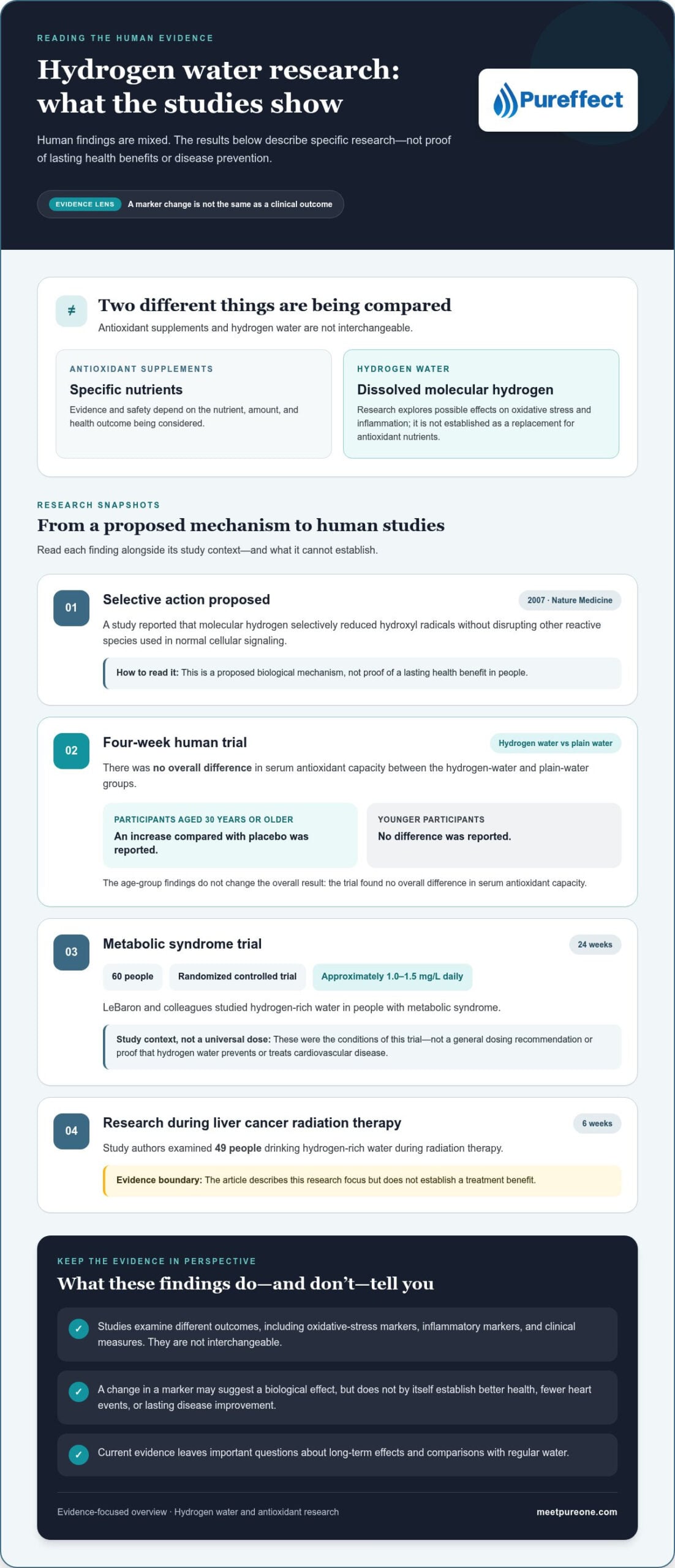
A 2007 study in Nature Medicine reported that molecular hydrogen selectively reduced hydroxyl radicals without disrupting other reactive species used in normal cellular signaling. In a 4-week human trial, researchers found no overall difference in serum antioxidant capacity between hydrogen-water and plain-water groups. Participants aged 30 years or older showed an increase compared with placebo, while younger participants showed no difference.
Cardiovascular and Metabolic Benefits
Cardiovascular and metabolic research explores whether hydrogen water affects markers linked to oxidative stress, inflammation, and metabolic health. These markers matter, but changes in them do not by themselves establish fewer heart events or lasting disease improvement.
LeBaron and colleagues studied hydrogen-rich water in a 24-week randomized controlled trial involving 60 people with metabolic syndrome. Participants drank water containing approximately 1.0-1.5 mg/L of hydrogen daily. This offers a specific example of human metabolic research, not proof that hydrogen water prevents or treats cardiovascular disease.
Inflammation is another research focus, including studies of hydrogen water during cancer treatment. The liver cancer study authors examined 49 people drinking hydrogen-rich water for 6 weeks during radiation therapy. Animal studies have also suggested possible effects on treatment-related oxidative stress, fatigue, and inflammation. These findings are reasons for further research, not proof of treatment benefit.
Hydrogen water is generally considered safe and isn’t known to cause significant risks or side effects. Antioxidant supplements are different: risks depend on the nutrient and amount, so assess each ingredient rather than assuming every antioxidant has the same safety profile. There is no single daily limit for all antioxidant supplements; recommended limits vary by nutrient. Follow the product directions and consider your total intake from other supplements.
Research has studied different hydrogen-water concentrations and durations, including 1.0-1.5 mg/L daily in LeBaron’s 24-week trial. Those study conditions aren’t universal dosing recommendations. For supplements, use the specific nutrient’s guidance rather than applying one dose across vitamins or antioxidant products. Overall, current evidence leaves important questions about long-term effects and comparisons with regular water.
PH and oxidation-reduction potential (ORP)
pH and oxidation-reduction potential describe different properties of water. Neither reading alone shows whether drinking the water changes oxidative stress or improves health.
On the pH scale, a value above 7 is alkaline. Alkaline water is commonly described with a pH of 8.0 to 10.0, while antioxidant or hydrogen-rich water is described with a pH of 7.5 to 9.5. These ranges overlap, but the labels refer to different ideas: pH indicates acidity or alkalinity, while “antioxidant” usually points to dissolved molecular hydrogen.
For context, municipal drinking-water guidance gives a pH range of 6.5 to 8.5 as a non-enforceable aesthetic standard. That range concerns water characteristics, not a clinical measure of antioxidant action. A pH meter cannot tell you how much hydrogen is dissolved in water, and a higher reading does not automatically mean greater antioxidant effects.
ORP measures a solution’s tendency to gain or lose electrons in oxidation-reduction reactions. A negative ORP is often presented as evidence of reducing potential, but it doesn’t directly measure the body’s response to drinking the water. ORP can vary with water chemistry and testing conditions, so treat it as a property of the sample, not a clinical outcome or a measure of radicals inside the body.
Oxidative Stress, Nutrient Status, and Hydrogen Water
Oxidative stress occurs when reactive molecules outweigh the body’s protective systems. Those molecules also play a role in normal signaling, so the goal isn’t to eliminate every reactive molecule. Nutrient deficiencies can affect normal body function, but a water’s pH or ORP reading cannot identify a deficiency or replace an assessment of diet and health.
Research on hydrogen water examines whether dissolved hydrogen may act selectively on certain reactive molecules. That proposed action is distinct from changing water’s pH. When assessing a study, check what it measured: oxidative damage markers, inflammatory markers, and clinical measures are not interchangeable. A change in one marker may suggest a biological effect, but it doesn’t by itself establish better health.
How can you evaluate products? For hydrogen water, look for a stated dissolved-hydrogen concentration and clear measurement conditions. For supplements, review the named nutrients, amounts, and evidence for the specific health outcome. Don’t treat pH or ORP claims as proof of clinical benefit.
If you’re exploring dissolved hydrogen for home use, the PureONE Molecular Hydrogen Generator is one option designed for drinking hydrogen-infused water.
Definition of antioxidant water and dissolved molecular hydrogen
“Antioxidant water” usually refers to water containing dissolved molecular hydrogen, not water molecules changed into a different nutrient. The distinction matters: ordinary water already contains hydrogen atoms, while hydrogen-rich water has additional hydrogen gas dissolved in it.
A water molecule is H2O: two hydrogen atoms bonded to one oxygen atom. Molecular hydrogen, written H2, is a separate gas made of two bonded hydrogen atoms. Adding dissolved H2 does not replace the water molecule or turn it into a vitamin tablet. It changes what is present in the water.
At 20°C, molecular hydrogen’s solubility in water is roughly 1.6 mg/L. That figure describes an approximate saturation point under that temperature, not a guaranteed concentration in every drink. Actual dissolved levels depend on conditions such as temperature, pressure, container, and time after preparation.
Hydrogen also escapes from water. In an open container at room temperature, half of its dissolved hydrogen can be lost within 30-60 minutes, depending on surface area and agitation. Bottled hydrogen water may lose much of its dissolved gas within days, sometimes within hours. So “hydrogen-rich” describes a changing state, not a permanent feature of water.
The word “antioxidant” can be confusing. Hydrogen-rich water is studied for possible effects on oxidative processes, while vitamins such as vitamin C are nutrients with distinct functions. Neither a neutral taste nor a neutral pH tells you whether water contains dissolved hydrogen. Plain water and hydrogen water taste the same, so taste alone can’t distinguish them.
In the United States, the National Cancer Institute classifies hydrogen-rich water as a nutritional supplement. That category doesn’t make it equivalent to antioxidant tablets or establish that it prevents disease. Research evaluates a particular substance, amount, and outcome; a broad label such as “antioxidant” can’t answer all three.
How much does hydrogen water cost compared with antioxidant supplements in the United States? There’s no direct, like-for-like comparison: supplement costs depend on the ingredient and serving, while hydrogen water costs depend on whether it’s bottled or prepared at home. Compare cost per serving and intended use, rather than relying on the word “antioxidant” on a label.
Can antioxidant supplements or hydrogen water interact with medications or cancer treatments? Interaction risks depend on the supplement ingredient and medication, so antioxidant products don’t share one universal interaction profile. During cancer treatment, tell your oncology team about supplements or hydrogen-rich water before adding them.
For a practical comparison, separate three questions: what substance is present, how much reaches the drink, and which health outcome the research measured. This keeps claims about immune or cellular effects distinct from basic chemistry, including whether molecular hydrogen is dissolved in the water.
What evidence supports antioxidant supplements for preventing or treating disease?
Evidence for antioxidant supplements must be judged by the specific nutrient and disease outcome studied. The comparison of antioxidant supplements vs hydrogen water is useful only if it keeps those research questions separate. For example, the 2007 Nature Medicine paper examined molecular hydrogen, not whether vitamin supplements prevent or treat disease.
For disease-related claims, look for studies that test the supplement itself against a meaningful outcome, such as disease occurrence, symptoms, or treatment response. A biochemical explanation can make a study worth pursuing, but it can’t establish that taking a supplement changes a person’s health outcome. The nutrient, population, and condition all shape what a result can reasonably support.
Consider metabolic research as one example. A1c reflects blood sugar levels over 2 or 3 months, so it represents a different endpoint from a single blood-glucose measurement or a laboratory marker of oxidative stress. A supplement study reporting an A1c change would address a specific metabolic measure, not automatically prove prevention or treatment of every disease linked with oxidative processes.
Use this short appraisal when reading a supplement claim:
- Identify the exact nutrient and the condition researchers studied.
- Check whether the outcome was a clinical result, symptom, or laboratory measure.
- See whether the study tested the supplement alone or alongside other interventions.
- Apply the finding only to populations and outcomes similar to those studied.
This careful approach matters because an established nutritional role is not the same as evidence for a disease claim. For example, vitamin C contributes to iron absorption, but that alone doesn’t show that a vitamin C supplement treats an illness. Evidence for one nutrient also can’t establish effects for a blend or for hydrogen water. The phrase antioxidant supplements vs hydrogen water should prompt a comparison of distinct evidence, not an assumption that both act alike.
If you’re considering hydrogen-infused water as a separate wellness option, explore the home molecular hydrogen generator as one way to prepare it.
Pureffect: PureONE Molecular Hydrogen Generator
PureONE Molecular Hydrogen Generator offers a home option for people interested in drinking hydrogen-infused water. The device also supports hydrogen inhalation and topical application, providing several ways to use molecular hydrogen as part of a wellness routine.
PureONE is best understood as a way to use hydrogen, not as an antioxidant supplement or disease treatment. The research discussed above provides the right context: potential effects are still being studied, and hydrogen water shouldn’t replace prescribed care or nutrients your body needs.
If you’re considering a home generator as part of your wellness routine, visit meetpureone.com to learn more about PureONE.
Make your next wellness choice with intention
Let your goal guide your next step. If you’re addressing a diagnosed nutrient deficiency, focus on the specific nutrient and relevant guidance. If you’re curious about hydrogen water, consider it a separate wellness choice, not a shortcut or substitute for care. This makes the antioxidant supplements vs hydrogen water comparison more useful: it shifts attention from broad labels to what you want a product to do.
It can also help to keep a simple record of what you add to your routine and why. Note the product, your intended purpose, and any changes you discuss with a healthcare professional, especially during treatment or while taking medication. Clear decisions are easier to review than a stack of overlapping claims.
Pureffect offers the PureONE Molecular Hydrogen Generator for people interested in exploring hydrogen at home. Explore the PureONE Molecular Hydrogen Generator and consider whether it fits your personal wellness goals. Keep asking thoughtful questions, and choose your next step with confidence.
Frequently Asked Questions
Are there any risks to drinking hydrogen water?
Hydrogen water is generally considered safe and isn’t known to cause significant risks or side effects. Still, safety doesn’t establish that it treats a health condition or suits every person. If you’re considering it during cancer treatment, discuss it with your oncology team before adding it to your routine. Keep prescribed treatment and established medical advice separate from wellness choices.
Can You Use Both?
Hydrogen water and antioxidant supplements can be considered separately within the same wellness routine, but using both doesn’t prove their effects combine. Research hasn’t specifically tested hydrogen water mixed with vitamin C, creatine, branched-chain amino acids, magnesium, or commercial electrolyte formulations in randomized controlled trials. Choose each for a clear reason, and don’t assume combining products creates an added benefit.
Final Thoughts: Should You Choose One Over the Other?
Choose according to your goal, not the shared “antioxidant” label. If a healthcare professional has identified a nutrient deficiency, addressing it is a different decision from trying hydrogen water out of general interest. For example, someone addressing low vitamin intake shouldn’t treat hydrogen water as a substitute for that nutrient. Compare the evidence for the specific product and intended outcome before deciding.
What Is Antioxidant Water?
“Antioxidant water” commonly means water with dissolved molecular hydrogen, rather than water containing an antioxidant vitamin. The phrase describes a product category, not a guaranteed health effect. Check what the label identifies: the added substance, its measured amount, and how that amount is reported. A broad “antioxidant” claim alone doesn’t tell you what you’re drinking.
What Is ORP, and Why Does It Matter?
ORP, or oxidation-reduction potential, measures a sample’s tendency to participate in electron-transfer reactions. It can describe water chemistry, but it isn’t a direct measure of antioxidant activity in your body. If you compare readings, treat them as a property of the water sample, not proof of a clinical effect or a measure of your health.
What are antioxidant supplements and hydrogen water, and how are they supposed to work?
Antioxidant supplements provide particular nutrients, while hydrogen water contains dissolved molecular hydrogen. Their proposed roles differ, so evidence for one cannot establish benefits for the other. Vitamin B3 participates in more than 400 enzymatic reactions, and vitamin B6 participates in more than 100 enzyme reactions. Those figures illustrate why nutrients have specific biological roles, not why every supplement prevents disease.
Disclaimer
The information provided by Pureffect and any of its products are for educational and informational purposes only and is not intended as medical advice. Individual results may vary, and no specific health outcomes are guaranteed. Always consult a qualified healthcare professional before starting any wellness practice or product.