
What if the smallest molecule in the universe could act as a “smart” shield for your kidneys? It sounds like science fiction, but recent clinical shifts suggest otherwise. If you’ve been monitoring your creatinine levels with a sense of dread, you aren’t alone. It’s frustrating to feel like you’re losing ground against progressive decline. Many people feel overwhelmed by dense medical jargon and skeptical of wellness tools that promise the world without proof.
We’re here to bridge that gap. Research into molecular hydrogen for kidney health has surged, with a 2025 scoping review identifying 69 key publications on the topic. This guide explores how hydrogen selectively neutralizes the specific hydroxyl radicals that cause renal scarring. You’ll discover the science behind this “smart” antioxidant and learn a practical protocol for home support. We will compare inhalation to infused water and examine the latest findings from 2024 to help you make an informed decision for your renal wellness.
Key Takeaways
- Learn why the kidney’s high metabolic rate makes it uniquely susceptible to reactive oxygen species and how this drives renal scarring.
- Explore the 2025 clinical findings on molecular hydrogen for kidney health, specifically its role in mitigating damage from acute kidney injury and chronic conditions.
- Understand the bioavailability differences between inhalation and infused water to determine which method provides the systemic saturation your kidneys need.
- Discover how a proprietary stainless steel condenser ensures gas purity, providing a research-aligned approach to long-term renal support at home.
The Vulnerable Kidney: Why Oxidative Stress is the Primary Threat
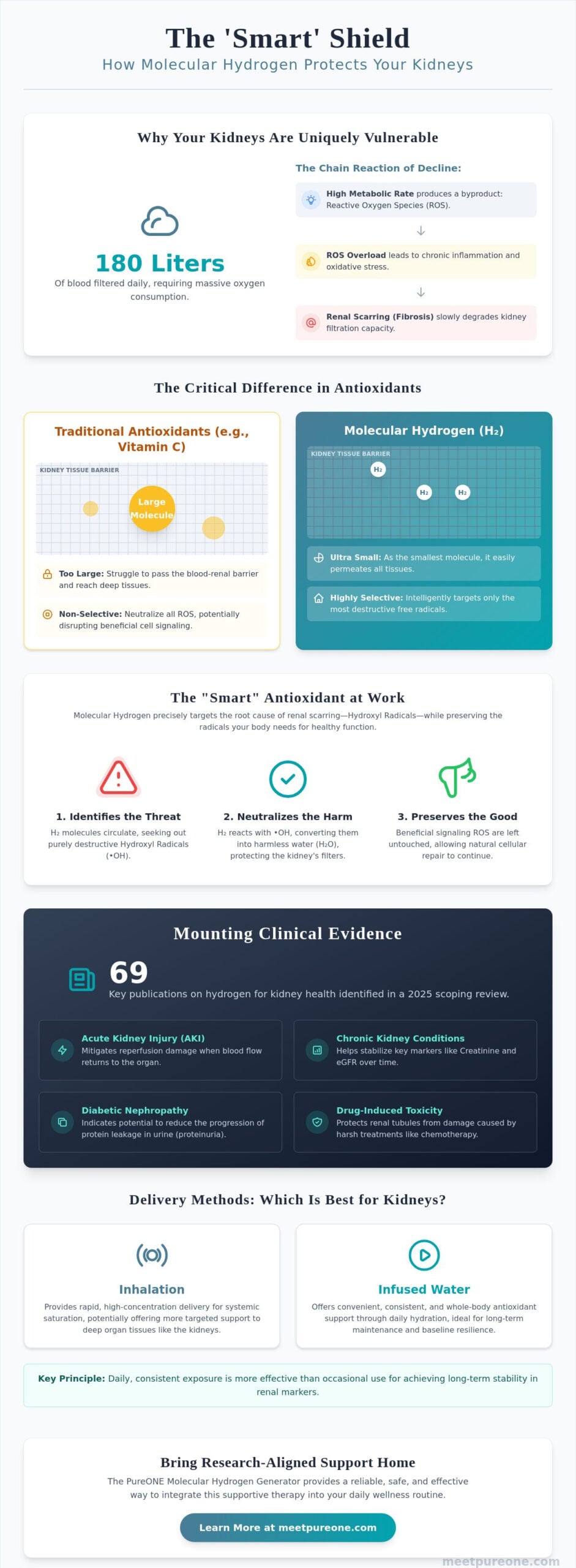
Why are your kidneys so prone to damage? Think of them as high-performance engines. They filter approximately 180 liters of blood every single day. This constant activity requires a massive amount of oxygen, which naturally creates reactive oxygen species (ROS) as a byproduct. While your body has built-in defenses, an overload of these molecules leads to chronic inflammation. This is the primary driver of renal scarring, or fibrosis, which slowly drags down your filtration rate. It’s a quiet process that often goes unnoticed until markers like creatinine begin to climb.
This is where the research into molecular hydrogen for kidney health offers a unique advantage. Hydrogen is the smallest molecule in existence. It can slip through the blood-renal barrier where other compounds get stuck. Most importantly, it’s a selective antioxidant. It doesn’t just neutralize everything; it targets the specific radicals that cause the most harm. This precision is vital for maintaining the delicate balance within your renal tissues.
The Role of Hydroxyl Radicals in Renal Decline
Not all free radicals are villains. Some act as essential signaling molecules that help your cells communicate. However, hydroxyl radicals are purely destructive. They attack the glomerular basement membrane, which is the “sieve” of your kidney. When this membrane is damaged, protein leaks into your urine and your total filtration capacity drops. Oxidative stress in the nephron occurs when the production of these reactive species overwhelms the kidney’s natural antioxidant capacity. Current research into Hydrogen therapy shows that H2 specifically seeks out these hydroxyl radicals while leaving the beneficial signaling molecules alone.
Why Traditional Antioxidants Often Fall Short
Have you ever wondered why taking extra Vitamin C doesn’t always show up in your kidney markers? Size is the main culprit. Large antioxidant molecules like Vitamin C or E struggle to reach the deep, oxygen-deprived tissues of the renal medulla. There’s also the problem of over-neutralization. If you wipe out all ROS, you might actually disrupt the very signaling pathways your kidneys use to repair themselves. To get a better handle on the basics, you can read our deep dive into What is Molecular Hydrogen? for more context. Hydrogen avoids these pitfalls by being small enough to go anywhere and “smart” enough to know when to stop.
Clinical Evidence: Hydrogen Therapy and Kidney Function
Does the research actually back up the hype? It’s a fair question. Scientific interest in molecular hydrogen for kidney health has surged recently. A 2025 scoping review identified 69 key publications on the topic, with research output peaking in 2019 and 2024. These studies move beyond the lab, focusing on how hydrogen gas interacts with the human body in real-world clinical settings. For instance, researchers are finding that hydrogen can significantly mitigate reperfusion damage in Acute Kidney Injury (AKI). It acts as a protective buffer during the critical moments when blood flow returns to the organ, preventing the sudden “burst” of oxidative damage that often follows.
The impact on long-term markers is where things get even more interesting. Clinical trials have monitored creatinine levels and glomerular filtration rate (eGFR) with promising results. By neutralizing the most aggressive free radicals, hydrogen helps stabilize these markers over time. This NIH review on hydrogen therapy for kidney disease provides a comprehensive look at how these biological effects support renal function. For those managing diabetic nephropathy, the focus is often on proteinuria. Research indicates that hydrogen may help reduce the progression of protein leakage in the urine, which is a vital goal for maintaining kidney integrity.
Case Study Insights: Renal Recovery in Elderly Patients
Elderly patients often face a steeper climb when it comes to renal stability. An In Vivo case report recently highlighted an elderly patient who saw improved renal markers and a significant reduction in daily fatigue after starting hydrogen therapy. The study suggests a synergistic effect. When used as a partner to conventional renal care, molecular hydrogen for kidney health helps the body maintain a more resilient baseline. The takeaway from these individual reports is clear. Daily, consistent exposure is more effective than occasional use for long-term stability.
H2 and the Prevention of Drug-Induced Kidney Toxicity
What about the kidneys’ response to harsh medical treatments? New research explores how hydrogen protects the delicate renal tubules from chemotherapy-induced damage, particularly from drugs like Cisplatin. It works by dampening the intense inflammatory response that typically follows these treatments. You can explore how hydrogen gas reduces internal inflammation to understand the deeper biological mechanics. If you’re ready to bring this level of support into your daily routine, the PureONE Molecular Hydrogen Generator offers a research-aligned way to get started at home.
Inhalation vs. Infused Water: Which Is Best for Your Kidneys?
Is it better to drink your hydrogen or breathe it? This is the most common question we hear from people exploring molecular hydrogen for kidney health. The answer depends on your specific goals. For general wellness, drinking hydrogen-infused water is an excellent habit. However, targeting deep-seated, high-metabolic organs like the kidneys requires a different approach. The kidneys benefit most from systemic saturation to effectively combat the oxidative stress that drives renal decline. While both methods have value, they play very different roles in a renal support protocol.
The primary challenge with water is physics. At standard pressure, the solubility of hydrogen in water is quite low, approximately 1.57 mg/L. To ingest enough hydrogen to match the doses used in clinical research, you would need to consume several liters of water daily. Recent papers on the Clinical applications of molecular hydrogen for kidney disease suggest that higher concentrations are often necessary for therapeutic impact. Inhalation sessions of 30 to 60 minutes allow the gas to reach a “therapeutic window” that water alone simply cannot achieve.
The Case for High-Concentration Inhalation
Why does inhalation offer an edge for renal support? It’s about the route of travel. Inhaled gas bypasses the digestive system entirely, moving from the lungs directly into the bloodstream for immediate vascular transport to the kidneys. Many advanced systems produce a mixture of 66% hydrogen and 33% oxygen. This blend, often called oxyhydrogen, supports cellular oxygenation while simultaneously delivering a massive dose of antioxidants. Gas inhalation provides a significantly higher total dose of molecular hydrogen than drinking infused water alone.
Practical Protocols for Renal Support at Home
How do you put this research into practice? We suggest a balanced approach. Drinking hydrogen water throughout the day helps maintain your baseline antioxidant “tone” and supports gut health. For targeted renal support, add a dedicated inhalation session in the morning or immediately following exercise. This is a similar strategy to the one we discuss regarding Molecular Hydrogen Benefits for Eyes, where microvascular health is the priority. By combining both modalities, you ensure your kidneys receive consistent, high-level protection.
Ready to start your own research-backed protocol at home? The PureONE Molecular Hydrogen Generator makes it simple to switch between high-concentration inhalation and daily infused water.
The PureONE Approach: Targeted Hydrogen Delivery for Wellness
How do you translate complex clinical research into a daily habit? It’s one thing to understand the benefits of molecular hydrogen for kidney health, but it’s another to have a reliable tool that delivers a research-aligned dose. The PureONE Molecular Hydrogen Generator was designed to fill that gap. It provides the consistent, high-concentration output necessary to reach the therapeutic window we’ve discussed. Whether you are focused on stabilizing creatinine levels or supporting long-term filtration, having a precise delivery system is the first step.
One of the biggest hurdles in home therapy is ensuring gas purity. We solved this with a proprietary stainless steel condenser. This component ensures the gas remains clean and dry, preventing the moisture buildup that can compromise other systems. This versatility allows you to switch seamlessly between inhalation for systemic renal support and water infusion for daily antioxidant maintenance. It’s a professional-grade solution built for the home environment.
Safety and Purity in Home Therapy
Why do we emphasize materials so much? Low-grade components can leach heavy metals into the gas stream, which is exactly what you want to avoid when protecting your kidneys. PureONE is built with rigorous quality standards and Canadian manufacturing to ensure safety. We believe in the science, but we also believe in your personal discovery. That’s why we offer a 365-day risk-free trial. We encourage you to track your own lab results, like eGFR and creatinine, during this period. It’s the ultimate way to validate the logic for your own body.
A Holistic View of Cellular Health
Your kidneys are central to your overall vitality. When you support renal function, you’re also helping your body manage blood pressure and maintain steady energy levels. It’s a foundational approach to wellness. Better filtration often leads to improved skin vitality and a stronger sense of daily resilience. If you’re ready to take a proactive step, explore the PureONE Molecular Hydrogen Generator to start your renal support journey today.
Taking Control of Your Renal Future
The science is clear. Your kidneys don’t have to be at the mercy of oxidative stress. We’ve explored how the smallest molecule in existence can navigate the blood-renal barrier. It protects delicate tissues from destructive hydroxyl radicals. By choosing high-concentration inhalation, you provide the systemic saturation that research suggests is vital for long-term stability. It’s a proactive way to support your body’s natural filters.
Bringing molecular hydrogen for kidney health into your home shouldn’t be intimidating. It’s about consistent, research-aligned support. Our systems are manufactured in Canada with medical-grade components to ensure the highest purity. Even Howie Mandel trusts our approach to wellness. Investing in preventative health at home is a simple, common-sense shift that puts the power back in your hands.
Ready to see the difference? You can invest in your renal health with the PureONE Molecular Hydrogen Generator today. With our 365-day risk-free trial, you have a full year to track your own lab markers. Feel the impact on your daily energy. You are your own best advocate. We are here to provide the tools for your journey toward better living.
Frequently Asked Questions
Can molecular hydrogen therapy replace my kidney medication?
No, molecular hydrogen is a supportive wellness tool and should never replace medications prescribed by your doctor. It acts as a partner to your current renal care by addressing oxidative stress at a cellular level. Think of it as a supplemental layer of protection. Always talk to your nephrologist before making any changes to your medical regimen.
How long does it take to see improvements in kidney markers like creatinine?
You should expect a gradual process rather than an overnight fix. Clinical findings suggest that markers like creatinine and eGFR typically show stability or improvement after several weeks of consistent daily use. It’s a marathon, not a sprint. We always recommend keeping a detailed log of your lab results to track your progress over three to six months.
Is hydrogen inhalation safe for patients already on dialysis?
Research originating from Asia, particularly Japan, has shown that hydrogen inhalation is safe for those on dialysis. It can even help mitigate the inflammation often triggered during the filtration process. Still, your dialysis center needs to be in the loop. They can help you monitor how the therapy integrates with your specific treatment schedule.
Do I need to drink hydrogen water or inhale the gas for the best kidney results?
For the most significant impact on renal tissues, inhalation is the preferred method. While drinking infused water is a great daily habit, inhalation sessions of 30 to 60 minutes allow for the systemic saturation required to reach the kidneys. Combining both methods is often the most effective way to utilize molecular hydrogen for kidney health.
Are there any side effects of using molecular hydrogen for renal health?
Molecular hydrogen is widely considered to have an exceptional safety profile. It has no known toxicity and is naturally produced by your gut bacteria in small amounts. The FDA has even granted it “Generally Recognized as Safe” (GRAS) status for use in water. It’s a gentle, non-invasive way to support your renal health without the risk of heavy side effects.
How does hydrogen therapy compare to other renal supplements like CoQ10?
It comes down to size and precision. Most renal supplements, like CoQ10 or Vitamin E, are large molecules that struggle to reach the oxygen-deprived tissues of the renal medulla. Hydrogen is small enough to go anywhere. It also selectively targets only the most destructive radicals, whereas some traditional supplements can over-neutralize the “good” free radicals your body needs for signaling. For a broader perspective on building a proactive wellness strategy, explore the 2026 shift toward investing in preventative health at home and how research-backed tools are transforming long-term cellular resilience.
Disclaimer
The information provided by Pureffect and any of its products are for educational and informational purposes only and is not intended as medical advice. Individual results may vary, and no specific health outcomes are guaranteed. Always consult a qualified healthcare professional before starting any wellness practice or product.