
That deep, restrictive ache forty-eight hours after a heavy lifting session isn’t caused by lactic acid. It’s actually a Type 1b structural muscle disorder known as Delayed Onset Muscle Soreness (DOMS). Does it feel like your progress is stalled because you’re constantly waiting for your body to catch up? You aren’t alone. Most athletes struggle with the frustration of slow recovery times and the conflicting advice surrounding ice, heat, or NSAIDs. We understand that you want to stay consistent without the debilitating pain. This guide explores the most effective methods for reducing muscle soreness after workout by targeting inflammation where it starts: at the cellular level.
You’ll discover why high doses of Vitamin C might actually be sabotaging your mitochondrial growth and how selective molecules like hydrogen can lower serum creatine kinase levels by nearly 18 percent. Why settle for passive rest when you can actively accelerate tissue repair? We are going to break down the latest findings from the German Journal of Sports Medicine and recent trials in Frontiers in Physiology. By the end, you will have a clear, science-backed roadmap to faster turnarounds and better performance. Ready to see what your recovery is actually capable of?
Key Takeaways
- Learn why peak pain occurs 24 to 72 hours post-exercise and why the “lactic acid” theory is actually a myth.
- Discover why traditional high-dose antioxidants might stunt your progress and how selective redox modulators offer a smarter path to recovery.
- Master the science of active recovery to improve blood flow and accelerate the process of reducing muscle soreness after workout.
- Explore how molecular hydrogen acts as a high-tech tool to neutralize cytotoxic radicals without blunting your body’s natural training adaptations.
- Review clinical evidence showing how H2 preserves explosive power and lowers markers of muscle membrane leakage.
What is DOMS? Understanding Why Your Muscles Hurt
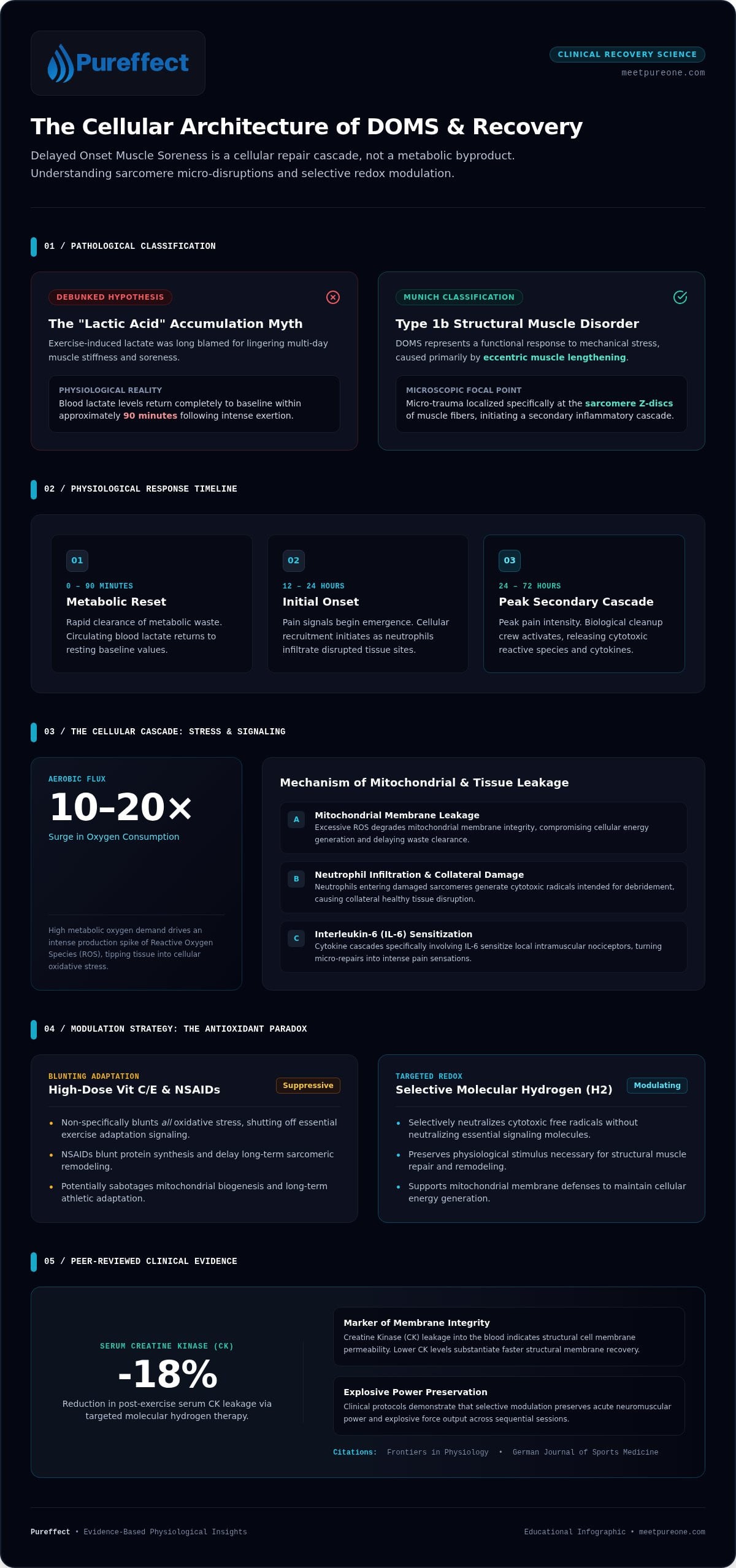
Ever wonder why your legs feel fine right after a run but turn into lead two days later? It isn’t lactic acid. Science has thoroughly debunked that old myth. Blood lactate levels actually return to baseline within about 90 minutes of finishing your session. The true culprit is delayed onset muscle soreness (DOMS). Clinically, this is classified under the Munich Muscle Injury Classification as a Type 1b structural muscle disorder. It’s a functional response to mechanical stress, not a metabolic byproduct. Understanding this shift in perspective is the first step toward reducing muscle soreness after workout effectively.
When you train, you create microscopic disruptions at the sarcomere Z-discs of your muscle fibers. This micro-trauma isn’t a “tear” in the sense of a clinical injury. Instead, it triggers a complex repair cycle. Pain typically starts 12 to 24 hours later. It reaches peak intensity between 24 and 72 hours as your body initiates a secondary inflammatory cascade. This is the biological “cleanup crew” at work.
The Role of Eccentric Loading
Eccentric movements occur when your muscle lengthens under tension. Think of the lowering phase of a bicep curl or the repetitive impact of downhill running. Research consistently shows these actions cause the most significant sarcomeric disruption. While this “good” soreness indicates you’ve challenged your tissues, it’s different from the sharp, immediate pain of a Type 3 or 4 structural tear. Knowing the difference helps you decide when to push and when to pivot your strategy for reducing muscle soreness after workout.
Why Inflammation is Both Friend and Foe
You need inflammation. It’s the signal that tells your body to repair and grow stronger. Without this response, your muscles wouldn’t adapt to the stress of training. However, when neutrophils infiltrate the tissue, they release cytotoxic reactive species that can cause collateral damage. This is where the pain becomes a hurdle. The goal isn’t to kill the inflammation entirely with NSAIDs, which can actually blunt protein synthesis and delay remodeling. Instead, we want to modulate the response. We want to keep you moving without stopping the growth.
The Cellular Fight: Oxidative Stress and Recovery
When you exercise, your oxygen consumption increases ten to twenty times above your resting rate. This surge provides the power you need, but it also triggers the production of Reactive Oxygen Species (ROS). These are highly reactive molecules that can damage cellular structures if they aren’t managed by your body’s defenses. Oxidative stress is an imbalance between free radicals and antioxidants. When this balance tips too far, your body struggles with reducing muscle soreness after workout, leading to longer gaps between your training sessions.
This oxidative stress specifically targets your mitochondrial membranes. Think of mitochondria as the engines of your muscle cells. When ROS levels spike, these engines can suffer from “mitochondrial leakage,” where they lose the ability to produce energy efficiently. This doesn’t just make you feel tired. It triggers a cytokine response, specifically involving signaling molecules like interleukin-6 (IL-6). These cytokines sensitize your pain receptors, turning a minor structural repair into a noticeable ache. It’s a complex internal battle that dictates how quickly you can get back to your peak performance.
Mitochondrial Health and Muscle Fatigue
Healthy mitochondria do more than just provide power. They act as the cellular cleanup crew, helping to clear metabolic waste after intense exertion. If your mitochondria are compromised by exercise-induced stress, that waste sticks around longer and delays the repair process. This is why focusing on increasing cellular energy is one of the most overlooked aspects of athletic recovery. When your “engines” are optimized, your body processes the damage of a hard session much faster.
The Antioxidant Defense System
Your body has its own internal system to neutralize free radicals. However, many athletes try to speed this up with high-dose Vitamin C or E supplements. While it sounds logical, research suggests this might be counterproductive. A systematic review on post-exercise recovery techniques highlights that blunting all oxidative stress can actually stop the signaling your muscles need to grow. You don’t want to eliminate the stress; you want to manage it selectively. This selective approach is the key to reducing muscle soreness after workout without losing your hard-earned gains. Using a tool like a molecular hydrogen generator helps target the most harmful radicals without interfering with the beneficial signals your body needs for long-term adaptation.
Evidence-Based Strategies for Reducing Muscle Soreness
Recovery isn’t a passive event. While it’s tempting to spend your rest day completely stationary, science suggests a more proactive approach. Sleep remains your primary recovery tool. It’s during deep sleep that your body releases the majority of its growth hormone to repair the micro-trauma in your muscle fibers. Without seven to nine hours of quality rest, your cellular repair cycle simply can’t keep up. But what about the hours you’re awake? This is where the “Active Recovery” paradox comes in. Low-intensity movement, like a light walk or swimming, increases blood flow to damaged tissues without adding further mechanical stress. This movement helps flush out metabolic byproducts far more effectively than total inactivity.
We also have to consider mechanical aids. Compression garments and percussive therapy are popular for a reason. They help move lymphatic fluid and can reduce the subjective perception of pain. In fact, clinical research on molecular hydrogen and muscle recovery shows that combining physical tools with biochemical support can significantly lower markers of muscle damage. One 2024 study on elite athletes found that serum creatine kinase levels, a key marker of muscle membrane leakage, stayed significantly lower in treated groups compared to those using a placebo. This data confirms that reducing muscle soreness after workout requires a multi-pronged attack on both physical and chemical fronts.
Nutrition and Hydration for Tissue Repair
Novel Recovery Modalities
Are ice baths still the gold standard? Recent research into contrast therapy suggests that alternating between heat and cold may be more effective for boosting circulation than cold alone. Myofascial release, through foam rolling or massage, also helps by improving blood flow to damaged tissues. If you’re looking for deeper cellular support, you might want to compare how different technologies stack up. Take a look at our breakdown of hydrogen therapy vs. infrared sauna to see which science-backed method fits your routine. Ready to take control of your recovery? You can start by using the PureONE Molecular Hydrogen Generator to support your body at the cellular level.
Molecular Hydrogen: A New Frontier in Athletic Recovery
Molecular hydrogen (H2) is the smallest known molecule in the universe. This tiny size is its greatest advantage. Because it’s so small and non-polar, it can passively diffuse through cell membranes and reach the mitochondria and nuclei directly. Most bulkier antioxidants struggle to penetrate these deep cellular compartments. By reaching the source of oxidative stress, H2 provides a unique advantage for reducing muscle soreness after workout without the downsides of traditional supplements.
What makes H2 truly disruptive is its selectivity. As we discussed earlier, some inflammation is necessary for growth. Unlike Vitamin C or E, which can blunt your training adaptations, H2 acts as a selective redox modulator. It targets only the most cytotoxic radicals, like the hydroxyl radical, while preserving the beneficial signaling molecules your muscles need to recover and grow. It’s the difference between using a sledgehammer and a scalpel. You aren’t just shutting down the body’s response; you’re refining it.
The Science of Hydrogen Inhalation for Athletes
Inhalation is one of the most efficient ways to deliver H2 systemically. Recent clinical research on hydrogen therapy for athletes shows remarkable results. In a 2024 double-blind trial, athletes who used molecular hydrogen saw serum creatine kinase levels stay at 156 U/L compared to 190 U/L in the placebo group. This indicates significantly less muscle membrane leakage. Subjective pain was also lower, with treated groups reporting a soreness score of 34 mm versus 42 mm on a standard scale. This isn’t just about feeling better. It’s about preserving explosive power for your next session.
Integrating PureONE into Your Recovery Routine
The PureONE Molecular Hydrogen Generator brings this professional-grade science into your home. It produces a precise mixture of 66% hydrogen and 33% oxygen, which is designed for optimal therapeutic delivery. To get the best results, you should aim for the “golden window” immediately following your training. The device offers four distinct therapeutic modes to fit your lifestyle, including inhalation for systemic recovery and hydrogen water for cellular hydration.
Consistency is the secret to reducing muscle soreness after workout. By making H2 a daily part of your cool-down, you’re providing your body with the cellular support it needs to bounce back faster. It’s a simple, evidence-based addition that turns your rest days into active repair days. We invite you to explore the logic and see how this small molecule can make a big difference in your training longevity.
Take Control of Your Recovery Journey
You now have a clearer understanding of the biological mechanisms that drive your post-training pain. Recovery isn’t about waiting for the ache to fade; it’s about providing your cells with the right tools to rebuild. By targeting oxidative stress selectively and prioritizing sleep, you are no longer at the mercy of a slow repair cycle. Reducing muscle soreness after workout becomes a predictable process rather than a guessing game. Why let a heavy leg day sideline you for a week when the science of rapid recovery is within reach?
Are you ready to apply these scientific findings to your own routine? The PureONE Molecular Hydrogen Generator offers professional-grade 66/33 hydrogen-oxygen output to support your tissues at the mitochondrial level. It’s a home-based tool endorsed by wellness experts for its ability to manage inflammation without blunting your hard-earned gains. With our 365-day risk-free trial, you can verify the logic and the results for yourself.
Experience rapid recovery with the PureONE Molecular Hydrogen Generator and get back to the training you love sooner. Your body is capable of incredible things. We are just here to help you unlock that potential.
Frequently Asked Questions
Is it better to use ice or heat for muscle soreness?
It depends on the timing. Ice is usually reserved for the first 24 hours to manage acute swelling, while heat is better for increasing blood flow to stiff tissues later on. However, current research suggests that contrast therapy, which is alternating both, is often more effective for circulation. This method helps pump blood through the damaged area. It accelerates the removal of metabolic byproducts and supports the natural repair of micro-trauma.
Can I workout if I am still sore from my last session?
Yes, you can usually train through mild soreness. In fact, low-intensity movement is a cornerstone of active recovery. If the pain is typical DOMS, classified as a Type 1b disorder, light exercise can actually improve blood flow and ease discomfort. However, if your range of motion is severely limited or the pain is sharp rather than aching, it’s safer to pivot to a different muscle group to avoid a serious structural injury.
How long does Delayed Onset Muscle Soreness (DOMS) typically last?
Delayed Onset Muscle Soreness characteristically manifests between 12 to 24 hours after exercise. According to the German Journal of Sports Medicine, peak subjective discomfort and functional impairment usually occur between 24 and 72 hours. While the most intense phase is relatively short, it typically takes 5 to 7 days for the muscle tissue to resolve the inflammatory cascade and return to its baseline state completely.
Do BCAAs actually help with reducing muscle soreness?
BCAAs, particularly leucine, play a role in protein synthesis and repairing micro-tears in muscle fibers. While they provide the building blocks for repair, they don’t address the oxidative stress that drives the inflammatory pain. For a more comprehensive approach to reducing muscle soreness after workout, many athletes combine amino acids with selective antioxidants like molecular hydrogen to target both the structural damage and the chemical signaling that causes pain.
What is the fastest way to get rid of muscle soreness?
The fastest approach is a multi-modal strategy. Prioritize 7 to 9 hours of sleep for growth hormone release and use active recovery to maintain circulation. Adding molecular hydrogen inhalation has been shown to lower markers of muscle damage, such as creatine kinase, by nearly 18 percent. This combination addresses the structural, inflammatory, and oxidative components of soreness simultaneously. It allows for a much faster turnaround for reducing muscle soreness after workout.
Is molecular hydrogen therapy safe to use every day after exercise?
Yes, molecular hydrogen is recognized by the FDA as Generally Recognized As Safe (GRAS). It’s a non-toxic gas that doesn’t build up in the body. The PureONE generator produces a consistent 66% hydrogen and 33% oxygen mixture, which is designed for safe, daily therapeutic use. Many athletes use it during their post-workout golden window to manage inflammation and support mitochondrial health without the risks associated with non-selective antioxidants.
Disclaimer
The information provided by Pureffect and any of its products are for educational and informational purposes only and is not intended as medical advice. Individual results may vary, and no specific health outcomes are guaranteed. Always consult a qualified healthcare professional before starting any wellness practice or product.