
What if the most reliable natural support for age-related memory loss isn’t a supplement? Everyday habits are a practical starting point, while new therapies and products can sound more certain than the evidence allows. That distinction matters when you’re trying to support your brain health and make sense of a change you’ve noticed.
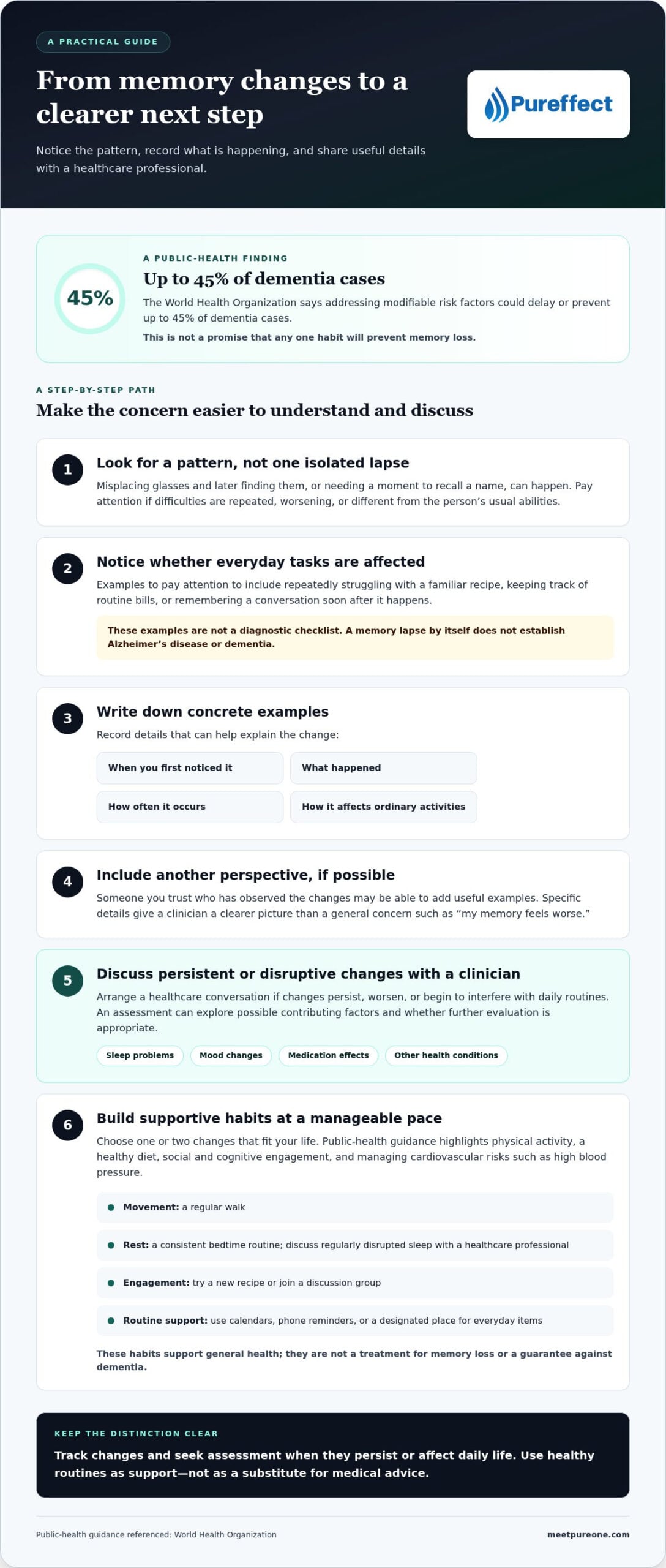
It’s understandable to wonder whether forgetting a name or misplacing your keys is a normal part of aging or a reason to seek help. Occasional lapses can happen, but changes that disrupt daily life deserve attention. The World Health Organization’s July 2026 guidance says addressing modifiable risk factors could delay or prevent up to 45% of dementia cases. That’s encouraging, but it isn’t a promise that any one habit can prevent memory loss.
This article separates practical steps from hopeful claims. You’ll learn which everyday habits have evidence for supporting cognitive health, how to interpret supplement and hydrogen research, and what changes to discuss with a healthcare professional. The goal is a clear next step, not a quick fix.
Key Takeaways
- Learn how to distinguish occasional forgetfulness from changes that may warrant a medical assessment.
- Explore practical habits that support cognitive health without promising to prevent or reverse memory loss.
- See how to assess supplement and hydrogen claims by considering the type and limits of the evidence.
- Use a balanced next-step plan for natural support for age-related memory loss, from tracking changes to weighing wellness options thoughtfully.
Age-related memory loss: what can be normal, and what deserves attention?
Forgetting something now and then can happen at any age, and memory may feel less quick with age. You might misplace your glasses, retrace your steps, and find them. A name may take a moment to come back. A lapse like this, by itself, doesn’t show that something serious is happening.
How does ordinary forgetfulness differ from a concerning change?
Look at the pattern, not one isolated moment. Occasional slips are different from repeated, worsening difficulty with familiar tasks or conversations. For example, someone might repeatedly struggle to follow a familiar recipe, keep track of routine bills, or remember a conversation soon after it happens. These examples aren’t a diagnostic checklist. They’re reasons to pay attention if they represent a change from the person’s usual abilities. A general overview of memory changes is available in Memory loss on Wikipedia.
Memory lapses alone do not establish Alzheimer’s disease. Memory concerns can have multiple possible causes, including sleep problems, mood changes, medication effects, or other health conditions. A symptom list can’t identify the cause, and a single forgotten word or misplaced item can’t diagnose dementia. Consider how often the changes happen, whether they’re getting worse, and whether they affect everyday independence.
When should someone discuss memory changes with a clinician?
Arrange a healthcare conversation if changes persist, worsen, or begin to interfere with daily routines. An assessment can help explore possible contributing factors and whether further evaluation is appropriate. That’s a more useful first step than trying to label the change at home.
Prepare a few concrete examples. Note when you first noticed the changes, what happened, how often it occurs, and how it affects ordinary activities. If possible, bring someone you trust who has observed the changes. Specific details give the clinician a clearer picture than a general concern such as “my memory feels worse.”
Natural support for age-related memory loss can include habits that support overall health, but those habits shouldn’t replace assessment when memory changes persist or affect independence. Start by noticing the pattern, then share it with a healthcare professional.
Which everyday habits have evidence for supporting cognitive health?
There’s no single routine that guarantees a sharper memory. Habits that support physical and overall health are sensible foundations for cognitive health, too. The World Health Organization’s 2026 guidance emphasizes physical activity, a healthy diet, social and cognitive engagement, and managing cardiovascular risks such as high blood pressure. Mayo Clinic also recommends regular exercise, adequate sleep, social connection, and keeping the mind active. These are practical recommendations, not proof that one habit can prevent dementia or restore lost memory.
Which daily routines are practical places to start?
Choose a change small enough to keep going. A regular walk, a consistent bedtime routine, or a weekly shared activity may be easier to sustain than a complete lifestyle overhaul. For mental engagement, pick something that requires attention or learning, such as trying a new recipe or joining a discussion group. Calendars, phone reminders, and a designated place for everyday items can also make routine tasks easier to manage.
Pick one or two changes that fit your life, then build from there. A manageable routine is more useful than an ambitious plan that quickly falls away. Sleep belongs in that picture, too. If rest is regularly disrupted, discuss it with a healthcare professional rather than assuming poor sleep is simply part of getting older.
How should readers interpret lifestyle research?
Evidence needs context. If research finds that people who exercise or stay socially engaged have better health outcomes, that association alone doesn’t prove the habit caused the difference. Studies may vary in who took part, how habits were measured, and which outcomes were tracked. Public-health guidance brings findings together to recommend broadly supportive behaviors, but it can’t predict an individual person’s results.
Sustainable habits can support general cognitive health, but they aren’t a treatment for memory loss. Choose routines for their overall health value, without expecting any one walk, puzzle, or sleep schedule to prevent age-related memory loss. Natural support for age-related memory loss starts with practical steps that fit your life, alongside medical advice when concerns persist or affect daily activities.
Do supplements or hydrogen help memory? Judging evidence
A promising idea isn’t the same as a proven treatment. To assess a claim, ask what kind of research supports it, who took part, what outcome was measured, and what the study couldn’t establish. The examples below show why those details matter.
| Evidence | What was reported | Key limitation |
|---|---|---|
| WHO guidance on vitamins B and E, and omega-3 | The World Health Organization advises against using these supplements to prevent dementia unless a deficiency is diagnosed. | This is prevention guidance, not advice to stop a supplement prescribed for a diagnosed deficiency or another medical reason. |
| Vitamin D study, published in Sleep Medicine in August 2026 | Older adults with mild cognitive impairment and sleep problems who took at least 5,000 IU daily scored over 13% higher on a cognitive test than those who took none. | The result applies to a specific group. The information available here doesn’t establish that vitamin D improves memory for older adults generally or prevents dementia; other 2026 findings have raised concerns about supplementation in people with normal vitamin D levels. |
| Hydrogen-rich water review, October 2026 | A narrative review in the Hoa Binh University Journal of Science and Technology discussed small, short-term human trials reporting possible cognitive improvement. | The review called for larger, longer trials. It doesn’t establish a benefit for age-related memory loss or dementia. |
What does research on herbs and memory actually show?
A 2021 review of herbs proposed for neuroprotective effects is a starting point for questions, not proof that herbs improve memory in people. Reviews may include human trials alongside animal experiments, laboratory findings, and theoretical explanations. These types of evidence aren’t interchangeable. Before trying an herb or supplement, discuss it with a qualified healthcare professional, especially if you take medication or have a health condition. For broader context on hydrogen research, see this molecular hydrogen research overview.
What is known about molecular hydrogen and cognitive health?
Proposed biological mechanisms can help researchers decide what to study, but they don’t demonstrate improved memory in people. The human evidence summarized above is preliminary, and molecular hydrogen is not established as a treatment for memory loss or dementia. PureONE is an optional wellness device, not a memory-loss treatment. If you’re curious, review the PureONE device details with that distinction in mind. Natural support for age-related memory loss should be judged by evidence, not possibility alone.
A balanced next-step plan for memory concerns and optional wellness support
Before choosing a wellness option, be clear about what you want it to do. Are you looking for a routine that fits your day, or hoping a product will change a memory problem? Those are different goals. A wellness choice can sit alongside clinical care, but it shouldn’t replace assessment or treatment recommended by a healthcare professional.
What can readers do this week?
Use the questions you’ve gathered to make your next healthcare conversation more focused. Ask what kinds of changes deserve follow-up, whether any current health factors could affect memory, and how you’ll know if the plan needs revisiting. For any option you’re considering, write down what it claims to do and what evidence would meaningfully support that claim. This keeps the decision grounded in your needs rather than in a persuasive promise.
How can PureONE fit without overstating the evidence?
PureONE is an optional home wellness device, not an established way to prevent, treat, or reverse memory loss, Alzheimer’s disease, or dementia. Its four use modes are drinking hydrogen-infused water, applying that water to the skin, applying gas directly to the body, and inhaling the gas. The device produces a mixed-gas stream of approximately 66% molecular hydrogen and 33% oxygen. These features describe how the product is used, not a proven cognitive benefit.
If you’re interested in the device for general wellness, review the PureONE product details and consider whether its uses align with your preferences. PureONE offers a 365-day money-back guarantee for the machine after a year of use. Shipping costs aren’t refundable.
Natural support for age-related memory loss is best considered with realistic expectations. Keep wellness choices optional, and let evidence guide what you expect from them.
Choose your next step with confidence
There’s no need to find one perfect answer. Stay curious and set your own standard for what counts as convincing evidence. That can make choices about natural support for age-related memory loss feel less driven by bold claims and more connected to what matters to you.
If you’re exploring a wellness device for general use, consider whether its features suit your preferences. Explore PureONE’s features and make an informed choice at your own pace.
Small, thoughtful decisions add up. Keep asking good questions, and let your confidence grow with what you learn.
Frequently Asked Questions
Is memory loss a normal part of aging?
Some forgetfulness can occur with age, but a change in memory isn’t automatically explained by aging. Consider whether a lapse is occasional or becoming a pattern, and whether the person can still manage their usual responsibilities. Memory symptoms alone can’t identify a cause or establish Alzheimer’s disease. If the change affects daily life, share concrete examples with a healthcare professional rather than trying to interpret them from a symptom list.
Can natural approaches reverse age-related memory loss?
No natural approach should be presented as a reliable way to reverse memory loss. Physical activity, restorative sleep, and social engagement can support general health, but their effects vary and shouldn’t be treated as a substitute for medical care. It may help to define a realistic goal, such as keeping a routine that supports wellbeing, rather than expecting a specific memory improvement. Persistent or disruptive changes still merit professional assessment.
What happens if memory problems are caused by something other than aging?
Different factors can affect memory, and a healthcare professional can determine what evaluation or follow-up may be appropriate. At home, focus on describing what you’ve noticed rather than trying to identify the cause. Note whether the change appeared gradually or suddenly, whether it varies from day to day, and which activities have become harder. Bring an up-to-date list of medicines and supplements to the appointment.
Do herbal supplements improve memory in older adults?
Does molecular hydrogen treat age-related memory loss?
No. PureONE is not established as a treatment for memory loss, Alzheimer’s disease, or dementia. When assessing a hydrogen claim, look for human studies that directly test memory or cognition, rather than relying on laboratory mechanisms or indirect measures. Even an early positive result doesn’t show that a wellness product will produce the same outcome. Treat PureONE as an optional wellness device, not as a proven memory intervention.
When should I seek medical advice about memory changes?
Arrange a healthcare conversation if memory changes persist, worsen, or make familiar activities harder. Beforehand, write down a few examples and when they occurred. If someone close to you has noticed a change, their observations may also be useful. You can ask what the assessment involves and what follow-up makes sense. Seeking an evaluation is a way to understand the concern, not proof that a person has dementia.
Disclaimer
The information provided by Pureffect and any of its products are for educational and informational purposes only and is not intended as medical advice. Individual results may vary, and no specific health outcomes are guaranteed. Always consult a qualified healthcare professional before starting any wellness practice or product.