
Did you know that by 2040, an estimated 78 million U.S. adults will be living with arthritis? If you spend the first hour of every morning waiting for your knees or hands to “unfreeze,” you aren’t alone. It’s exhausting to worry about losing your independence just because your range of motion feels locked away. You’ve likely tried various home remedies for joint stiffness only to be met with conflicting advice or products that don’t deliver. We understand that frustration. It’s why we’re looking at the hard data instead of the hype.
Are you ready to stop guessing and start moving? This guide explores the latest medical research to help you restore your mobility naturally. We’ll dive into the April 2026 FDA warnings about hidden drugs in common supplements and explain why the 2024 Behavioral Risk Factor Surveillance System showed such high rates of activity limitation. You’ll also learn how the PureONE Molecular Hydrogen Generator fits into a research-driven strategy to manage joint health. By the end, you’ll have a clear, science-backed plan to reduce morning stiffness and reclaim your daily life. Let’s look at what the research actually says.
What You’ll Discover
- The “Gelling” Phenomenon: Understand why your joints feel locked in the morning and how synovial lubrication actually works.
- Evidence-Based Nutrition: Why the specific pairing of curcumin and piperine is essential for modulating inflammatory markers.
- The 66/33 Breakthrough: A review of 2026 research on why a specific hydrogen-to-oxygen ratio supports cellular recovery without oxidative rebound.
- Validated Home Remedies for Joint Stiffness: How to navigate the 2026 FDA warnings to find safe, research-driven relief.
- The 2026 Mobility Protocol: A step-by-step guide to integrating the PureONE Molecular Hydrogen Generator into your daily routine for better range of motion.
Why Do Joints Get Stiff? The Biological Root of the Morning Creak
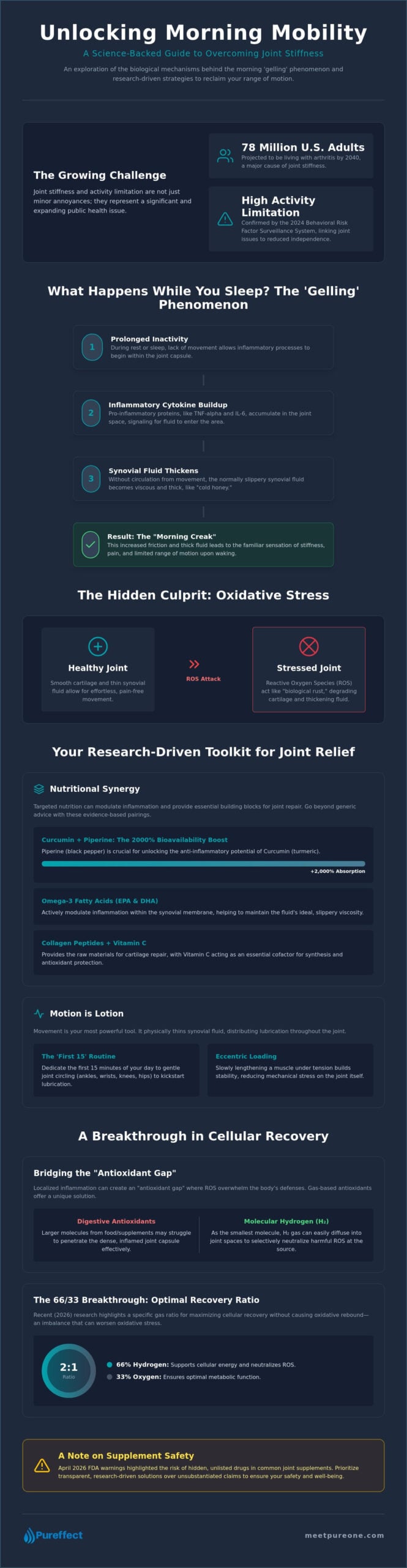
Ever wonder why your knees feel like they’re filled with sand first thing in the morning? That sensation of Joint stiffness isn’t just a random annoyance. It’s a specific biological event. When you’re still for hours, your body’s “Inflammatory Clock” takes over. Pro-inflammatory cytokines, specifically TNF-alpha and IL-6, begin to accumulate in the joint space. These proteins act like a cellular alarm system. They signal for more fluid to enter the area, but without movement, that fluid doesn’t circulate. This is why searching for effective home remedies for joint stiffness usually starts with understanding this morning “creak.”
This “gelling phenomenon” occurs because your joints are essentially sealed chambers. When you stop moving, the friction between synovial membranes increases. Think of it like a door hinge that hasn’t been oiled in years. The biological “rust” is real, and it’s driven by a process called oxidative stress.
The Role of Oxidative Stress in Joint Health
Reactive Oxygen Species (ROS) are the primary culprits behind cartilage wear. Think of ROS as biological “rust.” These unstable molecules attack the cells within your joints, leading to synovial thickening and cartilage degradation. This damage isn’t just local. It’s often a sign of systemic inflammation. Building cellular resilience is your best defense. By neutralizing these ROS, you protect the delicate tissues that keep your joints gliding smoothly. Research shows that high levels of oxidative markers directly correlate with the severity of morning stiffness. Interestingly, the same systemic oxidative stress that drives joint inflammation has also been linked to skin conditions, as explored in research on managing rosacea symptoms from within, suggesting that internal antioxidant support benefits multiple body systems simultaneously.
Synovial Fluid: Your Joints Inner Lubricant
Your joints rely on synovial fluid, a substance with fascinating “non-Newtonian” properties. What does that mean? It means the fluid changes thickness based on how much you move. When you’re sleeping, it thickens. It becomes viscous, almost like cold honey. This is the gelling phenomenon. As soon as you start moving, the fluid thins out and lubricates the surfaces. Hydration plays a massive role here. If you’re dehydrated, that fluid stays thick and sticky. Every step feels like a chore. “Motion is lotion” isn’t just a catchy phrase. It’s a physiological reality. To keep that lubricant thin and effective, you need both consistent movement and proper cellular hydration.
Evidence-Based Dietary and Lifestyle Foundations
How often do you hear “just eat better” as a solution for your aching knees? It’s vague and often unhelpful. When looking for effective home remedies for joint stiffness, you need specific, research-backed interventions. For instance, the synergy between curcumin and piperine is well-documented. Curcumin, the active compound in turmeric, is notoriously difficult for the body to absorb. However, adding piperine (black pepper extract) can increase its bioavailability by up to 2,000%. This combination specifically targets pro-inflammatory cytokines like IL-6, which we previously identified as a primary driver of morning tightness.
Omega-3 fatty acids are another heavy hitter in your kitchen. EPA and DHA don’t just support heart health; they actively modulate the inflammatory response within the synovial membrane. This helps maintain the fluid’s ideal viscosity so your joints don’t “gel” as quickly during rest. Even with a perfect diet, you might face an “Antioxidant Gap.” This happens when localized reactive oxygen species (ROS) in the joint space are too concentrated for digestive antioxidants to reach effectively. Bridging this gap requires a multi-modal approach, often involving home remedies for stiff joints that address cellular health from the inside out. Research published in early 2026 confirms that a lower dietary antioxidant capacity is a common thread across multiple inflammatory conditions, a finding also central to managing rosacea symptoms from within, reinforcing why internal antioxidant strategies matter for whole-body health.
Nutritional Interventions for Cartilage Support
Cartilage doesn’t have its own blood supply, making it hard to “feed.” Research into collagen peptides suggests they can accumulate in cartilage tissue, providing the raw materials needed for cellular repair. Don’t forget to pair your collagen with Vitamin C. It’s a necessary cofactor for collagen synthesis and offers an extra layer of antioxidant protection. You might also explore the science of molecular hydrogen. As a gas-based antioxidant, it can diffuse into joint spaces that larger molecules might miss. The same selective antioxidant properties that make molecular hydrogen effective for joint tissue have also shown promise in oral health, as detailed in this guide to hydrogen therapy for dental health, where it targets oxidative stress in gum tissue without disrupting the oral microbiome.
Motion is Lotion: Targeted Movement Strategies
Movement is your most effective tool for redistributing synovial fluid. Research into eccentric loading, where you slowly lengthen a muscle under tension, shows significant benefits for joint stability. Try a “First 15” routine of gentle joint circling every morning. This physical movement triggers the release of natural lubricants. It’s also vital to focus on mitochondrial health. When your cellular engines are running well, the muscles surrounding your joints provide better support, reducing the mechanical stress on the bone. For a comprehensive recovery plan, consider how a PureONE Molecular Hydrogen Generator can support this process at a cellular level.
Advanced Home Therapies: Molecular Hydrogen and Thermal Regulation
While diet and basic movement are essential foundations, sometimes the “morning creak” needs a more targeted approach. Have you considered the potential of molecular hydrogen? It’s gaining traction in 2026 research as one of the more sophisticated home remedies for joint stiffness. Specifically, studies focusing on rheumatoid markers have shown that H2 inhalation can significantly lower oxidative stress within the joint capsule. This is a game-changer for those who find that topical creams only provide fleeting relief. Why is inhalation different? It’s about systemic penetration. Those dealing with widespread pain conditions like fibromyalgia may find similar cellular-level benefits, as detailed in this guide to managing fibromyalgia symptoms naturally, where oxidative stress is also identified as a key driver of chronic discomfort.
A specific breakthrough in 2026 research highlights the importance of the “66/33 Ratio.” This is a mixture of 66% hydrogen and 33% oxygen. This precise balance supports cellular recovery by neutralizing harmful radicals without causing an “oxidative rebound.” This is a common issue when the body is flooded with too much of a single antioxidant. By using a systemic delivery method, you’re allowing the smallest molecule in the universe to cross the blood-joint barrier. This barrier often blocks larger molecules found in traditional supplements or creams. Evidence-based home remedies like this are shifting the focus from masking pain to addressing the cellular environment directly.
Hydrogen Inhalation for Joint Inflammation
A clinical trial in early 2026 focused on patients with chronic joint stiffness. The results showed that inhaling hydrogen gas was more effective at reducing oxidative markers than drinking hydrogen-rich water alone. This comes down to concentration and duration. When you inhale, the H2 enters the bloodstream through the lungs, reaching peak levels in the synovial fluid much faster. If you’re curious about the best delivery method for your needs, it’s worth comparing a hydrogen inhalation machine vs water bottle to see which fits your mobility goals.
Optimizing Heat and Cold Therapy
Thermal regulation is another powerful tool. Heat therapy is excellent for vasodilation. It brings fresh, oxygenated blood to the joint and increases the elasticity of collagen fibers. On the flip side, cold therapy can “reset” inflammatory signaling pathways when a joint feels particularly hot or swollen. Try combining these with H2 therapy for a synergistic effect. Using heat to open up circulation just before an inhalation session can potentially enhance the delivery of hydrogen to the joint tissues. Ready to upgrade your recovery? You can order the PureONE Molecular Hydrogen Generator to start your advanced home protocol today.
Building Your 2026 Daily Mobility Protocol
Information is great, but action is better. To actually reclaim your range of motion, you need a structured routine that addresses the biological “gelling” we discussed earlier. This is where most home remedies for joint stiffness fall short; they are treated as occasional fixes rather than daily maintenance. How do you measure success? We recommend tracking your Time to First Fluid Movement (TFFM). This is the number of minutes it takes from the moment you wake up until your joints move without resistance. A successful protocol should see this number drop steadily over several weeks.
Consistency is the secret sauce here. Your joints don’t just need a one-time lubricant; they need a constant environment of low oxidative stress. By timing your interventions, you can work with your body’s natural circadian rhythms to minimize that morning “unfreezing” period.
The Morning Reset
Your morning routine should focus on mechanical and chemical “thinning” of the joint environment. Follow these three steps to prime your system:
- Step 1: Spend 5 minutes performing dynamic joint circles before your feet hit the floor. This mechanical movement thins the synovial fluid from its overnight “gel” state.
- Step 2: Hydrate immediately with hydrogen-infused water. This supports cellular hydration and prepares your tissues for the day.
- Step 3: Dedicate 20 minutes to H2 inhalation. Integrating PureONE therapy during your morning coffee or reading allows the gas to reach the joint capsules while your circulation is increasing from your initial movement.
Long-Term Maintenance and Consistency
Joint health is a marathon of small, consistent actions. Daily antioxidant support helps build a buffer against the oxidative stress that leads to synovial thickening over time. If you are an active individual, you may need to adjust this protocol for athletic recovery, focusing on sessions immediately following intense workouts to neutralize exercise-induced ROS. Age-related stiffness, conversely, benefits most from the consistent daily application of these home remedies for joint stiffness to maintain cartilage resilience. For those whose widespread pain extends beyond the joints into conditions like fibromyalgia, the same cellular antioxidant principles apply, and a dedicated resource on managing fibromyalgia symptoms naturally can help you tailor your approach to that specific condition.
When should you call a professional? If you experience “locking,” where a joint physically cannot move, or if you see significant redness and localized heat, it may indicate structural damage or an acute flare-up. For standard morning creakiness, the science is clear: movement and cellular support are your best allies. Are you ready to see that TFFM number drop? Start your protocol tomorrow and let the research-backed results speak for themselves.
Reclaim Your Range of Motion
You now have the research-backed tools to address that morning “creak” at the cellular level. We’ve looked at how synovial fluid transitions from a gel to a lubricant and why neutralizing oxidative stress is the key to long-term mobility. By combining foundational movement with targeted antioxidants, you aren’t just masking symptoms. You’re actively participating in your own recovery. Finding effective home remedies for joint stiffness shouldn’t feel like a guessing game. It requires a protocol that matches the complexity of your own biology.
The PureONE Molecular Hydrogen Generator offers a professional-grade solution manufactured in Canada with medical-grade components. It’s even endorsed by Howie Mandel for daily wellness support. Because we value transparency and your long-term results, it comes with a 365-day risk-free trial. Experience the PureONE difference for joint resilience today and start your journey toward effortless movement. You deserve to move through your day with confidence.
Common Questions About Improving Mobility
Is morning joint stiffness a sign of arthritis?
Morning stiffness is a hallmark symptom of several types of arthritis, but it isn’t always a cause for panic. In osteoarthritis, this “creakiness” usually resolves within 30 minutes of moving around. If your stiffness lasts longer than an hour, it may point toward inflammatory conditions like rheumatoid arthritis. It’s essentially a signal that your body’s inflammatory markers have accumulated in the joint space while you were still.
How long should home remedies take to show results for stiffness?
The timeline for home remedies for joint stiffness depends entirely on the method you choose. Mechanical remedies like heat and gentle movement provide relief in minutes by thinning the synovial fluid. Biological changes from supplements like omega-3s or curcumin are different. These typically require 4 to 8 weeks of consistent daily use to reach therapeutic levels in your tissues and modulate your inflammatory response.
Can molecular hydrogen really help with knee stiffness?
Research indicates that molecular hydrogen is highly effective for knee stiffness because it neutralizes localized oxidative stress. A 2026 study showed that H2 inhalation reduced rheumatoid markers by directly penetrating the joint capsule. Because hydrogen is the smallest molecule in existence, it crosses the blood-joint barrier more easily than traditional supplements. This allows it to address the cellular “rust” that causes synovial thickening and discomfort.
Which is better for stiff joints: heat or cold?
Heat is almost always the better choice for stiffness. It encourages vasodilation, which brings fresh blood to the area and increases the elasticity of your connective tissues. Cold therapy is a different tool. Use ice only when a joint is actively swollen, red, or “hot” to the touch. For that classic morning tightness, a heating pad or warm shower is the most effective way to get things moving.
Are there specific exercises I should avoid when my joints are stiff?
Avoid high-impact or “ballistic” movements like jumping, running, or heavy weightlifting until your joints are fully warmed up. These activities can put excessive mechanical stress on a joint that hasn’t yet reached its full range of motion. Stick to the “First 15” routine of gentle, controlled joint circles. Once the “gelling” sensation has cleared, you can safely transition into more intense physical activities.
How does hydration affect joint lubrication?
Hydration is the single most important factor for maintaining the quality of your synovial fluid. This lubricant is primarily water-based. When you’re dehydrated, the fluid becomes thicker and more viscous, which increases friction between the joint surfaces. Maintaining proper hydration ensures your natural “oil” stays thin and slippery. This allows your joints to glide smoothly rather than sticking during your first steps of the day.
Disclaimer
The information provided by Pureffect and any of its products are for educational and informational purposes only and is not intended as medical advice. Individual results may vary, and no specific health outcomes are guaranteed. Always consult a qualified healthcare professional before starting any wellness practice or product.