
Did you know that cardiovascular disease currently claims a life in the United States every 34 seconds? With nearly a million deaths annually and costs projected to hit $1.5 trillion by 2050, it’s clear that the old “eat less, move more” mantra isn’t telling the whole story. You might feel like you’re doing everything right, yet still worry about silent inflammation or conflicting nutrition advice. We understand that frustration. It’s hard to feel confident when the goalposts for improving cardiovascular health naturally seem to keep moving.
This guide is here to change that. We’ve distilled the latest 2026 American Heart Association dietary patterns and the newest clinical findings into a clear roadmap for your heart. You’ll discover how to support your endothelial function at a cellular level and learn why over 2,000 studies now point toward molecular hydrogen as a breakthrough for managing oxidative stress. Let’s look at the science together and find practical steps that actually fit your life.
Key Takeaways
- Discover why the 2026 approach to improving cardiovascular health naturally shifts the focus from managing symptoms to building foundational cellular resilience.
- Learn how to stimulate Nitric Oxide, the body’s master signaling molecule, to maintain flexible and responsive arteries.
- Explore the specific relationship between Zone 2 heart rate training and deep sleep cycles for optimal blood vessel repair.
- Uncover the latest clinical research on how molecular hydrogen therapy can support flow-mediated dilation and combat oxidative stress.
Beyond the Basics: What Does Improving Cardiovascular Health Naturally Really Mean?
What does it actually look like to focus on improving cardiovascular health naturally in 2026? For years, the conversation stayed on the surface. We talked about “clogged pipes” and “pumping harder.” Today, the science has shifted. We’ve moved from simply managing symptoms to building foundational cellular resilience. This means we are no longer just reacting to a high blood pressure reading. Instead, we are using biological triggers to optimize how the heart and vessels function at their core.
Have you ever considered that your heart might be older than your birth certificate? This is the difference between chronological age and biological age. In the world of cardiovascular function, your “age” is determined by how well your cells can handle stress and repair damage. When we talk about improving cardiovascular health naturally, we are talking about narrowing that gap. It is about making your biological systems as young and responsive as possible through smart, evidence-based interventions.
The Endothelium: Your Heart’s First Line of Defense
Think of the endothelium as the real “brain” of your heart health. This microscopic, one-cell-thick lining covers the entire interior of your blood vessels. It isn’t just a passive barrier. It actively regulates your blood flow, determines which nutrients pass into your tissues, and prevents plaque from sticking to your vessel walls. Endothelial dysfunction is the silent precursor to almost every major heart issue. When this lining loses its ability to signal for natural vasodilation, your risk for Cardiovascular disease increases significantly. Maintaining this delicate lining is the most important step in any natural heart protocol.
Oxidative Stress: The ‘Cellular Rust’ of the Arteries
Why do these vital linings break down in the first place? The culprit is often oxidative stress. Think of it as “cellular rust” that eats away at your internal systems. Over time, your body produces Reactive Oxygen Species (ROS). While some acute stress is actually beneficial for growth, chronic oxidative damage acts like sandpaper on your arterial walls. This damage triggers silent inflammation and makes it harder for your heart to recover from daily strain. To combat this effectively, it helps to understand what is molecular hydrogen and how it acts as a selective antioxidant. By neutralizing the most harmful free radicals while leaving the beneficial ones alone, you can protect your endothelium from the inside out. The same oxidative mechanisms that damage arterial walls are also implicated in chronic pain conditions, which is why researchers exploring managing fibromyalgia symptoms naturally are finding overlapping cellular pathways worth investigating.
The Science of Natural Vasodilation and Nitric Oxide
How do your arteries stay flexible enough to handle a sudden sprint or a stressful meeting? The secret lies in a tiny signaling molecule called Nitric Oxide (NO). Think of NO as the master key for your blood vessels. It tells your arteries when to relax and widen, a process known as vasodilation. Without enough of it, your vessels become stiff and unresponsive. This is where many people struggle when improving cardiovascular health naturally; they focus on the heart as a pump but forget the chemical signals that guide the flow.
Natural Triggers for Nitric Oxide Production
You don’t always need a prescription to boost your NO levels. Dietary nitrates found in arugula, spinach, and beets provide the raw materials your body needs. Research highlights that these nitrates can significantly lower blood pressure markers by improving the bioavailability of NO. But have you tried changing how you breathe? Nasal breathing is a simple, natural habit that captures Nitric Oxide produced in the paranasal sinuses, delivering it directly to your lungs and blood. This synergy between breath and diet is essential for long-term arterial health. Incorporating these lifestyle changes for heart health ensures your signaling molecules are always ready to respond.
Mitochondrial Resilience in Cardiac Muscle
The heart is the most mitochondria-dense organ in your body for a good reason. It never takes a break. These cellular powerhouses must produce a constant stream of energy to maintain a steady rhythm. When mitochondria fail, the heart’s efficiency drops, often leading to the fatigue many associate with aging. Learning how to increase cellular energy is a critical part of improving cardiovascular health naturally. By protecting these “engines” from oxidative decay, you help prevent the age-related decline that affects millions of adults. Research from 2024 and 2025 suggests that maintaining mitochondrial membrane potential is a key factor in preventing heart failure, which currently affects approximately 6.7 million Americans.
Managing silent inflammation is often the missing link in this process. Chronic inflammation actually blocks the enzymes responsible for creating Nitric Oxide. It’s a vicious cycle: inflammation lowers NO, which leads to stiffer vessels, which then creates more stress. Breaking this cycle requires a targeted approach to cellular wellness. The same neurovascular inflammation that stiffens arteries is also a key driver of conditions like migraines, and those seeking at-home therapy for chronic migraines are discovering that addressing oxidative stress at the cellular level can benefit both brain and heart health. If you’re looking for a simple way to support this internal balance daily, consider how a molecular hydrogen generator could fit into your morning routine.
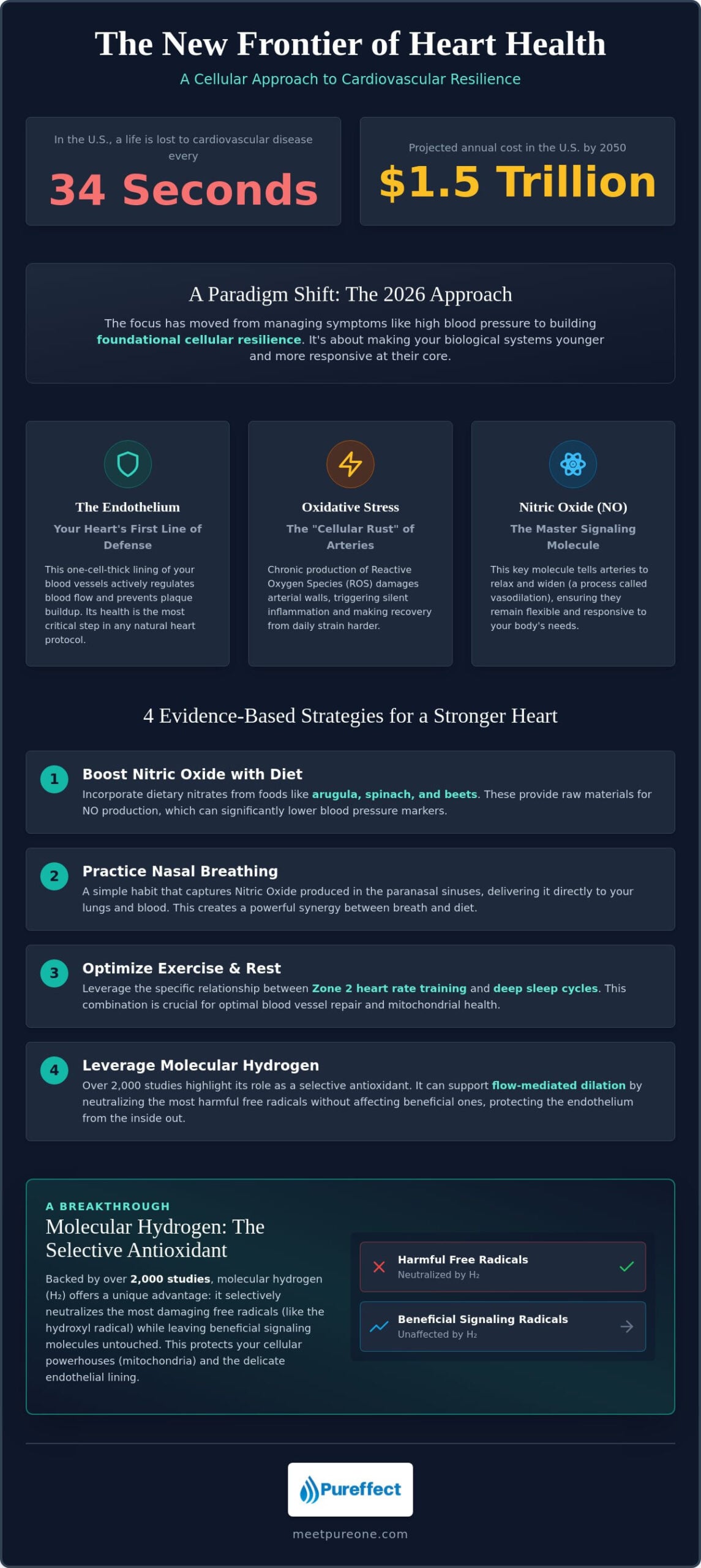
4 Evidence-Based Strategies for a Stronger Heart
Building a resilient heart isn’t about one-off “hacks.” It’s about consistent, biology-aligned habits. While standard advice often stops at basic activity, improving cardiovascular health naturally in 2026 requires a deeper look at how our daily choices interact with our cells. Are you ready to move beyond the generic 150 minutes of walking and start targeting your arterial age? From how you move to how you rest, these four strategies are backed by the latest research to prevent heart disease and optimize your performance.
The ‘Zone 2’ Revolution in Heart Longevity
Not all exercise is created equal. Zone 2 training, or low-intensity steady-state cardio, is the gold standard for mitochondrial biogenesis. This means you’re literally building more power plants in your heart cells. Unlike high-intensity training that can sometimes spike cortisol, Zone 2 improves metabolic flexibility. It teaches your heart to burn fat efficiently while keeping your heart rate at a level where you can still hold a conversation. You don’t need a lab to find your Zone 2. If you can speak in full sentences but would prefer not to, you’re likely in the sweet spot.
Sleep as an Arterial Repair Mechanism
Sleep isn’t just downtime for your brain. It’s a critical window for your blood vessels. During deep sleep, your heart rate variability (HRV) increases, and your glymphatic system clears metabolic waste. Research shows that even a single night of poor sleep can trigger immediate vascular inflammation. This stiffens the arteries we discussed in earlier sections. Truly investing in preventative health at home starts with a bedroom environment that prioritizes these repair cycles. Without deep sleep, your body lacks the resources to maintain the endothelium.
Nutrition has also evolved. The 2026 AHA guidelines move away from strict nutrient rules toward lifelong eating patterns. This means choosing whole grains and plant-based proteins like legumes over ultra-processed options. We also see a growing role for “selective antioxidants.” A 2024 meta-analysis found that molecular hydrogen significantly helps reduce triglycerides and LDL in people with metabolic disorders. It supports flow-mediated dilation (FMD), which is a fancy way of saying it helps your arteries open up when they need to. If you’re ready to add this fourth pillar to your routine, you can explore the PureONE generator to see how it supports your heart health journey.
Integrating Molecular Hydrogen into a Heart-Healthy Routine
Is there a way to target the “cellular rust” we discussed earlier without blocking the benefits of your Zone 2 training? This is where molecular hydrogen shines. Unlike traditional antioxidants like high-dose Vitamin C, which can sometimes interfere with the body’s natural adaptation to exercise, hydrogen is selective. It only targets the most aggressive free radicals, such as hydroxyl radicals, while leaving beneficial signaling molecules untouched. For those focused on improving cardiovascular health naturally, this precision is a game-changer. It’s a way to protect your arteries while your body does the hard work of repair. This same selectivity is one reason researchers studying managing fibromyalgia symptoms naturally are increasingly interested in hydrogen therapy as a tool for addressing systemic oxidative stress without disrupting the body’s own healing signals.
Research Spotlight: Hydrogen and Vascular Function
A 2024 meta-analysis confirmed that hydrogen-rich interventions significantly support flow-mediated dilation (FMD). FMD is the gold standard for measuring how well your arteries can widen in response to blood flow. By activating the Nrf2 pathway, hydrogen encourages your body to produce its own internal antioxidants. This isn’t just about adding a supplement; it’s about upregulating your heart’s native defense systems. Research suggests this pathway is essential for maintaining the delicate balance of the endothelium over time. Unlike other interventions, hydrogen acts as a signal to the body to fix itself from the inside out.
How to Use the PureONE for Heart Support
Integrating this into your day is surprisingly simple. The PureONE is a Canadian-made solution that delivers a specific 66/33 hydrogen-oxygen mix. This ratio ensures you maintain optimal oxygenation while receiving a therapeutic dose of hydrogen gas. Most people find that 30 to 60 minutes of inhalation while reading or relaxing is enough to support systemic inflammation reduction. You can also infuse your water for a quick boost during the day. It’s a high-tech tool that feels like a low-barrier habit. For anyone serious about improving cardiovascular health naturally, having a consistent source of pure gas is a foundational part of a modern wellness routine.
By combining this cellular support with the dietary patterns and movement strategies we’ve covered, you’re building a truly comprehensive defense. You don’t have to guess if your efforts are working. When you support your body at the molecular level, the results often show up in your energy, your recovery, and your long-term heart resilience. It’s about giving your heart the environment it needs to thrive.
Taking the Next Step Toward Cellular Resilience
We’ve explored how the endothelium acts as your heart’s gatekeeper and why managing “cellular rust” is the real secret to longevity. Real progress in improving cardiovascular health naturally isn’t about following a list of restrictive rules. It’s about aligning your daily habits, from Zone 2 movement to deep sleep, with your body’s native repair mechanisms. By focusing on Nitric Oxide signaling and mitochondrial protection, you’re building a foundation that lasts.
Are you ready to bring this research into your own home? The PureONE generator provides a consistent 66% Hydrogen and 33% Oxygen output to support your heart at the molecular level. It’s a tool endorsed by health experts and public figures for its purity and ease of use. Because we value your journey toward better living, we offer a 365-day risk-free trial. Discover how the PureONE supports your heart at the cellular level and see the difference that selective antioxidant support can make. Your heart works hard every second. Give it the environment it needs to thrive.
Frequently Asked Questions
How can I improve my cardiovascular health naturally without medication?
You can improve your heart health by adopting the 2026 AHA dietary patterns, which prioritize whole grains and plant-based proteins. Consistent Zone 2 cardio training helps build mitochondrial density, while nasal breathing naturally boosts Nitric Oxide levels. These lifestyle adjustments target the root of vascular function. It’s about creating a biological environment where your heart can thrive without relying solely on synthetic interventions.
What is the best natural supplement for heart health in 2026?
Current research highlights Bergamonte citrus bergamot and nattokinase as top choices for lipid and circulation support. These compounds help manage cholesterol levels and reduce inflammation naturally. Omega-3 fish oils and CoQ10 remain foundational for maintaining cellular energy and arterial flexibility. Always consult your healthcare provider to ensure these supplements don’t interact with existing treatments, especially if you’re already managing specific heart risks.
Can molecular hydrogen therapy really help my heart?
Yes, molecular hydrogen acts as a selective antioxidant that neutralizes harmful hydroxyl radicals without disrupting beneficial signaling molecules. Research from 2024 and 2025 shows that hydrogen inhalation supports flow-mediated dilation, which is essential for flexible arteries. By reducing silent inflammation, it helps protect the endothelium. This makes it a powerful tool for anyone interested in improving cardiovascular health naturally at a cellular level.
Does drinking hydrogen water lower blood pressure naturally?
Drinking hydrogen-rich water supports healthy blood pressure by improving endothelial function and vessel elasticity. A 2024 meta-analysis found that hydrogen helps reduce triglycerides and total cholesterol in people with metabolic disorders. While it isn’t a standalone cure for hypertension, it facilitates better vasodilation. This natural support makes it easier for your heart to move blood through the body with less resistance.
How long does it take to see improvements in heart health naturally?
Some biological markers, like flow-mediated dilation, can show positive shifts within just a few days of starting hydrogen therapy or nasal breathing. However, structural changes like improved mitochondrial density or lower LDL goals typically take three to six months of consistent effort. Your body needs time to repair the endothelium and adjust its metabolic patterns. Patience and consistency are your best allies in this long-term journey.
Is it possible to reverse endothelial dysfunction with lifestyle changes?
Yes, clinical research suggests that the endothelium is highly responsive to lifestyle changes. By combining a high-polyphenol diet with strategic Zone 2 exercise, you can restore the lining’s ability to produce Nitric Oxide. Reducing chronic oxidative stress through selective antioxidants like molecular hydrogen further supports this recovery. It is a proactive way of managing your biological age and ensuring your arteries remain youthful and resilient.
Disclaimer
The information provided by Pureffect and any of its products are for educational and informational purposes only and is not intended as medical advice. Individual results may vary, and no specific health outcomes are guaranteed. Always consult a qualified healthcare professional before starting any wellness practice or product.