
Could a wellness routine fit into your workday without adding another task to an already full calendar? A realistic wellness routine for busy professionals starts with small habits attached to things you already do, like taking a short walk after lunch or pausing to stretch between meetings.
Long hours can leave little energy for self-care, and advice that calls for a complete lifestyle overhaul can be hard to sustain. You don’t need a perfect schedule to begin. You need a practical starting point that can flex when work gets busy.
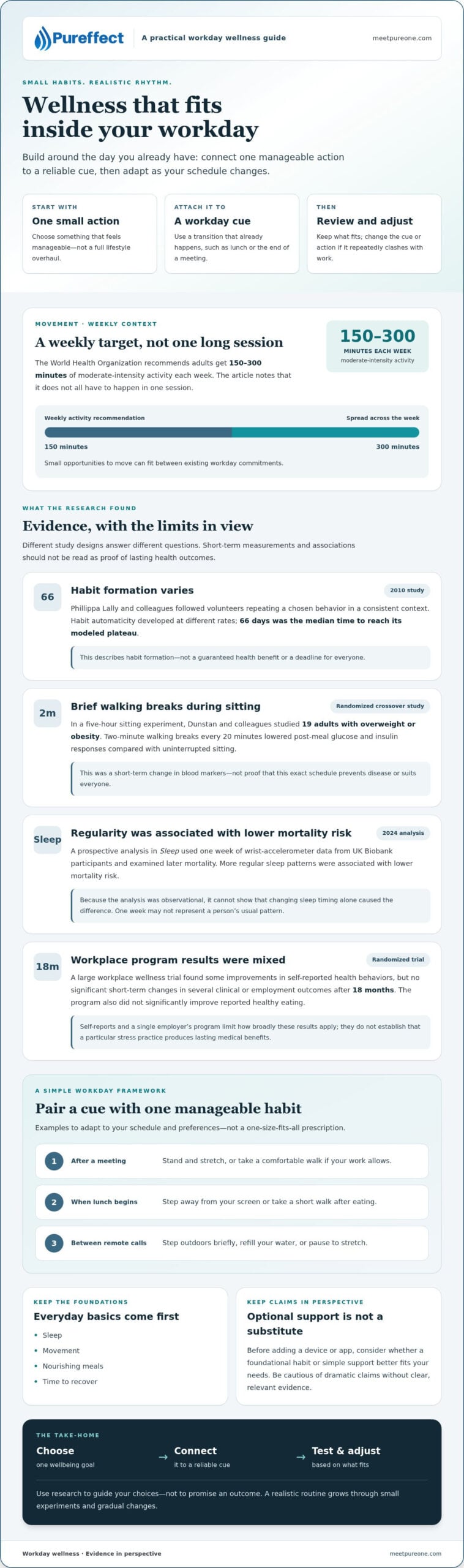
This guide will help you build repeatable habits around your existing workday anchors, understand what research supports, and choose one manageable change to try. The World Health Organization recommends adults get 150-300 minutes of moderate-intensity activity each week, but that doesn’t mean it all has to happen in one session. We’ll look at ways to fit movement, recovery, and other foundational habits into your day while keeping the evidence in perspective. Start small, see what fits, then adjust.
Key Takeaways
- Choose one wellbeing goal and pair a small action with a reliable workday cue, such as finishing a meeting or taking lunch.
- Use research to guide your choices, checking who was studied, what was measured, and where the findings may not apply.
- Adapt a sample workday plan to your schedule and preferences rather than treating it as a one-size-fits-all prescription.
- Before adding a tool, consider whether a foundational habit or simple support would better fit your needs. Optional devices aren’t substitutes for those basics.
- Build a wellness routine for busy professionals by testing one manageable habit, reviewing how it feels, and adjusting it over time.
Why a Wellness Routine for Busy Professionals Should Start Small
A wellness routine doesn’t need to take over your calendar. A wellness routine is a repeatable set of everyday habits that supports physical and mental wellbeing, without promising a particular health outcome. It could mean eating lunch away from your screen or taking a brief outdoor reset between remote meetings. The right routine depends on your needs, workday, and what you can realistically repeat.
Long workdays can squeeze out time for rest, movement, and meals. That’s not a personal failing, and it doesn’t mean you need a perfect morning schedule to make a useful change. Small moments of care within the day you already have can support work-life balance.
What counts as a realistic wellness routine?
Look for transitions that already happen: after sending your first email, before lunch, or when one video call ends and the next begins. You might step outside between remote meetings, refill your water before settling back in, or stand and stretch during a screen break. These are examples, not prescriptions. Your routine might include one habit or several, depending on your schedule, preferences, and personal circumstances.
Why small, repeatable habits can be easier to maintain
A cue links an action to something that already happens. For example, closing your laptop for lunch can remind you to step away from your desk. In a 2010 study in the European Journal of Social Psychology, Phillippa Lally and colleagues followed volunteers repeating a chosen behavior in a consistent context. Habit automaticity developed at different rates, and the median time to reach its modeled plateau was 66 days. That finding describes habit formation, not a guaranteed health benefit or a deadline for everyone.
Start with a version that feels manageable, then notice what gets in the way. If a habit repeatedly clashes with meetings or leaves you feeling pressured, adjust the cue or choose a smaller action. A wellness routine for busy professionals develops through testing and gradual changes, not an overnight transformation.
What Medical Research Says About Workday Wellness Habits
Research can help separate plausible habits from big promises, but the details matter. A brief lab experiment, a long-term observational study, and a workplace program trial answer different questions. A finding about a short-term measure doesn’t automatically demonstrate lasting health benefits.
Movement and recovery during a desk-heavy day
In a randomized crossover study published in Diabetes Care, Dunstan and colleagues tested 19 adults with overweight or obesity during five-hour sitting conditions. Brief, two-minute walking breaks every 20 minutes lowered participants’ post-meal glucose and insulin responses compared with uninterrupted sitting. That’s a short-term change in blood markers, not proof that this exact break schedule prevents disease or suits everyone.
Sleep, stress, and the limits of wellness claims
A 2024 prospective analysis in Sleep used a week of wrist-accelerometer data from UK Biobank participants and examined later mortality. More regular sleep patterns were associated with lower mortality risk. Because this was observational, it can’t show that changing sleep timing alone caused the difference. A week of measurement also may not represent someone’s usual pattern.
Stress recovery deserves the same care in interpretation. A large randomized workplace wellness trial, described by Harvard Medical School’s research on wellness programs, found some improvements in self-reported health behaviors, but no significant short-term changes in several clinical or employment outcomes after 18 months. Self-reports and a single employer’s program limit how broadly the results apply. The findings also don’t establish that a particular stress practice produces lasting medical benefits.
For a wellness routine for busy professionals, use research as a guide, not a guarantee. Build foundations first, then assess optional supports on their own evidence. If you’re considering a device as an add-on, review the PureONE Molecular Hydrogen Generator details and weigh the available evidence without treating the device as a substitute for everyday health habits or medical care.
How to Build a Wellness Routine Around a Busy Workday
A routine works best when it fits the day you actually have, not an idealized calendar. Use this sequence: choose one goal, attach one small habit to a dependable cue, test it, then review and adjust. It’s a framework, not a promise of specific results.
Choose workday anchors instead of adding a packed schedule
- Choose one goal. Be specific, such as adding movement during the workday or creating a clearer stopping point in the evening.
- Pick a cue and action. After a recurring meeting, stand or walk during the next suitable call. At lunch, try eating away from your screen or taking a short walk if your setting and schedule allow.
- Test the habit. Try it during a typical workweek. Keep it small enough to fit without rearranging your whole day.
- Review and adjust. Notice whether the cue was reliable and the action felt practical. Keep it, change the cue, or scale it down.
Make the routine flexible enough to survive busy weeks
Build two versions. On an ordinary day, you might take a short walk at lunch and use a consistent end-of-work transition. On a high-pressure day, your minimum version could be standing briefly between tasks and pausing before opening your next work message. The smallest version still counts as practice, not failure.
Keep a simple note of whether you did the habit and how it felt. This can help you spot practical barriers or preferences, but it isn’t medical evidence that the habit changed your health. If a week gets disrupted, restart at the next available cue rather than trying to make up for missed days.
A research guide to cellular energy can offer context on related topics, but it shouldn’t replace the basics of a routine. If you’re considering an optional addition, review the PureONE Molecular Hydrogen Generator details and evaluate the available evidence for yourself.
How to Personalize Your Wellness Routine and Choose Optional Tools
A simple framework for deciding what to add
- Start with the foundation. Consider everyday habits such as sleep, movement, nourishing meals, and recovery before adding optional products.
- Look for a real barrier. Would a reminder help you pause, or is the main issue that your calendar leaves no space? A tool can’t solve every obstacle.
- Check the fit. Does it work with a routine you already have, and does it feel manageable to keep using?
- Examine the evidence. Look for research on people and outcomes relevant to the claim. Separate a product’s stated features from health benefits established independently.
Where an at-home wellness device may fit
PureONE is a home-use molecular hydrogen generator with modes for inhalation, hydrogen-infused water, and direct skin application. It produces a mixture of 66% molecular hydrogen and 33% oxygen. These are product features, not proof of a particular health outcome. Consider the device an optional addition, not a treatment or a replacement for everyday wellness habits. For a separate discussion of the research, see this guide to molecular hydrogen science and cellular health.
A wellness routine for busy professionals can include no products at all. If you’re curious about this device, take a low-pressure next step: review the PureONE product details and consider how its features fit your needs, alongside the limits of the available evidence.
Start With One Habit You Can Repeat
A practical wellness routine for busy professionals doesn’t need to fill every gap in your calendar. Choose one action that fits your day, connect it to a reliable cue, and adjust it when your schedule or needs change. Keep foundational habits at the center, and treat research as guidance rather than a guarantee of personal results.
Optional tools may suit some routines, but they aren’t a substitute for established care or medical advice. PureONE is a home-use molecular hydrogen generator manufactured in Canada. The company offers a 365-day risk-free trial; review the current product information and trial terms before deciding.
If you’d like to learn more, explore the PureONE product details and consider whether it fits your needs. Start with what feels manageable. Small, thoughtful choices can help you shape a routine that works for your life.
Frequently Asked Questions
How do I start a wellness routine when I have a busy schedule?
Start by identifying one point in your day when you regularly feel a need, such as losing focus late in the afternoon. Choose a small response that won’t require extra planning, then try it during the workdays ahead. If it doesn’t fit, change the timing or action. The aim is to find a practical behavior that suits your schedule, not to follow an idealized routine perfectly.
What should a daily wellness routine include?
Can short breaks during work improve wellbeing?
They can give you a chance to change posture, move, or briefly shift attention away from a demanding task. For example, use a natural pause to walk to a printer or look away from your screen before returning to work. The effects will depend on the person and the break. A brief pause isn’t a proven treatment for a health condition. Choose an option that’s safe and practical for your setting.
How long does it take to build a wellness routine?
There’s no universal timeline. A habit may feel easier to repeat as it becomes part of a familiar pattern, but the pace varies with the action and a person’s circumstances. Rather than setting a deadline, check whether the routine fits your actual week and what tends to interrupt it. If it keeps slipping, simplify the action or choose a more reliable moment to try it.
What is the best wellness routine for remote workers?
Are wellness devices necessary for a healthy routine?
No. A wellness device is optional, not a requirement for everyday wellbeing, and it shouldn’t replace medical advice or established care. PureONE is a home-use molecular hydrogen generator with modes for inhalation, hydrogen-infused water, and direct skin application. These are product features, not proof of a specific health outcome. Review the evidence behind health-related claims and discuss health concerns or treatment choices with a qualified healthcare professional.
Disclaimer
The information provided by Pureffect and any of its products are for educational and informational purposes only and is not intended as medical advice. Individual results may vary, and no specific health outcomes are guaranteed. Always consult a qualified healthcare professional before starting any wellness practice or product.