
What if improving deep sleep cycles starts with protecting your whole night, rather than chasing a higher sleep-stage score? If you spend enough time in bed but still wake unrefreshed, it’s understandable to wonder whether you’re getting enough deep sleep, or whether your tracker’s reading is accurate.
Deep sleep matters, but it’s only one part of a normal night. Sleep stages shift naturally, and consumer trackers can’t reliably measure each stage for everyone. There are practical ways to support more restorative sleep, though. A September 2026 report in The Washington Post described a Nature Health study linking fiber-rich, plant-diverse diets with more restorative deep and REM sleep. That’s an association, not proof that a particular food will fix sleep.
In this guide, you’ll learn what deep sleep does, how it differs from REM, and which everyday habits have the strongest footing. We’ll also cover what trackers can and can’t tell you, when persistent sleep problems warrant clinical advice, and what current evidence does and doesn’t show about hydrogen and sleep. No magic shortcuts, just a clearer way to assess your options.
Key Takeaways
- Improving deep sleep cycles starts with supporting a consistent, adequate sleep opportunity rather than trying to force a particular sleep stage.
- Use a simple wind-down routine and review changes over time instead of reacting to one restless night or a single sleep score.
- When weighing sleep research, check whether a study measured sleep directly and whether its findings are established, preliminary, or observational.
- Assess wellness claims for relevant human evidence and safety information. PureONE is a molecular hydrogen generator, not an established sleep treatment.
What Deep Sleep Means, and Why Sleep Cycles Matter
If you wake feeling worn out, it’s natural to wonder whether you got enough deep sleep. But a sleep-stage estimate and how rested you feel are related questions, not identical ones. Understanding the difference can make improving deep sleep cycles feel less like chasing a number and more like looking at the full picture.
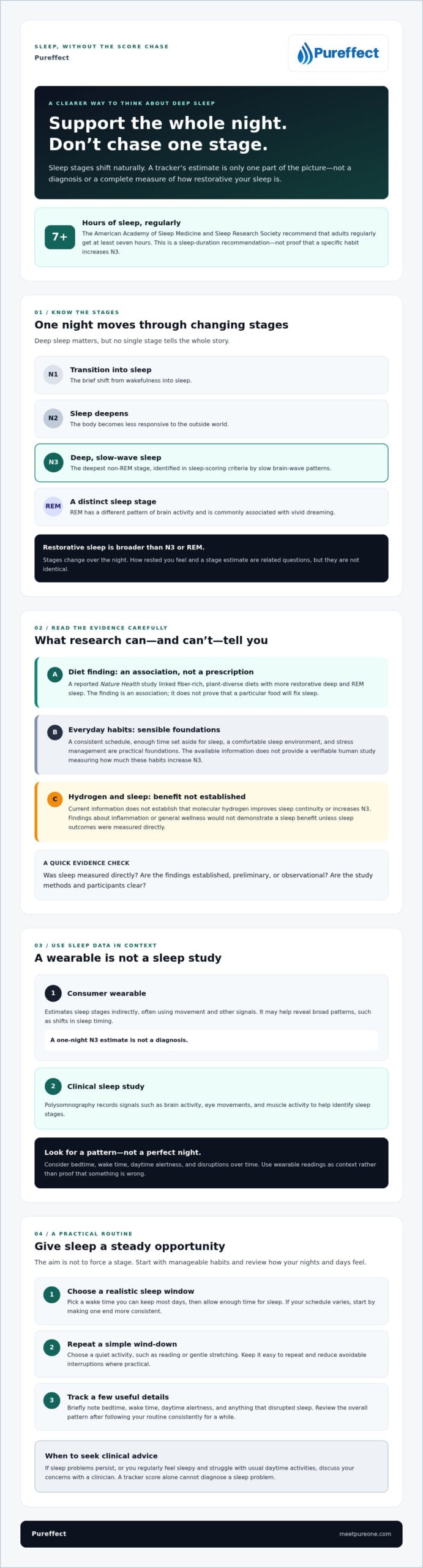
Deep sleep is stage N3, a phase of non-REM sleep marked by slow brain waves. The American Academy of Sleep Medicine’s sleep-scoring criteria identify N3 using these patterns. It’s also called slow-wave sleep. N3 is one part of a night that moves through several stages, not a standalone measure of sleep quality.
What happens during deep, light, and REM sleep?
N1 is the brief transition from wakefulness into sleep. In N2, sleep deepens and the body becomes less responsive to the outside world. N3 is the deepest non-REM stage. REM sleep has a different pattern of brain activity and is commonly associated with vivid dreaming. None of these stages tells the whole story on its own.
A sleep cycle moves through changing stages, and the pattern can shift as the night goes on. Deep sleep and REM sleep are distinct; “restorative sleep” is broader. It describes sleep that supports feeling and functioning well, and can’t be reduced to a single stage or score.
How can you tell whether sleep is restorative?
Start with your overall pattern. Are you generally alert during the day and able to manage your usual activities, or do you regularly feel sleepy and struggle to function? These observations provide useful context, but a single symptom can’t diagnose a sleep problem.
In a clinical sleep study, called polysomnography, sensors record signals such as brain activity, eye movements, and muscle activity to help identify sleep stages. Consumer wearables estimate stages indirectly, often using movement and other signals. They can help you notice broad patterns, such as changes in sleep timing, but a one-night estimate of N3 isn’t a diagnosis. If a reading seems unexpectedly low, use it as a prompt to consider your experience over time, not as proof that something is wrong.
What Research Says About Improving Deep Sleep Cycles
Evidence supports protecting sleep as a whole, but it doesn’t establish a reliable way to increase N3 on demand. The American Academy of Sleep Medicine and Sleep Research Society recommend that adults regularly get at least seven hours of sleep. This is a sleep-duration recommendation, not evidence that a particular habit adds deep sleep. For improving deep sleep cycles, that distinction matters: general sleep guidance shouldn’t be presented as proof of a specific change in sleep stages.
Which sleep habits have evidence behind them?
A consistent schedule, enough time set aside for sleep, and a comfortable sleep environment are sensible foundations. Cleveland Clinic outlines practical tips to improve deep sleep, including schedule consistency and stress management. However, no directly relevant human study with verifiable details on its design, participants, and measured N3 outcome is available to cite here. Without those details, it wouldn’t be responsible to claim these habits increase deep sleep by a known amount.
Likewise, a reported association between a lifestyle factor and sleep stages doesn’t by itself show cause and effect. Study methods and other influences matter. Treat practical habits as reasonable steps to support sleep, not as guaranteed ways to change a particular stage.
What does emerging hydrogen research say about sleep?
Current information doesn’t establish that molecular hydrogen improves sleep continuity or increases N3. Findings about inflammation or general wellness wouldn’t demonstrate a sleep benefit unless researchers measured sleep outcomes directly. Without verifiable study details, including the participants, methods, and sleep measures, a benefit shouldn’t be assumed.
PureONE is a molecular hydrogen generator, not an established sleep treatment. If you’re curious about the device, review the PureONE Molecular Hydrogen Generator separately from sleep claims, and discuss persistent sleep concerns with a clinician.
Practical Steps to Support More Restorative Sleep
A useful routine doesn’t need to be elaborate. Start with a steady schedule and enough room for sleep, then make small changes you can maintain. The goal isn’t to force a particular amount of deep sleep. It’s to give your body a regular opportunity to sleep and see whether your nights and days feel better.
A simple routine to test consistently
- Set a realistic sleep window. Choose a wake time you can keep most days, then work backward to allow enough time for sleep. If your schedule changes often, begin by making one end of the schedule more consistent.
- Build a repeatable wind-down. Pick a quiet activity that helps you shift out of the day, such as reading or gentle stretching. Keep the routine simple enough to repeat, and reduce avoidable interruptions in your sleep environment where practical.
- Look for patterns, not perfect nights. Make brief notes about bedtime, wake time, daytime alertness, and anything that disrupted sleep. Review the overall pattern after following your routine consistently for a while. A wearable can add context, but its stage estimates aren’t clinical measurements. Don’t change your plan based on one night’s score.
These steps are a starting point, not a guarantee. Work, caregiving, health conditions, and other demands can affect what’s realistic. Adjust the routine to fit your life, and focus on changes you can sustain rather than adding rules that create more stress.
When should sleep problems be discussed with a clinician?
Arrange a conversation with a qualified clinician if sleep difficulties persist, worsen, or significantly affect your daytime functioning. Loud snoring, witnessed pauses in breathing, or struggling to stay awake during the day are also reasons to ask about an assessment. They don’t prove you have a particular condition, but they deserve more than a tracker reading or a new bedtime routine.
Sleep habits can support health, but sleep hygiene alone may not resolve a medical sleep condition. A clinician can help decide whether further evaluation or treatment is appropriate. If you’re considering wellness products alongside routine changes, review the PureONE Molecular Hydrogen Generator on its own merits. It isn’t an established treatment for sleep problems.
How to Assess Sleep-Wellness Claims, and Choose Your Next Step
Wellness claims can sound convincing, especially when they use scientific language. Ask whether the research actually measured sleep, or studied a different outcome and suggested a possible connection. That distinction helps separate evidence about improving deep sleep cycles from broader claims about health.
How to judge whether a sleep claim is credible
Before relying on a product or practice, check the evidence for the specific sleep benefit being claimed. Look for:
- Relevant human research. Was the approach studied in people, or is the claim based on laboratory, animal, or theoretical research?
- Direct sleep outcomes. Did researchers measure sleep itself, such as continuity or sleep stages, rather than an indirect wellness marker?
- Clear methods and limitations. Can you tell who participated, how sleep was assessed, and what the study could not establish?
- Independent confirmation and safety information. Have other researchers found similar results, and are potential risks explained?
- Realistic language. Testimonials and proposed biological mechanisms can raise questions, but they aren’t proof that a product improves sleep.
For example, research about inflammation wouldn’t establish that a product increases N3 unless sleep was measured and the study supported that conclusion. The same standard applies to claims involving molecular hydrogen. Learning what molecular hydrogen is is different from having evidence that it changes sleep.
What is a sensible next step if sleep still feels unrefreshing?
If the problem persists or affects your daily life, discuss it with a qualified clinician. Bring a brief record of sleep timing, nighttime disruptions, and how you feel during the day. This can help guide a conversation about possible contributing factors and whether further assessment is appropriate. A consumer sleep score or one rough night can’t answer that on its own.
PureONE is a molecular hydrogen generator, not an established sleep treatment. Available information doesn’t establish that it improves deep sleep or treats sleep disorders. If you’re curious about the device, you can review the PureONE product details separately from any sleep-related claims. Keep the evidence and your health goals in view as you decide what, if anything, fits your needs.
Build Better Sleep One Steady Step at a Time
Improving deep sleep cycles isn’t about forcing a specific stage or chasing a perfect tracker score. Deep sleep is one part of a changing night, and how you feel and function over time matters too. Give yourself a realistic sleep opportunity, keep your schedule as steady as you can, and notice broader patterns rather than judging each night in isolation.
If sleep problems persist or affect your daily life, bring your observations to a qualified clinician. When considering a wellness product, look for direct human evidence of the sleep benefit being claimed. Available information doesn’t establish PureONE as a sleep treatment. PureONE is a home-use molecular hydrogen generator with four modes, including options to inhale hydrogen gas, drink hydrogen-infused water, or apply it directly to the skin. Review its product details and any trial terms before making a decision.
If you’re curious about the device, explore the PureONE molecular hydrogen generator and assess its details separately from sleep-related claims. Small, consistent steps can help you make more informed choices. Give your routine time, stay curious, and seek support when you need it.
Frequently Asked Questions
How can I improve my deep sleep naturally?
How much deep sleep should you get each night?
For healthy adults, deep sleep is often estimated at about 13% to 23% of total sleep. That works out to roughly one to two hours for someone sleeping seven to nine hours, but it’s a general range, not a personal target or diagnostic threshold. Sleep-stage proportions vary between people and nights, and deep sleep tends to decrease with age. A tracker estimate outside the range doesn’t, by itself, mean something is wrong.
Can you increase deep sleep with a device?
Some devices aim to measure or influence sleep, but that doesn’t mean they’re proven to increase deep sleep for everyone. Consumer trackers estimate sleep stages and shouldn’t be treated as clinical measurements. Before relying on a device, check whether human studies measured N3 directly, what the comparison was, and whether results have been independently confirmed. If you’re considering a device for persistent sleep problems, ask a qualified clinician about evidence and safety.
What happens if you do not get enough deep sleep?
Deep sleep is one part of normal sleep, but you can’t determine its effects from one night or a tracker score alone. Feeling unrefreshed or sleepy can have many possible causes, including insufficient sleep opportunity or disrupted sleep. If these problems persist or interfere with daily life, discuss them with a clinician. They can help assess the broader pattern rather than assuming low deep sleep is the cause.
Do sleep trackers accurately measure deep sleep?
Consumer sleep trackers can help you notice broad patterns, such as bedtime or sleep duration, but their stage estimates are indirect and may be inaccurate. Polysomnography, a clinical sleep study that records signals including brain activity, is used to assess sleep stages. Don’t treat a single low N3 estimate as a diagnosis or let nightly scores create extra worry. Consider how you feel and function over time, and seek clinical advice if concerns persist.
Can molecular hydrogen improve deep sleep cycles?
Current information doesn’t establish that molecular hydrogen improves deep sleep cycles or treats sleep disorders. Evidence about other wellness outcomes wouldn’t prove a sleep benefit unless research measured sleep directly in people. PureONE is a home-use molecular hydrogen generator with four modes, but it isn’t an established sleep treatment. If you’re considering it, assess product information separately from sleep claims, and speak with a clinician about ongoing sleep difficulties.
Disclaimer
The information provided by Pureffect and any of its products are for educational and informational purposes only and is not intended as medical advice. Individual results may vary, and no specific health outcomes are guaranteed. Always consult a qualified healthcare professional before starting any wellness practice or product.