
Before choosing an at-home treatment for eczema and psoriasis, consider whether the rash has been diagnosed. The symptoms can look similar, and the wrong approach may irritate skin or delay care. Supportive skin care can help with comfort, but it is not a substitute for diagnosis-specific medical treatment.
This guide explains how eczema and psoriasis can differ, which low-risk home-care habits may support comfort, and when to contact a clinician. It also puts emerging wellness claims in context. For example, a 2026 study in Clinical & Experimental Immunology reported reduced inflammatory activity with molecular hydrogen in cell and mouse models of psoriasis-like inflammation. That is early research, not proof that it treats people.
Use these practical steps to distinguish routine skin care from treatments that need professional guidance, and make choices based on more than guesswork or product claims.
Key Takeaways
- Similar-looking rashes can have different causes. Get a clinician’s assessment rather than relying on appearance alone.
- At-home treatment for eczema and psoriasis starts with gentle skin care, but the right plan depends on the condition and any prescribed treatment.
- Build a simple routine around gentle cleansing and a suitable moisturizer, and follow your clinician’s directions for medications.
- Seek medical advice if symptoms worsen or your current care is not helping.
- Emerging wellness approaches need condition-specific human evidence before they can be considered a substitute for established care.
Eczema and Psoriasis: Why Diagnosis Matters
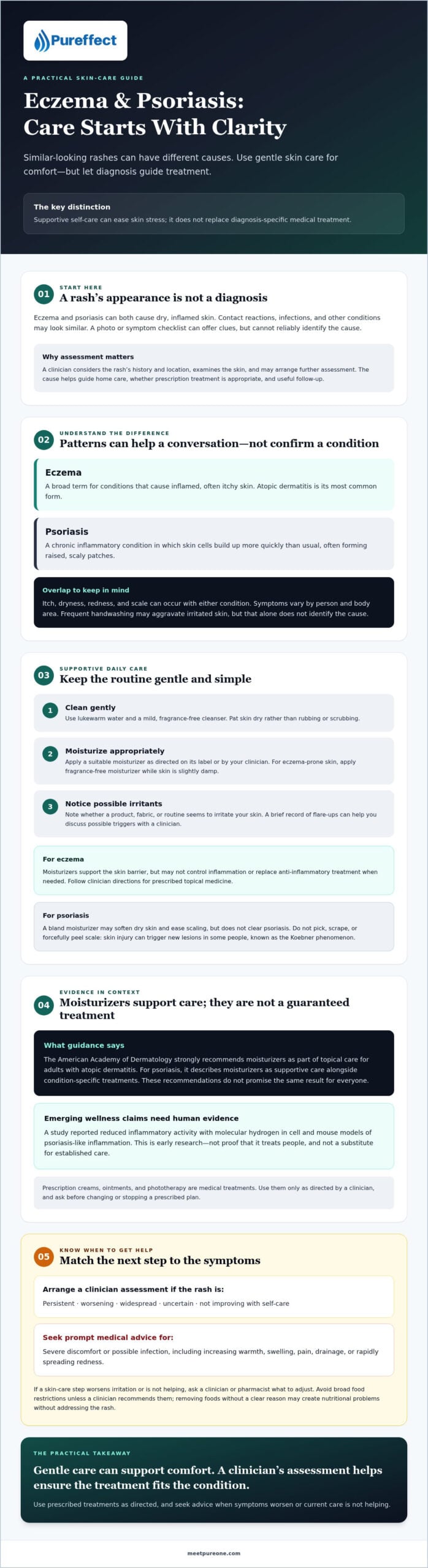
A persistent rash can be itchy, sore, and disruptive, especially when it is hard to tell what is causing it. Eczema and psoriasis can both cause dry, inflamed skin. Other conditions, including contact reactions and infections, can look similar. A photo or symptom checklist may offer clues, but it cannot provide a reliable diagnosis.
How eczema and psoriasis can differ
Eczema is a broad term for conditions that cause inflamed, often itchy skin. Atopic dermatitis is its most common form; the Atopic dermatitis overview describes its signs, possible causes, and diagnosis. Psoriasis is a chronic inflammatory condition in which skin cells build up more quickly than usual, often forming raised, scaly patches. Itch, dryness, redness, and scale can occur with either condition, and symptoms vary by person and body area.
Patterns can be useful to discuss with a clinician, but they do not confirm a diagnosis. For example, frequent handwashing may dry out and aggravate already-irritated skin. That alone does not establish whether the problem is eczema, psoriasis, or something else. A clinician considers the rash’s history and location, examines the skin, and may arrange further assessment when needed.
Why the right diagnosis changes care
The cause of a rash helps guide home care, whether prescription treatment is appropriate, and what follow-up may be useful. Gentle cleansing and moisturizer can support the skin barrier, but they may not control inflammation. Eczema and psoriasis can require different condition-specific treatments, so treating them as interchangeable can lead to ineffective care or irritation.
Supportive self-care can ease skin stress; it does not replace diagnosis-specific medical treatment.
When a clinician should assess a skin condition
Arrange an assessment if the rash is persistent, worsening, widespread, or uncertain, or if self-care is not helping. Seek prompt medical advice for severe discomfort or possible infection, such as increasing warmth, swelling, pain, drainage, or rapidly spreading redness. Your clinician can help assess these changes and advise what to do next.
This article is for education, not diagnosis or an individualized treatment plan. An accurate assessment is a practical first step toward choosing an at-home treatment for eczema and psoriasis that fits the condition.
Evidence-Based At-Home Care for Eczema and Psoriasis
Home care can support comfort and the skin barrier, but it may not control the inflammation driving eczema or psoriasis. Moisturizers are supportive, not guaranteed treatments. Prescription creams, ointments, and phototherapy are medical treatments. Use them only as directed by a clinician, and ask before changing or stopping a prescribed plan.
The American Academy of Dermatology (AAD) guideline for adults with atopic dermatitis strongly recommends moisturizers as part of topical care. This supports regular use to help manage dry skin, but it does not show that moisturizer alone controls eczema flares or works equally well for everyone. For psoriasis, the AAD describes moisturizers as supportive care alongside condition-specific treatments. These recommendations guide care; they do not promise a particular result. See the AAD atopic dermatitis guidelines and psoriasis guidelines.
Home care that may support eczema-prone skin
Note whether a particular product, fabric, or routine seems to irritate your skin. A brief record of flare-ups can help you discuss possible triggers with a clinician. Avoid broad food restrictions unless a clinician recommends them. Removing foods without a clear reason may create nutritional problems without addressing the rash.
Home care that may support psoriasis management
For psoriasis, a bland moisturizer may soften dry skin and ease scaling, but it does not clear the condition. The AAD presents moisturizers as supportive care, distinct from clinician-directed options such as prescribed topical medicines or phototherapy. Do not pick, scrape, or forcefully peel scale. Skin injury can trigger new psoriasis lesions in some people, a response known as the Koebner phenomenon.
Build a Safe At-Home Skin-Care Routine and Know When to Get Help
A routine should be simple enough to follow and flexible enough to fit your diagnosis. Follow any specific instructions from your clinician first. The steps below may support comfort, but they do not replace prescribed treatment or a personalized care plan.
A simple daily routine for skin comfort
- Clean gently. Wash with lukewarm water and a mild cleanser suited to your skin. Pat dry rather than rubbing or scrubbing.
- Moisturize. Apply a suitable moisturizer as directed on its label or by your clinician. If it causes persistent stinging or irritation, ask a clinician or pharmacist whether to switch.
- Use prescribed treatments as directed. Do not change the amount, timing, or duration of a prescription without checking with the clinician who recommended it.
- Keep brief notes. Record flare-ups, sleep disruption, skin-care products, and possible exposures. If irritation appeared after you started a new laundry product, note the timing. That is a clue to discuss, not proof that the product caused the rash.
These notes can make a clinical conversation more useful. Avoid eliminating multiple products or foods at once based only on a suspected connection. It can be hard to tell what, if anything, made a difference.
Signs that home care is not enough
Have persistent, worsening, spreading, or undiagnosed symptoms assessed by a clinician, especially if they disrupt sleep or daily activities. If you are unsure whether your current routine is appropriate, ask before adding products or changing treatment. The right next step depends on the cause of the rash.
Seek prompt medical advice if you notice possible infection, such as new weeping, pus-filled spots, crusting, rapidly worsening redness, or fever. NICE guidance on secondary bacterial infection of eczema lists features such as weeping, pustules, crusts, rapid worsening, and fever as reasons for clinical assessment. These signs do not confirm infection on their own, but they warrant professional advice.
A safe at-home treatment for eczema and psoriasis means supportive care plus a clear plan for follow-up, not guessing indefinitely. If symptoms are not improving or you are concerned, contact a clinician rather than stopping or changing prescribed treatment on your own.
Molecular Hydrogen for Eczema or Psoriasis: What the Evidence Can and Cannot Say
A proposed wellness mechanism is not proof of a skin benefit. Findings from laboratory experiments, animal models, or research on other health conditions cannot establish that molecular hydrogen improves eczema or psoriasis in people. The key question is whether studies directly test these skin conditions in people and measure meaningful outcomes.
What research on molecular hydrogen and skin conditions actually shows
A 2026 study in Clinical & Experimental Immunology found that hydrogen treatment inhibited the cGAS-STING inflammatory signaling pathway in cell and mouse models of psoriasis-like skin inflammation. Researchers also reported less keratinocyte hyperproliferation and lower inflammatory markers. These preclinical findings may help identify a biological mechanism, but they do not show that people with psoriasis will improve or establish a safe, effective dose.
A late-2025 study tested a transdermal hydrogen-delivery system in a psoriasis model and reported reduced oxidative stress and inflammation. That experimental approach is not evidence for a consumer wellness device. For eczema, a 2025 review discussed hydrogen-rich water baths, but the available evidence summary does not provide enough detail about human study design, participants, or outcomes to determine whether they help. Overall, there are no large randomized controlled trials establishing molecular hydrogen as a primary treatment for eczema or psoriasis. The best delivery method and long-term effects in people remain uncertain.
How to evaluate a wellness device without replacing medical care
PureONE is a home-use molecular hydrogen generator with four therapeutic modes, including inhalation, hydrogen-infused water, and application to the skin. These are product-use descriptions, not evidence that the device treats a skin disease. Findings from other delivery methods or preclinical models cannot be assumed to apply to this device. Discuss complementary products with your healthcare professional, and continue your prescribed care unless they advise otherwise.
Molecular hydrogen is not an established eczema or psoriasis treatment, and PureONE should not replace clinician-guided care. If you are researching the device for general wellness, you can review the PureONE product details with that limitation in mind.
Choose Skin Care With Confidence
The most useful at-home treatment for eczema and psoriasis starts with knowing what you are treating. A clinician’s assessment can guide care, while gentle cleansing, a suitable moisturizer, and prescribed treatments used as directed can support a practical routine. If symptoms persist, worsen, spread, or disrupt sleep, seek medical advice rather than relying on guesswork.
Keep emerging wellness claims in perspective. Early molecular hydrogen research, including laboratory and animal findings, does not establish that it treats eczema or psoriasis in people. PureONE is a home-use molecular hydrogen generator with four modes, but those product features are not evidence of a skin-disease benefit and do not replace clinician-guided care.
If you are researching the device for general wellness, review the PureONE molecular hydrogen generator and discuss any complementary wellness product with your healthcare professional. With a clear diagnosis and a care plan you understand, you can take practical next steps with more confidence.
Frequently Asked Questions
Can eczema or psoriasis be treated at home?
Home care can support comfort, but it may not control the underlying condition or replace a diagnosis. Gentle cleansing and a suitable moisturizer may help with dryness, while prescribed treatment may also be needed. The best at-home treatment for eczema and psoriasis depends on which condition you have, since their care plans can differ. Ask a clinician about persistent, worsening, widespread, or uncertain symptoms.
What is the best moisturizer for eczema and psoriasis?
Can diet clear eczema or psoriasis?
No particular food should be assumed to cause or clear eczema or psoriasis for everyone. If you suspect a pattern, keep a simple record of symptoms and possible food or product exposures, then discuss it with a clinician. A noted connection is a clue, not proof. Avoid restrictive diets or supplements based on online claims, and do not replace prescribed treatment with dietary changes without professional guidance.
Is molecular hydrogen a proven at-home treatment for eczema or psoriasis?
No. Molecular hydrogen is not an established treatment for eczema or psoriasis. A 2026 study in Clinical & Experimental Immunology reported reduced inflammatory activity in cell and mouse models of psoriasis-like inflammation, but those findings do not show that people improve. Research in other conditions also cannot establish a skin benefit. Discuss wellness devices with your clinician and continue condition-specific care as advised.
When should I see a doctor about eczema or psoriasis?
Seek medical advice if symptoms persist, worsen, spread, disrupt sleep, or are difficult to identify. Get prompt guidance for severe discomfort or possible infection, such as new weeping, pus-filled spots, rapidly worsening redness, or fever. These signs do not confirm an infection, but they warrant assessment. A clinician can help identify the cause and recommend suitable care. Do not stop or change prescribed treatment without discussing it with the prescriber.
Can I use a wellness device alongside prescribed skin treatment?
Possibly, but ask your healthcare professional before adding a wellness device or complementary approach. A general wellness claim does not establish safety or benefit for eczema or psoriasis, and a device should not delay diagnosis, prescribed treatment, or follow-up. PureONE is a home-use molecular hydrogen generator with four modes; those features are not evidence that it treats either skin condition. Follow the device instructions and your clinician’s care plan.
Disclaimer
The information provided by Pureffect and any of its products are for educational and informational purposes only and is not intended as medical advice. Individual results may vary, and no specific health outcomes are guaranteed. Always consult a qualified healthcare professional before starting any wellness practice or product.