
What if the biggest hydrogen-water number on the label tells you less than you think? The parts per million (PPM) in hydrogen water describes concentration, not a guaranteed health benefit or a complete measure of product quality. When one label uses PPM and another uses parts per billion (PPB), comparing them can feel like decoding a different language.
That confusion is understandable. A concentration claim is useful only when you know what was measured, when it was measured, and under what conditions. Hydrogen can also leave water over time, so a number without measurement context may not tell the whole story.
Here, you’ll learn what PPM and PPB mean, how to compare concentration claims, and why the amount of hydrogen in a serving depends on both concentration and volume. We’ll also look at what research can and can’t tell us about concentration. The goal isn’t to chase the highest number. It’s to understand the evidence and make a choice without treating PPM as a health guarantee.
Key Takeaways
- Understand how parts per million (PPM) in hydrogen water relates to parts per billion: 1 PPM equals 1,000 PPB.
- Compare concentration claims only when the measurement method, timing, and test conditions are stated.
- When reviewing medical research, check who participated, what concentration they consumed, which outcomes were measured, and what limitations researchers reported.
- Choose a hydrogen-water format based on how you plan to use it and the measurement details available, not on a headline number alone.
- Explore the PureONE Molecular Hydrogen Generator as a home-use option with a hydrogen-water mode, without assuming a particular PPM output.
What Does PPM in Hydrogen Water Measure?
PPM is a concentration unit that describes how much dissolved molecular hydrogen is present relative to the amount of water in a sample. In other words, parts per million (PPM) in hydrogen water describes concentration, not the total hydrogen in every serving and not a guaranteed health effect.
For dilute water solutions, PPM is often used approximately as milligrams of hydrogen per liter. That shorthand relies on the usual water-density approximation, so it helps explain a label but doesn’t replace knowing the measurement method. Molecular hydrogen, or H₂, is the specific dissolved gas being discussed. Learn more in what molecular hydrogen is.
PPM vs. PPB: How Do the Units Relate?
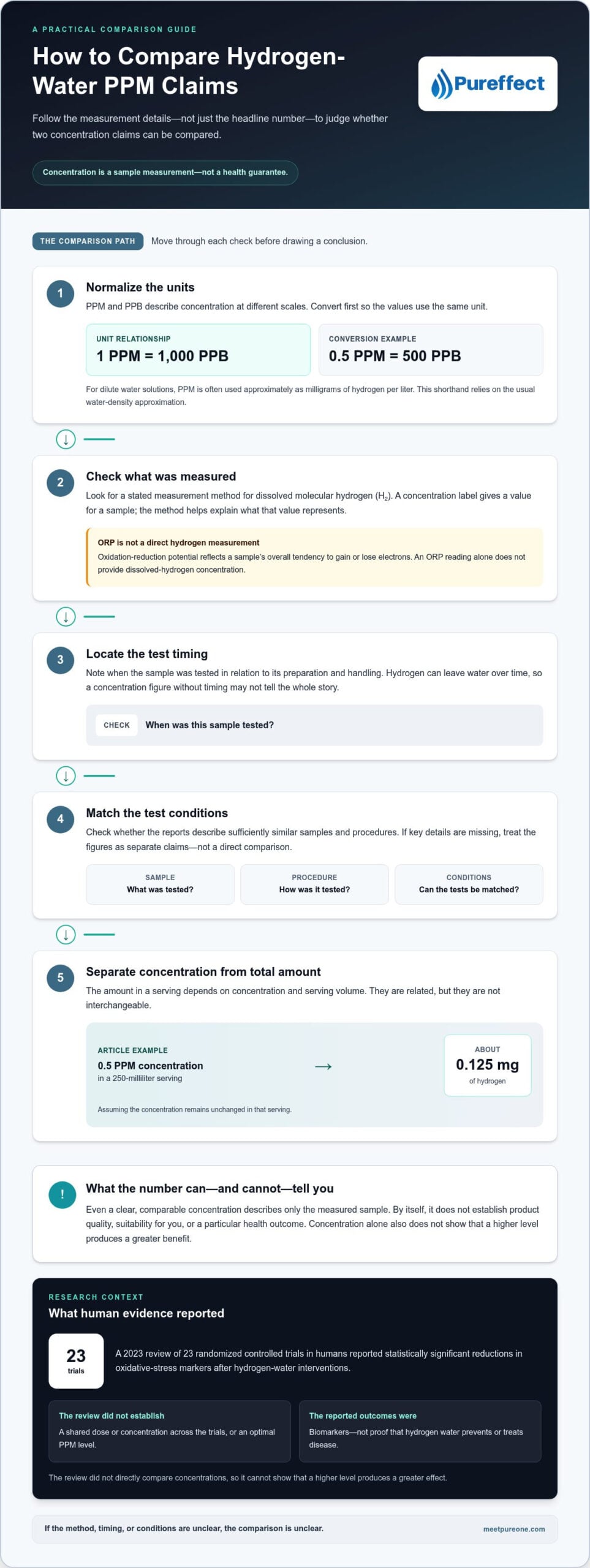
One PPM equals 1,000 parts per billion (PPB). The units describe the same kind of concentration at different scales. For the same sample and measurement basis, a value in PPB is 1,000 times the value in PPM.
Example: 0.5 PPM equals 500 PPB. If that concentration is approximately 0.5 milligrams per liter, a 250-milliliter serving contains about 0.125 milligrams of hydrogen, assuming the concentration remains unchanged in that serving. Concentration and total amount are related, but they aren’t interchangeable.
What Does a Hydrogen-Water Concentration Label Tell You?
A concentration label gives a value for a sample. On its own, it doesn’t tell you the serving size, when the sample was tested, or the conditions used. Those details matter when comparing values, especially when one claim is in PPM and another is in PPB.
Look for the unit, serving volume, measurement timing, and stated test conditions. Without that context, two values may not be meaningfully comparable. Even a clear, comparable concentration describes only the measured sample. It doesn’t establish product quality, suitability for you, or a particular health outcome.
What Medical Research Says About Hydrogen-Water Concentration
Human studies can help assess whether hydrogen-water use is associated with measured changes, but they don’t necessarily show which concentration is best. A review of clinical outcomes and a direct comparison of PPM levels answer different questions. When assessing a concentration claim, check whether a study measured and compared hydrogen-water concentrations or simply assessed an outcome after an intervention.
A 2023 review of 23 randomized controlled trials in humans reported statistically significant reductions in oxidative-stress markers after hydrogen-water interventions. The findings summarized here don’t specify a shared dose or concentration across the trials and don’t establish an optimal PPM level. The reported outcomes were biomarkers, not proof that hydrogen water prevents or treats disease. Because the review didn’t compare concentrations directly, it can’t show that a higher level produces a greater effect.
How to Read Research Findings Without Overstating Them
First, distinguish human clinical trials from animal or laboratory research. A review summarizes previous studies; it doesn’t test a new group of participants. Then check what each study measured. A change in a biomarker after a hydrogen-water intervention doesn’t, by itself, establish a meaningful health benefit or show that concentration caused the change.
For broader evidence context, explore this research guide to molecular hydrogen therapy. Interpret each finding in light of its study design and measured outcome.
Does a Higher PPM Number Mean a Greater Health Benefit?
No. Concentration alone doesn’t establish a greater or proven health benefit. To support a dose-response conclusion, research would need to compare different concentrations under sufficiently similar conditions and assess relevant outcomes. A study using one concentration can report what happened among its participants, but it can’t show that a higher concentration would work better.
Parts per million (PPM) in hydrogen water is one detail to consider alongside the study population, intervention, exposure, and outcome. For a home-use option with a hydrogen-water mode, explore the PureONE Molecular Hydrogen Generator. Its product information describes its features, but a concentration number alone can’t predict a personal result.
How to Compare PPM Claims in Hydrogen Water
Start with the testing details, not the headline number. Before comparing parts per million (PPM) in hydrogen water, check whether each claim describes a sample tested under conditions that can be meaningfully matched. If key details are missing, treat the figures as separate claims rather than a direct comparison.
A measured value applies to a particular sample and test procedure. A marketing claim is harder to assess when those details aren’t provided.
Which Measurement Details Should You Look For?
Check whether the result is reported in PPM or PPB and how the unit is defined. Look for the measurement method, when the sample was tested, and the conditions described in the report. These details clarify what the result represents and whether another value can be compared fairly.
Oxidation-reduction potential (ORP) is not a direct measurement of dissolved hydrogen. It reflects the sample’s overall tendency to gain or lose electrons, so an ORP reading alone doesn’t provide a dissolved-hydrogen concentration.
A Practical Checklist for Comparing Product Claims
Use this checklist to assess whether two claims are comparable:
- Confirm the units. Check that both results use the same unit, or convert them correctly.
- Review the method. Look for a description of how dissolved hydrogen was measured.
- Check sample timing. Note when testing occurred in relation to sample preparation and handling.
- Compare test conditions. Check whether the reports describe sufficiently similar samples and procedures.
- Read test reports for scope. For independent testing, look at which sample was tested, what method was used, and what the result covers.
For example, a PPM figure measured immediately after preparation and one measured later shouldn’t be treated as a like-for-like comparison unless the reports explain why the timing difference doesn’t affect interpretation. Missing details don’t prove a claim is false, but they limit what you can conclude from it.
If you’re considering a home-use device with a hydrogen-water mode, explore the PureONE Molecular Hydrogen Generator and review its product information alongside the measurement details that matter to you.
Choosing a Hydrogen-Water Approach Beyond the PPM Number
Start with your routine. Do you want an option focused on hydrogen-infused water, or would a device with several modes better match how you plan to use it at home? The right fit is the one whose format and setup suit your preferences.
Match the Format to How You Plan to Use It
A water-focused product centers on preparing hydrogen-infused water. A multi-mode device offers additional ways to use it, which may suit you if those options fit your preferences. PureONE is a home-use molecular hydrogen generator with four therapeutic modes, including drinking hydrogen-infused water, hydrogen inhalation, and topical application. Choose based on the modes you expect to use, rather than assuming one format is universally superior.
What a PPM Number Cannot Decide for You
A concentration figure can’t tell you whether a product’s format will fit comfortably into your day. Consider how you’ll use it, which modes interest you, and whether the product information explains its measurements clearly.
To make the choice more concrete, think through these questions:
- Will I mainly use hydrogen-infused water, or do I value additional modes?
- Does the product’s setup suit my home and daily routine?
- Can I find measurement information that helps me understand the stated concentration?
If a home-use device with a drinking-water mode sounds practical, explore the PureONE Molecular Hydrogen Generator and see whether its features align with how you want to use it.
Make Your Next Step a Confident One
Set your decision criteria before choosing a hydrogen-water approach. What would make it practical for your routine? What measurement information do you want to see? What evidence would you need before drawing conclusions about possible benefits? Clear answers can keep product claims in perspective and help you choose based on your needs, not a headline number.
The parts per million (PPM) in hydrogen water can be useful information, but it shouldn’t carry the whole decision. Focus on what matters to you, review the product information, and keep health expectations grounded in the evidence.
If a home-use option feels like a fit, explore the PureONE Molecular Hydrogen Generator. It comes with a 365-day risk-free trial, giving you time to consider whether it suits your needs. Explore PureONE and decide whether its features fit your routine.
Frequently Asked Questions
Is higher PPM always better in hydrogen water?
No. A higher PPM reading doesn’t automatically mean a product is better or more useful. A larger figure may reflect a different test time or sample condition rather than a meaningful difference in what you’ll drink. Compare figures only when measurement details are available, and consider whether the product suits your routine. The number is one piece of information, not a ranking on its own.
Can PPM in hydrogen water prove that it will improve my health?
No. PPM indicates concentration, not a predicted health result. A label can’t show how an individual will respond or establish that a product prevents or treats a condition. If you’re considering hydrogen water alongside care for a health concern, discuss that decision with a qualified healthcare professional. Interpret research findings according to the participants, intervention, and outcomes studied, rather than assuming they apply to everyone.
How is dissolved hydrogen in water measured?
Dissolved hydrogen can be assessed with instruments designed to measure it directly or with analytical methods such as gas chromatography. Results are meaningful only when the method suits the sample and testing procedure. Sample handling matters too: delays or exposure to air before measurement may affect the result. A useful report identifies the method and when the sample was tested, rather than giving a number alone.
Does hydrogen-water concentration change after the container is opened?
Yes, it can. Opening a container exposes the water to air, and dissolved hydrogen can escape from the liquid. The amount and speed of change depend on factors such as the container, remaining headspace, and time after opening. A reading taken before opening may not represent the concentration later in a poured serving. Follow the product’s storage and use directions, and don’t assume the concentration stays fixed over time.
Can home test strips accurately measure hydrogen-water PPM?
Ordinary water test strips generally check properties such as pH or chlorine, not dissolved molecular hydrogen. Don’t treat a color change as a reliable hydrogen-concentration result unless the strip’s manufacturer specifically validates it for that measurement and explains its method and limits. For a meaningful comparison, look for a method designed to assess dissolved hydrogen, with testing conditions and sample timing described.
Is PPM the same as milligrams per liter in hydrogen water?
For dilute water samples, PPM is commonly treated as approximately equivalent to milligrams per liter, so 1 PPM is often expressed as about 1 mg/L. This is an approximation based on water’s density, not a universal identity for every substance or measurement context. Check how a product or test report defines its units before comparing values, especially if one source uses a different basis.
Disclaimer
The information provided by Pureffect and any of its products are for educational and informational purposes only and is not intended as medical advice. Individual results may vary, and no specific health outcomes are guaranteed. Always consult a qualified healthcare professional before starting any wellness practice or product.