
If water is already made of two hydrogen atoms and one oxygen atom, why on earth would you pay for more? It is a fair question. When comparing hydrogen water vs regular water, it is easy to assume that “hydrogen-rich” is just a fancy label for the same old H2O. You are right to be skeptical of wellness trends that lack a scientific backbone. Standard tap or filtered water is a vital solvent, but it does not contain the free, dissolved gas necessary to trigger specific biological signaling.
This article moves past the marketing fluff to examine the molecular science of cellular hydration. You will discover the critical distinction between hydrogen atoms bound in a water molecule and free molecular hydrogen gas acting as a selective antioxidant. We will dive into clinical data, such as the 2025 dose-comparison study that highlighted the therapeutic gap between 0.6 PPM and 1.0 PPM concentrations. By the end, you will understand how this dissolved gas targets the hydroxyl radical and what over 1,000 scientific articles say about its role in reducing oxidative stress. It is time to look at the data and decide for yourself.
Key Takeaways
- Understand why the covalent bonds in standard H2O keep hydrogen atoms “locked,” preventing them from acting as the free radical scavengers found in molecular therapy.
- Discover the scientific reality of hydrogen water vs regular water by examining how dissolved H2 gas selectively targets the cytotoxic hydroxyl radical (•OH).
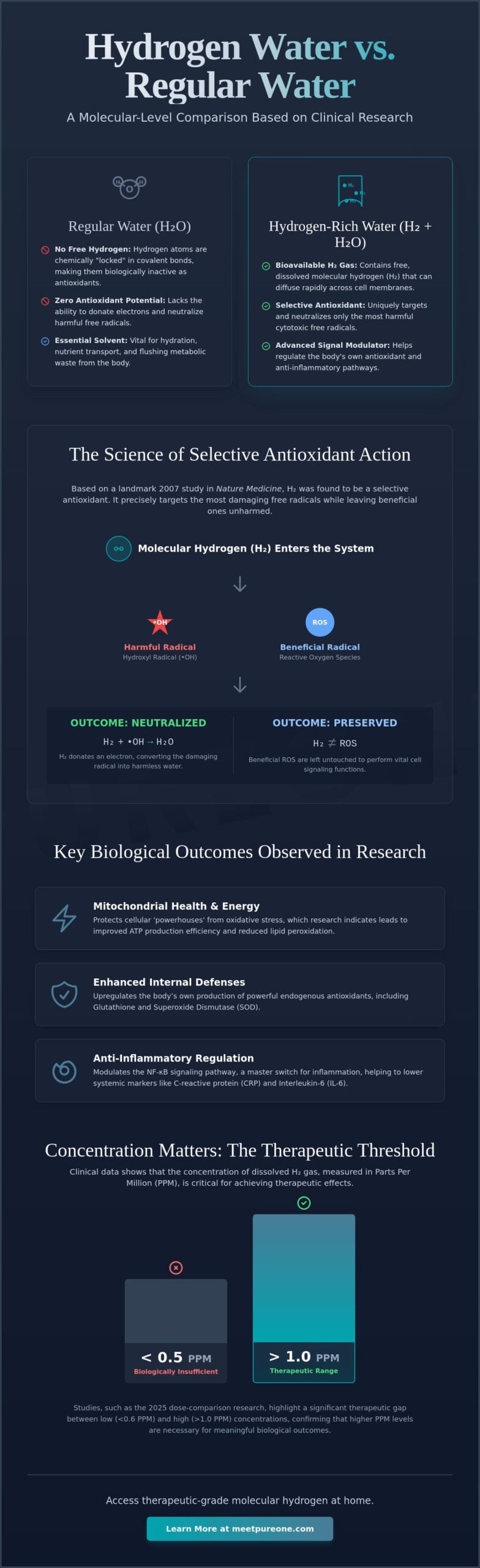
- Identify the critical therapeutic threshold and why concentrations below 0.5 ppm are often insufficient for triggering meaningful biological outcomes according to clinical data.
- Learn why high-concentration gas mixtures, specifically the 66% hydrogen and 33% oxygen ratio, provide a superior dosage for cellular safety and systemic bioavailability.
Understanding the Molecular Distinction: H2O vs. Dissolved H2 Gas
Why doesn’t regular water act like an antioxidant? After all, it’s two parts hydrogen. The answer lies in the covalent bond. In a water molecule, hydrogen atoms are chemically bound to oxygen. They are “stuck.” This stability is great for hydration, but it means those atoms cannot neutralize free radicals. Molecular hydrogen (H2) is entirely different. It is a neutral, non-polar molecule capable of effortless cellular membrane diffusion. When we look at hydrogen water vs regular water, the real difference isn’t the liquid itself; it’s the tiny, dissolved gas molecules waiting to go to work. These gas molecules remain suspended in the water through physical dispersion, creating a solution where the hydrogen is available for biological interaction rather than being locked in a chemical structure.
The Chemistry of “Free” Hydrogen
H2 is a diatomic gas. It’s the smallest molecule in existence. Because it’s so small and carries no charge, it zips through the blood-brain barrier and into the mitochondria with zero resistance. Regular tap or filtered water contains near-zero levels of this dissolved gas. While hydrogen therapy is gaining traction in clinical research, you won’t find these specific benefits in a standard glass of water. The gas must be physically dissolved into the medium at therapeutic concentrations to remain bioavailable. This state of “free” hydrogen allows it to act as a selective antioxidant, a role that bound hydrogen simply cannot fulfill. Key properties of this free gas include:
- Minimal molecular size: Allows for rapid diffusion across all biological barriers, including the blood-brain barrier.
- Non-polar nature: Ensures it can pass through lipid-rich cell membranes without needing a transporter.
- High solubility: Stays suspended in water at concentrations measured in parts per million (PPM) to provide therapeutic effects.
Bioavailability: Why You Can’t Just “Drink More” Regular Water
Standard hydration is a solvent. It moves nutrients and flushes waste. But it has zero antioxidant potential. Hydrogen-rich water carries a negative oxidation-reduction potential (ORP). This means it can actually donate electrons to stabilize unstable molecules. When comparing hydrogen water vs regular water, think of regular water as the delivery truck and H2 as the specialized cargo. Research involving more than 800 clinical studies suggests H2 acts as a signal modulator. It doesn’t just hydrate; it helps regulate cellular responses to oxidative stress. For those looking to implement this at home, using a system like the PureONE Molecular Hydrogen Generator ensures the gas remains suspended long enough for ingestion, providing a level of bioavailability that regular water cannot match.
The Selective Antioxidant Mechanism: What Clinical Research Reveals
The real scientific breakthrough occurred in 2007. Dr. Shigeo Ohsawa and his team published a landmark study in Nature Medicine that redefined our understanding of molecular hydrogen. They discovered that H2 acts as a selective antioxidant. This is a crucial distinction. Unlike traditional vitamins that neutralize all free radicals indiscriminately, hydrogen only targets the most destructive ones. Specifically, it hunts down the hydroxyl radical (•OH). This matters because your body actually needs some reactive oxygen species (ROS) for cellular signaling. Standard antioxidants can sometimes interfere with these healthy processes. When evaluating hydrogen water vs regular water, this selectivity is the defining factor. Regular water provides no such defense. Molecular hydrogen doesn’t just stop at neutralizing radicals; it also upregulates your body’s own defense systems. Clinical data shows it boosts levels of glutathione and superoxide dismutase (SOD), the heavy hitters of internal cellular protection.
Targeting Oxidative Stress at the Mitochondrial Level
Most oxidative damage starts in the mitochondria. Research indicates that H2 protects these powerhouses, leading to improved ATP production efficiency. In trials involving metabolic syndrome patients, researchers observed a significant reduction in lipid peroxidation markers. This means the fats in your cell membranes are less likely to “rust” from oxidative stress. It’s about protecting the cell from the inside out. If you’re curious about how to bring this level of protection into your daily routine, the PureONE Molecular Hydrogen Generator offers a practical way to access these therapeutic concentrations consistently.
Anti-Inflammatory Signaling Pathways
Inflammation isn’t just a feeling; it’s a measurable chemical state. H2 modulates the NF-κB signaling pathway, which acts like a master switch for inflammation. By downregulating this pathway, molecular hydrogen helps lower systemic markers like C-reactive protein (CRP) and Interleukin-6 (IL-6). This has massive implications for physical performance and long-term health. You can see the specific research outcomes in our guide on hydrogen therapy for athletic recovery. In the debate of hydrogen water vs regular water, the ability to influence genetic expression and signaling pathways is what sets molecular hydrogen apart. It’s not just water. It’s a biological signaling molecule.
Bioavailability and Therapeutic Thresholds: Comparing H2 Concentrations
Does the concentration actually matter? In the debate of hydrogen water vs regular water, the amount of dissolved gas is the only metric that dictates biological impact. Clinical research suggests a clear therapeutic threshold exists. If your water contains less than 0.5 parts per million (ppm) of dissolved H2, it likely lacks the potency needed to trigger the antioxidant signaling pathways discussed earlier. A 2025 dose-comparison study confirmed this, showing significant differences in clinical outcomes between 0.6 ppm and 1.0 ppm. Saturation levels in standard atmospheric conditions peak at approximately 1.6 ppm. Regular water sits at 0.0 ppm. Without active infusion, you are simply drinking a solvent without the therapeutic payload.
PPM vs. PPB: Understanding the Metrics of Potency
Reading lab reports shouldn’t require a chemistry degree. You might see results in parts per billion (ppb) instead of ppm. It’s a simple conversion: 1,000 ppb equals 1.0 ppm. Most clinical studies use concentrations between 1.0 and 3.0 ppm to achieve significant results. To reach these higher levels in a liquid, high-pressure infusion is often required to overcome standard saturation limits. When comparing hydrogen water vs regular water, always look for third-party testing that confirms these specific metrics. Without verified data, you are likely overpaying for standard hydration.
The Limitations of Bottled Hydrogen Water
Hydrogen is the smallest molecule in the universe. It’s a literal escape artist. Because of this, bottled products face a massive technical hurdle: gas leakage. Even in specialized aluminum cans, H2 levels begin to drop the moment the product is packaged. Plastic is even worse, as the gas diffuses right through the bottle walls over time. For those seeking maximum potency, making hydrogen water at home ensures you consume the gas before it dissipates into the environment. Freshness is the only way to guarantee you are hitting that 1.6 ppm saturation point. If you want a reliable way to hit these therapeutic markers every time, the PureONE Molecular Hydrogen Generator provides the high-concentration output needed for true cellular support.
Implementing Molecular Therapy: From Water to Inhalation
While drinking H2-rich water is an excellent entry point, it has physical limits. As we established, water saturation peaks around 1.6 ppm under standard conditions. To achieve a higher therapeutic dosage for systemic issues, inhalation is often the preferred clinical route. By bypassing the digestive tract, hydrogen gas enters the bloodstream directly through the lungs. This delivery method allows for a significantly higher volume of H2 to reach the brain and vital organs in a shorter window. When comparing hydrogen water vs regular water, inhalation represents the jump from maintenance to intensive molecular therapy. A key finding in recent research is the efficacy of the 66% hydrogen and 33% oxygen mixture. This specific ratio ensures the body receives a high dose of therapeutic gas while maintaining optimal oxygen saturation for cellular respiration.
The PureONE Molecular Hydrogen Generator is engineered to achieve these consistent therapeutic gas mixtures. By providing a stable output, it allows users to move beyond the limitations of liquid saturation. This is particularly relevant for managing long-term oxidative stress, where higher gas volumes may be required to influence deep-tissue inflammation markers.
The Multi-Modal Approach to Hydrogen
Safety and Long-Term Use
Is it safe for the long haul? The FDA designates molecular hydrogen as “Generally Recognized as Safe” (GRAS). This status applies to concentrations up to 2.14% by volume in beverages, but inhalation is also well-tolerated. Clinical studies for deep-sea diving have shown that even much higher concentrations of hydrogen gas are non-toxic. To maintain this safety profile at home, gas purity is paramount. High-quality systems utilize proprietary condenser technology to ensure the gas is free from byproduct contamination. Using food-grade hydrogen gas with a purity of 99.995% or higher is the standard for ensuring that your journey toward better living remains both effective and clean.
Ready to Upgrade Your Cellular Defense?
The science is clear. When we weigh hydrogen water vs regular water, the difference comes down to the presence of bioavailable, free H2 gas. You’ve seen the data. Regular water is essential for life, but it lacks the selective antioxidant power to target the destructive hydroxyl radical. By reaching therapeutic thresholds above 1.0 ppm, you move from basic hydration to active molecular therapy. It’s about giving your mitochondria the support they need to thrive in an environment full of oxidative stress.
We believe in transparency and evidence-based results. That’s why the PureONE Molecular Hydrogen Generator is manufactured in Canada with proprietary condenser technology. It’s specifically engineered to deliver the 66% hydrogen and 33% oxygen mix that clinical research favors for safety and efficacy. Even Howie Mandel trusts this approach for his daily wellness routine. You don’t have to take our word for it, though. We invite you to verify the logic and see the difference in your own energy levels. Take the leap and experience the PureONE 365-Day Risk-Free Trial today. Your cells will thank you for the upgrade.
Frequently Asked Questions
Is hydrogen water better than regular water for hydration?
Hydrogen water provides the same foundational hydration as regular water but adds a therapeutic signaling molecule to the mix. While regular water acts as a vital solvent for moving nutrients, it lacks the dissolved H2 gas necessary for selective antioxidant activity. In the debate of hydrogen water vs regular water, think of the hydrogen as an added functional benefit. It doesn’t replace the need for hydration; it enhances the biological outcome of every sip you take.
Can I get enough hydrogen just by drinking more regular water?
No, you cannot get therapeutic levels of hydrogen by simply increasing your intake of regular water. The hydrogen atoms in a water molecule are chemically bound to oxygen through strong covalent bonds. These atoms are not bioavailable as antioxidants. To see a physiological change, you need free, dissolved molecular hydrogen gas (H2) that is not part of the H2O structure. Regular water contains virtually zero parts per million of this dissolved gas.
How long does the hydrogen gas stay in the water after it is generated?
Molecular hydrogen is the smallest molecule in existence, which makes it a literal escape artist. Once generated, the gas begins to dissipate into the atmosphere almost immediately. In an open container, most of the therapeutic concentration will be gone within 30 to 60 minutes. To maximize the benefits of hydrogen water vs regular water, it’s best to consume it immediately after generation. Keeping it in a sealed, high-quality aluminum container can slow this process slightly.
Are there any side effects to drinking high concentrations of hydrogen water?
Molecular hydrogen has an excellent safety profile and is designated as Generally Recognized as Safe (GRAS) by the FDA. Because it’s a neutral gas, it doesn’t build up in the system or interfere with normal biological processes. Any excess hydrogen that your body doesn’t use is simply exhaled through the lungs. Research involving deep-sea divers has shown that even inhaling extremely high concentrations of hydrogen gas is well-tolerated with no known toxic effects.
What is the difference between hydrogen water and alkaline water?
Disclaimer
The information provided by Pureffect and any of its products are for educational and informational purposes only and is not intended as medical advice. Individual results may vary, and no specific health outcomes are guaranteed. Always consult a qualified healthcare professional before starting any wellness practice or product.