
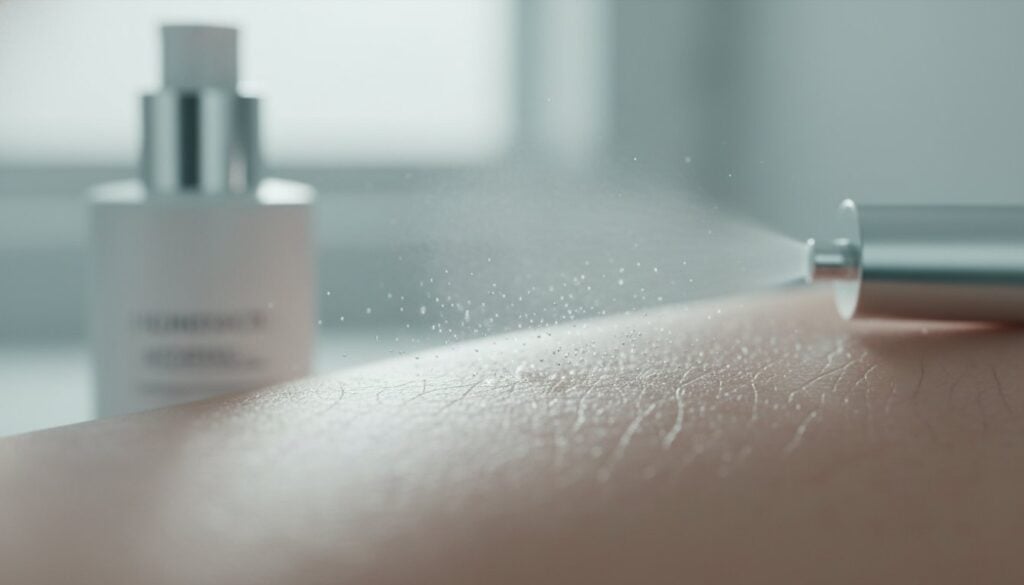
Why do most “deep-acting” skincare treatments struggle to actually get past the surface? It’s a question of physics. Most active ingredients are simply too bulky to bypass the skin’s natural defense system. This is where topical hydrogen therapy changes the conversation. Unlike heavy creams, molecular hydrogen is the smallest molecule in the universe. Its unique size and non-polar nature allow it to move through the stratum corneum via rapid diffusion. This isn’t just another beauty trend; it’s a mechanism of molecular biology that targets oxidative stress exactly where it starts. Pure science, no filler.
You’re likely tired of managing chronic inflammation or waiting for localized injuries to heal. We understand that skepticism. If you’ve tried everything else, you want to see the data. This article dives into the peer-reviewed evidence supporting H2 for skin health. We’ll explore how this tiny gas neutralizes selective free radicals like the hydroxyl radical. We’ll also look at practical applications, from using hydrogen-rich water at 1.6 mg/L to utilizing gas output between 192 and 696 mL/min for localized recovery. Ready to look at the research?
Key Takeaways
- Understand how the non-polar nature of H2 allows it to bypass the skin’s primary barrier without needing complex cellular transporters.
- Discover why topical hydrogen therapy acts as a selective antioxidant, neutralizing cytotoxic hydroxyl radicals while preserving essential cellular signaling.
- Examine peer-reviewed data on how H2 reduces pro-inflammatory cytokines like IL-1β and IL-6 to manage chronic skin inflammation and UV damage.
- Learn how to utilize the PureONE generator to create localized H2-rich mists and soaking solutions for targeted recovery at home.
What is Topical Hydrogen Therapy and Why Does Molecular Size Matter?
Think of topical hydrogen therapy as a precision strike for your skin. It involves applying molecular hydrogen gas or H2-infused liquids, like saline or purified water, directly to the dermis. While drinking hydrogen water is great for systemic health, topical application focuses on achieving localized redox homeostasis. This means we’re balancing oxidative stress exactly where it’s happening, whether that’s a patch of dermatitis or a sore muscle. It’s a targeted approach that addresses tissue-specific damage without waiting for the circulatory system to deliver the goods.
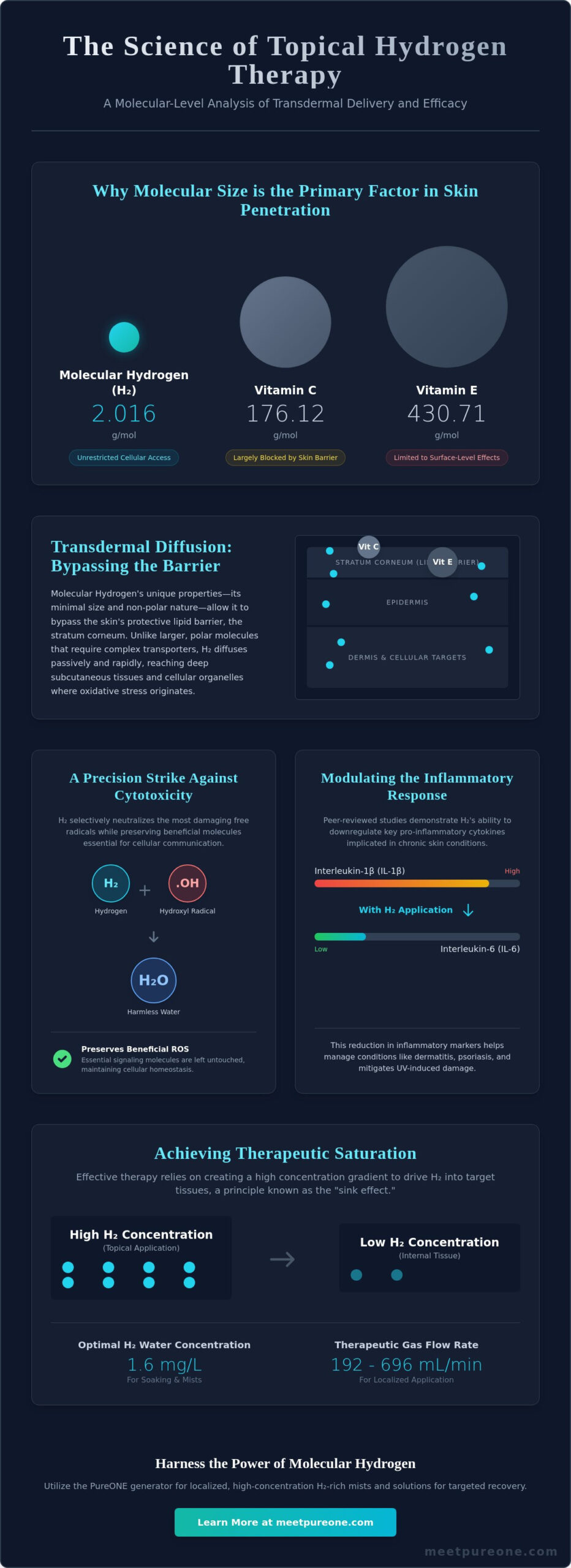
Why do we focus so much on molecular size? It’s simple physics. Molecular hydrogen is the smallest molecule in existence, with a mass of only 2.016 g/mol. Compare that to popular antioxidants like Vitamin C at 176 g/mol or Vitamin E at 430 g/mol. These larger molecules often get stuck on the surface of the skin. Because H2 is so tiny and non-polar, it doesn’t need a “key” or a transporter to enter your cells. It simply diffuses through the lipid bilayers of your cell membranes, reaching the mitochondria and nucleus with ease.
The Chemistry of Selective Neutralization
Hydrogen is a selective scavenger. In a direct chemical reaction, H2 combines with the hydroxyl radical (.OH) to form harmless water: H2 + 2(.OH) → 2H2O. This is a big deal because the hydroxyl radical is the most cytotoxic oxidant in human biology. Many antioxidants are “dumb” and neutralize everything, including beneficial reactive oxygen species (ROS) that your body uses for immune signaling. Hydrogen therapy is “smart.” It leaves those essential signaling molecules alone, maintaining the delicate balance of your cellular communication while removing the real threats. The same selective neutralization of hydroxyl radicals that protects skin cells is also being studied for its role in molecular hydrogen for kidney health, where renal scarring caused by oxidative stress is a primary concern.
Topical vs. Systemic Delivery
Why not just breathe the gas or drink the water? While those methods are vital, they don’t always provide the concentration needed for specific skin conditions or joint inflammation. Topical application creates a high concentration gradient right at the source. Because H2 has such a rapid diffusion rate, it penetrates deep into the subcutaneous layers quickly. Using a tool like the PureONE Molecular Hydrogen Generator allows you to create high-concentration mists or soaking solutions that deliver a potent dose directly to the affected area. It’s about getting the right amount of H2 to the right place at the right time.
The Science of Transdermal Diffusion: How H2 Penetrates the Skin
How does a gas actually get into your skin? It comes down to the physics of diffusion. In topical hydrogen therapy, we rely on a phenomenon known as the “sink effect.” When you apply a high concentration of molecular hydrogen to the skin surface, a steep concentration gradient is created. Because the internal tissues have a much lower H2 concentration, the gas naturally moves inward. This movement continues as long as the external source remains higher than the internal levels. It is a passive, efficient process that doesn’t require your body to expend any energy.
The non-polar nature of H2 is its greatest advantage. Most therapeutic molecules are polar, meaning they have a charge that makes them get stuck in the lipid layers of the cell membrane. They require specific protein channels or transporters to enter a cell. Molecular hydrogen is different. It is entirely non-polar. It slides through cell membranes like a ghost walking through a wall. This allows it to reach the mitochondria and the cell nucleus almost instantly after application.
Overcoming the Stratum Corneum
The stratum corneum is your skin’s primary defense. It’s a lipid-rich extracellular matrix designed to keep things out. Water-soluble antioxidants like Vitamin C struggle here; they often require chemical enhancers or microneedling to reach the deeper dermis. H2 gas molecules are small enough to navigate the interstitial spaces between these skin cells. They move through the lipid matrix without resistance, bypassing the barrier that stops most expensive serums in their tracks.
Concentration Gradients and Saturation
The rate of diffusion is governed by Fick’s Laws, which state that the flux of a molecule depends on the concentration difference. Higher concentrations result in deeper and faster penetration. Temperature also plays a role; warmth increases the kinetic energy of the molecules, further accelerating their movement into the tissue. To achieve therapeutic saturation, you need a consistent and high-output source of the gas. Many Clinical Studies on Hydrogen Therapy highlight that the efficacy of treatment often depends on maintaining these levels over a specific duration. If you want to explore this at home, the PureONE Molecular Hydrogen Generator is designed to provide the steady, high-concentration flow necessary for effective localized saturation.
Clinical Research: Topical H2 for Dermatology and Wound Healing
Does the science back up the physics of diffusion? When we look at clinical trials, the data for topical hydrogen therapy is compelling. For patients struggling with Atopic Dermatitis, research indicates that H2 application significantly suppresses the expression of pro-inflammatory cytokines, specifically IL-1β and IL-6. By downregulating these signals, H2 helps quiet the overactive immune response that leads to chronic itching and redness. It isn’t just masking symptoms; it is modulating the underlying inflammatory pathway at a cellular level.
Wound healing sees similar benefits through the modulation of the inflammatory phase. H2 accelerates the transition to the proliferative phase by promoting the formation of healthy granulation tissue. This is particularly useful for slow-healing localized injuries where oxidative stress is high. Beyond the skin, research into joint health shows that H2 can reduce oxidative markers within synovial fluid. This offers a non-invasive way to manage localized discomfort and joint inflammation without systemic side effects.
H2 for Chronic Skin Conditions
Psoriasis patients have seen notable success with H2-infused baths. In clinical observations, participants who utilized hydrogen-rich water over an 8-week period showed a significant reduction in PASI (Psoriasis Area and Severity Index) scores. Many experienced clearer skin and a marked decrease in scaling. For those focused on aesthetic outcomes, you can explore the Hydrogen Therapy for Skin Rejuvenation guide for a deeper look at anti-aging molecular science.
Localized Inflammation and Recovery
Athletes often use H2 to manage acute injuries like bruises and muscle strains. Applying H2 directly to the affected area helps reduce lactic acid accumulation and lowers oxidative stress within the muscle tissue itself. This leads to faster recovery times and less post-exercise soreness. Specialized care is even possible for sensitive areas; check out the Molecular Hydrogen Benefits for Eyes for details on research-driven ocular therapy. If you’re ready to implement these findings at home, the PureONE Molecular Hydrogen Generator provides the high-output gas needed for effective topical saturation.
Implementation: How to Use the PureONE for Topical Therapy
Ready to bring the lab home? Implementing topical hydrogen therapy doesn’t require a medical degree. It just requires the right equipment and a bit of consistency. While wellness centers charge significant fees for single sessions, the PureONE generator allows for daily, high-concentration application in your own living room. It produces a specific mixture of 66% molecular hydrogen and 33% oxygen. This ratio is vital. While the H2 targets oxidative stress, the O2 supports localized tissue oxygenation, creating a synergistic environment for skin repair and recovery.
To get the most out of your device, follow these research-backed steps:
- Step 1: Preparation. Infuse purified water or saline by bubbling the gas for 10 to 15 minutes. This achieves a saturation near 1.6 mg/L, perfect for mists or soaking.
- Step 2: Application. Use the direct gas mode for intense delivery to specific joints or skin patches. This bypasses the need for a liquid medium entirely.
- Step 3: Protocol. Consistency is key. Aim for 20 to 30-minute sessions. Clinical data suggests that this duration allows for adequate transdermal saturation and peak tissue concentration.
H2-Infused Bathing and Mists
What about the technical window? H2 is a tiny, slippery molecule. In an open container, the concentration begins to drop significantly after 20 to 30 minutes. If you’re using a mist to combat environmental pollutants, apply it immediately after infusion. A three-times-daily misting protocol is an excellent way to neutralize ozone and particulate matter before they trigger a pro-inflammatory response in the dermis.
Direct Gas Application Protocols
Direct gas bagging or cupping provides the highest possible saturation for acute issues. By enclosing the target area, you maintain a high concentration gradient that drives H2 deep into the subcutaneous layers. The proprietary stainless steel condenser in the PureONE ensures the output is cool and medical-grade. It removes excess moisture and potential impurities before the gas reaches your skin, ensuring a pure, comfortable experience every time.
Harnessing the Power of Molecular Diffusion
Why settle for surface-level skincare when you can target oxidative stress at the source? We’ve seen how topical hydrogen therapy works by using the universe’s smallest molecule to bypass skin barriers and reach the mitochondria. It’s about more than just hydration. It’s about neutralizing cytotoxic radicals like the hydroxyl radical and supporting your body’s natural recovery. The peer-reviewed evidence for managing dermatitis and accelerating wound healing is clear. It’s time to put that science to work for you.
The PureONE is manufactured in Canada and features a proprietary condenser to ensure medical-grade purity. It delivers the ideal 66/33 H2-O2 ratio endorsed by health advocates for consistent results. You can explore these benefits at your own pace. We offer a 365-day risk-free trial with a 100% money-back guarantee to ensure you’re completely satisfied. Experience the PureONE Molecular Hydrogen Generator for yourself and see what precision recovery looks like. Your journey toward better living starts with a single, tiny molecule.
Frequently Asked Questions
Is topical hydrogen therapy safe for sensitive skin?
Yes, topical hydrogen therapy is exceptionally safe for sensitive skin because molecular hydrogen is an inert gas with a low toxicity profile. Unlike acidic peels or harsh chemical actives, H2 doesn’t disrupt the skin’s pH or damage the protective lipid barrier. It selectively targets only the most harmful oxidants, making it an ideal choice for those who react poorly to traditional anti-inflammatory treatments. It’s a gentle but technically advanced way to calm reactive tissues without side effects.
How long does it take for hydrogen to penetrate the skin?
Molecular hydrogen begins penetrating the skin almost immediately upon contact. Due to its non-polar nature and extremely low molecular weight, it diffuses through the stratum corneum and into the deeper dermis within minutes. Research suggests that peak concentrations in localized tissues are typically achieved within a 20 to 30-minute session. This rapid diffusion allows for efficient saturation of the target area without the need for chemical penetration enhancers or invasive delivery methods.
Can I use topical hydrogen therapy alongside my current skincare routine?
How often should I apply hydrogen topically for chronic conditions?
For chronic conditions, clinical protocols often suggest daily application to maintain therapeutic levels. Most research-driven guidelines recommend one to three sessions per day, lasting 20 to 30 minutes each. This frequency helps maintain a steady concentration of H2 in the localized tissues, ensuring that oxidative stress is consistently managed. Consistency is vital for long-term redox homeostasis, especially when dealing with persistent inflammation or slow-healing localized injuries that require constant antioxidant support.
What is the difference between topical H2 and drinking hydrogen water?
The primary difference lies in the concentration gradient and target area. While drinking hydrogen water provides systemic antioxidant support for your internal organs, topical hydrogen therapy creates a high concentration of H2 exactly where you need it most. This localized approach allows the gas to saturate specific tissues, such as a sore joint or a patch of dermatitis, much more effectively than the relatively small amount that reaches the skin after being processed through the circulatory system. Those interested in how systemic hydrogen water consumption supports internal organ health may also find the research on molecular hydrogen for kidney health particularly relevant, as the kidneys are among the organs most vulnerable to oxidative damage.
Disclaimer
The information provided by Pureffect and any of its products are for educational and informational purposes only and is not intended as medical advice. Individual results may vary, and no specific health outcomes are guaranteed. Always consult a qualified healthcare professional before starting any wellness practice or product.