
What if the purchase price is only the beginning of your budget? The long-term cost of owning a hydrogen machine can also include electricity and any accessories or replacement parts relevant to your use. It’s reasonable to want a clearer picture before committing, especially when wellness benefits aren’t guaranteed.
A home hydrogen machine isn’t the same as a hydrogen fuel system or a hydrogen-powered car, so their costs and lifespan figures aren’t useful shortcuts for estimating yours. Your actual expenses depend on the specific machine, how often you use it, and the supplies it requires. Electricity costs also vary with your local rate and the machine’s power use.
This guide separates one-time costs from recurring ones and offers a practical way to build a personal ownership budget. We’ll also look at how to weigh features, support, and guarantee terms against uncertain health value, without counting on unverified savings or promises. The goal is a more informed decision based on costs you can identify and the value that matters to you.
Key Takeaways
- Build your long-term cost of owning a hydrogen machine from the purchase price, verified running costs, relevant accessories, and the period you expect to use it.
- Estimate electricity spending with the machine’s verified wattage, your expected hours of use, and your electricity rate, rather than relying on a generic estimate.
- Separate what a machine demonstrably does from health outcomes, and assess wellness research by its study design, participants, findings, and limitations.
- Compare PureONE’s four usage modes with the ways you’d actually use a machine to judge which features matter to you.
- Review ownership terms as well as features: PureONE’s 365-day money-back guarantee covers the machine, while shipping costs are not refundable.
What Does the Long-Term Cost of Owning a Hydrogen Machine Include?
The long-term cost of owning a hydrogen machine is the purchase price plus any relevant expenses during the time you use it. Some costs happen once; others may recur. Not every owner will need every accessory or replacement part. Start with the specific machine and your intended use, rather than a generic estimate for “hydrogen.”
Household machine ownership costs depend on use and verified product-specific expenses. A home-use device isn’t an industrial hydrogen production system, a storage installation, or a hydrogen car. Those systems have different designs and cost drivers. The overview of hydrogen technologies and production methods can help explain why large-scale production and infrastructure costs belong to a different category.
Which costs belong in a household hydrogen machine budget?
Separate potential expenses, and include only categories that apply to the model you’re considering:
- Machine purchase: the initial cost of acquiring the device.
- Electricity: an ongoing expense based on verified power consumption, how often and how long you use the machine, and your household electricity rate.
- Accessories: include items relevant to your planned use, and note whether they’re included or purchased separately.
- Replacement parts: budget for these only if the product information identifies parts that may need replacing.
Don’t automatically add subscriptions, routine maintenance, or consumables. Include them only when they apply to the particular machine and are supported by its product information. For a household estimate, verified details matter more than assumptions.
Why hydrogen fuel and hydrogen-car costs are different
Industrial systems involve production, storage, and infrastructure considerations. Hydrogen-car ownership adds vehicle-related expenses and refuelling. Neither provides a direct cost estimate for a tabletop home-use machine like PureONE. The equipment, purpose, and use patterns differ, so importing those figures can make a household budget misleading.
PureONE is a home-use machine that produces a mixed gas stream of approximately 66% hydrogen and 33% oxygen. Its product details provide a more relevant starting point for assessing this specific device. For another household comparison, see Hydrogen Inhalation Machine vs. Water Bottle: Which Is Right for You?. The formats differ, and the right cost categories depend on how you plan to use your machine.
How to Estimate a Hydrogen Machine’s Long-Term Running Costs
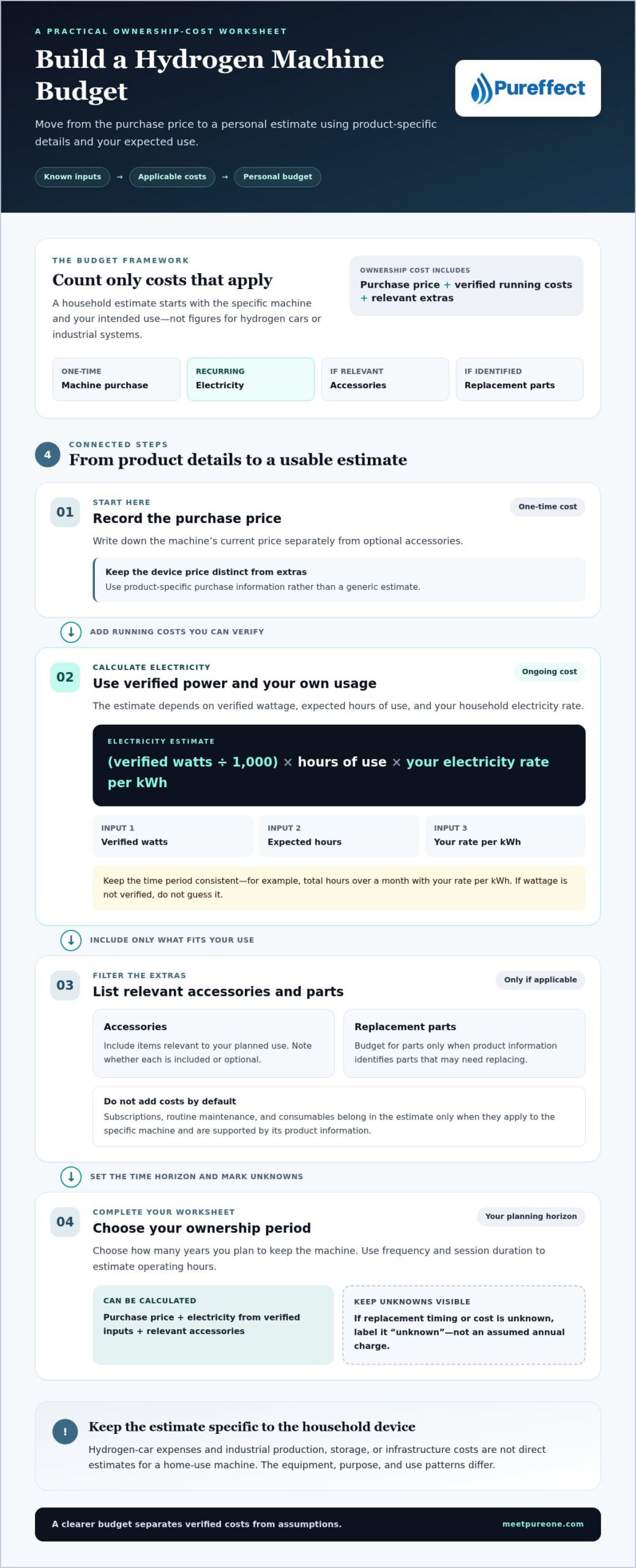
A useful estimate doesn’t need guessed numbers. It needs clear inputs and a note of what’s still unknown. Use this four-step worksheet to build a personal ownership budget, then update it when you have product-specific information.
A practical ownership-cost worksheet
- Record the purchase price. Write down the machine’s current price separately from optional accessories. For PureONE’s product and purchase information, use its product details and pricing.
- Add verified running costs. For electricity, use this formula: (verified watts ÷ 1,000) × hours of use × your electricity rate per kWh. Keep the time period consistent. For example, estimate total hours over a month and use your rate per kWh. Don’t enter a machine wattage unless it’s verified.
- List relevant accessories. Include only accessories that apply to your intended use, and note whether they’re included or optional. Leave out purchases you don’t expect to make.
- Set your ownership period. Choose how many years you plan to keep the machine. If replacement parts might be needed but their timing or cost is unknown, mark them “unknown,” not as an assumed annual charge.
A specific running-cost estimate isn’t reliable without verified power data, expected hours of use, and your electricity rate. The U.S. Department of Energy’s overview of hydrogen production methods and costs covers broader production considerations, but those figures aren’t a substitute for a household device’s verified electricity use.
What changes the total from one owner to another?
Use frequency and session duration determine total operating hours, so two households can get different electricity estimates even with the same machine. The modes you use can also affect which accessories are relevant and how you plan to use the device. Don’t assume one mode costs more to run than another without product-specific power information.
Keep the budget separate from expectations about wellness results. For research context, The Science of Hydrogen Therapy for Athletic Recovery: A Research-Driven Guide discusses evidence in that area. Research findings aren’t a financial guarantee or a promise of personal results. Once you’ve filled in the known inputs, your estimate will show what you can calculate and what remains unknown.
Does the Potential Wellness Value Justify the Long-Term Cost?
A machine’s functions can be described and measured. A guaranteed health outcome is different. Research on molecular hydrogen is still developing, so a product feature or a result in one study can’t predict what an individual buyer will experience. That distinction matters when weighing the long-term cost of owning a hydrogen machine against possible wellness value.
How to assess research without turning it into a promise
Start with peer-reviewed human studies that examine the form of hydrogen use and outcome you care about. For example, Aoki and colleagues’ 2012 pilot study in Medical Gas Research used a randomized, double-blind crossover design with 10 male soccer players. It examined hydrogen-rich water around acute exercise and reported differences in blood lactate and muscle function measures. The small, specific group and short-term exercise setting limit what the findings can say about other people, other uses, or long-term health.
Before relying on a study, check the original paper for its sample size, duration, comparison group, and measured outcomes. A preliminary finding is a reason for further research, not an established clinical conclusion. For foundational context, see What is Molecular Hydrogen? The Science of Cellular Health in 2026, while keeping individual study results in perspective.
How to decide what value means for you
Consider how you’d actually use the machine. PureONE offers four modes: drinking infused water, applying infused water to skin, applying gas to the body, and inhaling gas. These are usage options, not evidence that a particular health outcome will follow. A product specification describes what a device does; it doesn’t establish clinical efficacy.
Then compare your personal budget with the costs you can verify and the value you place on having those options at home. A trial and public-figure endorsements don’t prove that a product will work for you. PureONE’s 365-day money-back guarantee covers the machine, but shipping costs aren’t refundable. The guarantee can reduce purchase risk, but it can’t guarantee wellness results or a personal return on investment.
For a closer look at PureONE’s features and current purchase information, review the PureONE machine and weigh its functions against your priorities.
What to Consider Before Owning PureONE Long Term
Long-term fit is about more than which functions sound appealing. Consider how the machine would fit into your home routine, where you’d place a tabletop device, and which product details matter in everyday use. PureONE is made in Canada and has an integrated proprietary stainless-steel condenser that is 80 times more efficient than PVC and eliminates the external tower. Those design details may matter when you’re considering the machine’s footprint and setup. Check the product information for the dimensions and other specifications that matter to you.
Which PureONE features matter to long-term use?
If you plan to use the included bubbler, its stated performance can help you assess whether it suits your routine: it infuses one litre of water in 10 minutes at 100% duty cycle, yielding about 0.8 ppm dissolved molecular hydrogen. The water reaches maximum saturation at that point, so a longer infusion won’t increase the ppm. Treat this as a product specification, not a prediction of a health effect or a reason to extend use unnecessarily.
For a considered ownership decision, distinguish features you expect to use from those you may rarely need. That keeps optional spending and your personal value assessment tied to actual plans, rather than assumptions about future use. If a feature’s role in your routine isn’t clear, leave it out of your budget until you have a reason to include it.
How the guarantee and support inform a buying decision
Support and purchase terms are useful parts of the ownership picture. Phone and email support are provided by Molecular Hydrogen Institute-certified H₂ advisors with at least three years of hands-on expertise. Read the guarantee terms alongside the product details, and consider what the stated policy covers without treating it as evidence of wellness outcomes.
When you’re ready to compare those details with your priorities, review PureONE’s features and purchase information. A clear decision comes from matching product information to your intended use and budget.
Make Your Next Step a Confident One
The right decision isn’t about finding a universal answer. It’s about deciding whether the machine’s documented features fit your routine, whether the expenses you can verify fit your budget, and whether you’re comfortable with uncertainty around personal wellness outcomes. That’s a more useful test than assuming a purchase will pay for itself or deliver a particular result.
Before you commit, review the product information alongside your ownership worksheet. Revisit any costs you’ve marked unknown, and keep your expectations grounded in what research can show. This puts the long-term cost of owning a hydrogen machine in context: a decision shaped by your usage, budget, and priorities, not just a number.
If PureONE is on your shortlist, explore PureONE’s features and 365-day guarantee to assess whether it suits your plans. Review the product details and make your decision based on the features and costs that matter to you.
Frequently Asked Questions
How much does it cost to run a hydrogen machine?
There’s no single running-cost figure that applies to every household. The amount depends on the particular machine and how you use it. For a useful estimate, use device-specific information rather than figures for a hydrogen car or another type of product. Keep running costs separate from the machine’s purchase price, and revisit your estimate if your routine changes.
Does a home hydrogen machine need replacement parts or ongoing purchases?
That depends on the model and its stated product requirements. Review what comes with the machine and distinguish included items from optional accessories. Don’t assume a part needs replacing on a regular schedule unless the product information gives a replacement interval. If you’re tracking ownership expenses, keep receipts for additional purchases so you can compare actual spending with your initial budget.
Is a hydrogen machine the same as a hydrogen fuel cell car?
No. A household hydrogen machine is a home-use device, while a hydrogen fuel cell car is a vehicle. Their purposes and ownership expenses differ, so vehicle purchase or refuelling figures aren’t a sound basis for estimating a home device’s running costs. Compare home-use formats instead, focusing on how each fits your routine and what its product information says is included.
Does PureONE produce pure hydrogen?
No. PureONE produces a mixed gas stream of approximately 66% hydrogen and 33% oxygen, rather than pure hydrogen alone. When comparing product descriptions, look for the stated gas composition and distinguish it from shorthand labels that may simply say “hydrogen.” That helps you compare what a device produces with what you expect from its description.
What does PureONE’s 365-day money-back guarantee cover?
It covers a full refund for the machine after a year of use; shipping costs aren’t refundable. Keep the machine refund distinct from other spending in your personal budget. The guarantee concerns the machine purchase, not a promised health outcome. Reading the terms before purchasing can help you understand the stated coverage and account for the non-refundable shipping cost.
Can research tell me whether a hydrogen machine will be worth the cost for me?
Research can inform your judgment, but it can’t predict your personal results or establish your individual return on investment. Check whether a study’s participants, type of hydrogen use, and measured outcome are relevant to your question. Before deciding, write down what evidence would matter to you, then assess the findings against that standard rather than relying on testimonials or product specifications alone.
Disclaimer
The information provided by Pureffect and any of its products are for educational and informational purposes only and is not intended as medical advice. Individual results may vary, and no specific health outcomes are guaranteed. Always consult a qualified healthcare professional before starting any wellness practice or product.