

Molecular hydrogen isn’t just another general antioxidant; its real power comes from being a selective signaling molecule capable of crossing the blood-brain barrier. It’s exhausting to wade through wellness blogs that promise the world without showing the receipts. You want to know if this is a legitimate breakthrough or just another expensive trend. We’ve sifted through the noise to bring you the scientific evidence for hydrogen therapy based on over 2,000 publications and 100 clinical trials.
Do you ever feel overwhelmed by dense medical journals? We understand. This review examines the specific biological pathways H2 influences, such as its ability to neutralize hydroxyl radicals and peroxynitrite without disrupting essential signaling molecules. We’ll look at 2024 meta-analyses showing improved recovery and clinical data regarding survival rates in stage IV lung cancer patients. By the end, you’ll identify the most effective concentrations and delivery methods to support your cellular health with confidence. It’s time to replace the guesswork with peer-reviewed data.
Key Takeaways
- Learn how H2 acts as a selective antioxidant. We’ll explain how it targets the hydroxyl radical while leaving your body’s essential signaling molecules alone.
- Explore the scientific evidence for hydrogen therapy found in human trials. Discover specific findings regarding cholesterol profiles, glucose tolerance, and cognitive health.
- Why is inhalation often the best choice for neurological support? Compare the bioavailability of different delivery methods to see which one delivers the highest peak concentrations.
- Identify the exact “dosage” and session lengths used in clinical research. We’ll show you how to apply these evidence-based protocols in your own home with confidence.
The Molecular Mechanism: How H2 Functions as a Selective Antioxidant
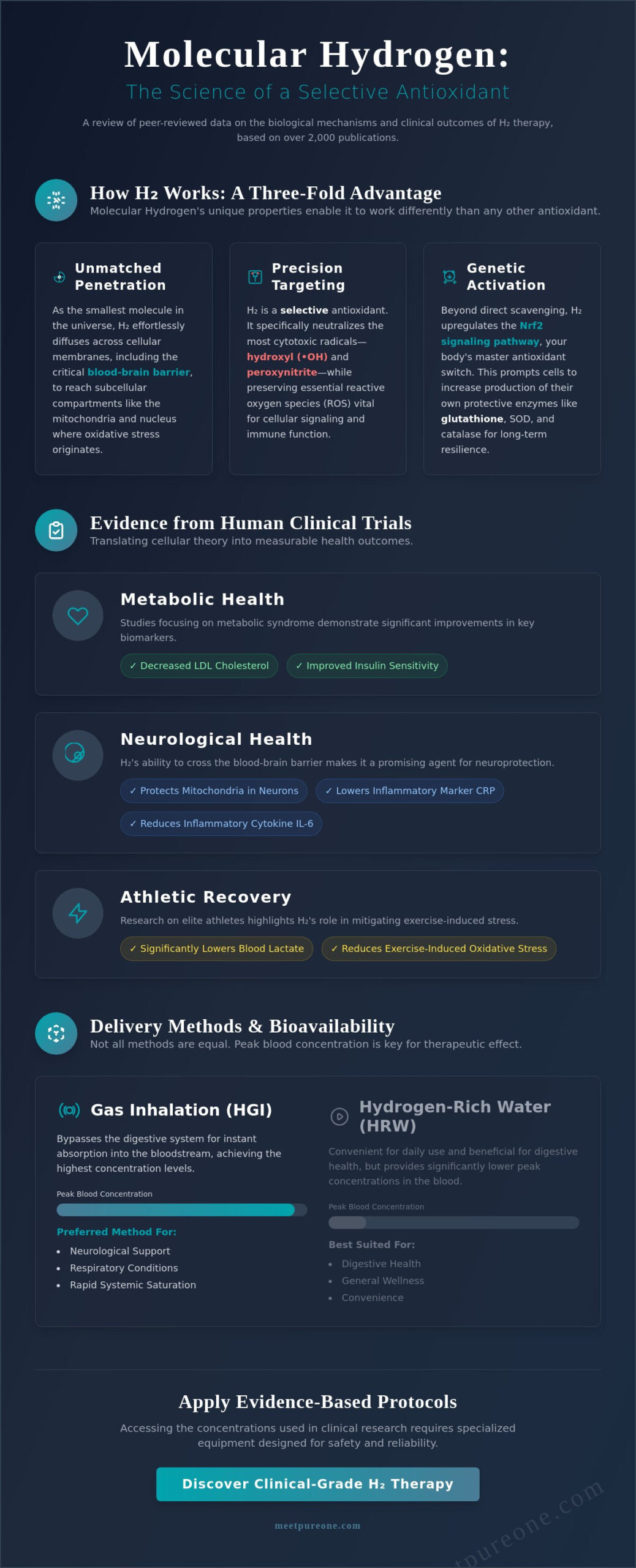
Why does size matter in cellular health? Hydrogen is the smallest molecule in the universe. This unique physical property allows it to diffuse effortlessly through cellular membranes and penetrate the blood-brain barrier. While larger antioxidants often struggle to reach the mitochondria or the nucleus, H2 moves through your body like a ghost through walls. This accessibility is a cornerstone of the scientific evidence for hydrogen therapy, ensuring that the molecule reaches the very heart of oxidative stress where damage often starts.
Most traditional antioxidants, like Vitamin C, act as broad-spectrum scavengers. They neutralize free radicals, but they don’t always discriminate between the harmful ones and those your body actually needs. Your cells use certain reactive oxygen species (ROS) for vital signaling and immune function. If you wipe them all out, you might inadvertently disrupt your body’s natural communication lines. H2 is different. It functions as a selective scavenger, specifically targeting the highly reactive hydroxyl radical (•OH) and peroxynitrite. Hydrogen therapy research suggests this precision prevents the “antioxidant paradox” where excessive supplementation hinders cellular signaling. The selective nature of H2 is its primary differentiator from other antioxidant therapies, acting as a precision tool rather than a broad-spectrum supplement. To understand the precise biological pathways behind this selectivity, including how it modulates chronic inflammation at the cellular level, explore our detailed breakdown of the hydrogen gas mechanism for reduction in inflammation.
Activation of the Nrf2 Signaling Pathway
Human Clinical Trials: Evidence for Metabolic and Neurological Health
How does molecular hydrogen translate from cellular theory to human reality? The shift from lab benches to bedside observations has produced a compelling body of scientific evidence for hydrogen therapy. In the context of metabolic syndrome, trials have focused on cholesterol profiles and glucose tolerance. A comprehensive review of clinical trials on hydrogen therapy documents that regular H2 intake can lead to a measurable decrease in low-density lipoprotein (LDL) cholesterol. It also improves insulin sensitivity. These aren’t just vague wellness claims; they’re data points reflected in blood panels.
Neurological research is equally promising. Because H2 crosses the blood-brain barrier so easily, it can target mitochondrial oxidative stress within neurons. This neuroprotective effect is currently being studied for its impact on Parkinson’s disease and cognitive decline. In fact, a clinical study on H2 inhalation for mild cognitive impairment is set to begin in January 2026. By protecting the mitochondria, hydrogen helps maintain the energy production necessary for brain health. It also addresses systemic inflammation by lowering markers like C-reactive protein (CRP) and Interleukin-6 (IL-6). To replicate the high-concentration environments used in these studies, many researchers use specialized equipment. The PureONE Molecular Hydrogen Generator provides a reliable way to access these evidence-based concentrations at home.
Hydrogen Therapy for Athletic Recovery and Fatigue
Athletes are often the first to adopt new science. Research on elite competitors shows that H2 can significantly lower blood lactate levels after strenuous activity. Lower lactate means less muscle burn and a quicker return to peak performance. This reduction in exercise-induced oxidative stress is a pillar of the scientific evidence for hydrogen therapy. For a more detailed look at the data behind physical performance, explore our guide on The Science of Hydrogen Therapy for Athletic Recovery.
Delivery Methods: Comparing Inhalation, Ingestion, and Topical Application
Research published in Frontiers in Physiology on the molecular mechanisms of hydrogen therapy suggests that systemic saturation is key for chronic issues. Inhalation allows for sustained levels of H2 that ingestion simply can’t match. For localized concerns, topical application is gaining traction in dermatology. Studies show it helps with skin rejuvenation and reducing inflammation by delivering H2 directly to the dermal layers. To achieve these clinical-grade concentrations at home, you need equipment capable of high-flow delivery. You can explore the PureONE Molecular Hydrogen Generator to see how it bridges the gap between clinical research and daily wellness.
The Synergy of Hydrogen and Oxygen (Brown’s Gas)
Why use a 66/33 ratio? This specific mixture contains 66% hydrogen and 33% oxygen. It’s designed to support mitochondrial respiration while you’re receiving the antioxidant benefits of H2. During long-duration sessions, maintaining oxygen levels is critical to prevent hypoxia. This ratio ensures your cells have the fuel they need for energy production while H2 selectively neutralizes reactive oxygen species. It’s a balanced approach that maximizes cellular efficiency based on the latest scientific evidence for hydrogen therapy. By providing both the “shield” of hydrogen and the “fuel” of oxygen, you’re supporting the body’s foundational health at the mitochondrial level.
Practical Application: Implementing Evidence-Based Protocols at Home
Ready to move from theory to practice? Translating the scientific evidence for hydrogen therapy into a home routine requires a focus on consistency and precision. Most clinical trials utilize session lengths ranging from 30 to 60 minutes. Depending on your specific health goals, researchers often recommend a frequency of once or twice daily to maintain cellular saturation. It’s not about a one-time mega-dose. Instead, it’s a steady, rhythmic approach that mimics the successful protocols seen in metabolic and neurological studies.
Purity is non-negotiable. To ensure the gas you’re inhaling is stable and free from contaminants, the equipment matters. A proprietary stainless steel condenser is essential for maintaining gas purity and preventing moisture buildup in the delivery lines. This technical detail ensures you’re receiving exactly what the research prescribes. Safety is another strong point; molecular hydrogen has been designated as “Generally Recognized As Safe” (GRAS) by the FDA for concentrations up to 2.14%, and numerous studies report no chronic or toxic effects. If you’re looking to target specific areas, you can explore the PureONE shop for specialized accessories like eye goggles or skin applicators that expand the utility of your device.
What to Look for in a Molecular Hydrogen Generator
To replicate the environments found in human clinical trials, your generator must provide a consistent 66/33 gas mixture. This specific ratio of hydrogen to oxygen is what researchers use to support mitochondrial function while mitigating oxidative stress. High-purity materials are also vital. Using medical-grade components prevents the introduction of unwanted byproducts during gas production. When you choose a device that prioritizes these engineering standards, you’re ensuring the scientific evidence for hydrogen therapy actually applies to your personal results. It’s about bringing the lab home without compromising the data.
Your Path to Evidence-Based Wellness
Ready to put the data to work? We’ve explored how molecular hydrogen acts as a precision shield for your cells. It doesn’t just block everything. It targets the most toxic radicals while leaving your body’s natural signaling alone. From metabolic improvements to neuroprotective potential, the scientific evidence for hydrogen therapy is robust and growing. It’s no longer a question of “if” it works, but how you’ll choose to use it. Why settle for guesswork when you can use the same concentrations found in clinical research?
You can experience the research-backed power of the PureONE Hydrogen Generator. It’s the same device endorsed by Howie Mandel. We manufacture it right here in Canada using our proprietary condenser technology to ensure gas purity. Because we believe in the science, we offer a 365-day risk-free trial. You have a full year to see the results for yourself. It’s time to take charge of your cellular health with confidence. We’re excited to be your partner in this discovery.
Frequently Asked Questions
Is there real scientific evidence that hydrogen therapy works for humans?
Yes, there are over 2,000 scientific publications and more than 100 clinical trials investigating its therapeutic potential. These studies cover everything from athletic recovery to chronic metabolic health. For example, a 2024 systematic review found that hydrogen supplementation effectively enhances antioxidant capacity during intermittent exercise. This growing body of scientific evidence for hydrogen therapy moves the conversation from simple theory to documented clinical outcomes in human subjects.
Can hydrogen therapy cross the blood-brain barrier?
Hydrogen is the smallest molecule in the universe, which allows it to diffuse effortlessly across the blood-brain barrier. Most larger antioxidants struggle to reach the central nervous system, but H2 penetrates cellular membranes and reaches the mitochondria within neurons easily. This unique accessibility is why researchers are currently conducting trials for neurological conditions like mild cognitive impairment, with new studies scheduled to begin as early as January 2026.
What is the most effective way to take molecular hydrogen?
The most effective method depends on your specific goals, but gas inhalation offers the highest peak concentrations in the blood. While drinking hydrogen-rich water is excellent for metabolic support, inhalation allows for systemic saturation by bypassing the digestive tract entirely. This makes it the preferred choice for targeting the brain and respiratory system. The scientific evidence for hydrogen therapy suggests that inhalation provides the sustained levels needed for deep cellular repair.
Are there any side effects or risks associated with hydrogen inhalation?
Molecular hydrogen has a remarkable safety profile and is designated as Generally Recognized as Safe (GRAS) by the FDA. Numerous studies have reported no chronic or toxic effects even at concentrations much higher than those used for therapy. It doesn’t build up in your system because any excess gas is simply exhaled through the lungs. It’s a non-toxic, non-reactive molecule that selectively targets only the most harmful free radicals. For a deeper look at how this selectivity works to combat chronic inflammation specifically, see our 2026 guide on the hydrogen gas mechanism for reduction in inflammation.
How long does it take to see results from hydrogen therapy based on research?
Timelines vary by condition, but many clinical trials show measurable changes within weeks. For instance, a study on liver cancer patients found that daily use for six weeks significantly reduced radiation side effects like appetite loss. In athletic settings, some recovery benefits are reported almost immediately after a session. Consistency is the most important factor. Most evidence-based protocols suggest daily use for at least 30 to 60 days to evaluate long-term shifts.
Disclaimer
The information provided by Pureffect and any of its products are for educational and informational purposes only and is not intended as medical advice. Individual results may vary, and no specific health outcomes are guaranteed. Always consult a qualified healthcare professional before starting any wellness practice or product.