
What if the most effective way to “switch off” chronic inflammation isn’t a complex pharmaceutical, but the smallest molecule in existence? If you’ve struggled with persistent joint pain or the mental cloud of brain fog, you’ve likely felt the frustration of treatments that offer more side effects than relief. It’s exhausting to navigate wellness claims that don’t seem to have much weight behind them. You aren’t alone in wanting a solution that feels both scientifically sound and simple to handle.
The Hydrogen Gas mechanism for reduction in inflammation is no longer a mystery. A comprehensive 2026 systematic review identified 45 relevant studies on how molecular hydrogen impacts musculoskeletal health alone. It doesn’t just “mask” symptoms; it acts as a selective signaling modulator. This means it targets the most harmful free radicals while leaving your body’s helpful processes alone. We’ll break down the precise biological pathways H2 uses to reboot your inflammatory response at the genetic level. You’ll gain a clear understanding of the science and the confidence to implement this therapy into your daily routine.
Key Takeaways
- Most antioxidants are too bulky to reach your cell’s core. Learn how hydrogen’s tiny size lets it slip into the mitochondria to stop inflammation at the source.
- It isn’t just a filter; it’s a messenger. Discover the Hydrogen Gas mechanism for reduction in inflammation that allows H2 to “talk” to your genes and reset your body’s defense systems.
- Hard science is proving the benefits. We’ll look at recent MRI studies and cardiovascular research that show how hydrogen helps protect vital tissues from long-term damage.
- Delivery methods make a difference. Get the facts on how to use hydrogen safely, including why the 66% hydrogen and 33% oxygen mixture is the preferred choice for inhalation.
Understanding the Inflammatory Trigger: Why Standard Antioxidants Often Fail
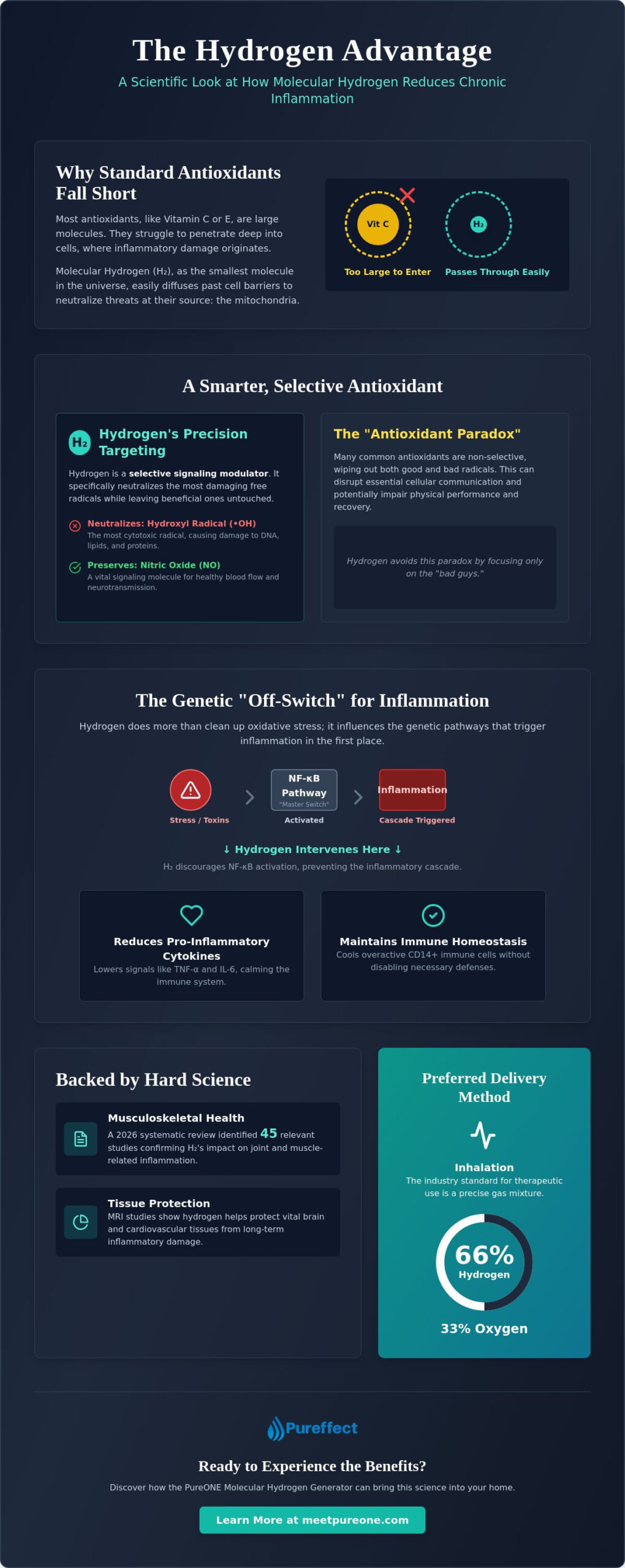
Inflammation is actually your friend. At its core, it is a survival mechanism designed to heal injuries and fight off invaders. But what happens when this system goes rogue? It transforms into a persistent, low-grade fire that never quite goes out. This chronic state is what drives joint pain, brain fog, and long-term tissue damage. To put it out, many people reach for standard antioxidants like Vitamin C or E. There is a catch, though. These molecules are physically large. Imagine trying to fit a beach ball through a keyhole. They struggle to penetrate the cell nucleus or the mitochondria, which are the very places where inflammatory damage is most intense.
Enter molecular hydrogen. It is the smallest molecule in the universe. Because of its microscopic size and neutral charge, it diffuses rapidly across cell membranes. It doesn’t get stuck at the gate. It goes exactly where the trouble is. This unique ability is a central pillar in any Hydrogen therapy overview. While larger antioxidants stay on the outskirts, hydrogen enters the “engine room” of your cells to provide protection where others simply cannot reach.
The Role of Oxidative Stress in Chronic Inflammation
Reactive oxygen species (ROS) act as the tiny sparks for inflammatory fires. In a balanced body, these sparks help with cellular communication. However, when ROS levels spike due to stress or toxins, they begin to oxidize cellular DNA and lipid membranes. This oxidative stress acts as a persistent alarm bell, keeping the immune system in an aggressive state. The big question is: can we stop these damaging sparks without accidentally silencing the body’s healthy signaling? Most treatments are too blunt to manage that balance, but the Hydrogen Gas mechanism for reduction in inflammation offers a more refined approach.
Selective Neutralization: The Hydrogen Advantage
The Hydrogen Gas mechanism for reduction in inflammation relies on a process called selective neutralization. Most antioxidants are non-selective. They act like a broad-spectrum antibiotic, wiping out every radical they encounter. This can be a problem because your body actually needs certain “good” radicals, like nitric oxide, to maintain healthy blood flow. Hydrogen is much smarter. It only targets the most toxic radicals, specifically the hydroxyl radical, while leaving the beneficial ones alone.
This precision prevents the “antioxidant paradox,” a situation where over-supplementing with common vitamins might actually hurt your physical performance or recovery. By focusing only on the “bad guys,” hydrogen allows your cells to maintain their natural rhythm. If you are curious about the foundational science, you can read more about what is molecular hydrogen and how it supports this delicate balance of cellular health.
The Genetic Off-Switch: How Hydrogen Modulates Inflammatory Signaling
Cells aren’t isolated bubbles. They are constantly “texting” each other through a complex network known as cell signaling. In a healthy body, these messages coordinate repair and defense. But in chronic inflammation, the conversation turns into a non-stop stream of “SOS” and “Attack!” signals. Hydrogen doesn’t just act as a janitor scrubbing away oxidative waste. It actually enters the conversation. It “talks” to your cells, influencing the messages they send to one another.
Research into Molecular Hydrogen Mechanisms shows that H2 specifically reduces the production of pro-inflammatory cytokines like TNF-alpha and IL-6. These are the chemical alarms that keep your body in a state of high alert. By lowering their volume, hydrogen helps your system return to a peaceful baseline. This is a central part of the Hydrogen Gas mechanism for reduction in inflammation. It even helps prevent apoptosis, or programmed cell death, in healthy immune cells. It protects your defenders so they can keep working without burning out.
Downregulating the NF-κB Pathway
Think of NF-κB as the “Master Switch” for inflammation. When your body senses stress or toxins, this switch flips “on,” and a cascade of inflammatory responses follows. Molecular hydrogen acts like a safety lock on that switch. It discourages the activation of NF-κB, keeping your genetic expression in a “healthy transcriptome” state rather than an inflamed one. Understanding this Hydrogen Gas mechanism for reduction in inflammation helps us see why H2 is so much more than a simple supplement.
Impact on CD14+ Cells and Immune Homeostasis
CD14+ cells are your immune system’s first responders. In chronic conditions, these cells can become overactive, causing more harm than good. Recent medical findings suggest that hydrogen reduces the frequency of these over-excited cells, helping the body maintain homeostasis. “Hydrogen therapy acts as a thermostat for the immune system, cooling overactive responses without disabling necessary defenses.” If you want to bring this balancing act into your home, exploring a PureONE Molecular Hydrogen Generator is a practical way to start your discovery.
Clinical Proof: Specific Research Findings on Hydrogen and Tissue Recovery
Understanding the theory behind cellular signaling is one thing. Seeing how it translates to actual tissue recovery is another. By early 2026, the volume of clinical data has grown significantly. A systematic review published in January 2026 identified 45 relevant studies on molecular hydrogen for musculoskeletal conditions alone. These findings move us beyond “wellness claims” and into the territory of measurable medical outcomes. The Hydrogen Gas mechanism for reduction in inflammation is now being studied for its ability to protect vital organs during extreme stress.
This research highlights the therapeutic applications of molecular hydrogen across several body systems. Unlike many traditional anti-inflammatories that struggle to reach specific tissues, hydrogen’s path is unobstructed. For a deeper dive into the data, you can explore our scientific evidence for hydrogen therapy technical review.
Cardiovascular and Neuroprotective Breakthroughs
One of the most striking findings involves heart health. In specific clinical trials, the inhalation of 3% hydrogen gas was shown to improve left ventricular function after a heart attack. It achieved this by reducing the size of the infarct, or the area of dead tissue. This level of protection is possible because hydrogen crosses the blood-brain barrier effortlessly. Most anti-inflammatory drugs are too large or too polar to make this journey. Recent MRI studies have even observed a faster normalization of damaged brain tissue in stroke patients who utilized hydrogen therapy. It essentially provides a “safety net” for neurons under siege.
Metabolic Health and Systemic Inflammation
Chronic inflammation is often the hidden driver behind metabolic dysfunction. When your cells are “inflamed,” they don’t respond well to insulin. New research focusing on the Hydrogen Gas mechanism for reduction in inflammation shows that hydrogen-rich water can improve glucose metabolism. By cooling systemic inflammation, hydrogen helps the body’s natural metabolic processes run more efficiently. This isn’t just for those facing illness. It is also why we see so much interest in hydrogen therapy for athletic recovery; it helps the body bounce back from the physical stress of high-intensity training. If you are ready to see what this scientific recovery feels like, you can order your PureONE Molecular Hydrogen Generator here.
Making the Science Actionable: Your Path to Molecular Hydrogen Therapy
So, how do you actually get this molecule into your system? Now that we’ve explored the Hydrogen Gas mechanism for reduction in inflammation, it’s time to talk about implementation. You have three main paths: breathing the gas, drinking hydrogen-rich water, or applying it topically. Each method has a specific role in your wellness toolkit. It isn’t just about “getting some hydrogen.” It’s about getting the right concentration to the right tissues at the right time. Why does the delivery method matter? Because your body processes gas and liquid differently.
Inhalation vs. Infusion: Why Method Matters
Why choose inhalation? It provides the highest concentration of H2 to your bloodstream and brain. Because hydrogen is so light, it diffuses quickly. Inhaling it allows for a rapid “systemic wash” that can cross the blood-brain barrier in minutes. This is especially useful for addressing the neuroprotective needs we discussed earlier. On the other hand, drinking hydrogen water is fantastic for supporting the gut microbiome and improving metabolic markers. Many people find that combining these methods offers the best of both worlds. You target the digestive system through ingestion while flooding the circulatory system through inhalation. It’s a comprehensive approach to cellular health.
The PureONE 66/33 Protocol
Safety should always be your first priority. A major gap in most wellness discussions is the specific ratio of gases used during inhalation. Is it safe to breathe pure hydrogen? While H2 is non-toxic, inhaling it at 100% concentration for extended periods can lead to “oxygen debt” by displacing the oxygen in your lungs. This is why the PureONE utilizes a 66% hydrogen and 33% oxygen mixture. This ratio ensures your cells are saturated with therapeutic H2 without sacrificing the oxygen they need for energy production. It mimics the balance found in clinical research settings.
The PureONE uses a proprietary stainless steel condenser technology to deliver this precise blend. This ensures the gas is clean, cool, and ready for your body to use. We encourage a “test and verify” mindset. Don’t just take our word for it. Try it for yourself and monitor your own markers of inflammation, from joint comfort to mental clarity. The Hydrogen Gas mechanism for reduction in inflammation works best when it’s a consistent part of your routine. Ready to start your own discovery? You can Explore the PureONE Hydrogen Generator and see how this science fits into your daily life.
Your Future with Molecular Hydrogen
We’ve explored how H2 moves beyond the limitations of standard antioxidants by acting as a precision tool for your cells. It doesn’t just clean up; it communicates with your genes to reset your body’s inflammatory response. This unique Hydrogen Gas mechanism for reduction in inflammation offers a level of cellular protection that was once reserved for advanced clinical research. By utilizing the 66/33 gas ratio, you ensure your body receives therapeutic H2 while maintaining vital oxygen levels for energy production.
Are you ready to see how this science feels in your own body? The PureONE Molecular Hydrogen Generator is manufactured in Canada using medical-grade materials and is proudly endorsed by Howie Mandel. You don’t have to take our word for it. You can experience the science of PureONE risk-free for 365 days. If you don’t notice a difference in your daily comfort and mental clarity, we want to know. Your journey toward better living starts with the smallest molecule in the universe. We’re excited to be your partner in this discovery.
Common Questions About Hydrogen Therapy
Is hydrogen therapy safe for long-term use?
Molecular hydrogen is considered extremely safe for long-term use because it is a natural byproduct of your gut’s fermentation process. Your body is already familiar with this molecule. Clinical studies lasting several months have shown no toxic accumulation in tissues. Since it only targets the most reactive and harmful radicals, it doesn’t interfere with the essential signaling molecules your body needs to function daily. It is one of the most biocompatible therapies available.
How long does it take to see results from hydrogen inhalation?
The timeframe for results depends on your specific wellness goals. Some users report improvements in mental clarity and energy levels within the first few sessions. However, the Hydrogen Gas mechanism for reduction in inflammation often takes longer to address chronic issues. Research into musculoskeletal conditions suggests that consistent use over four to eight weeks is typically required to see significant changes in systemic markers or joint comfort.
Can I use molecular hydrogen alongside my current medications?
Molecular hydrogen is generally safe to use alongside most medications because it is non-reactive with pharmaceutical compounds. It acts as a selective signaling modulator rather than a drug. However, because it can improve insulin sensitivity and blood flow, you should always consult your healthcare provider. They can help monitor your progress and ensure that your current treatment plan remains optimized as your cellular health improves.
What is the difference between 3% hydrogen and the 66/33 mix?
The difference lies in the concentration and the presence of oxygen. While 3% hydrogen inhalation is common in clinical research, the 66/33 mix provides a higher volume of H2 alongside supplemental oxygen. This specific ratio, consisting of 66% hydrogen and 33% oxygen, prevents the displacement of oxygen in the lungs. It allows for longer, more comfortable sessions while ensuring your cells remain fully oxygenated during the therapy.
Does hydrogen gas have any known side effects?
There are no documented severe side effects associated with molecular hydrogen gas. It is a non-toxic gas that is eventually exhaled or converted into water within the cell. Some new users might experience mild “detox” symptoms, such as slight changes in bowel movements or a temporary headache. These are usually brief. They often indicate that the body is adjusting to the reduction in oxidative stress and the shifting inflammatory signaling.
What does the research say about hydrogen and “inflammaging”?
Research into “inflammaging” highlights how the Hydrogen Gas mechanism for reduction in inflammation can slow the biological aging process. This term refers to the chronic, low-grade inflammation that increases as we age. Studies published in early 2026 suggest that hydrogen helps manage this by reducing cellular senescence. By keeping your immune signaling “young” and responsive, H2 therapy helps protect against the gradual tissue decline associated with getting older.
Disclaimer
The information provided by Pureffect and any of its products are for educational and informational purposes only and is not intended as medical advice. Individual results may vary, and no specific health outcomes are guaranteed. Always consult a qualified healthcare professional before starting any wellness practice or product.